The binomial distribution
If we have a binomial experiment, we are often interested in the probability of having a certain number of successes. This leads to the binomial distribution.
Consider a binomial experiment with repetition number and success probability .
The random variable ="number of successes after repetitions" has the possible values , and is called the binomial random variable with parameters and . We also say that is binomially distributed with paramters and .
The probability function of , is denoted by , where is the number of successes. Thus we have
The cumulative distribution function of , is denoted by , thus we have
Let us make an example first, and then we will derive a formula for calculating the probabilities for every .
A biased coin has probability that head occurs. The coin is flipped times. Define the random variable "number of heads".
-
Is a binomial random variable? If so, what are its parameters and ?
-
What is the probability to get heads? Use the calculator and .
-
What is the probability to get no more than heads? Use the calculator and .
Solution
- As it is a binomial experiment (success "head"), is a binomial random variable with parameters and .
A formula for
So instead of using the calculator, let us derive a formula for calculating and . We will use the example from above (so study it before you go on). The tree representation of flips with a coin with is shown below.

We want to calculate the probability
where ="number of heads" is a binomial random variable with the parameters und . Thus, we have to add the path probabilities of all paths which contain exactly heads and tails. We already know that from the discussion of the binomial coefficient that there are
such paths. How do we know this? Well, each such path must correspond to a 4-letter word consisting of two and two (e.g. , ...), and there are ways to form such a words. But please verify in the above.
As each such path has exactly two heads and two tails, the path probability of each path is
Thus, the sum of the path probabilities is
Similar we have
and
(it is just by accident, that the two probabilities are the same).
The pattern should be apparent:
Generally, we have:
Consider a binomial random variable with the parameters and . It is:
where .
How to calculate
To calculate
note that first, can only take on the values , and second, the events , , are pairwise mutually exclusive. Thus we have
There is no simple formula for calculating the cumulative distribution function of the binomial random variable directly. But we can calculate it directly using the calculator:
is useful for finding the probability of events like "number of heads is equal or smaller than ". However, it can also be used for events like "at least 3 heads", or "more than heads", "number of heads is between and ", and so on. But to do so, you have to make some transformations:
Consider a binomial random variable with parameter and , and two numbers and with . The following is true:
The proof is left as an exercise.
Prove the statements above.
Solution
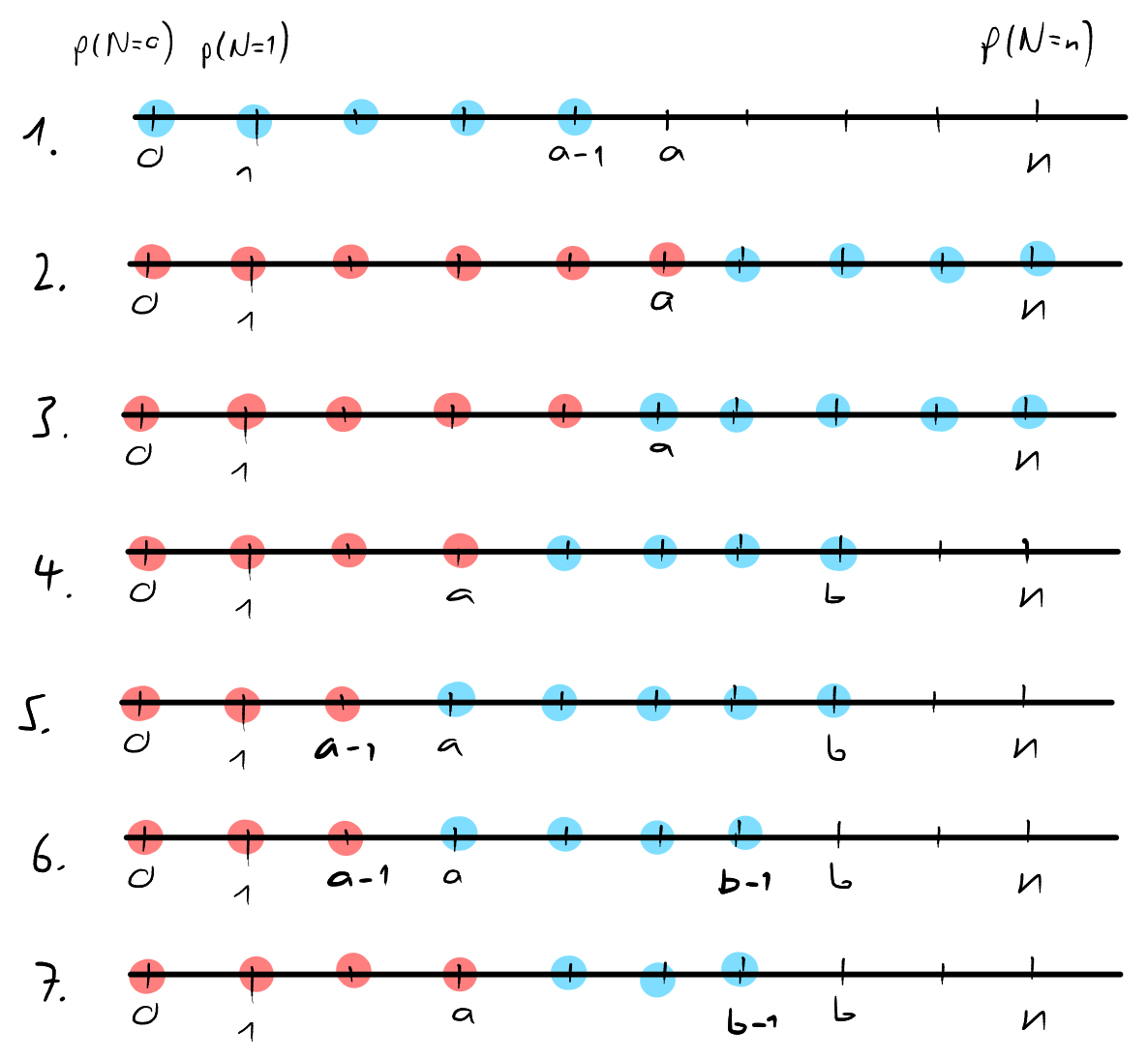
See the figure below. The blue dots indicate the event whose probability we want to calculate. An this event is calculated by adding the probability of all coloured dots minus the probability of all red dots.
A coin () is tossed times. denotes the number of heads. Determine the following probabilities:
-
equals (without calculator)
-
equals (without calculator)
-
is no more than
-
is smaller than
-
is at least
-
is bigger than
-
is at least and smaller than
-
is bigger than and no more than
-
is between and (borders included)
-
is between and (borders excluded)
-
is bigger than (without calculator)
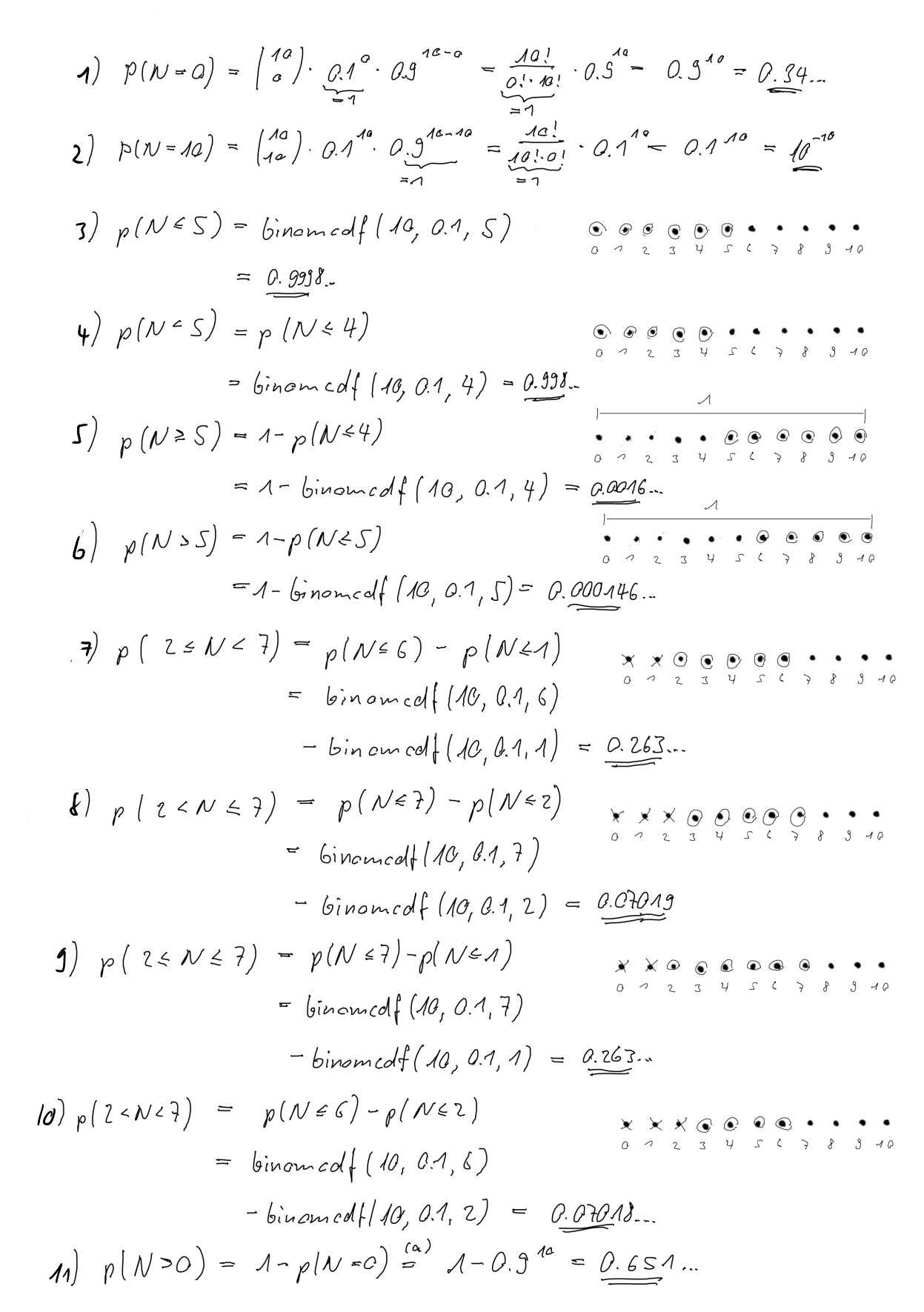
Solution
Q1
Hospital records show that of patients suffering from a certain disease, die of it. You select at random patients.
- What is the probability that will recover?
- What is the probability that no more than will recover?
Q2
In the old days, there was a probability of of success in any attempt to make a telephone call. (This often depended on the importance of the person making the call, or the operator's curiosity!) Calculate the probability of having at least successes in attempts.
Q3
A (blindfolded) marksman finds that on the average he hits the target times out of . If he fires four shots, what is the probability of
- more than hits?
- at least misses?
Q4
In Singapore, the probability for giving birth to a boy is , for a girl it is . What proportion of Singapore families with exactly children will have at least boys?
Q5
You roll a fair die twice and form the sum. Repeating this times, what is the probability for observing the sum more than half of the time?
Q6
A biased coin () is tossed times. Determine the probability for observing
- heads.
- at least heads.
- between and heads (borders included)
- The probability for observing more than heads should be smaller than . Determine (you have to do this by trial and error using the calculator).
Q7
Overbooking. A course in medicine is limited to students. Experience shows that of the students cancel their applications. How many applications can be considered so that the probability for ending up with too many students is less than ? Again, use trial and error to find the solution.
Q8
A biased coin with is flipped times. Find such that the probability for observing at least one head is at least .
Q9
In a village, voted for Trump, and for Biden. You make a survey and select a random sample of people.
-
If the sample size is people, what is the probability that more than people but less than people voted for Biden?
-
You want to choose the sample size big enough so that the sample contains at least one Biden voter with a probability of or bigger. What is the minimal sample size?
-
You want to choose the sample size big enough so that the sample contains more than Biden voters with a probability bigger than . What is the minimal sample size?
Solution
A1
="number of recovered patients" is a binomial RV with parameters and .
- .
A2
="number of successes" is a binomial RV with parameters and . .
A3
="number of hits" is a binomial RV with parameters and .
- .
A4
="number of boys" is a binomial RV with parameters and . .
A5
="number of times the sum is " is a binomial RV with parameters and (probability for sum is ). .
A6
="number of heads" is a binomial RV with parameters and
-
-
-
-
find with
With trial and error using the calculator, we get .
A7
Binomial experiment with success ="not cancelled" and success probability . is the number of applicants (the number of repetitions of the Bernoulli-experiment "a randomly selected applicant cancels or not"). ="number of times an application is not cancelled" (number of successes) is a binomial RV with parameters (unknown) and .
Find such that
that is
Trial and error .
A8
="number of heads" is a binomial RV with parameters and . We have to find such that
Because of , we have to find with
Let us first find with
With
we therefore have to find with
Taking the logarithm on both sides, we get
and thus , thus .
A9
It is a binomial experiment, where success ="Selected person voted for Biden", and the success probability is . is the number of people in the sample (the number or repetitions of the Bernoulli-Experiment, which is "select a person from the village at random, which will vote for Biden or not"). Let be the number of successes, that is, the number of people in the sample voting for Biden.
-
,
-
Find with
We can solve for :
Thus, find with
Thus, it is .
-
Find with
or
that is
In contrast to the previous problem (2), we cannot solve for , because does not reduce to a simple formula which we can solve. So we have to find by trial and error (insert some numbers for into the calculator). We get .