Straight lines
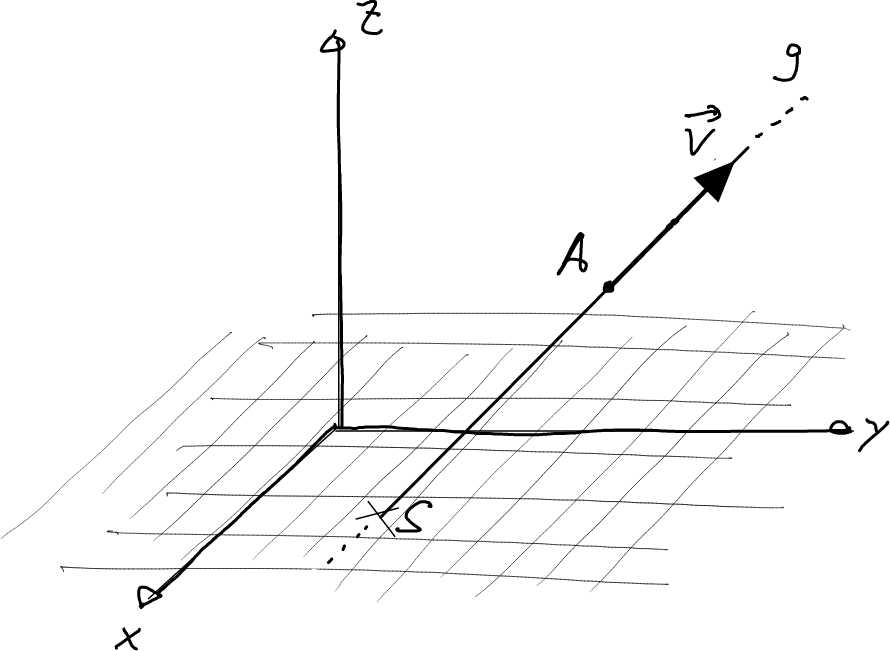
Consider a straight line that passes through some point and with direction . The vector is called the direction vector of . The direction vector points into the same direction as the straight line. In other words, if we start at and move along , we are still on line .
Now, take another point in the 3d-space. How can we check if is on line ?

As the figure above suggests, we have to check if the vector from to is collinear to the direction vector :
Let's consider what exactly this means for the coordinates of and . Since there is a value with
Note that we can also write the above expression as
or in vector notation as
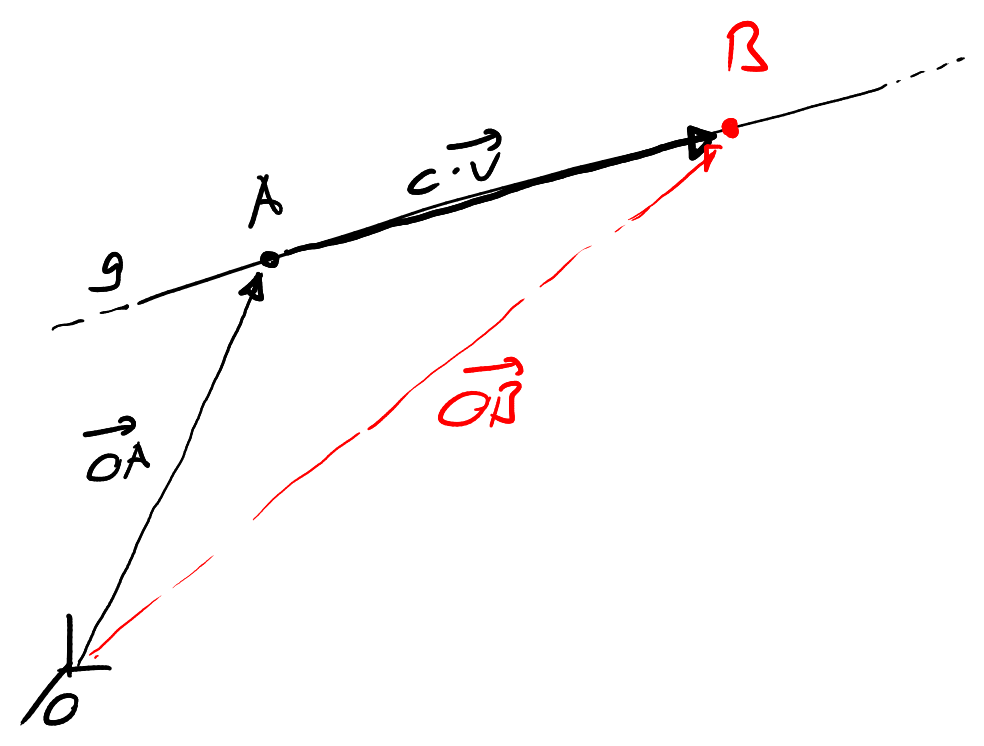
This last expression is also called the equation of a straight line, and says that lies on the straight line if I can reach it by starting at and following the direction (see sketch below, remember that and are just different notations for the position vector from to ):
Show that from the equation
follows
(and vice versa).
Solution
The short answer is as follows:
Because of
follows with
that
and adding on both sides we get
The longer answer involves the coordinates:
We can write
as
We thus obtain the equations
If we take the coordinates of to the other side, we get the equations
which is
or also
The straight line passes through the point and has the direction vector
Decide whether the point lies on .
Solution
Method 1: (Collinearity) We need to test whether , hence whether there is a with , thus if
so whether there is a such that all three equations are satisfied:
From the first equation it follows , and by checking the other two equations we see that for all equations are satisfied. is therefore on the straight line.
Method 2: (equation of straight line) We need to test whether there is a value with
therefore with
From which the three equations it follows:
From the first equation follows , and by checking the other two equations we see that for they are also satisfied, so is on the straight line.
-
A straight line passes through the points and . Find a direction vector of . How many direction vectors are there for line ? Characterise them.
-
A line passes through the point . Find its direction vector if is
- parallel to the -axis.
- parallel to the -axis.
- forms a right angle with the -plane.
-
Consider the straight line that passes through the point and has direction
- Is the point on the line?
- Does the line pass through the origin?
-
Consider the straight line that passes through the point and has direction
Where does intersect with the xy-plane?
Solution
- It is
- We have:
- Two methods:
- Method 1: (Collinearity) Find out if , that is, if there is a with (see figure below) so collinear. Thus, is on the line!
- Method 2: (equation of straight line) There must be a with: Or written with the components: We thus obtain the three equations We now need to test whether there exists a that satisfies all three equations. And indeed, this is the case for .
- Check whether lies on . We can again test whether , or whether there is a that satisfies the straight line equation . This is not the case, thus the straight line does not pass through the origin.
- Two methods:
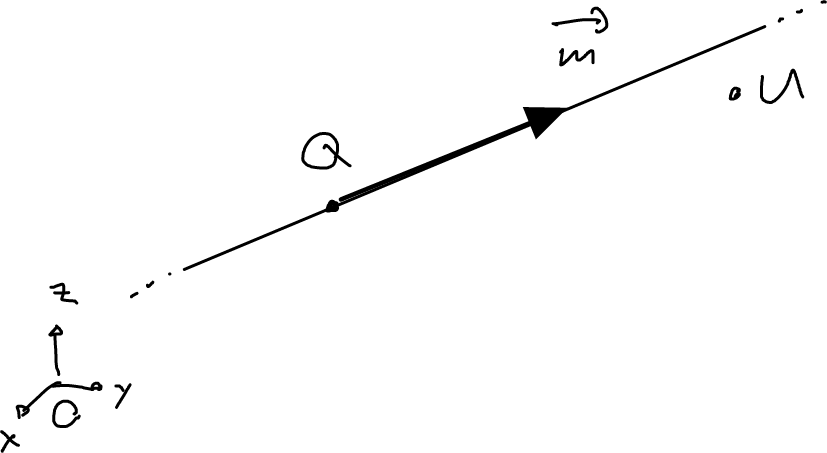
- We denote the intersection between and the -plane by (see sketch below). Since is the intersection point, it lies both in the -plane and on . We do not know the coordinates and , but since lies on the xy-plane, holds. So we have
Two methods to go on:
- Method 1 (collinearity): Since lies on the following must apply and thus there is a stretching factor with With follows
- Method 2 (equation of straight line): Since lies on the following must hold for a and thus With both methods follows (e.g. see the third equation in each case). So , and . The intersection point thus has the coordinates .