Vectors - Further problems

Further problems can also be found in the online script: Vectors > 17 Further problems

Q0

Make sure you know the volume formulae for a

  1. straight (or right) cone and a skew (or oblique) cone
  2. straight (or right) pyramid and a skew (or oblique) pyramid
  3. straight (or right) cylinder and a skew (or oblique) cylinder
  4. sphere

They are simple enough to remember.

Important: If not explicitly mentioned, you should assume that cones, pyramids and cylinders are skew.

Q1

Point P(402)P(4|0|-2) is mirrored on the plane EE, where EE contains the point A(500)A(5|0|0) and has a normal vector

n=(123)\vec{n}=\left(\begin{array}{ccc} 1 \\ -2 \\ 3\end{array}\right)

Determine the coordinates of the mirrored point PP' (PP' is on the other side of the plane).

Q2

The point P(10.251)P(1|0.25|-1) is mirrored on the straight line gg passing through the points A(031)A(0|3|1) and B(213)B(2|-1|3). Find the coordinates of the mirrored point PP^\prime.

Q3

A straight cone has vertex V(617)V(6|-1|7) and the axis direction

v=(122)\vec{v}=\left(\begin{array}{ccc} 1 \\ -2 \\ 2\end{array}\right)

The point P(175)P(-1|7|5) lies on the circle formed by the base of the cone. Determine the volume of the cone.

Q4

A (skew) pyramid with a triangular base ABCABC (A(100)A(1|0|0), B(010)B(0|1|0), C(001)C(0|0|1)) has vertex P(234)P(2|3|4). Determine the volume of the pyramid.

Show
A0
  1. Skew or straight cones: V=Gh3V=\frac{Gh}{3} where GG is the base area (circular area or triangular area) and hh is the height which is perpendicular to the base area.
  2. Skew or straight pyramids: the same as for cones
  3. Slate or straight cylinder: V=hGV=hG where GG is the base area (circular area) and hh is the height which is perpendicular to the base area.
  4. Spherical volume: V=4π3r3V=\frac{4\pi}{3}r^3 where rr is the radius.
A1

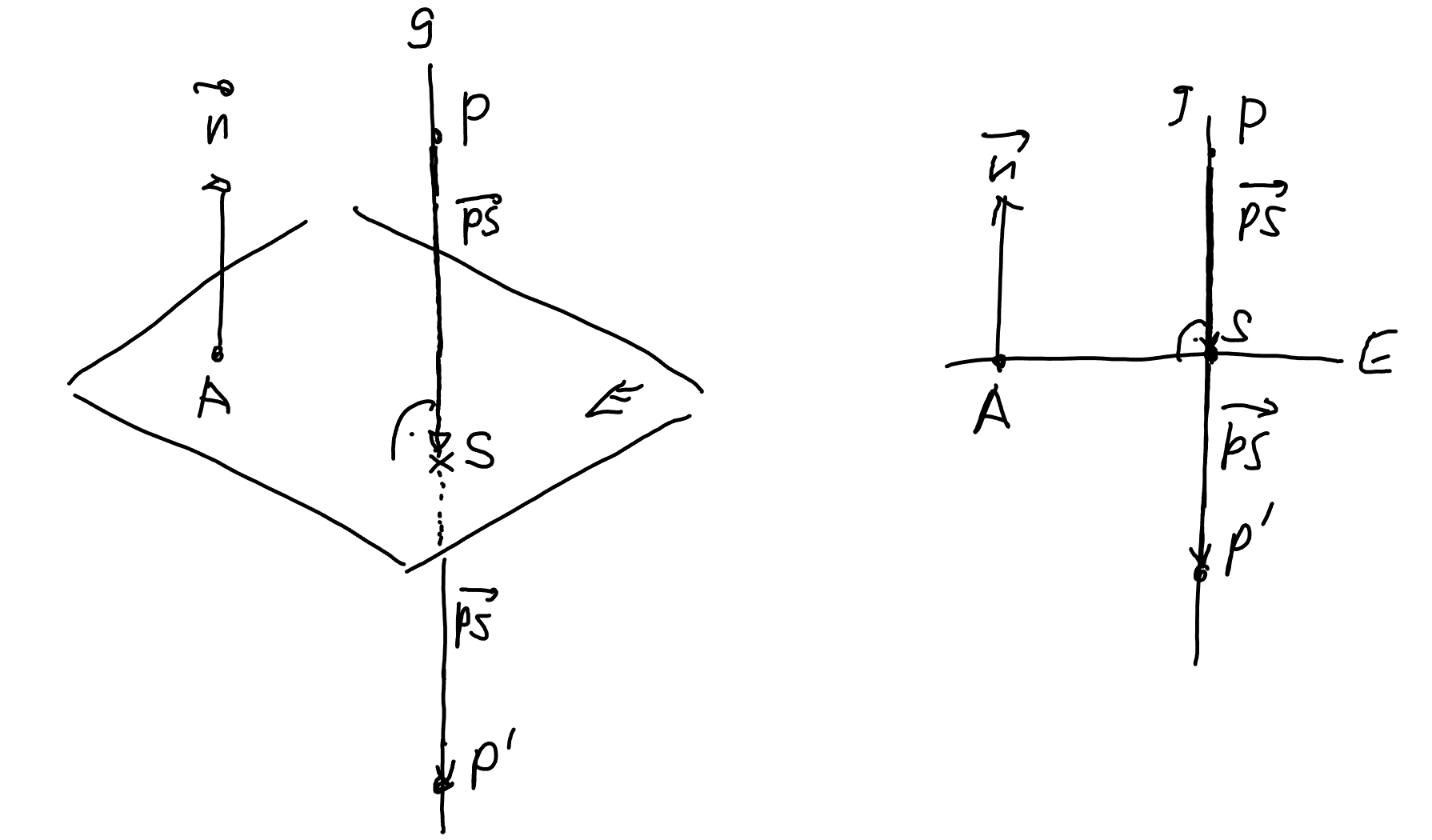
Let's define gg as the line that is orthogonal to EE and passes through PP. Thus, gg has direction vector n\vec n (the normal vector of EE). The mirrored point PP' is on the other side of plane EE, on the line gg. To be more precise, PP' is given by

P=S+PSP'=S+\overrightarrow{PS}

where point SS is the intersection point between gg and EE (see figure below).

So let's find point S(xyz)S(x|y|z): As SS is on gg, there is a scaling factor cc with

PS=cn(x4yz+2)=c(123)x=c+4y=2cz=3c2\overrightarrow{PS}=c \vec{n} \rightarrow \left(\begin{array}{ccc} x-4 \\ y \\ z+2\end{array}\right) = c\left(\begin{array}{c} 1 \\ -2 \\ 3\end{array}\right) \rightarrow \begin{array}{ccr} x & = & c+4\\ y & =& -2c \\ z & =& 3c-2\end{array}

As SS is on EE, we have

ASn=0(x5)+2y+3z=0\overrightarrow{AS} \cdot \vec{n} = 0 \rightarrow (x-5)+-2y+3z=0

Thus we get the following equation in cc

(c+45)2(2c)+3(3c2)=0c=0.5(c+4-5)-2(-2c)+3(3c-2)=0 \rightarrow c=0.5

and therefore S(4.510.5)S(4.5|-1|-0.5). With P=S+PSP'=S+\overrightarrow{PS} follows

P(4.5+0.5110.5+1.5)=(521)P'(4.5+0.5|-1-1|-0.5+1.5)=(5|-2|1)
A2

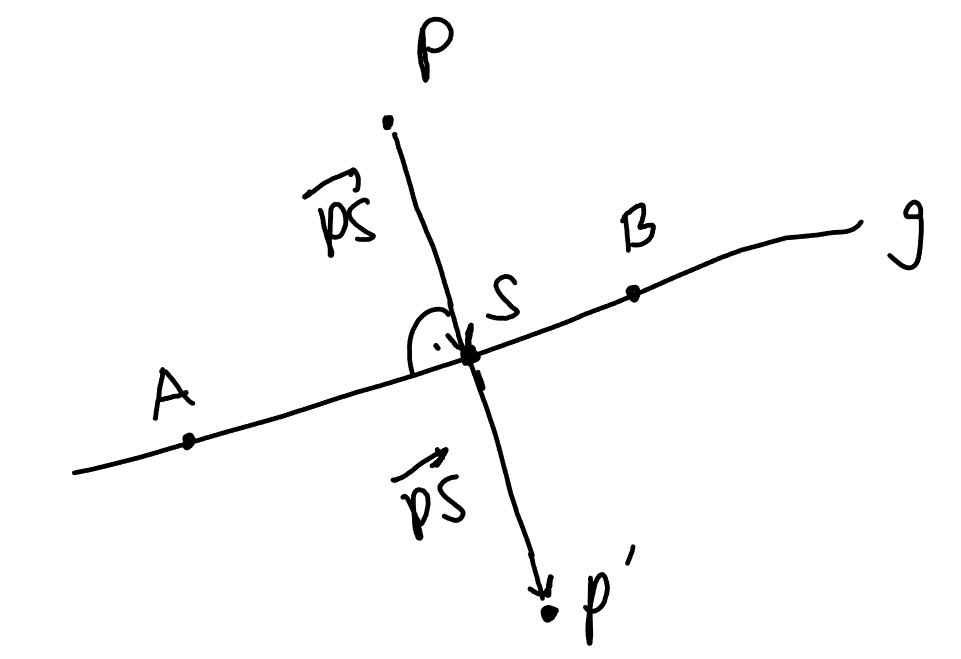
Find SS on gg with PS\overrightarrow{PS} is orthogonal to gg (see figure). It is then

P=S+PSP'=S+\overrightarrow{PS}

So let's find S(xyz)S(x|y|z). Because SS is on gg, there is a scaling factor cc with

AS=cAB(xy3z1)=c(242)x=2cy=4c+3z=2c+1\overrightarrow{AS}=c\cdot \overrightarrow{AB} \rightarrow \left(\begin{array}{ccc} x \\ y-3 \\ z-1\end{array}\right) = c \left(\begin{array}{c} 2 \\ -4 \\ 2\end{array}\right) \rightarrow \begin{array}{ccr} x & = & 2c\\ y & =& -4c+3 \\ z & =& 2c+1\end{array}

As PS\overrightarrow{PS} is orthogonal to gg, it follows

PSAB=02(x1)4(y0.25)+2(z+1)=0\overrightarrow{PS}\cdot \overrightarrow{AB}=0 \rightarrow 2(x-1)-4(y-0.25)+2(z+1) =0

Thus, we get the following equation for cc:

2(2c1)4(4c+30.25)+2(2c+1+1)=0c=0.3752(2c-1)-4(-4c+3-0.25)+2(2c+1+1) =0 \rightarrow c=0.375

It follows S(0.751.51.75)S(0.75|1.5|1.75) and with P=S+PSP'=S+\overrightarrow{PS} it is

P(0.750.251.5+1.251.75+2.75)=P(0.52.754.5)P'(0.75-0.25|1.5+1.25|1.75+2.75)=P'(0.5|2.75|4.5)
A3

Let's denote the plane containing the base of the cone by EE. It contains the point PP and a normal vector is the cone axis v\vec{v} (as it is a straight cone). A figure might help! We need to find the point SS in the plane EE that is closest to the point VV. The height of the coin is then h=VSh=|VS|. As SS is also the center of the circle, we can also calculate the radius of the circle as r=PSr=|PS|. Knowing hh and rr is enough to calculate the volume. So, to find S(xyz)S(x|y|z), we need to intersect the plane EE with the line gg which is orthogonal to EE and passes through VV. As SS is on gg, we have

VS=cn(x6y+1z7)=c(122)x=c+6y=2c1z=2c+7\overrightarrow{VS}=c\cdot \vec{n} \rightarrow \left(\begin{array}{ccc} x-6 \\ y+1 \\ z-7\end{array}\right) = c\cdot \left(\begin{array}{c} 1\\ -2 \\ 2\end{array}\right) \rightarrow \begin{array}{ccl} x & = & c+6\\ y & =& -2c-1 \\ z & =& 2c+7\end{array}

(line equation). And as SS is also in the plane EE , we have

nPS=0(x+1)2(y7)+2(z5)=0x2y+2z=5\vec{n} \bullet \overrightarrow{PS}=0 \rightarrow (x+1)-2(y-7)+2(z-5)=0 \rightarrow x-2y+2z=-5

(normal equation of plane). Inserting the x,yx, y and zz from the line equation into the normal equation, we get

c+62(2c1)+2(2c+7)=5c=3c+6-2(-2c-1)+2(2c+7)=-5 \rightarrow c=-3

and thus S(351)S(3|5|1). Thus, h=VS=9h=|\overrightarrow{VS}|=9 and r=PS=6r=|\overrightarrow{PS}|=6. The volume is the area of the circle times the height, divided by 33: V=62π93=108πV=\frac{6^2\cdot \pi\cdot 9}{3}=108\pi.

A4

Let's denote the plane containing the base of the cone by EE. The normal vector of EE is

n=AB×AC=(111)\vec{n}=\overrightarrow{AB}\times \overrightarrow{AC} = \left(\begin{array}{ccc} 1 \\ 1 \\ 1\end{array}\right)

We will also need to find the area of the triangle bb, and this area can be calculated with

b=12AB×AC=123b=\frac{1}{2}|\overrightarrow{AB}\times \overrightarrow{AC}|=\frac{1}{2}\sqrt{3}

To find the hight of the cone, we need to find the point S(xyz)S(x|y|z) on the plane EE that is closest to the point PP. The height is then h=PSh=|\overrightarrow{PS}|. As SS is on gg, we have

PS=cn(x2y3z4)=c(111)x=c+2y=c+3z=c+4\overrightarrow{PS}=c\cdot \vec{n} \rightarrow \left(\begin{array}{ccc} x-2 \\ y-3 \\ z-4\end{array}\right) = c\cdot \left(\begin{array}{c} 1\\ 1 \\ 1\end{array}\right) \rightarrow \begin{array}{ccl} x & = & c+2\\ y & =& c+3 \\ z & =& c+4\end{array}

(line equation). And as SS is also in the plane EE , we have

nAS=0(x1)y+z=0x+y+z=1\vec{n} \bullet \overrightarrow{AS}=0 \rightarrow (x-1)-y+z=0 \rightarrow x+y+z=1

(normal equation of plane). Inserting the x,yx, y and zz from the line equation into the normal equation, we get

c+2+c+3+c+4=1c=83c+2+c+3+c+4=1 \rightarrow c=-\frac{8}{3}

and thus S(2313,43)S(-\frac{2}{3}|\frac{1}{3},\frac{4}{3}). Thus, h=PS=4.6188h=|\overrightarrow{PS}|=4.6188 and the volume is V=13bh=43V=\frac{1}{3}bh=\frac{4}{3}.