The graph of quadratic functions
The graph of a quadratic function
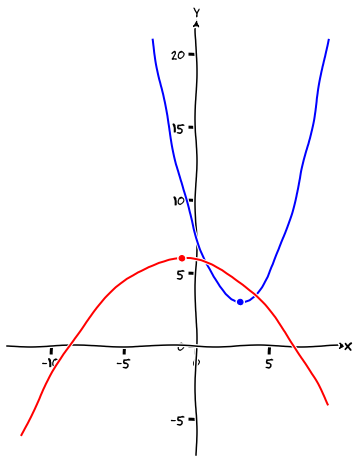
is shaped like a or , and is called parabola. The highest point of the -graph, or the lowest point of the -graph, is called the vertex of . The vertices for the two parabolas shown below are indicated by a small dot.
The simplest quadratic function is
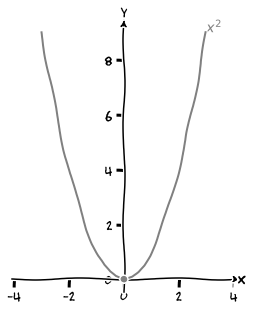
We call it the reference quadratic function. Using a table of values to draw its graph
we get the figure below. It has a shape and the vertex is at the origin: . Furthermore, the graph passes through the points and .
Determining the graph of a quadratic function in standard form
is not straight forward, as not all coefficients and have a clear geometric interpretation. For the parameters of the vertex form
however, there is a clear geometric interpretation, and is therefore the preferred form if we need to draw the graph of . We have the following interpretation of the parameters , and :
- : Stretch the graph of the reference function in -direction by a factor of . If , the graph of is stretched and also reflected about the -axis. In particular, the vertex of the new graph is still at the origin: .
- : Shift the graph we obtained above to the right () or to the left () by .The vertex of the new graph is now at .
- : Shift the graph obtained above up () or down () by .The vertex of the new graph is now at .
So you see, the parameters and are simply the coordinates of the vertex of the parabola.

Let's try to understand why these geometric interpretations of the parameters and are correct. Below you see the quadratic function in vertex form represented as a machine.
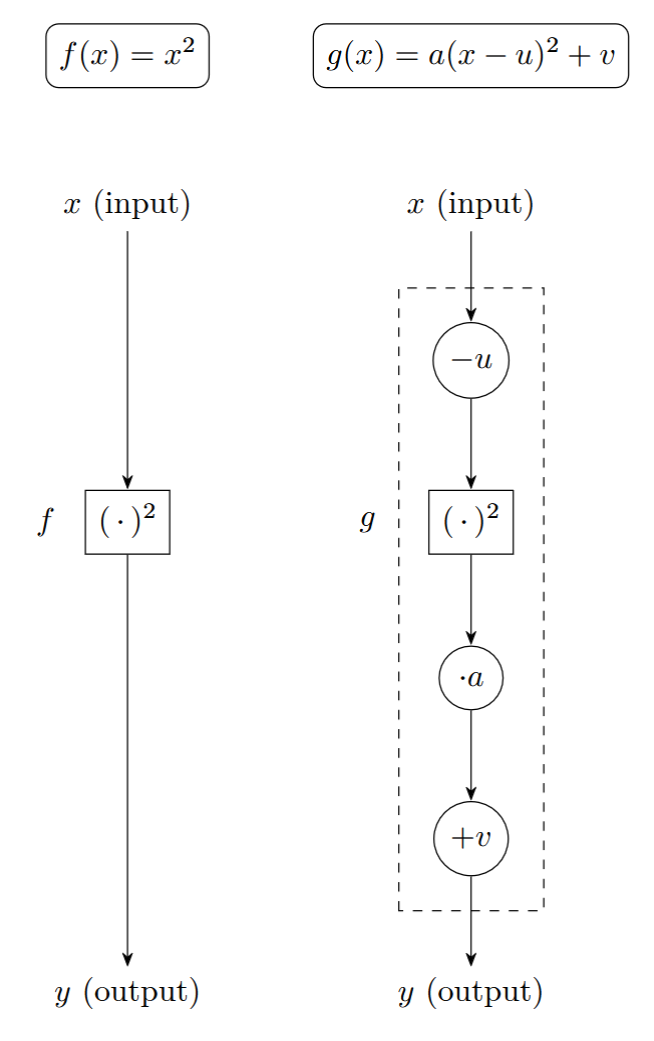
Notice that multiplies the output of the -machine, and adds to it. Because the output of a machine is the -coordinate of its graph, we see that stretches every point of the graph of by the factor in -direction, and shifts the points vertically up or down. So the effect of and on the reference graph should be clear.
To understand the effect of , let's find the position of the vertex of , that is, . So we know from above, that the vertex will be on the -axis. So let's calculate the -intercept of :
and we see that the vertex of is at . In other words, for the reference graph is shifted to the right, and for the reference graph is shifted to the left.
Let us summarise and formulate the theorem
Consider the vertex form of a quadratic function
The graph of is a stretched version of the reference graph (stretched in -direction by the factor of ). Its vertex is at . The graph of is -shaped for and -shaped for .
Consider the function .
-
Determine the stretching factor in -direction and the coordinates of its vertex.
-
Sketch the graph without a table of values, just by considering the succession of transformations applied to .
Solution
We bring into vertex form:
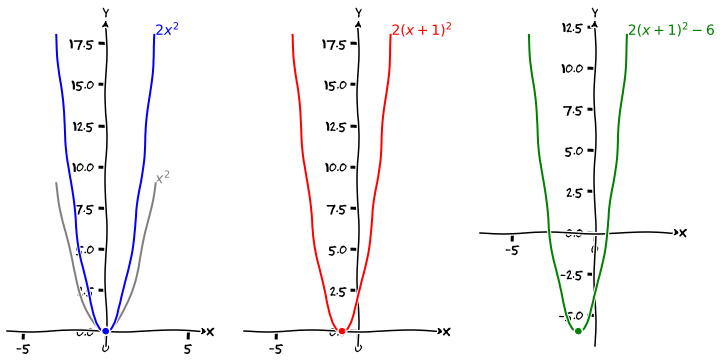
- Thus, is stretched in -direction by , and the vertex is at ().
- First, draw the graph of the reference function, and stretch it by a factor of in -direction. Then shift this new graph to the point . See figure below.
Solution
Let denote the reference function: , and the vertex.
- , thus , and therefore .That is, graph is shifted to .
- , thus , and therefore .That is, graph is stretched in -direction by the factor of , reflected about the -axis, and shifted to .
- , thus and therefore That is, graph is shifted to .
- , thus , and therefore .That is, graph shifted to .
- , thus and therefore .That is, graph is stretched in -direction by the factor of , reflected about the -axis, and shifted to .
- , thus and therefore .That is, graph is stretched in -direction by the factor of , and shifted to .
- , thus and therefore . That is, graph is stretched in -direction by the factor of , and shifted to .
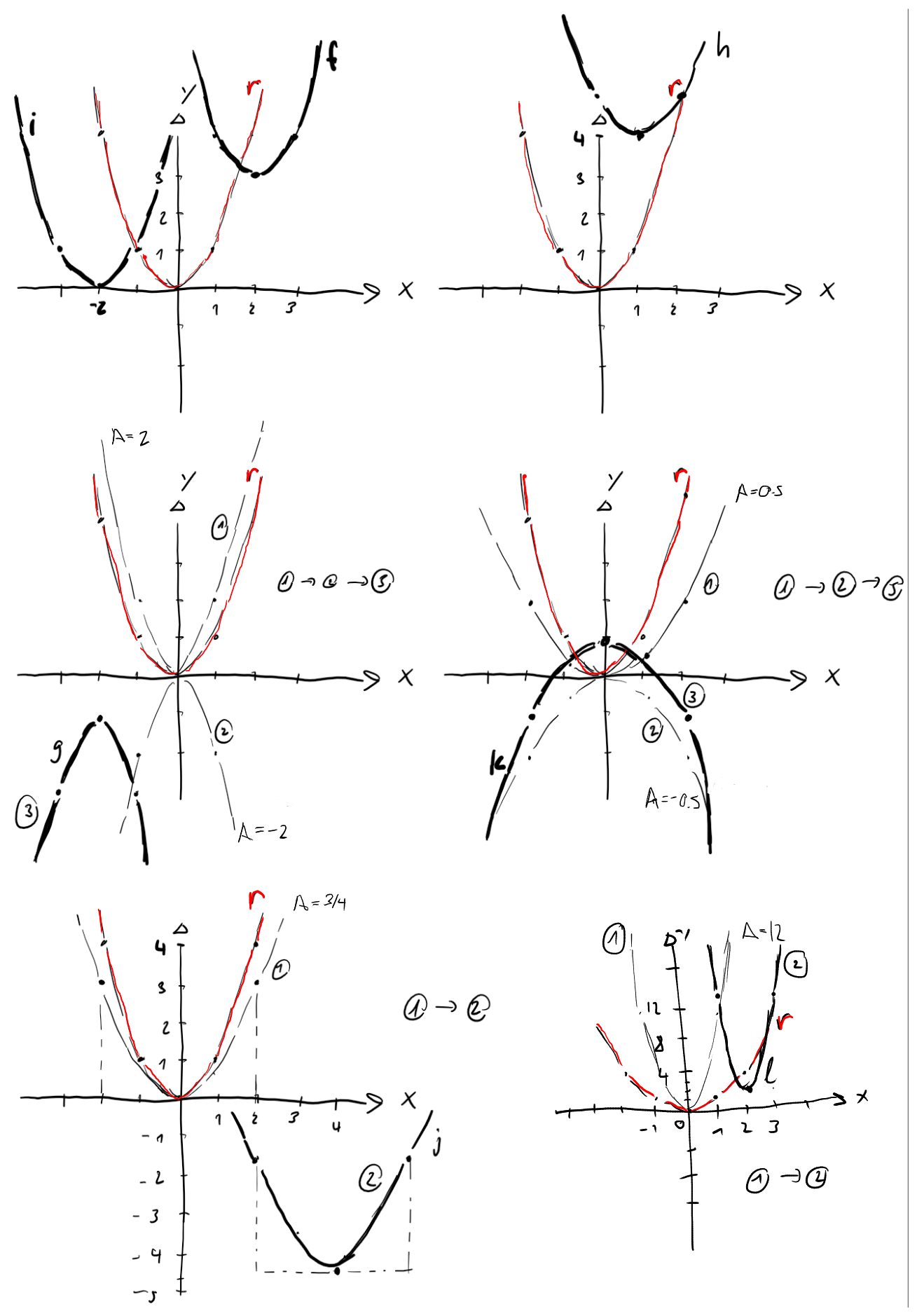
Determine the coordinates of the vertex and the stretching factor in -direction, then use this information to sketch the graph:
Solution
-
: Diagram , thus . To find , we see that . Thus, we have .The value of can also be directly inferred from the diagram if you compare with the reference function (one to the right from the vertex, one up).
-
: Diagram , thus . To find , we see that , thus . Thus we have . The value can also be derived directly by comparing with the reference function .
-
: Diagram , thus . To find , we see that and thus . Thus we have . Again, by comparing with the reference function , we could infer directly (two to the right from the vertex, 4 up, so we have to scale by ).
-
: Diagram thus . To find , we see that and thus . Thus we have . Again, we can infer directly by comparing with the reference function.
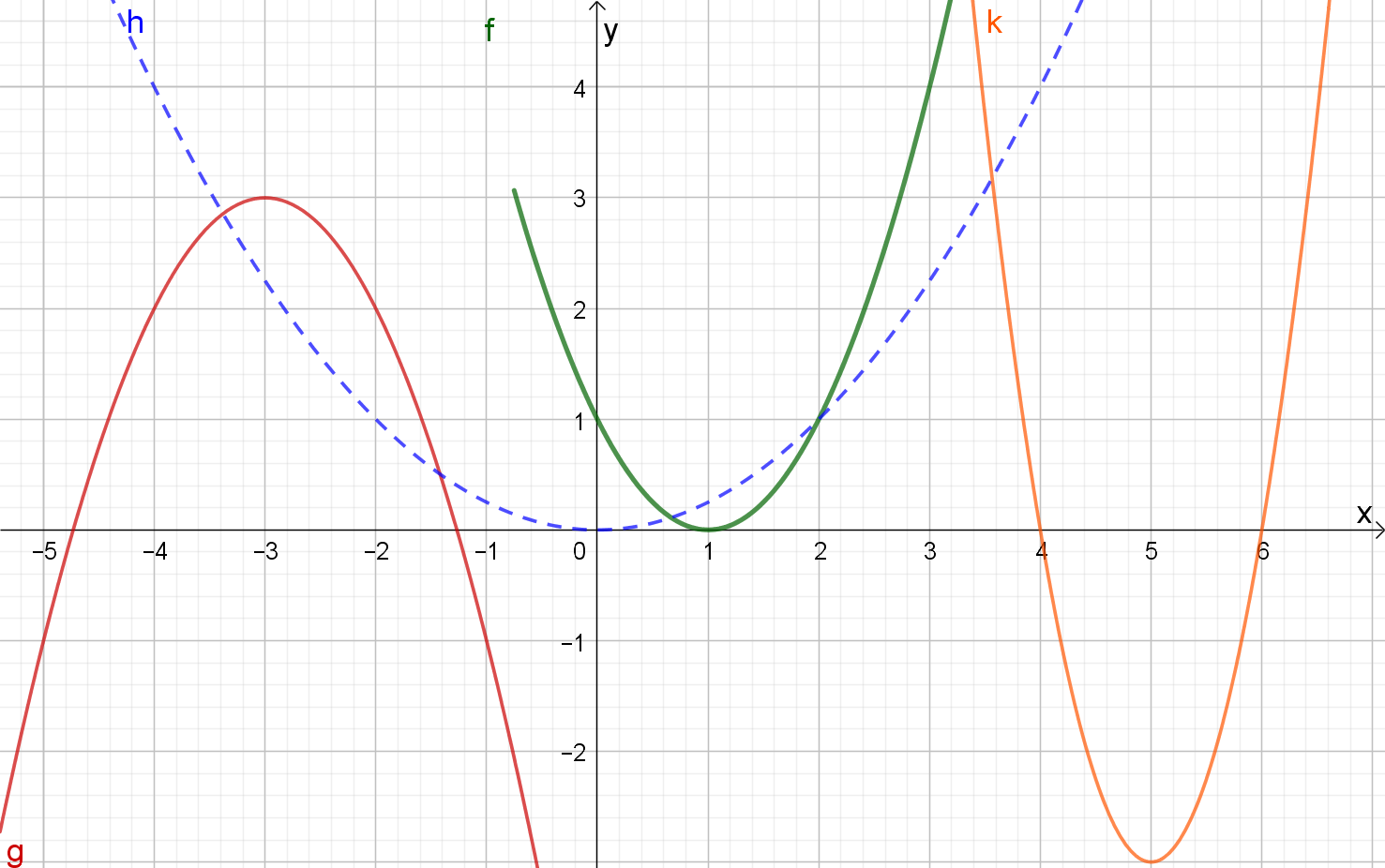
Determine the vertex form of the graphs shown below by first identifying the coordinates of the vertex on the diagram, and then finding the scaling factor in -direction.
The graph of the function is stretched in -direction by a factor of , reflected about the -axis, shifted to the right and upwards. Determine the function equation of the new graph.
Solution
, thus
- The - and -intercepts of the parabola .
- The point of intersections between the parabola and the straight line .
- The points of intersection between the parabolas and .
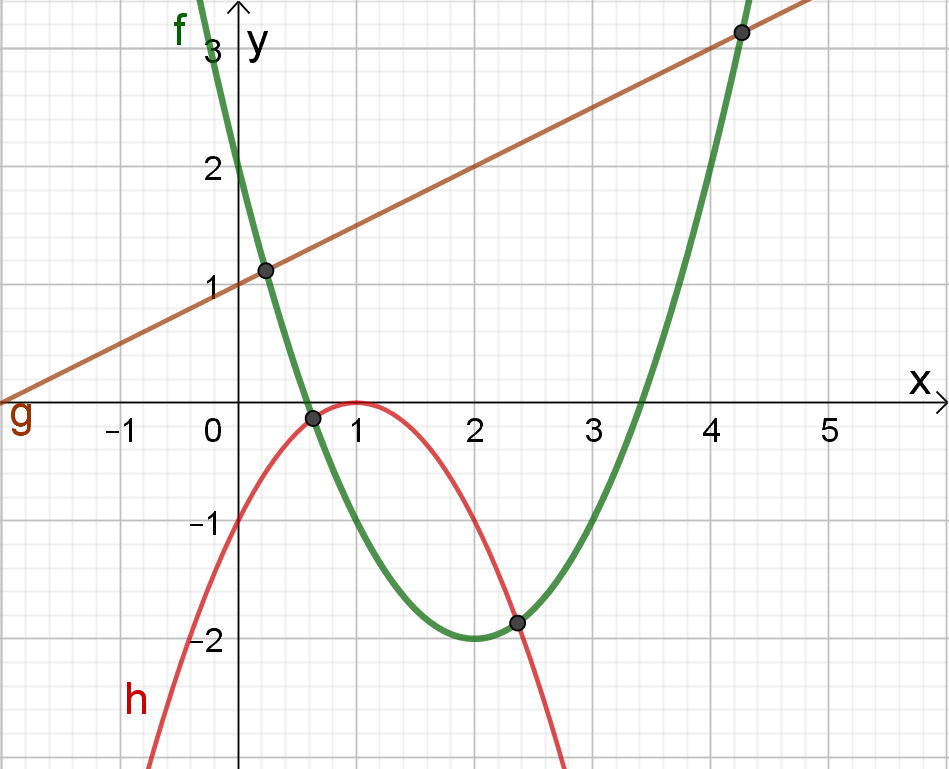
Solution
We first determine the function equations.
- graph has slope and -intercept , thus it is
- For graph it is , thus
- For graph it is , thus
- -intercept of is (see diagram). For the -intercept, find with , thus and therefore and .
- The points of intersections between and . Find with : Midnight formula: and . The corresponding -coordinates are and . Thus, the points of intersection are and .
- The points of intersections between and : Find with : Midnight formula: and . The corresponding -coordinates are and . Thus, the points of intersection are and .
The graph of the function has the vertex and passes through the point . Determine the parameters and of the standard form:
-
,
-
,
Solution
We start with the vertex form.
- , thus and therefore . To find use (as is on the graph of ), thus and therefore . It follows and therefore
- , thus and therefore . With follows , thus . We have , thus
Find the parameter of the function such that the vertex of the graph of has the coordinate . What is the corresponding -coordinate?
Solution
The vertex form of is . So the vertex has and . Since the -coordinate of the vertex is , we need to find such that . So it is and the coordinate of the vertex is .
The product of two numbers with difference should be as small as possible. Find the two numbers. Hint: vertex of quadratic function
Solution
Let be the smaller number, so the other number is . The product of the two numbers is thus , and we need to find such that is as small as possible. is a quadratic function with vertex form
Since , the vertex is the lowest point, and thus the -value we are looking for is . The two numbers are therefore and .
Which rectangle with a perimeter of has the largest area? Hint: vertex of quadratic function
Solution
Let and be the side lengths of the rectangle. Thus
and
The area is thus
which is a quadratic function with vertex form
Since , the vertex is the highest point, and so the area is largest for . The other side has length , therefore, it is a square.