The intersection between straight lines
Consider two straight lines and in a three dimensional space. Assume that passes through point and has direction vector , and passes through point and has direction vector . The two lines can have the following position relative to each other:
The lines intersect at one point
Two straight lines intersect if they have exactly one point in common. This point is called the point of intersection.
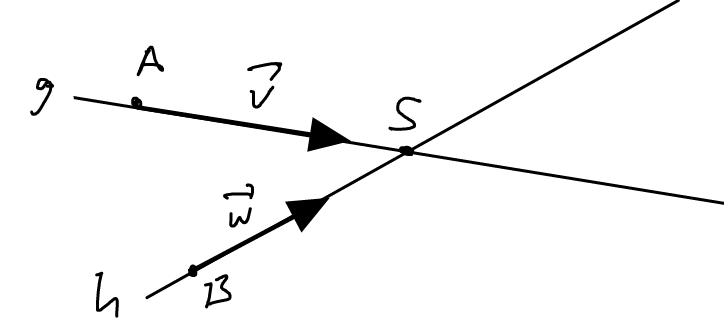
Often we want to find the coordinates of . To do so, note that for to be the intersection point it has to be on as well as on . For no other point in the 3d-space is this true. Using vector language, this condition translates to the following two conditions for point :
These two conditions hide a system of three equations from which the coordinates for can be found (see example below). Note that the two conditions above can also be rephrased as
The straight line passes through point and has direction , and the straight line passes through point and has direction . They intersect at point . Let us find its coordinates.
Solution
Let us denote the coordinates of the unknown intersection point by . For it to be on and on , there must exist two scalars and such that
Expressed with components, we get
and thus we get the system of three equations
Using two equations, we get and . Using , we get , using we also get .
Warning
Always calculate twice, once using the value for and once using the value for . If there is an intersection point you will get twice the same coordinates for . However, if the lines do not intersect, we could still make the same calculations above, but in this case the coordinates calculated using will differ from the coordinates calculated using . This fact will be relevant for detecting skew lines (see below).
The lines are parallel
Two straight lines are parallel, if they have collinear direction vectors.
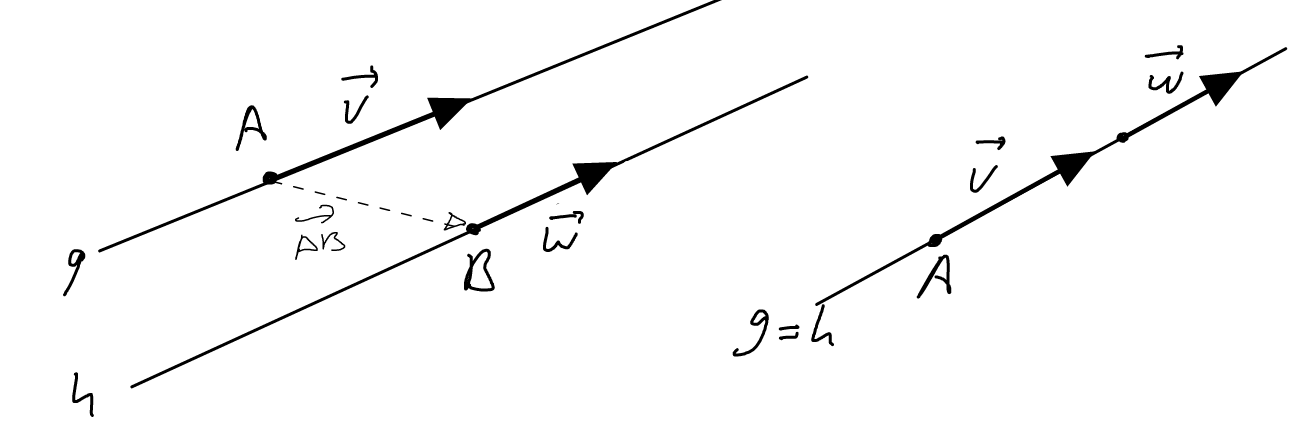
From the figure it follows that and are parallel if
And they form the same line if, and only if
The lines are skew
Two straight lines are said to be skew, if they neither intersect nor are they parallel. Skew lines are not possible in a 2d-space, because they have to be on two different, parallel planes:
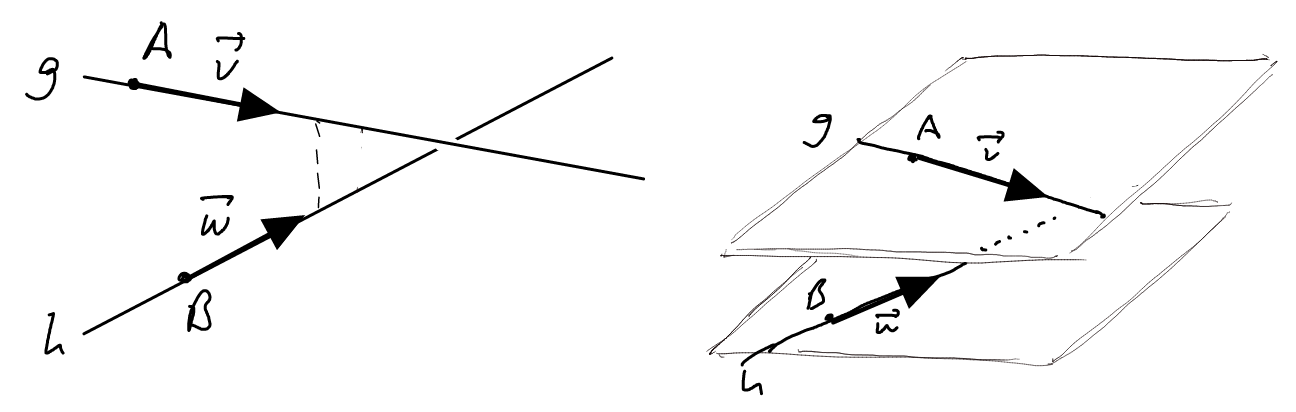
To find out if the two lines are skew or do intersect:
- verify that they are not parallel (which is easy, and quickly done)
- if not parallel, assume the lines intersect and calculate the point of intersection twice, once with and once with . If we get two different points , we know that there is no intersection point, and the lines have to be skew.
The straight line passes through point and has direction , and the straight line passes through point and has direction . Are they skew?
Solution
They are not parallel and not identical, because , so they might be skew. So assume there is an intersection point , and let us find its coordinates: Thus, find values and with
We get the system of three equations
Using the last two equations, we get and . For we get , for we get . We therefore get different points, which also means that the system of equations has no solution. The conclusion is that there is no intersection point, and the lines must be skew!
Q1
The straight line passes through and has direction , the straight line passes though the point and has direction . Determine the relative position of and (parallel, identical, skew, intersecting). If they intersect, determine the coordinates of the intersection point .
-
, , ,
-
, , ,
-
, , ,
-
, , ,
Q2
Consider the triangle with the vertices , , and . Show that all three medians ("Seitenhalbierende") intersect at the same point . Determine the coordinates of this point.
This, by the way, is a general fact about triangles.
Q3
Assume that the -plane represents the ground, and the -axis is the height. Aircraft 1 starts at airport , moving along the direction . Aircraft 2 starts at airport , moving along the direction . Is it theoretically possible for the two planes to collide? If so, and given that they take off at the same time, at what speed would the planes have to travel for a collision to happen after exactly two hours?
Solution
A1
- The lines are parallel (overlapping).
- The lines are parallel (not overlapping).
- The lines are skew.
- The lines intersect, .
A2
The intersection point is .
A3
The collision point is at . For a collision to happen, aircraft 1 needs to travel at a speed of , aircraft 2 at a speed of .