The binomial coefficient and nCr
We start with a definition:
Consider two natural numbers (including ) and , where . The binomial coefficient of and , denoted by
is defined as
(say "n choose r").
Another notation for the binomial coefficient is (say "n c r"). You can find this key on the calculator as well. In the last section we have seen the following:
Consider objects arranged in a row, where objects are identical, and also the remaining objects are identical. The number of possible permutations of these objects that can be formed by rearranging the order of the objects in the row is
The number of words that can be formed by rearranging the letters of the word HHHTTHT is
because the number of letters is and there are Hs. Of course we could also argue that there are Ts, and then we would get
and indeed we get the same number of possibilities. Nothing else would make sense.
Here are some further properties of binomial coefficients:
Prove the statements above in two ways. First by using the definition of the binomial coefficient, and second by finding the corresponding number of permutations of a word with letters.
Solution
Using the definition of the binomial coefficient
- and so the two expressions are the same!
Using number of permutations of a word with letters
For example, the word consists of the letters H and T, and let denote the number of H by .
-
, so no
H, so all letters are the same,TTTTT. By rearranging the letters, we always get the same word. Thus, -
, so only
Hs, so again all letters are the same,HHHHH. Thus, -
, so one letter
H, e.g.HTTTT. By rearranging the letters, we get possibilities (there are positions where we can place the :HTTTT,THTTT,TTHTT, ...). So -
, so letter
H, e.g.HHHHT. Again, we get . -
: number of words that can be formed if there are
Hs in the word, andTs.: number of words that can be formed if there are
Hs in the word, andTs.These are different words (e.g.
HHTTTandHHHTT), but clearly in both cases the number of possible permutations has to be the same (simply rename in the second case the letterHtoTand the letterTtoH).
There is a close relationship between the permutations of words consisting of two different letters and trees. Consider a word made of two letters, such as AABB. We already know that there are
permutations of the word. But what are these words? To find out, it is helpful to draw a tree as follows: As there are letters in the word, we draw generations of the tree, where on left the branch is always A and on the right branch is always B (or vice versa, it does not matter):
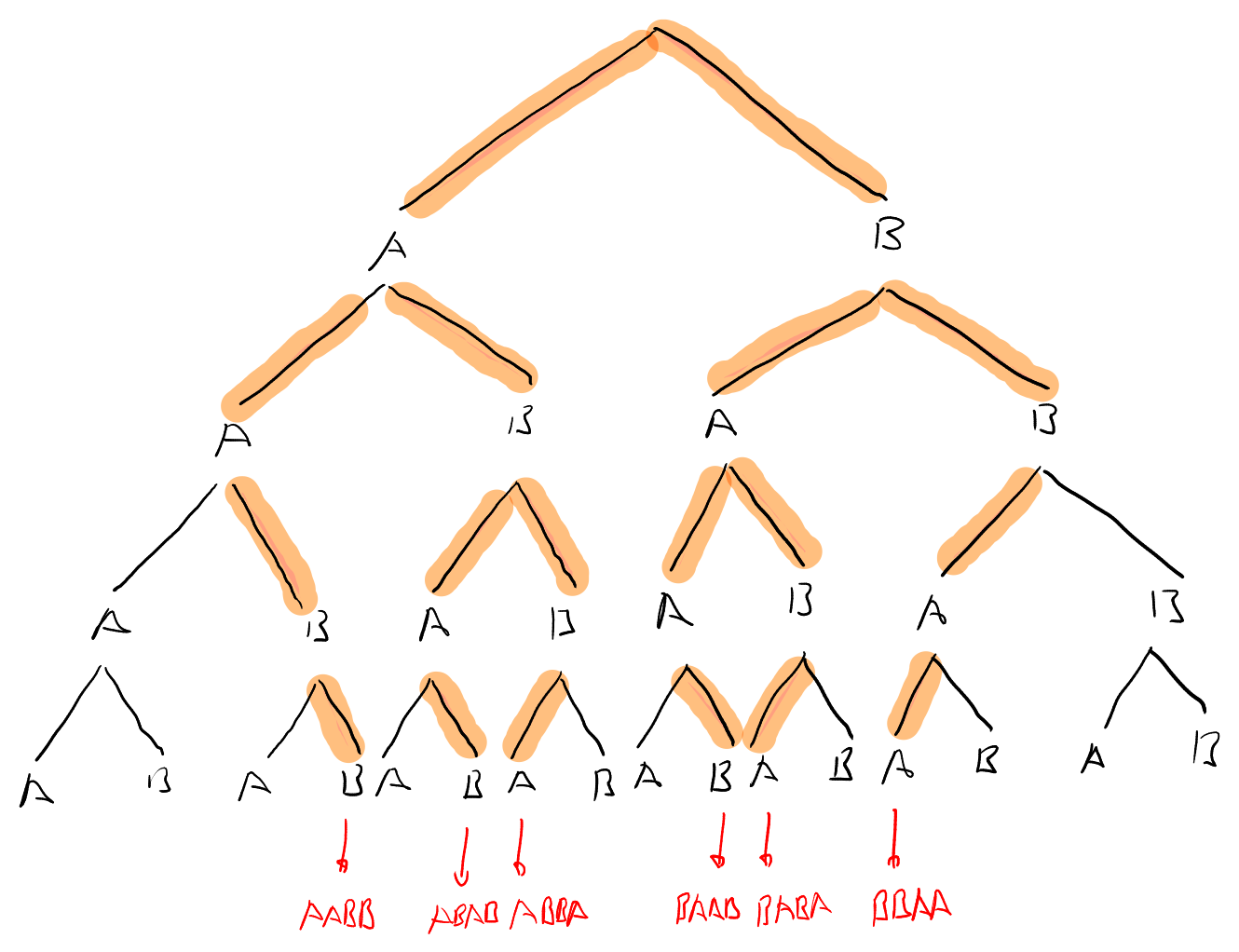
Every path from top to bottom traces out a word. If we follow all paths, we get all possible -letter words that can be formed with the letters A and B. There are such words (or paths).
Following the paths containing A and B, we can find out all the permutations of AABB (see figure above). There are
such words (or paths).
Or if we follow the paths containing A and B, we can find out all the permutations of ABBB. There are such words (or paths). And so on.