Solving linear equations

A linear equation is an equation of the form

ax+b=0\boxed{a x + b = 0}

where aa and bb are fixed numbers. For example, for the equation

3x4=03x - 4=0

we have a=3a=3 and b=4b=-4. This is the simplest type of equation, and pretty straight forward to solve. By solving we mean: "find all values such that when we replace these values for xx, the left side of the equation sign equals the right side of the equation sign." Each such value is called a solution of the equation.

The strategy to solve a linear equation is as follows: bring the xx-term on one side of the equation sign, and the value on the other side.

For example

3x4=03x-4=0

can be solved as follows:

3x4=0+43x=4:3x=43\begin{array}{llll} 3x -4& =& 0& \quad| \, +4\\ 3x & =& 4 &\quad| \, :3\\ x & =&\underline{\frac{4}{3}}\\ \end{array}

Note that we apply certain operations to the equation. In a first step we add a 44 to both sides. If we add 44 to the left side only, we would change the equation. Think of it as a scale: whatever we do to the left side we also have to do to the right side in oder to keep the balance.
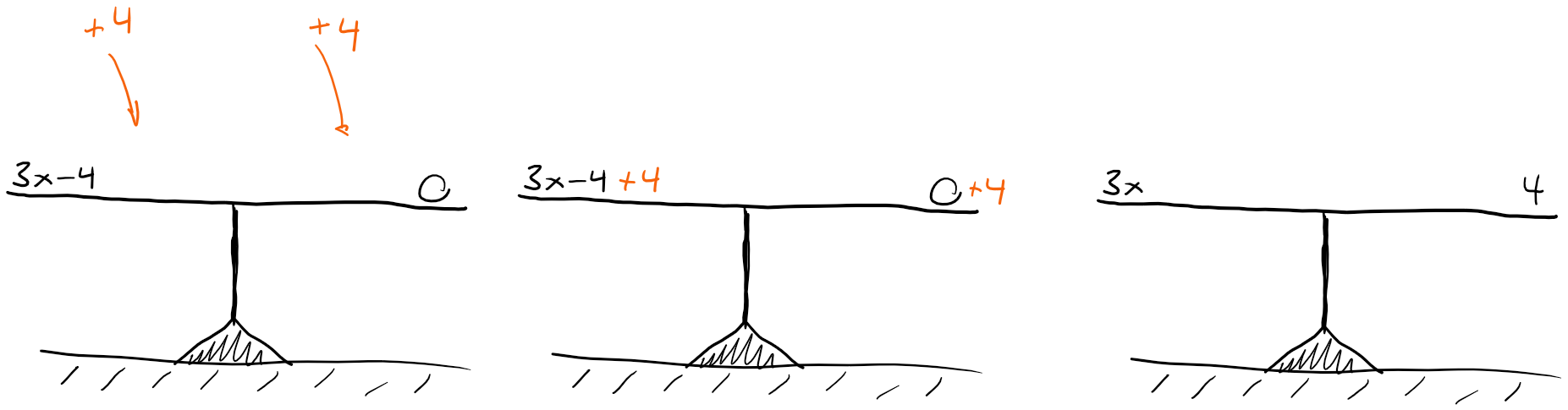
Similarly, if we divide the equation by 33 in the second step, we have to do this for the left side and to to the right side.

Sometimes the "linearity" of the equation is hidden, and you have to work a bit in order to bring it into a form where it can be solved. We give four typical examples.

Example 1

The variable xx is on both sides of the equation:

0.5x3=2x+10.5 x-3 = 2 x+1

Again, try to bring all the xx's onto one side of the equation, and the values on the other side:

0.5x3=2x+12x1.5x3=1+31.5x=4:1.5x=41.5=2.6\begin{array}{llll} 0.5 x-3 & =& 2 x+1 & \quad| \, -2x\\ -1.5 x -3 & =& 1 &\quad| \, +3\\ -1.5 x & =&4 & \quad| \, : -1.5\\ x & = &\frac{4}{-1.5}& & \\ & = &\underline{-2.\overline{6}} \end{array}
Example 2

It is also possible that there are several xx's on one or both sides, and possibly also more than one value. Then you should first simplify, that is, add all those xx's on each side, and also add all the values. Just to make sure you know how add the different xx's, consider the algebraic expression 3x+0.5x3x+0.5x. If we add those xx's, we get 3x+0.5x=3.5x3x+0.5x=3.5x. Why? Think of adding 33 apples and 0.50.5 apple - the sum is 3.53.5 apples. The formal argument is as follows:

3x+0.5x=x(3+0.5)=x3.5=3.5x3x+0.5x=x(3+0.5)=x\cdot 3.5=3.5x

Here is an example of such an equation:

0.5x3+4x+5=2.4x+13x+26xsimplify4.5x+2=6.6x+3+6.6x11.1x+2=3211.1x=1:11.1x=111.1=0.09009...\begin{array}{llll} 0.5 x-3 +4x +5& = &2.4 x+1 -3x+2-6x&\quad| \, simplify\\ 4.5 x +2 & =& -6.6x +3 &\quad| \, +6.6x\\ 11.1 x +2 & =& 3 &\quad| \, -2\\ 11.1 x & =&1 &\quad| \, :11.1\\ x & = &\frac{1}{11.1}&\\ &=&\underline{0.09009...} \end{array}
Example 3

The left or right hand side contains xx's that are raised to some power, but they cancel:

2x2+4x3=2x+2x22x^2+4x-3 = 2-x+2x^2

Again, try to bring all the xx's onto one side of the equation, and the values on the other side:

2x2+4x3=2x+2x22x24x3=2x+x5x3=2+35x=5:5x=1\begin{array}{llll} 2x^2+4x-3 &= & 2-x+2x^2& \quad| \, -2x^2\\ 4x -3 & = &2-x &\quad| \, +x\\ 5x -3 & = &2 &\quad| \, +3\\ 5x & =& 5& \quad| \, :5\\ x & =& \underline{1}\\ \end{array}
Example 4

The xx appears as the denominator of a fraction:

4x3=2\frac{4}{x}-3 = 2

Again, try to bring all the xx's onto one side of the equation, and the values on the other side:

4x3=2+34x=5x4=5x:545=x\begin{array}{llll} \frac{4}{x}-3 &=& 2 & \quad| \, +3\\ \frac{4}{x} & = &5& \quad| \, \cdot x\\ 4 & =& 5x&\quad| \, :5\\ \underline{\frac{4}{5}}& =& x & \end{array}

Note that you can also first multiply both side by xx, but then make sure to do it properly:

4x3=2xx(4x3)=2x43x=2x+3x4=5x:545=x\begin{array}{llll} \frac{4}{x}-3 &=& 2 & \quad| \, \cdot x\\ x\cdot (\frac{4}{x}-3) & =& 2x &\\ 4-3x & =& 2x &\quad| \, +3x\\ 4 & = & 5x&\quad| \, :5\\ \underline{\frac{4}{5}}& =& x & \end{array}
Exercise 1
Q1

If the equation is linear, solve it.

  1. 6x10=x56x-10=x-5
  2. x2=x+3-x-2=x+3
  3. 34x=52x163-4x=5-2x-16
  4. 15x7324x=5916+20x15x-73-24x=59-16+20x
  5. 56x435219x=772x56x+165x11256x-43-52-19x=7-72x-56x+165x-112
  6. 9213xx2=523xx292-13x-x^2=52-3x-x^2
  7. 14(10x)=014-(10-x)=0
  8. 14(x15)=2(6x+13)14-(x-15)=2-(6x+13)
  9. 5(4x+9)6(2x5)=755(4x+9)-6(2x-5)=75
  10. 106(x14)=203(2x25)10-6(x-14)=20-3(2x-25)
  11. (15x3)2=x(225x15)(15x-3)^2=x(225x-15)
  12. (x5)(x2)=(x4)(x3)(x-5)(x-2)=(x-4)(x-3)
  13. (x+3)(x5)=(x3)2(x+3)(x-5)=(x-3)^2
  14. x23x+14=x(x+7)x^2-3x+14=x(x+7)
  15. (2x3)2=(2x+3)2+12(2x-3)^2=(2x+3)^2+12
  16. x4+15=x2+x6\frac{x}{4}+\frac{1}{5}=\frac{x}{2}+\frac{x}{6}
  17. x+35=2x83\frac{x+3}{5}=\frac{2x-8}{3}
  18. 3x+1=2\frac{3}{x}+1 = 2
  19. 7x4=2x+2\frac{7}{x}-4 = \frac{2}{x}+2
  20. 2x+x=x+7\frac{2}{x}+x = x+7
Q2

Find an equation whose solution is the answer to the question below. Then solve the equation.

  1. The sum of 5 consecutive natural numbers is 960960. Find the smallest of these numbers.

  2. The difference between two natural numbers is 33. The difference between the squares of these two numbers is 381381. Find the smaller of these two numbers?

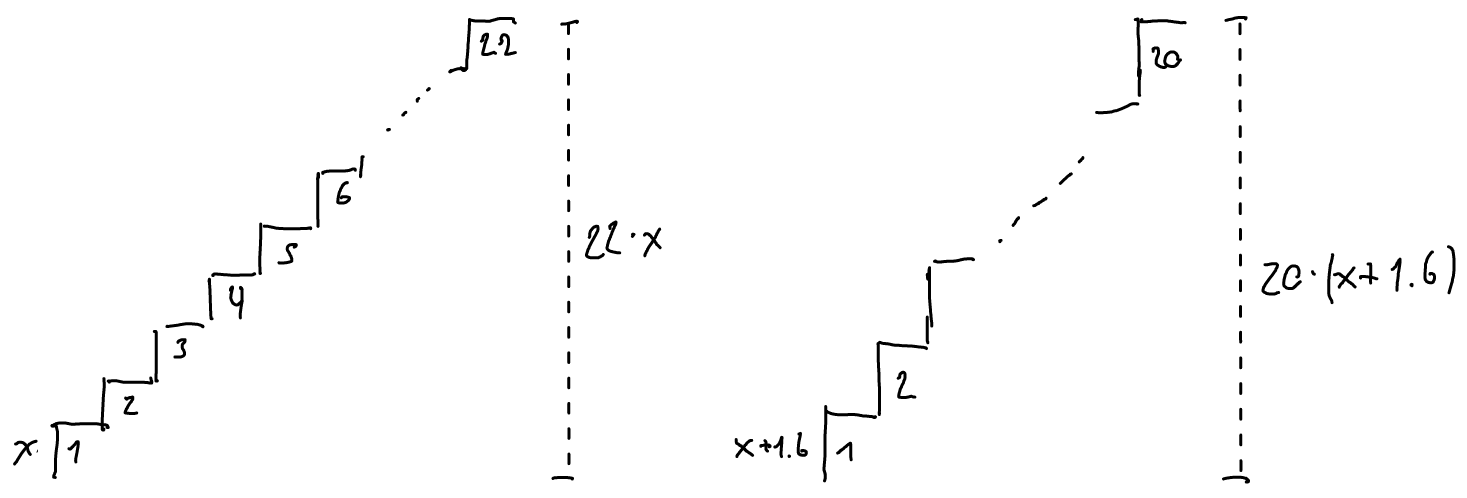
  3. A staircase to a flat in the first floor has 2222 steps. If the height of every step were increased by 1.6  cm\qty{1.6}{cm}, you would need only 2020 steps. What is the height of each step?

Solution
A1
  1. 6x10=x55x=5x=16x-10=x-5 \rightarrow 5x=5 \rightarrow x=\underline{1}
  2. x2=x+32x=5x=2.5-x-2=x+3 \rightarrow 2x=-5 \rightarrow x=\underline{-2.5}
  3. 34x=52x162x=14x=73-4x=5-2x-16 \rightarrow 2x=14 \rightarrow x=\underline{7}
  4. 15x7324x=5916+20x29x=116x=415x-73-24x=59-16+20x \rightarrow -29x=116 \rightarrow x=\underline{-4}
  5. 56x435219x=772x56x+165x1120=10(?)nosolution56x-43-52-19x=7-72x-56x+165x-112 \rightarrow 0 = 10 (?)\rightarrow \underline{no\, solution}
  6. 9213x4x2=523x4x210x=40x=492-13x-4x^2=52-3x-4x^2 \rightarrow 10x=40\rightarrow x=\underline{4}
  7. 14(10x)=04+x=0x=414-(10-x)=0 \rightarrow 4+x=0 \rightarrow x=\underline{-4}
  8. 14(x15)=2(6x+13)x+29=6x115x=40x=814-(x-15)=2-(6x+13) \rightarrow -x+29= -6x-11 \rightarrow 5x = -40 \rightarrow x=\underline{-8}
  9. 5(4x+9)6(2x5)=7520x+4512x+30=758x=0x=05(4x+9)-6(2x-5)=75 \rightarrow 20x+45 -12x+30 = 75 \rightarrow \rightarrow 8x=0 \rightarrow x=\underline{0}
  10. 106(x14)=203(2x25)106x+84=206x+7594=95(?)nosolution10-6(x-14)=20-3(2x-25) \rightarrow 10-6x+84 = 20-6x+75 \rightarrow 94=95(?) \rightarrow \underline{no \, solution}
  11. (15x3)2=x(225x15)225x290x+9=225x215x75x=9x=0.12(15x-3)^2=x(225x-15) \rightarrow 225x^2-90x+9 = 225x^2-15x \rightarrow 75x = 9 \rightarrow x=\underline{0.12}
  12. (x5)(x2)=(x4)(x3)x27x+10=x27x+1210=12(?)nosolution(x-5)(x-2)=(x-4)(x-3)\rightarrow x^2-7x+10 = x^2-7x+12 \rightarrow 10=12(?) \rightarrow \underline{no \, solution}
  13. (x+3)(x5)=(x3)2x22x15=x26x+94x=24=6(x+3)(x-5)=(x-3)^2\rightarrow x^2-2x-15 = x^2-6x+9 \rightarrow 4x=24 =\underline{6}
  14. x23x+14=x(x+7)x23x+14=x2+7x10x=14x=1.4x^2-3x+14=x(x+7)\rightarrow x^2-3x+14=x^2+7x \rightarrow 10x=14 \rightarrow x=\underline{1.4}
  15. (2x3)2=(2x+3)2+124x212x+9=4x2+12x+9+1224x=12x=0.5(2x-3)^2=(2x+3)^2+12\rightarrow 4x^2 -12x+9 = 4x^2+12x+9+12\rightarrow -24x=12 \rightarrow x=\underline{-0.5}
  16. x4+15=x2+x6x4x2x6=153x6x2x12=155x12=15x=1225=0.48\frac{x}{4}+\frac{1}{5}=\frac{x}{2}+\frac{x}{6}\rightarrow \frac{x}{4}-\frac{x}{2}-\frac{x}{6} = -\frac{1}{5} \rightarrow \frac{3x-6x-2x}{12}=-\frac{1}{5} \rightarrow \frac{-5x}{12}=-\frac{1}{5}\rightarrow x=\frac{12}{25}=\underline{0.48}
  17. x+35=2x83x+3=5(2x8)33(x+3)=5(2x8)3x+9=10x407x=49x=7\frac{x+3}{5}=\frac{2x-8}{3}\rightarrow x+3 = \frac{5(2x-8)}{3}\rightarrow 3(x+3)=5(2x-8) \rightarrow 3x+9=10x-40 \rightarrow 7x=49 \rightarrow x=\underline{7}
  18. 3x+1=23x=1x=3\frac{3}{x}+1 = 2\rightarrow \frac{3}{x}=1\rightarrow x=\underline{3}
  19. 7x4=2x+25x=66x=5x=0.83\frac{7}{x}-4 = \frac{2}{x}+2\rightarrow \frac{5}{x}=6 \rightarrow 6x=5 \rightarrow x=\underline{0.8\overline{3}}
  20. 2x+x=x+72+x2=x2+7x7x=2x=27\frac{2}{x}+x = x+7\rightarrow 2+x^2 = x^2+7x \rightarrow 7x=2 \rightarrow x=\underline{\frac{2}{7}}
A2
  1. The variable xx denotes the smallest of these 5 numbers. So the five consecutive numbers are xx, x+1x+1, x+2x+2, x+3x+3, x+4x+4. As the sum has to be 960960, we get the equations

    x+(x+1)+(x+2)+(x+3)+(x+4)=960x+(x+1)+(x+2)+(x+3)+(x+4)=960

    which simplifies to

    5x+10=960\underline{5x+10=960}

    The solution is

    x=9505=190x=\frac{950}{5}=\underline{190}

    Check the result: 190+191+192+193+194=960190+191+192+193+194=960

  2. The variable xx denotes the smaller of these two numbers. So the second number is x+3x+3 as the difference has to be 33. So we get the equation

    (x+3)2x2=381\underline{(x+3)^2-x^2=381}

    To solve it, first expand the algebraic expressions:

    (x+3)2x2=381x2+6x+9x2=38196x=372:6x=3726=62\begin{array}{llll} (x+3)^2-x^2 & =& 381 & \\ x^2+6x+9 -x^2 & =& 381 &\quad | \, -9\\ 6x & = &372& \quad | \, :6\\ x & =&\frac{372}{6}& \\ &=&\underline{62} & \\ \end{array}
  3. Draw the situation! You will get the following equation, where xx denotes the height of a step:

    20(x+1.6)=22x\underline{20 (x+1.6) = 22x}

    Solving the equation, we get

    20(x+1.6)=22x20x+32=22x20x32=2x:216=x\begin{array}{llll} 20 (x+1.6) & =& 22x &\\ 20x+32 & =& 22x &\quad | \, -20x\\ 32 & = &2x &\quad | \, :2\\ \underline{16} & =x \end{array}

    So the step site is 16cm16 cm.