Coordinate systems
1d-coordinate systems
Consider a horizontal straight line, and a point on the line. How can we specify the precise location of the point on the line? We pick somewhere on the line an origin, and agree that we walk along the line in steps of a predefined size. Furthermore:
- We indicate the steps along the line with small ticks, and also with numbers that tell you the number of steps from the origin.
- We use the convention to go right for a positive step number and to go left for a negative step number.
- The direction for the positive step numbers is always indicated by an arrow (see figure).

Now we can specify where the point is by counting the number of steps we need to walk from the origin to . This number is called the coordinate of . In our example, the point has the coordinate , meaning we used steps to reach , starting at the origin and walking to the right.
The straight line is called the axis, and sometimes we give the axis a name, such as -axis. We then say that the point has the coordinate . Or we can also write .
Determine the coordinate of the points and indicated below. If the coordinates are not on the ticks, approximate their coordinates as good as possible by decimal numbers. Also, indicate (as accurate as possible) on the axis the points and .

Solution
2d-coordinate systems
Consider now a plane (e.g. a flat sheet of paper), and a point on it. To specify the exact location of we now draw two axes, one horizontal and the other vertical, and choose both their origins at the point where the axes cross. Such a system of two axes is called a Cartesian coordinate system.
In maths, we the horizontal axis points to the right, and we typically call it the x-axis, and the vertical axis points upwards, and we typically call it the y-axis. But note that this is not a fixed rule, and these labels can change.
We can now specify the location of by starting at the origin, walking to the right or to the left (in -direction) until we are exactly below or above , and then walk up or down (in -direction) until we reach the point. The number of steps in -direction is called the x-coordinate of point , and the number of steps in -direction is called the y-coordinate of .
In the example below, the x-coordinate of is , and the -coordinate is , written in short , meaning that I have to walk to the right using 4 steps until I am exactly below , and then steps upwards to reach . Note that I could have first walked upwards using steps, and then walking to the right using steps to get to .
Note that there are several notations you can use for writing the coordinates of a point. We have use , but you also see a lot or or .
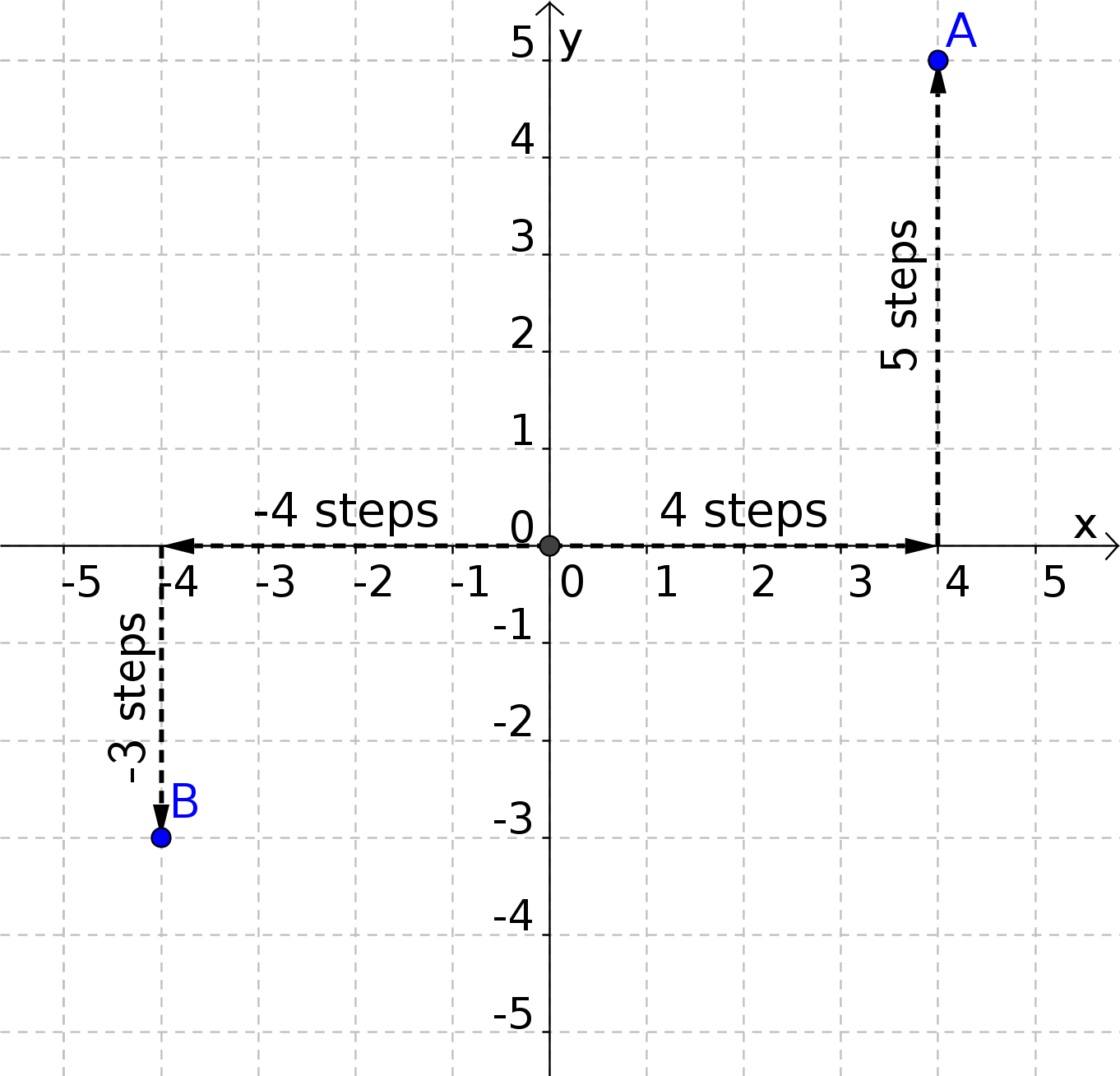
Point is given by the coordinate , meaning that I first have to take steps to the left and then steps downwards to get to , or vice versa, first moving downwards, and then to the left.
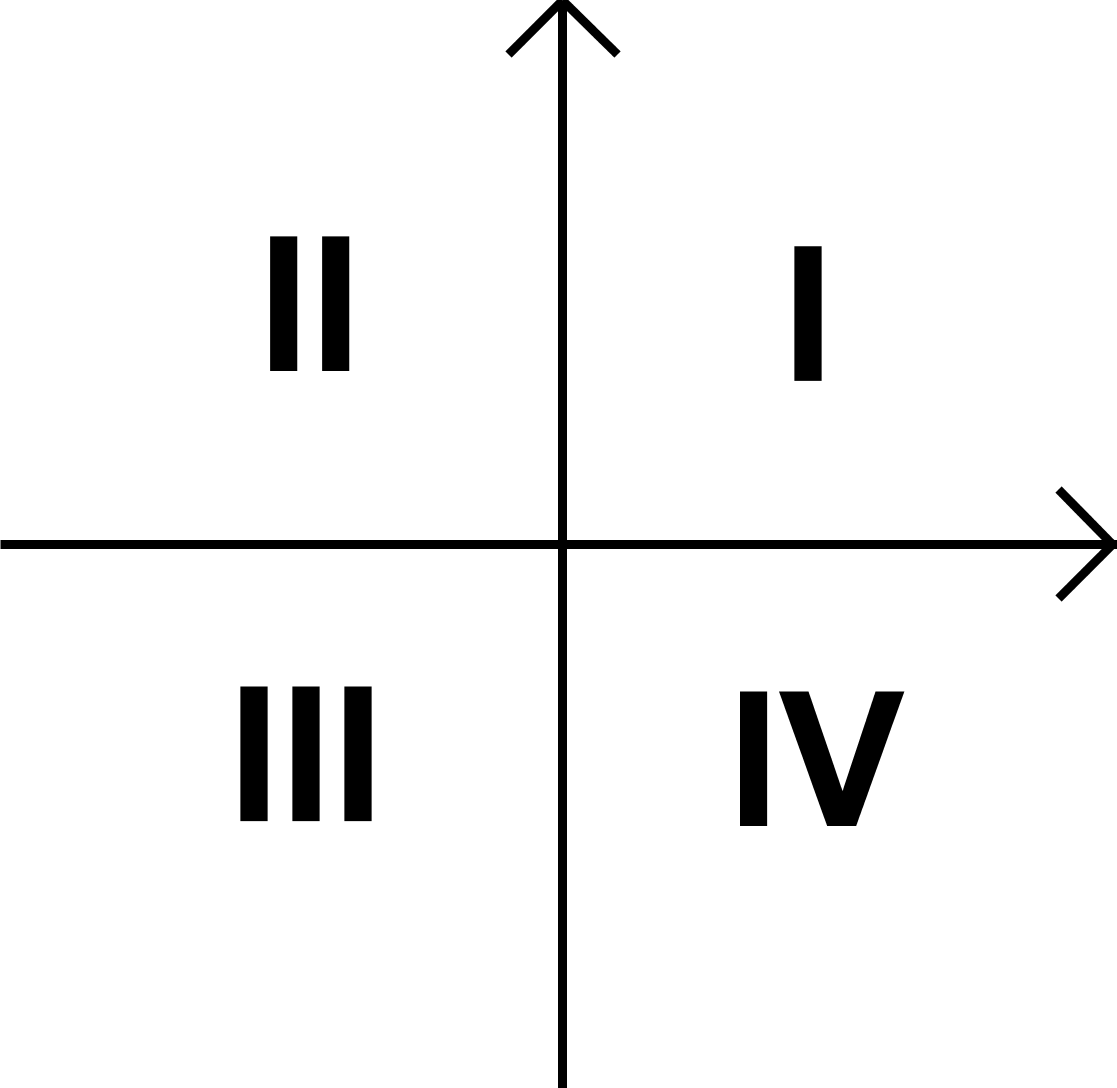
The Cartesian coordinate systems divides the plane into quadrants which we label with the roman numbers , , and (see figure below). So, point in the figure above is in the first quadrant (I), and point is in the third quadrant (III).
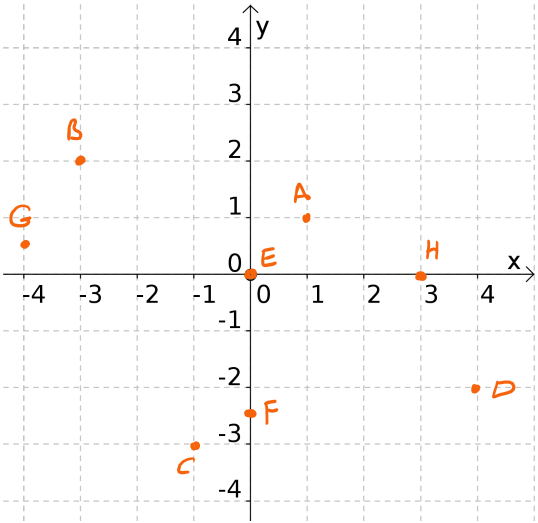
Determine the coordinates of the points.
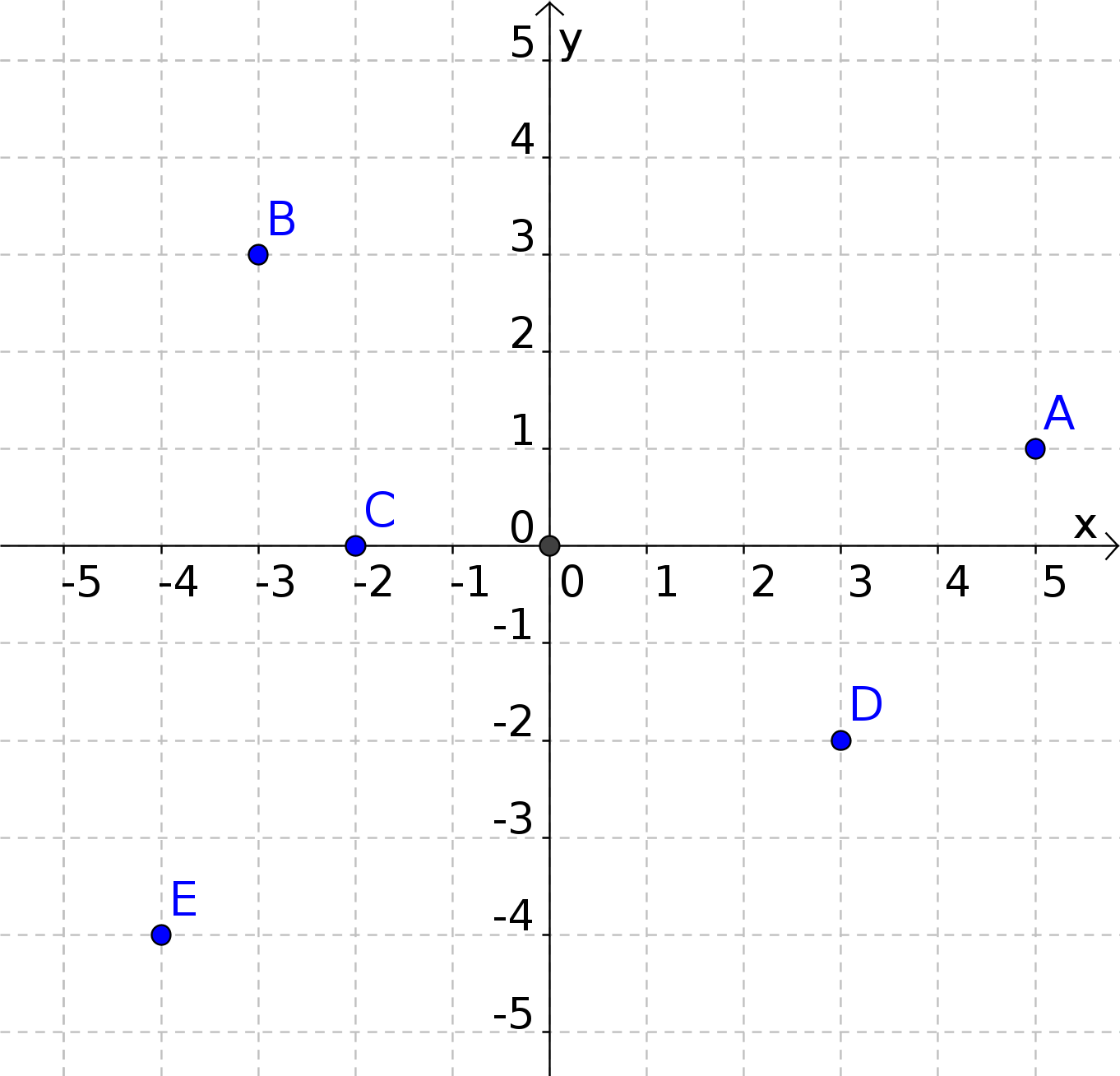
Solution
Draw a coordinate system and indicate the following points:
Solution
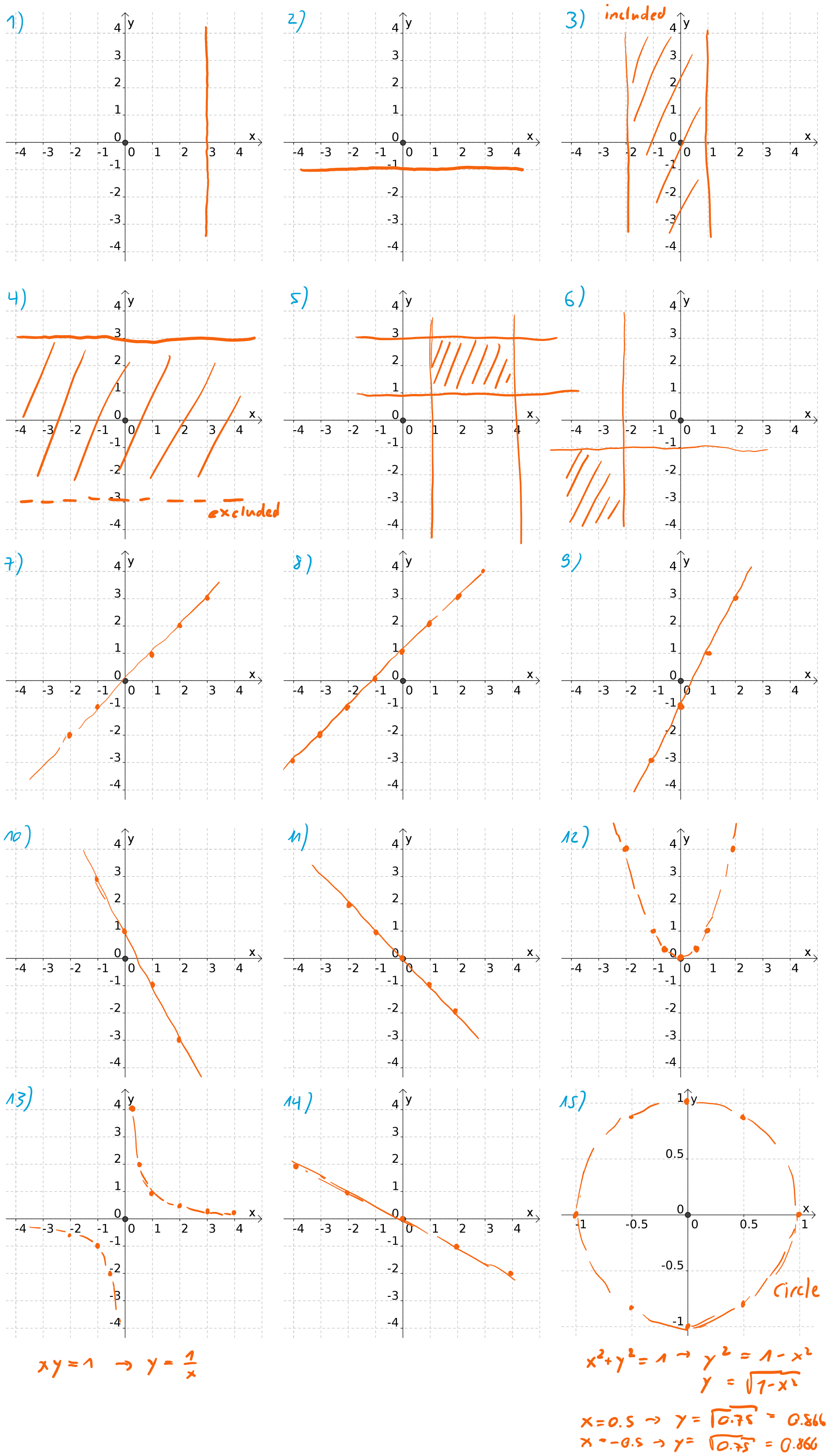
Draw for each problem a coordinate system and indicate all points for which the following is true for the - and -coordinates:
-
-
-
-
-
and
-
and
-
-
-
-
-
-
-
-
-
Solution