The slope of a tangent
Motivation
Consider a function , and a point on the graph. Our goal is to find the slope of the to the graph of at .
Insight
Note that it is no trivial matter to find the slope of the tangent. For the secant, finding the slope is simple because we typically have the coordinates of two known points and through which the secant passes, and this makes finding the slope straight forward using the:
For the tangent (also a straight line), however, we only know one point, the touch point . So how are we supposed to find the slope of this straight line? We need some more information to do so. The only other bit of information we know is that the tangent is a straight line that not only contains , but also touches the curve at . And it turns out that this extra information is enough to find the slope.
Let be a function, and is a point on the graph of , where for some given value . The -coordinate of is therefore . We want to find the slope of the tangent to the grpah of at . We denote this slope by . Here are the steps to find the slope:
-
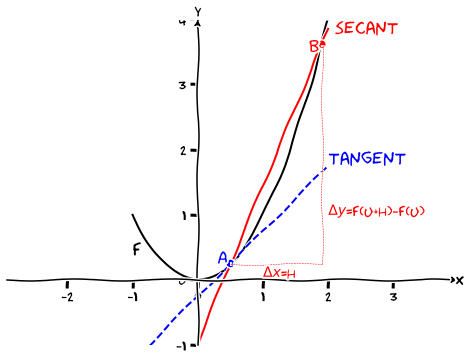
Determine the slope of a secant that passes through and some other point on the graph of . It does not really matter where point is, but let us assume that it is a little bit to the right of , horizontally displaced from by some distance (see picture below). The coordinates of are therefore
We already know from the previous section that the slope of the secant is given by the difference quotient
-
Now, note that for a smaller horizontal separation between the points and , point moves towards point and the new secant will be more parallel to the tangent. But the more parallel these two straight lines are, the more similar are also their slopes. Thus, if we let approach (), point will approach point , and the secant will approach the tangent, and thus the slope of the secant will approach the slope of the tangent .
Consider a function . The slope of the tangent to the graph of at (or at point ) is
The differential quotient is used to determine the slope of the tangent.
The symbol stands for limit, and the expression stands for "as approaches ". Putting everything together, the notation above means the slope of the tangent is the limit of the difference quotient if approaches . The difference quotient with the limit symbol in front of it is called differential quotient.
To make things more clear, let's work through an example.
Let us calculate the slope of the tangent for the picture above using the differential quotient. The function used was , and has the -coordinate .
-
It is . We want to find the slope of the tangent, . We choose a on the graph of , horizontally displaced by some distance on the graph. The slope of the secant passing through and is
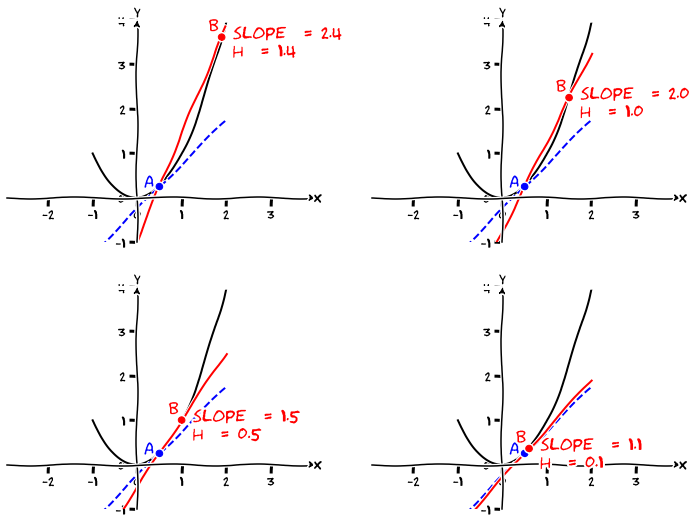
The picture below shows the secants for , , and . Observe how the secants (red) and the tangent (blue) get more parallel, and the slope of the secants approaches the slope of the tangent. For example, let us calculate the slope of the secant for (bottom right): It is
Clearly this forms a good approximation to the real slope of the tangent,
but how do we get an accurate value? This is done in step 2.
-
The slope of the tangent is obtained by letting approach :
For each value of do we get a number (the slope of the secant). Thus we have a sequence of numbers, and we want to know towards which number this sequence converges for . This number (the limit), must then be the slope of the sequence .
We are tempted to insert right away, but this will not work because we will get the expression
and it is not clear at all what value this is. So let us first try to simplify the difference quotient, and hopefully we will then see better what happens if approaches . We have
Indeed, now it is easy to see what happens for : the slope of the secant approaches . The slope of the tangent is therefore
Context
Algebraic simplification is often necessary to avoid the indeterminate form when evaluating the limit as .
Consider the function . Determine the slope of the tangent to the graph of
-
at (that is, determine )
-
for an arbitrary (that is, determine ). This results in a formula for determining the slope to the graph at any point .
-
Use the formula found above to determine the slope of the tangent at .
Solution
- . With we see that .
- . With we see that .
- Because of , we get .
Determine a formula for the slope of the tangent to the graph of (at an arbitrary value ).
-
for all
-
-
-
-
-
Solution
The slope of the tangent at any point with is .
- . So the slope is always . Looking at the graph of (a horizontal line), this result is obviously correct.
- . So the slope is always . Looking at the graph of (a straight line of slope ), this result is obviously correct.
- It is So the slope is .
- It is So the slope is .
- It is So the slope is .
- It is So the slope is .