The logarithm

Assume we have an number, say 77, and we want to express this number with the base 1010, that is, we are looking for a number aa such that

10a=710^a=7

What is the value of aa? Well, aa must be smaller than 11, because for a=1a=1 we get 101=1010^1=10, which is already bigger than 77. But a=0a=0 is too small, because 100=110^0=1. So aa must be somewhere between 00 and 11, but what is the exact value?

Exercise 1

Using the calculator, find a value for aa such that

10a710^a \approx 7
Solution

Trying out some values, we get, for example, that for a=0.85a=0.85 it is

100.85=7.07945...10^{0.85} = 7.07945...

which is close to 77.

To find the exact value we need a new tool, called the logarithm. On your calculator, this is the key

ln log\boxed{\texttt{ln log}}

You have to choose the option log\texttt{log} (so press the key twice). We will discuss the other option later. So how can we find the value aa? Enter in your calculator

log(7)\texttt{log(7)}

The result is

0.8450...0.8450...

and this is the solution! Indeed, using the calculator we see that

100.8450...=710^{0.8450...}=7

In words, if we want to know

10what=710^\text{what}=7

the answer is the number

log(7)\texttt{log(7)}

Of course we do not have to focus on the number 1010. For example, we could also ask

ewhat=7e^\text{what}=7

and the answer can be found with

ln(7)\texttt{ln(7)}

which, consulting the calculator, is the number

1.945...1.945...
Exercise 2

Determine aa

  1. 10a=1510^a=15

  2. ea=15e^a=15

Solution
  1. a=log(15)=1.176...a=\texttt{log(15)}=1.176...
  2. a=ln(15)=2.708...a=\texttt{ln(15)}=2.708...

Note that to be more explicit about the base which we want to use to represent the 77, we can write log10(7)\log_{10}(7) rather than log(7)\log(7) and loge(7)\log_e(7) rather than ln(7)\ln(7). More generally we have the following definition of the logarithm:

Definition 1

Consider two numbers b>0b>0 and c>0c>0. The logarithm base b of c is written as

logb(c)\log_b(c)

It is

logb(c)=a if ba=c\log_b(c)=a\, \text{ if }\, b^a=c

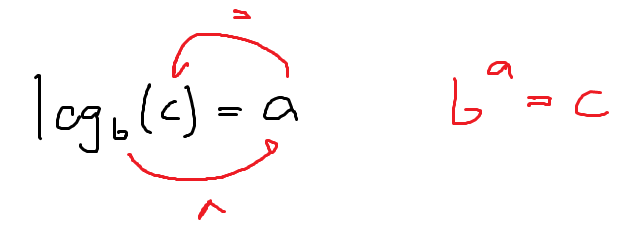
If this looks complicated, here is a helpful "snails"-diagram: logb(c)=a\log_b(c)=a if "bb raised to the power of aa is cc"

For the two bases ee (Eulers constant) and 1010, we do not write the base explicitely:

  • ln(c)=loge(c)\ln(c)=\log_e(c) ("natural logarithm")
  • log(c)=log10(c)\log(c)=\log_{10}(c)
Example 1
  1. log10(1000)=3\log_{10}(1000)=3, because 103=100010^3=1000 (so the log\log computers the number of zeros)
  2. log3(9)=2\log_3(9)=2 because 32=93^2=9
  3. log2(0.5)=1\log_2(0.5)=-1 because 21=0.52^{-1}=0.5

Before we start with the exercises, a quick note about the names of certain logarithms:

And now some exercises.

Exercise 3
  1. Determine without calculator.
    1. log(100)\log(100)
    2. log(10)\log(10)
    3. log(1)\log(1)
    4. log(0)\log(0)
    5. log(1)\log(-1)
    6. log(23)\log(-23)
    7. log(0.001)\log(0.001)
    8. log(102)\log(10^{-2})
    9. log(101)\log(10^{-1})
    10. log(110)\log(\frac{1}{10})
    11. log(110000)\log(\frac{1}{10\,000})
    12. log(102.37)\log(10^{2.37})
    13. log(103x)\log(10^{3x})
    14. log(103x4+3)\log(10^{3x^4+3})
    15. log(4+6)\log(4+6)
    16. 10log(4)10^{\log(4)}
  2. Determine without calculator.
    1. log3(9)\log_{3}(9)
    2. log5(125)\log_{5}(\frac{1}{25})
    3. log2(1024)\log_{2}(1024)
    4. log2(0.125)\log_{2}(0.125)
    5. log100(10)\log_{100}(10)
    6. log3(181)\log_{3}(\frac{1}{81})
    7. log3(910)\log_{3}(\sqrt[10]{9})
    8. log3(1275)\log_{3}(\frac{1}{\sqrt[5]{27}})
    9. logπ(1π)\log_{\pi}(\frac{1}{\pi})
    10. ln(e1/7)\ln(e^{1/7})
    11. eln(6)e^{\ln(6)}
  3. Can you simplify the expression?
    1. logb(0)\log_{b}(0)

    2. logb(1)\log_{b}(1)

    3. logb(b)\log_{b}(b)

    4. logb(b)\log_{b}(\sqrt{b})

    5. logb(1b)\log_{b}(\frac{1}{b})

    6. logb(1b)\log_{b}(\frac{1}{\sqrt{b}})

    7. logb(b101)\log_{b}(b^{101})

    8. logb(1)\log_{b}(-1)

    9. logb(b2x1)\log_{b}(b^{2x-1})

    10. blogb(4)b^{\log_b(4)}

Solution
  1. Find the logarithm
    1. log(100)=2\log(100)=2 because 102=10010^2=100
    2. log(10)=1\log(10)=1 because 101=1010^1=10
    3. log(1)=0\log(1)=0 because 100=110^0=1
    4. log(0)\log(0) does not exist, because there is no number aa with 10a=010^a=0
    5. log(1)\log(-1) does not exist, because there is no number aa with 10a=110^a=-1
    6. log(23)\log(-23) does not exist, because there is no number aa with 10a=210^a=-2
    7. log(0.001)=log(103)=3\log(0.001)=\log(10^{-3})=-3
    8. log(102)=2\log(10^{-2})=-2
    9. log(101)=1\log(10^{-1})=-1
    10. log(110)=log(101)=1\log(\frac{1}{10})=\log(10^{-1})=-1
    11. log(110000)=log(104)=4\log(\frac{1}{10\,000})=\log(10^{-4})=-4
    12. log(102.37)=2.37\log(10^{2.37})=2.37
    13. log(103x)=3x\log(10^{3x})=3x
    14. log(103x4+3)=3x4+3\log(10^{3x^4+3})=3x^4+3
    15. log(4+6)=log(10)=1\log(4+6)=\log(10)=1
    16. 10log(4)=410^{\log(4)}=4 because by definition log(4)\log(4) is the number aa with 10a=410^a=4.
  2. Determine without calculator.
    1. log3(9)=2\log_{3}(9)=2 because 32=93^2=9
    2. log5(125)=log5(52)=2\log_{5}(\frac{1}{25})=\log_5(5^{-2})=-2
    3. log2(1024)=log2(210)=10\log_{2}(1024)=\log_{2}(2^{10})=10
    4. log2(0.125)=log2(18)=log2(23)=3\log_{2}(0.125)=\log_2(\frac{1}{8})=\log_2(2^{-3})=-3
    5. log100(10)=log(1000.5)=0.5\log_{100}(10)=\log(100^{0.5})=0.5
    6. log3(181)=log3(34)=4\log_{3}(\frac{1}{81})=\log_3(3^{-4})=-4
    7. log3(910)=log3(91/10)=log3(32/10)=0.2\log_{3}(\sqrt[10]{9})=\log_3(9^{1/10})=\log_3(3^{2/10})=0.2
    8. log3(1275)=log3(33/5)=0.6\log_{3}(\frac{1}{\sqrt[5]{27}})=\log_3(3^{-3/5})=-0.6
    9. logπ(1π)=logπ(π1)=1\log_{\pi}(\frac{1}{\pi})=\log_{\pi}(\pi^{-1})=-1
    10. ln(e1/7)=17\ln(e^{1/7})=\frac{1}{7}
    11. eln(6)=6e^{\ln(6)}=6 because by definition ln(6)\ln(6) is the number aa with ea=6e^a=6.
  3. We always assume b>0b>0:
    1. logb(0)\log_{b}(0) no, for any b>0b>0 this number does not exist
    2. logb(1)=0\log_{b}(1)=0 because b0=1b^0=1 for any b>0b>0
    3. logb(b)=1\log_{b}(b)=1 because b1=bb^1=b for any b>0b>0
    4. logb(b)=0.5\log_{b}(\sqrt{b})=0.5 because b0.5=bb^{0.5}=\sqrt{b} for any b>0b>0
    5. logb(1b)=1\log_{b}(\frac{1}{b})=-1 because b1=1bb^{-1}=\frac{1}{b} for any b>0b>0
    6. logb(1b)=12\log_{b}(\frac{1}{\sqrt{b}})=-\frac{1}{2} because b1/2=1bb^{-1/2}=\frac{1}{\sqrt{b}} for any b>0b>0
    7. logb(b101)=101\log_{b}(b^{101})=101 because b101=b101b^{101}=b^{101} for any b>0b>0
    8. logb(1)\log_{b}(-1) does not exist, because there is no aa with ba=1b^a=-1
    9. logb(b2x1)=2x1\log_{b}(b^{2x-1})=2x-1 because b2x1=b2x1b^{2x-1}=b^{2x-1}
    10. blogb(4)=4b^{\log_b(4)}=4 because by definition for a=logb(4)a=\log_b(4) it is ba=4b^a=4.

Let us summarise some useful properties which follow from the exercise above:

Theorem 1

For every base b>0b>0 the following is true: 0. logb(c)\log_b(c) does not exist for c0c\leq 0

  1. logb(1)=0\log_b(1)=0

  2. logb(b)=1\log_b(b)=1

  3. logb(bu)=u\log_b(b^u)=u for every number uu

  4. blogb(c)=cb^{\log_b(c)}=c for every c>0c>0

Proof

Here are the proofs:

  1. There is no number aa with ba=0b^a=0 or bab^a is negative (for b>0b>0).
  2. logb(1)=0\log_b(1)=0 because b0=1b^0=1
  3. logb(b)=1\log_b(b)=1 because b1=bb^1=b
  4. logb(bn)=n\log_b(b^n)=n because bn=bnb^n=b^n
  5. By definition, for the number a=logb(c)a=\log_b(c) it is ba=cb^a=c, so indeed blogb(c)=cb^{\log_b(c)}=c
Exercise 4
  1. Argue, why is logb(cd)=logb(c)+logb(d)\log_b(c\cdot d)=\log_b(c)+\log_b(d)?

  2. Is the following true? log5(3x)=log5(3)+log5(x)\log_5(3x)=\log_5(3)+\log_5(x) for all xx?

  3. Is the following true? log5(3+x)=log5(3)log5(x)\log_5(3+x)=\log_5(3)\cdot \log_5(x) for all xx?

Solution
  1. To show that logb(cd)=logb(c)+logb(d)\log_b(c\cdot d)=\log_b(c)+\log_b(d) is correct, the equation must also be correct if we raise bb to the power of the left side and the right side of the equation: blogb(cd)=cd=blogb(c)+logb(d)\underbrace{b^{\log_b(c\cdot d)}}_{=c\cdot d}=b^{\log_b(c)+\log_b(d)} Using the power laws, we get for the right side blogb(c)+logb(d)=blogb(c)blogb(d)=cd\begin{array}{lll} b^{\log_b(c)+\log_b(d)}&=&b^{\log_b(c)}\cdot b^{\log_b(d)}\\ &=& c\cdot d \end{array} and we see that the left side is the same as the right side. This concludes the proof.
  2. It is correct (see question 1).
  3. No, it is wrong. Take for example x=1x=1. For the left side we get log5(3+x)=log5(3+1)=log5(4)0\log_5(3+x)=\log_5(3+1)=\log_5(4)\neq 0 and for the right side we get log5(3)log5(x)=log5(3)log5(1)=0=0\log_5(3)\cdot \log_5(x) = \log_5(3)\cdot \underbrace{\log_5(1)}_{=0}=0