Further problems
Q1
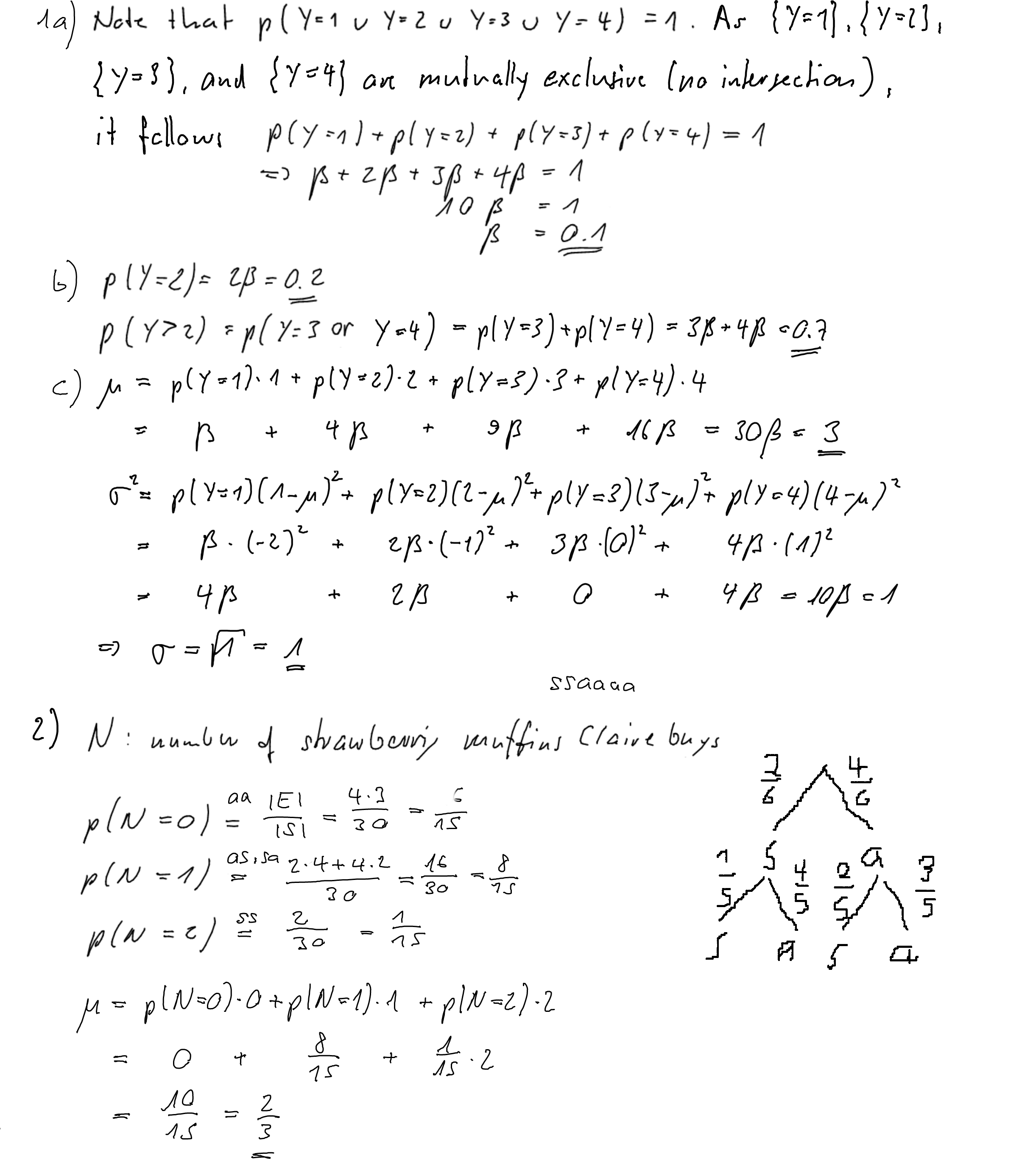
The probability function of the random variable is as follows: , , , .
- Find the value
- Find and
- Find the mean and standard deviation of
Q2
A bakery has six indistinguishable muffins on display. However, two of them have been filled with strawberry jam and the others with apricot jam. Claire, who hates strawberry jam, purchases two muffins at random. Determine the average number of strawberry muffins that Claire will buy if she uses this strategy every time she buys muffins.
Q3
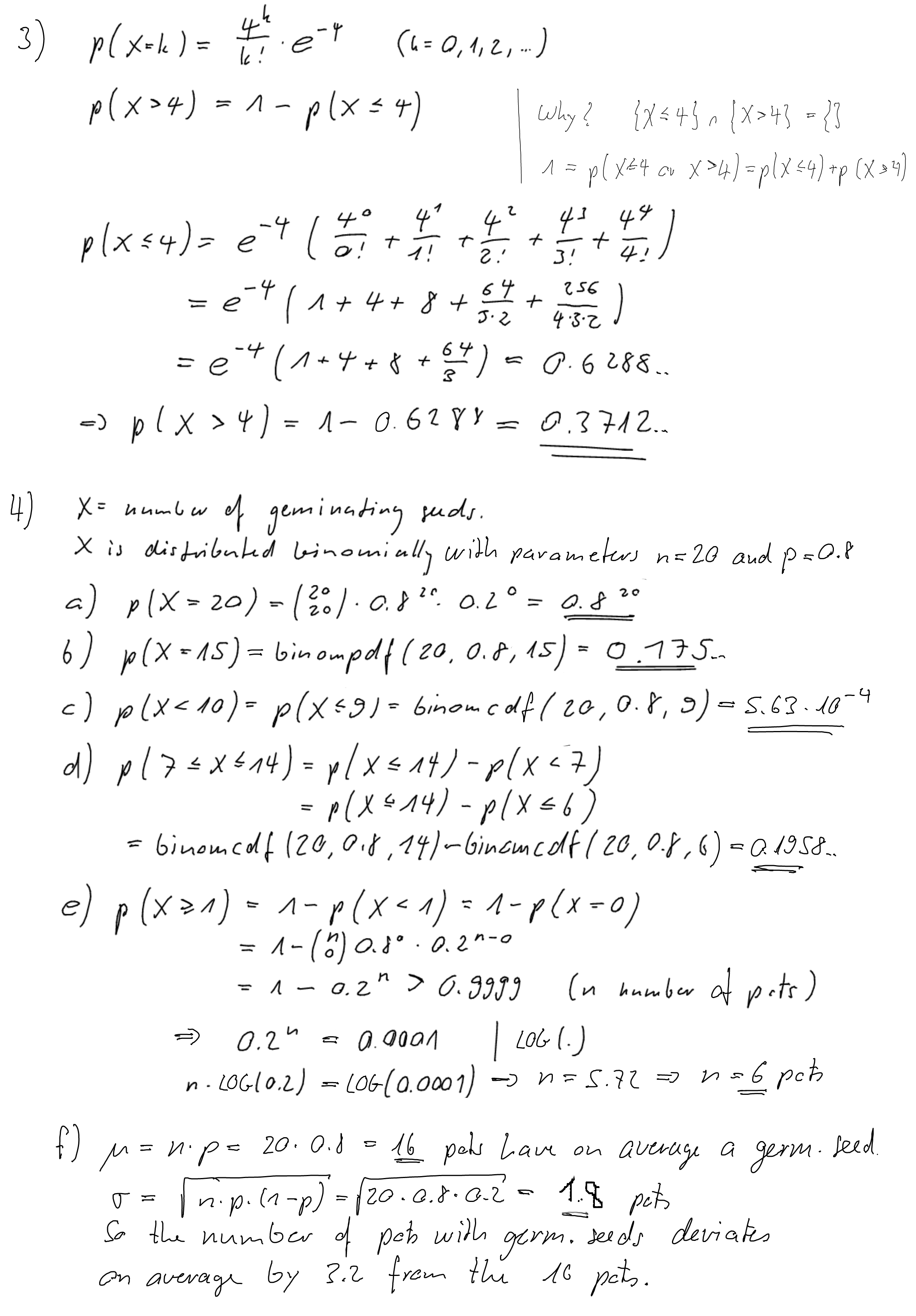
The number of particles emitted during a one hour period is denoted by the random variable . Experience shows that the probability function of is
where . Find the probability that during an hour more than particles are emitted.
Q4
Sophie has pots labelled one to twenty. Each pot, and its contents, is identical in every way. Sophie plants a seed in each pot with the hope that a flower grows. Each seed has a germinating probability of .
- What is the probability that all the seeds will germinate?
- What is the probability that only five seeds will not germinate?
- What is the probability that less than half of the seed will germinate?
- What is the probability that between and seeds will germinate (borders included)?
- How many pots must Sophie use to be sure that at least one seed germinates?
- Sophie plants pots each year. On average, how many germinating seeds does she receive each year? And by how much does this number vary per year?
Q5
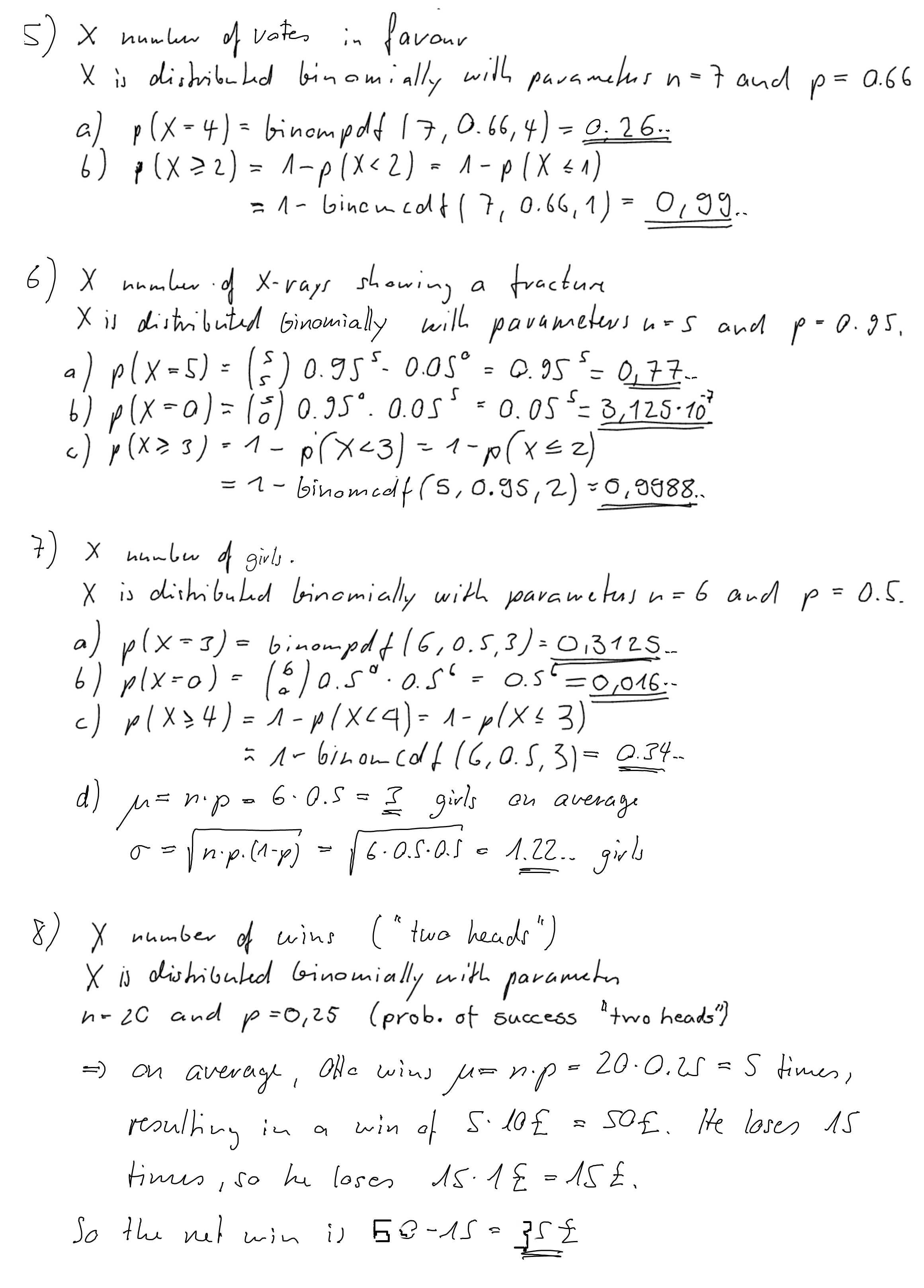
During an election campaign, of a population of voters are in favour of a food quality control proposal. A sample of voters was chosen at random from this population. Find the probability that:
- there will be voters that were in favour.
- there will be at least voters who were in favour.
Q6
An X-ray has a probability of of showing a fracture in the leg. If different X-rays are taken of a particular leg, find the probability that
- all five X-rays identify the fracture.
- the fracture does not show up.
- at least 3 X-rays show the fracture
Q7
The births of males and females are assumed to be equally likely. Find the probability that in a family of children:
- there are exactly girls.
- there are no girls.
- the girls are in the majority.
- How many girls do you expect to see in a family of 6 children? And what is the expected deviation from this average?
Q8
Two coins are tossed twenty times. Otto wins £ whenever two heads show up, and he loses £ otherwise. How much money can Otto expect to win on average?
Q9
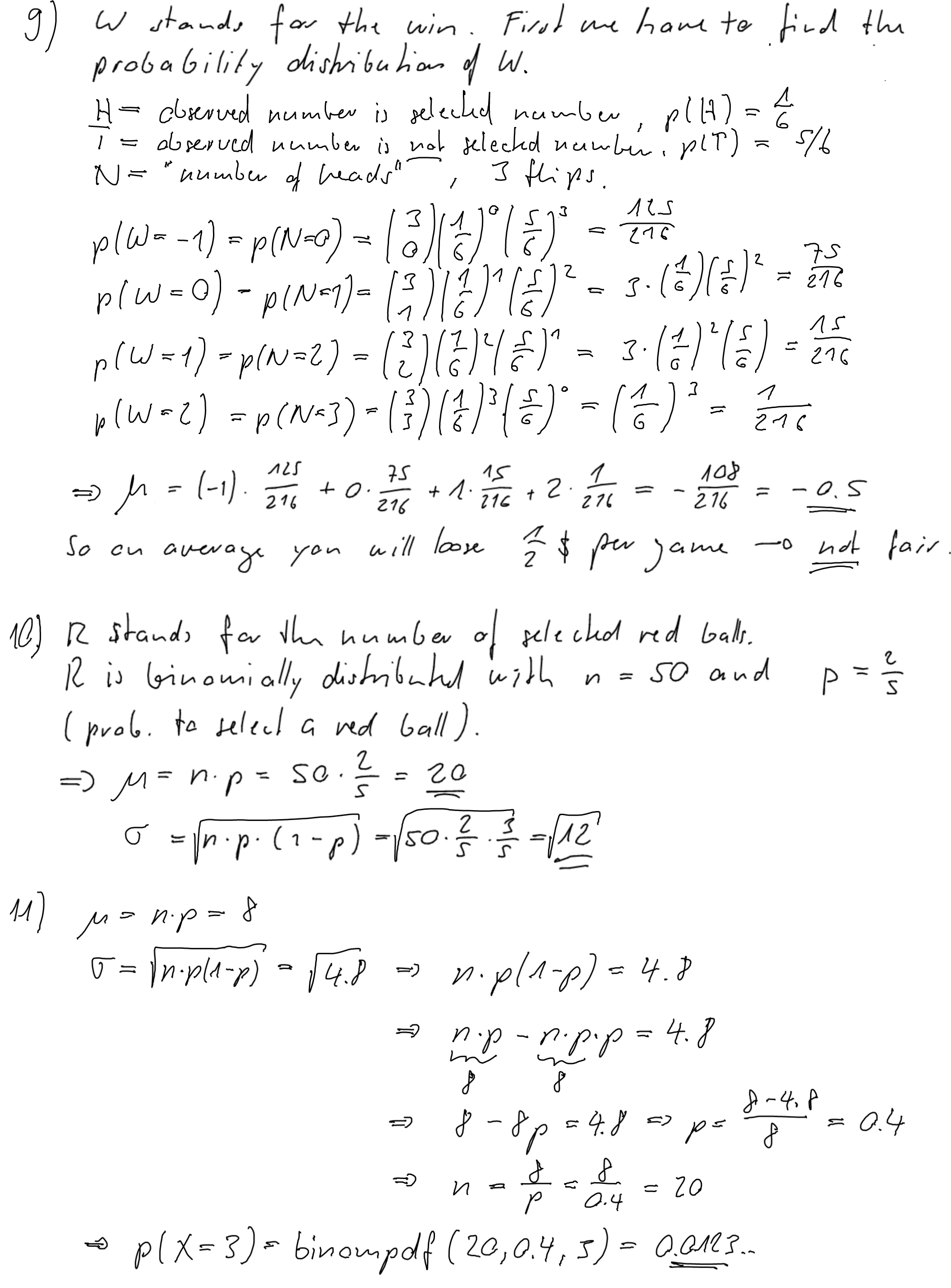
The entry fee for the game "chuck the luck" is Dollar. First, the player selects a number between and . A die is then rolled three times. If the selected number is not observed, the entry fee is lost. If the selected number is observed once, twice, or three times, the player wins , or Dollars, respectively. Is this a fair game, in the sense that the expected total win per game is zero?
Q10
A bag contains balls of which are red. A ball is selected at random, its color noted, and returned to the bag. This process is carried out times. Find the average and standard deviation of the number of selected red balls.
Q11
The binomial random variable has mean and standard deviation . Find .
Q12
In a shooting competition, a competitor always hits the target region, and hits the bulls eye on three out of every five attempts. If the competitor hits the bulls eye, she receives dollars, otherwise only dollars. What can the competitor expect in winnings
- in one attempt at the target?
- after attempts?
Show
Solutions
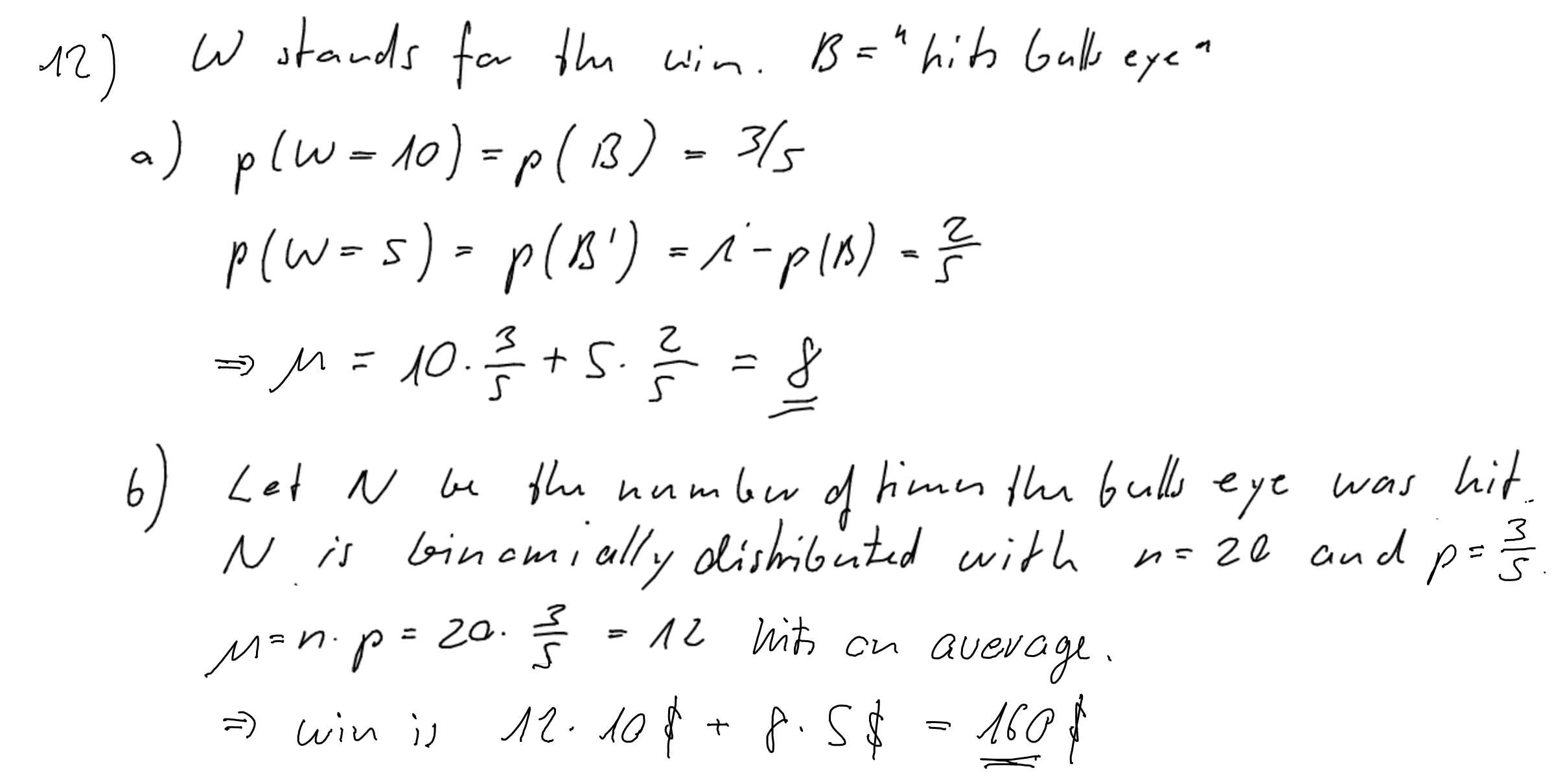
Note to problem 12
Here is another approach. As this is a binomial experiment, where the number of trials (number of arrows shot in the competition) is , and the success probability (probability for hitting the target) is , the average number of hits (per competition) is , and the average number of misses is therefore .
As you get for every hit, and for every miss, the total average amount you get is
a)
, thus average hits per competition is , average misses is , the average amount won is
b)
, thus average hits per competition is , average misses is , the average amount won is .
Which makes sense: as you have times more trial as in a, you get more money.