Vectors - Operations and relations
Q1
Consider the vectors
and the point .
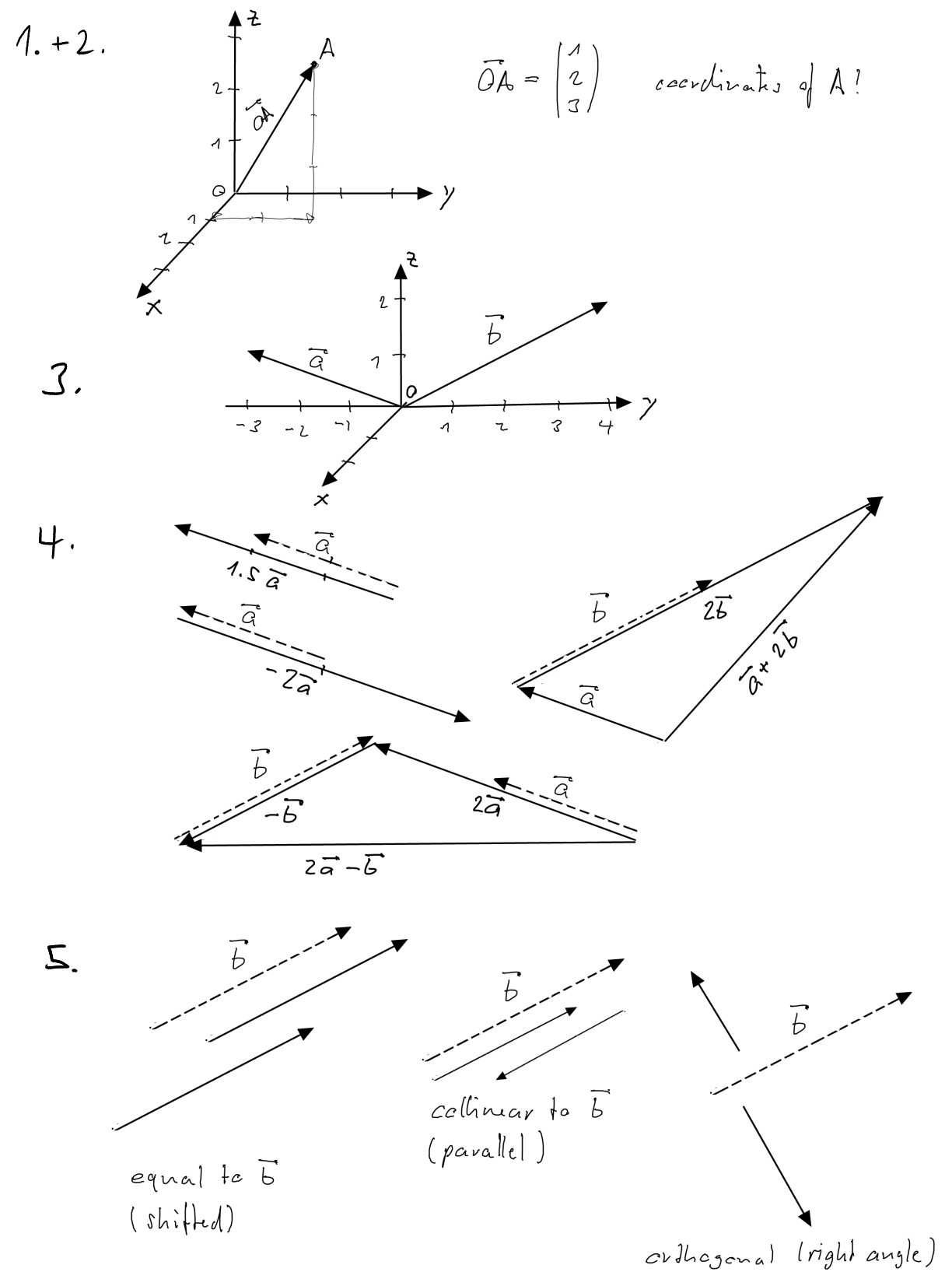
- Indicate point in a 3d-coordinate system.
- Draw the position vector of and determine its components.
- Draw vectors and .
- Draw the following vectors by construction: , , , .
- Draw a vector which is:
- equal to
- collinear to
- orthogonal to
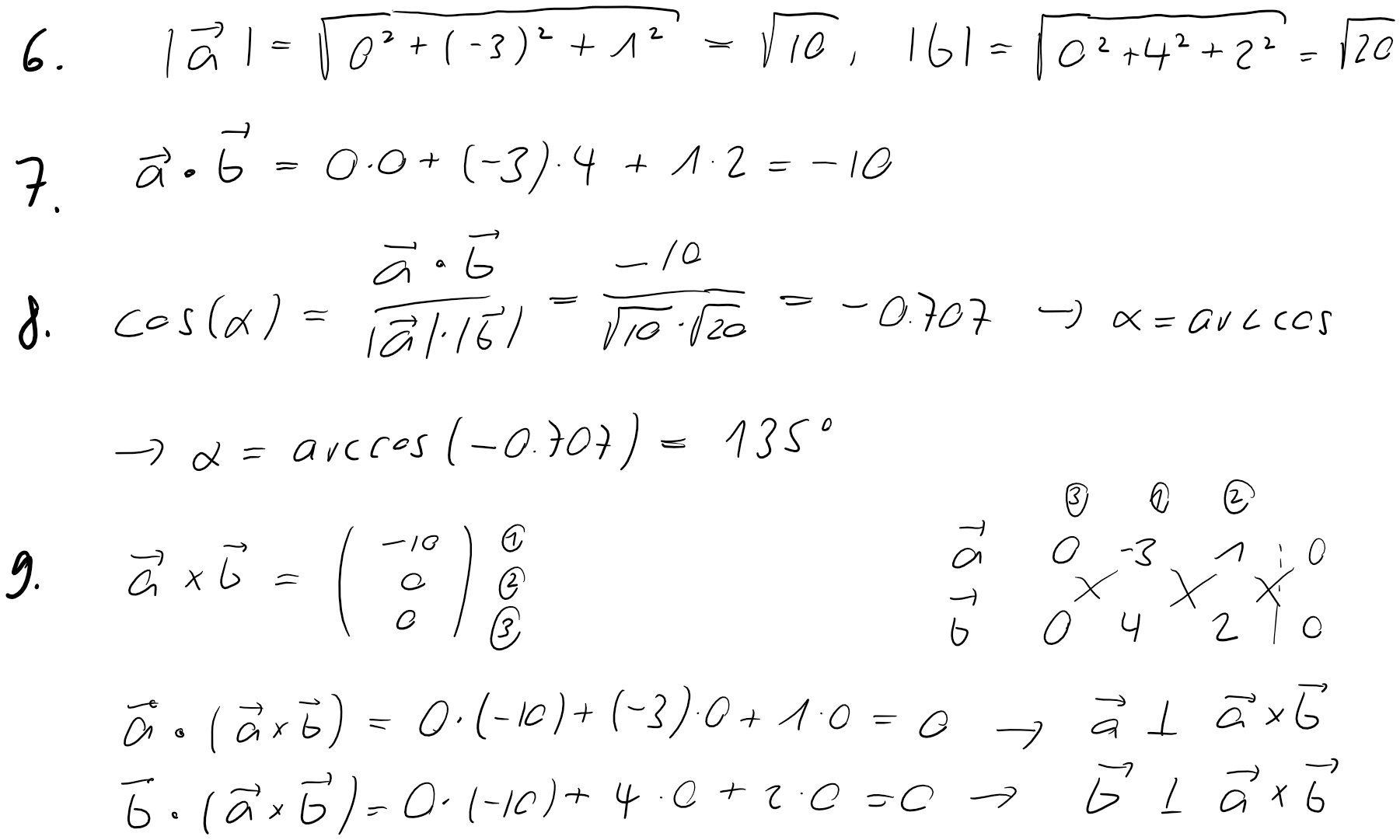
- Determine the magnitude of and .
- Determine the scalar product of and .
- Determine the angle between and .
- Determine the vector product (or cross product) of and . Show that this vector is orthogonal to und .
Show
A1
Q2
Consider the vectors
and the points and .
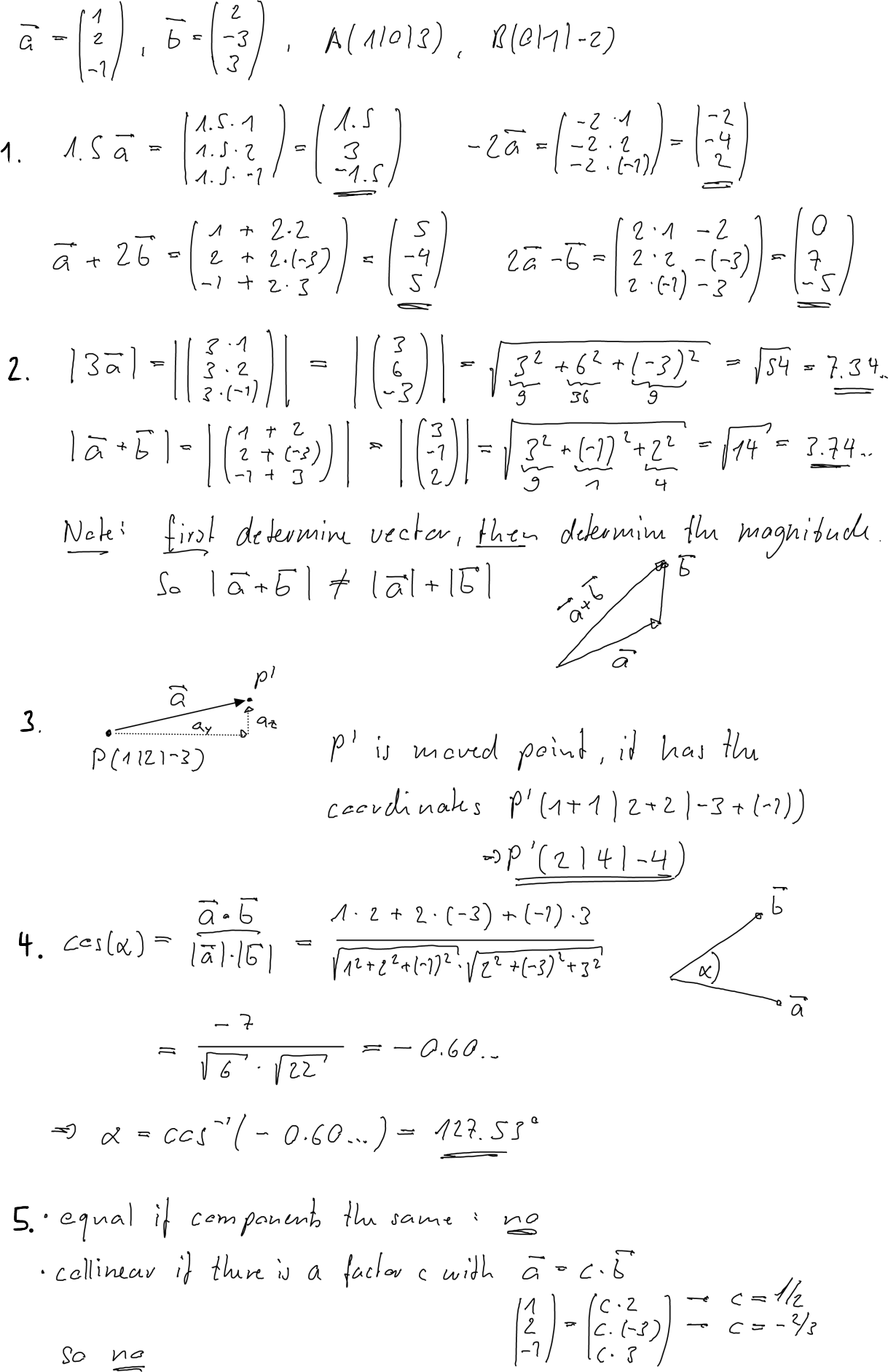
- Determine the components of the following vectors: , , , .
- Determine the magnitude of the vectors , and .
- Point is moved along the vector . What are the coordinates of the moved point?
- Determine the angle between and .
- Are the vectors and equal, collinear, or orthogonal?
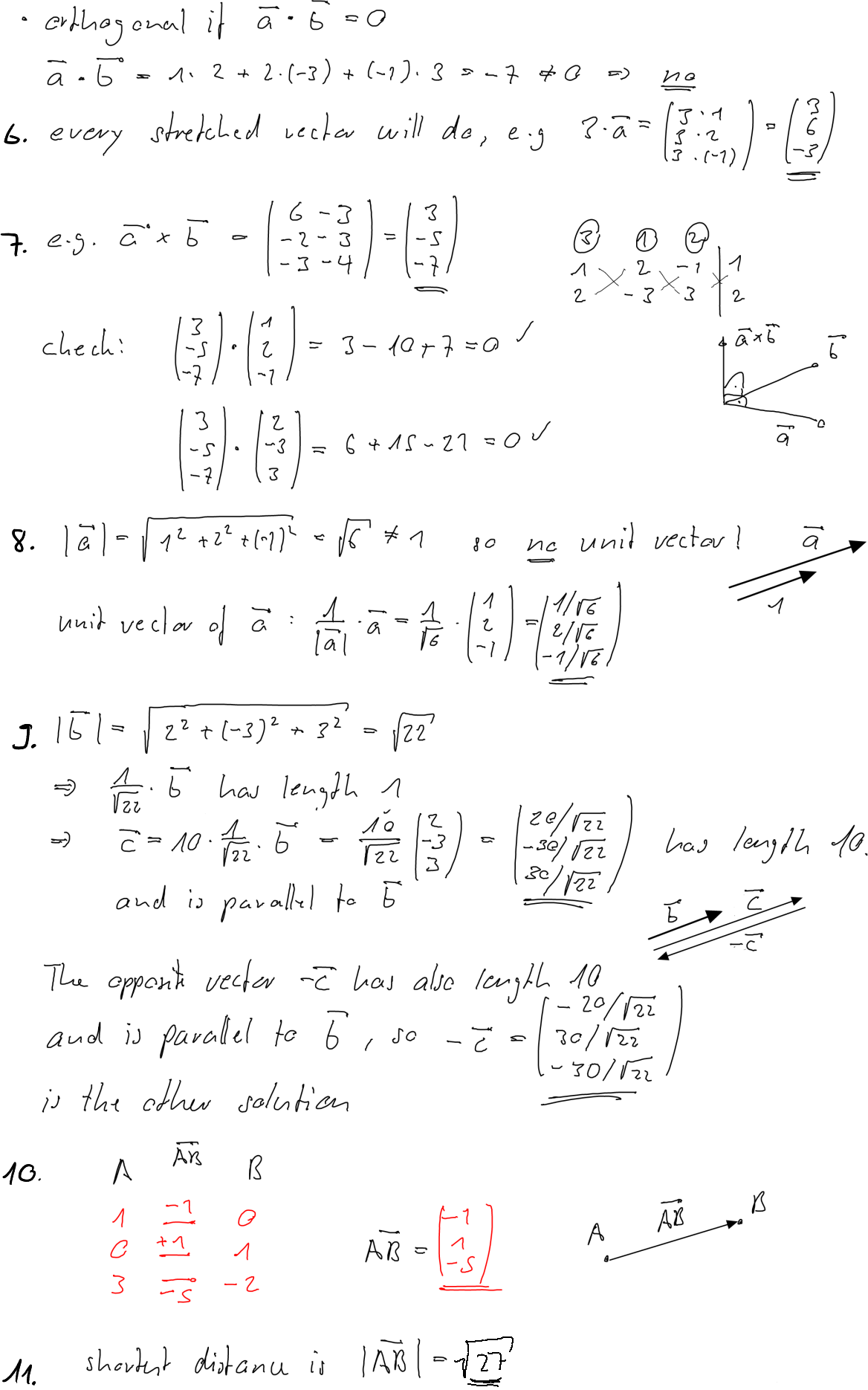
- Determine a vector that is collinear to .
- Determine a vector that is orthogonal to and .
- Is a unit vector? If not, find a unit vector of .
- Find all vectors that are parallel to and have length .
- Determine the vector from to .
- Determine the shortest distance from to .
Show
A2
Q3
Consider the points , , and , and the vectors
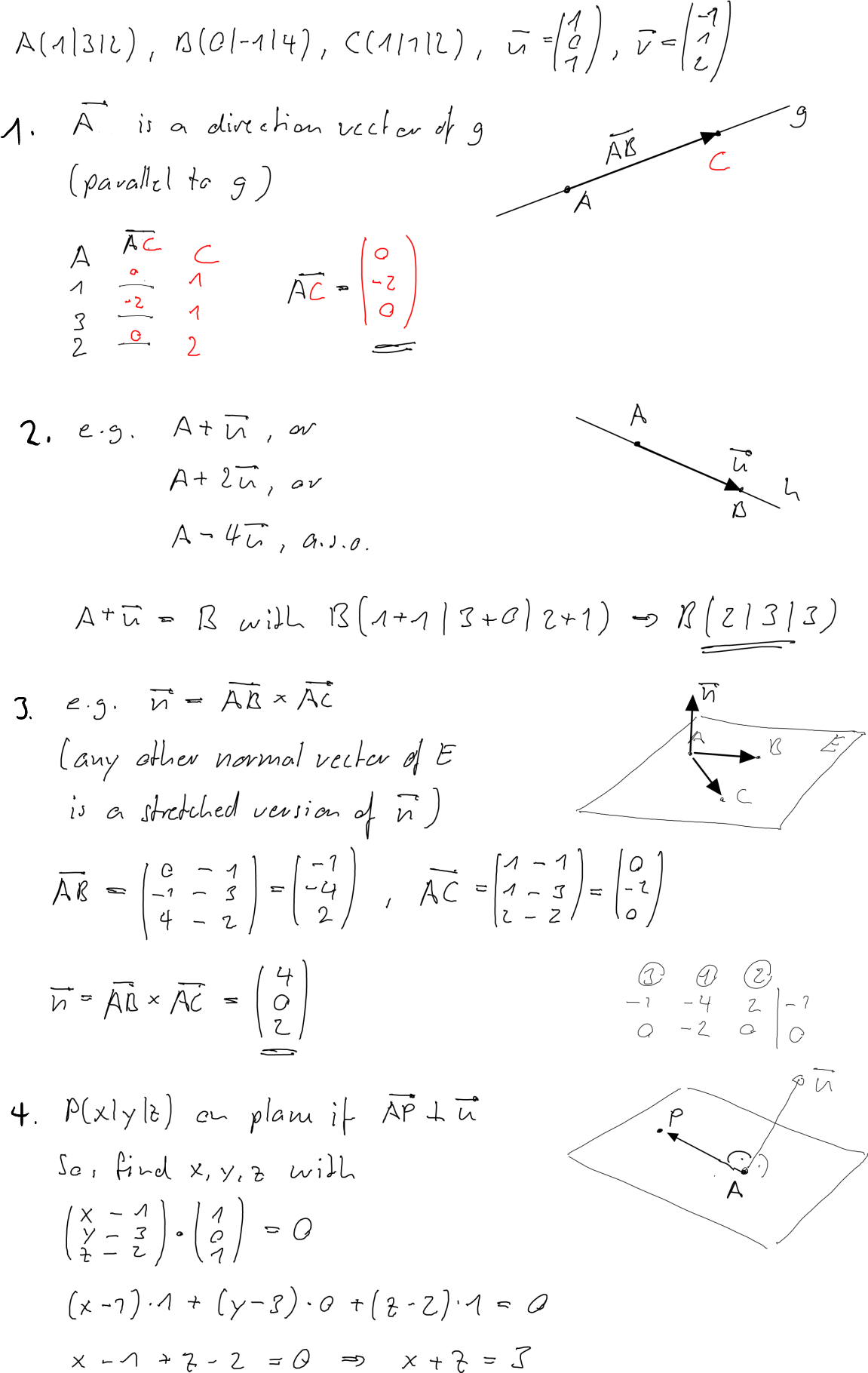
- Find the direction vector of the straight line passing through the points and .
- Find another point on the straight line passing through and has direction .
- Find the normal vector of the plane containing the points , , and .
- Find two other points on the plane containing the point and has normal vector .
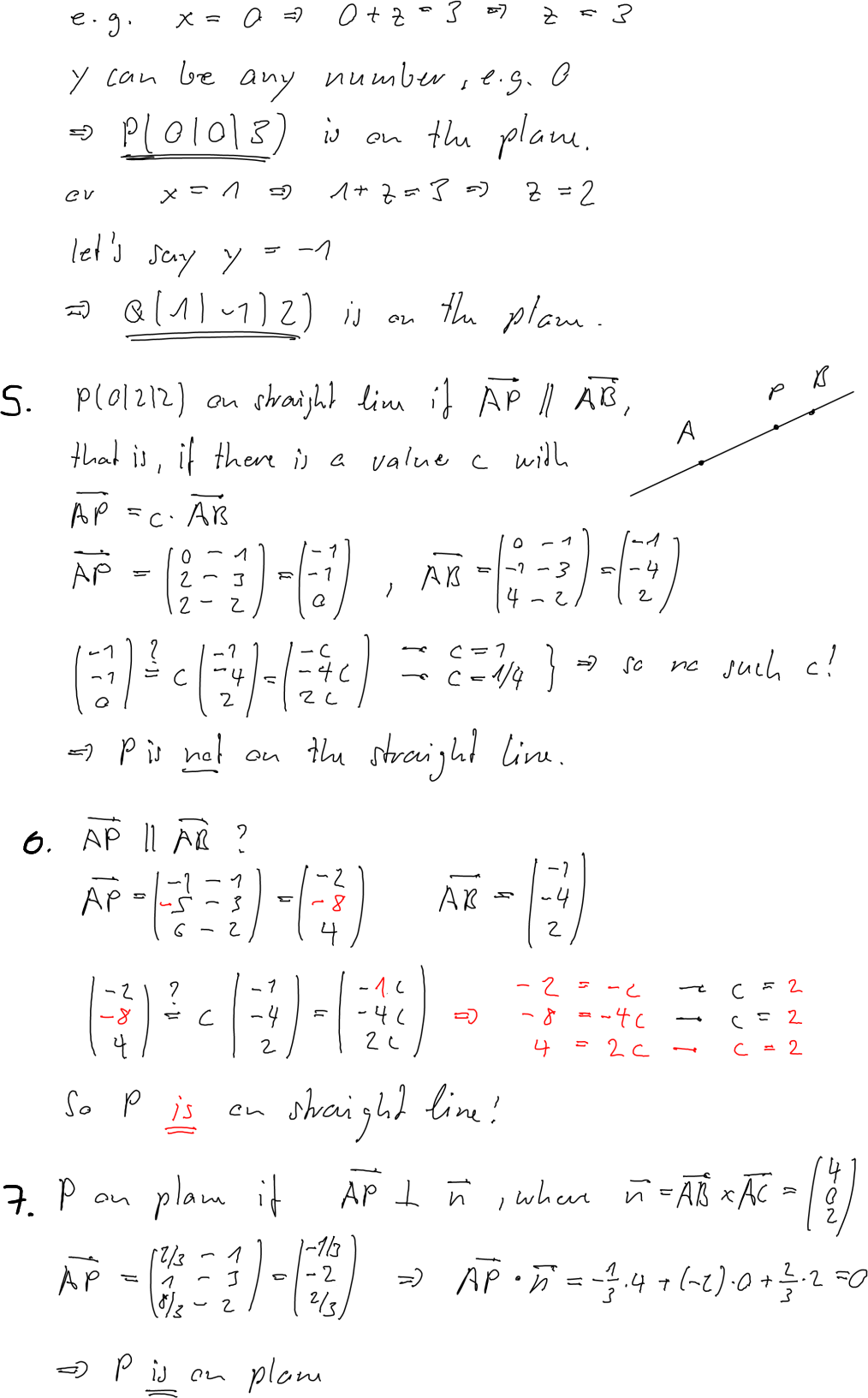
- Is the point on the straight line given by and ?
- Is the point on the straight line given by and ?
- Is the point on the plane given by the points , , and ?
- Is the point on the plane given by the points , , and ?
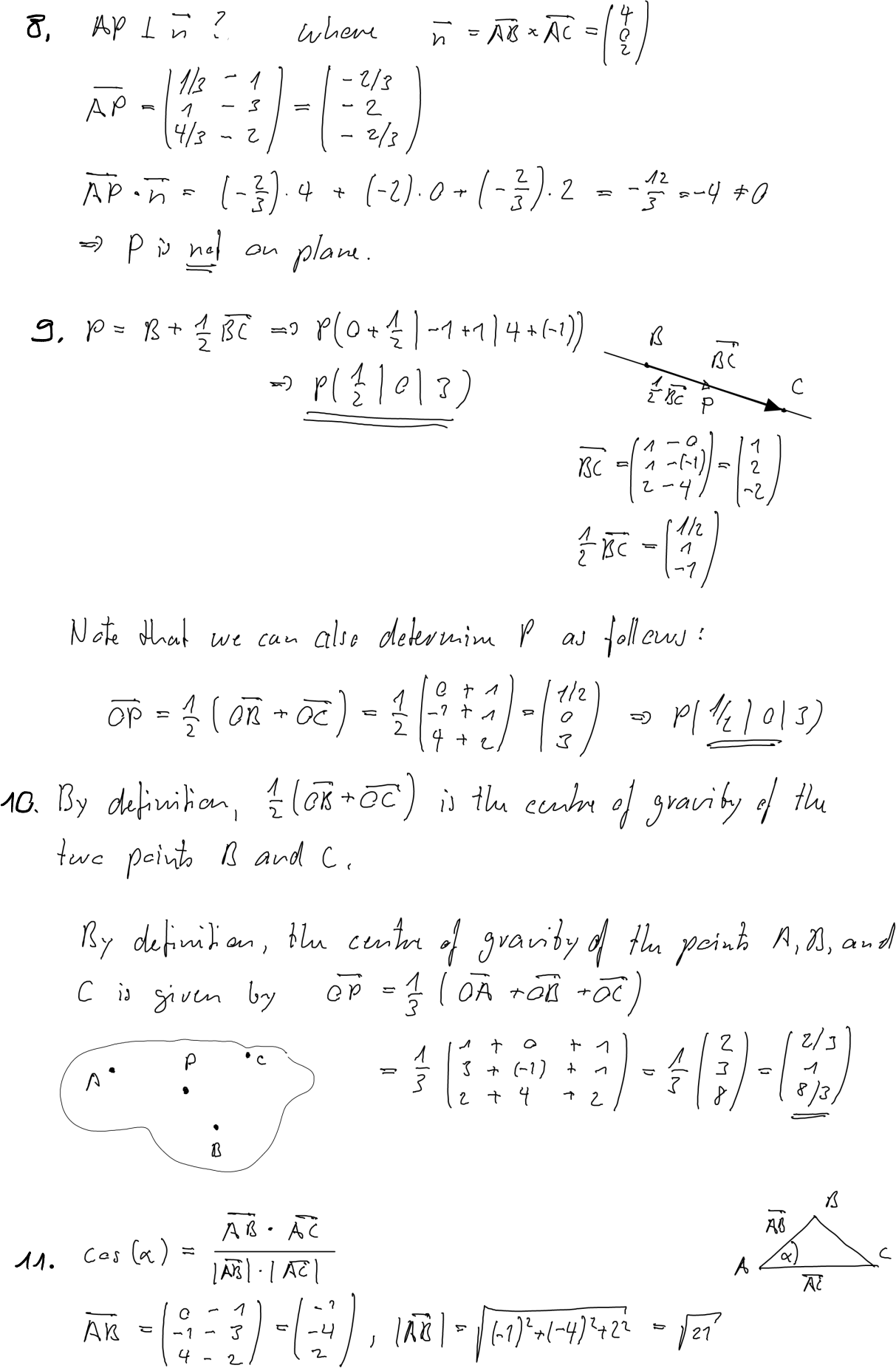
- Find the point which is in the middle of the segment from to .
- SKIP Determine the centre of gravity of the triangle .
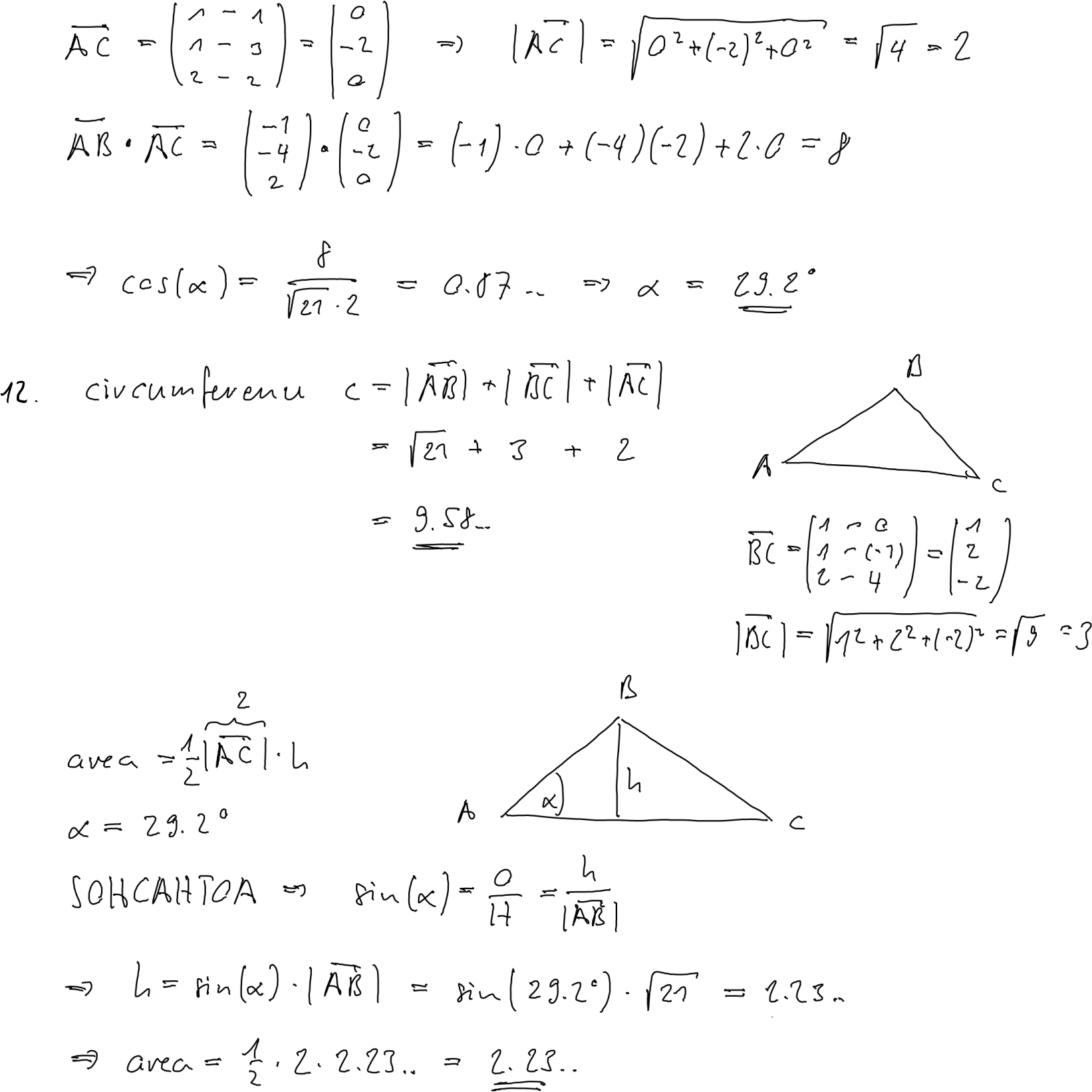
- Determine the angle at of the triangle .
- Determine the circumference and area of the triangle .
Show
A3
Q4
Consider the three points and .
- The straight line passes through and . Determine the equation of the straight line.
- Use the equation to show that is not on .
- Find the normal equation of the plane which contains the points , and .
- Use the normal equation to show that point is not in the plane.
Show
A4
- passes through and has a direction vector Thus, the equation of the straight line is That is, any point is on if there is a such that the equation above is satisfied.
- Is there a with That is, is there a with Clearly not, so .
- A normal vector of is Thus, the normal equation is To find , insert any point into the equation which is in , e.g. . We get Or what about inserting : Or In fact, any point in satisfies the normal equation
- Use the normal equation to show that point is not in the plane, , because if we insert the coordinates into the normal equation we get not :