Solid of revolution
We discuss how the idea of the area as a sum of bar areas can be extended to calculate the volume of a solid. The kind of solid we will discuss is called solid of revolution because it are created by rotating (or revolving) a curve around the -axis:
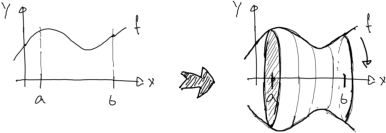
The rotating curve forms the surface of the solid.
The graph of a function is rotated about the -axis to form a solid of revolution. The volume from to of this solid is given by
Volume of a solid of revolution
Proof
To understand why the volume formula is correct, cover the area from to under the graph of with a huge number of very thin bars of width . A bar at location will have the height . Now, imagine that when we rotate the graph of about the -axis, we also rotate the bars as well. Each bar turns then into a {\it disk} whose width is simply the width of the bar, and whose radius is the height of the bar. So the bar at position has the volume
where
is the radius of the disk.
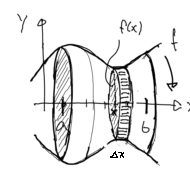
The volume of the solid is approximately the sum of the disk volumes
The approximation turns into equality for thinner and thinner bars, that is, for . So the formula is indeed correct.
Warning
Note that you have to square the function , which results in a new function (), and it is this new function which you have to integrate! A typical mistake is to first finding the integral of , and then square the result - but this is wrong!
The graph of the function (for ) is rotated about the -axis to form a solid of revolution. Draw the solid and determine its volume.
Solution
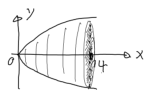
Here are two additional exercises.
-
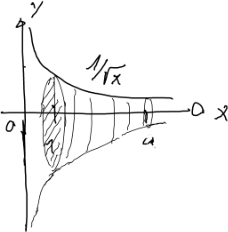
The graph of the function (for ) is rotated about the -axis to form a solid of revolution. Find a value of such that the solid has the volume .
-
Use calculus to prove that the volume of a sphere of radius is given by the formula
Hint: Find the function equation of a half-circle of radius .
Solution
-
Applying the volume formula, we have
As , we have to solve the equation
-
The sphere of radius is a solid of revolution, as it is obtained by rotating the half-circle of radius about the -axis. To find the function equation of the half-circle, let be the height of the half-circle at (see figure).
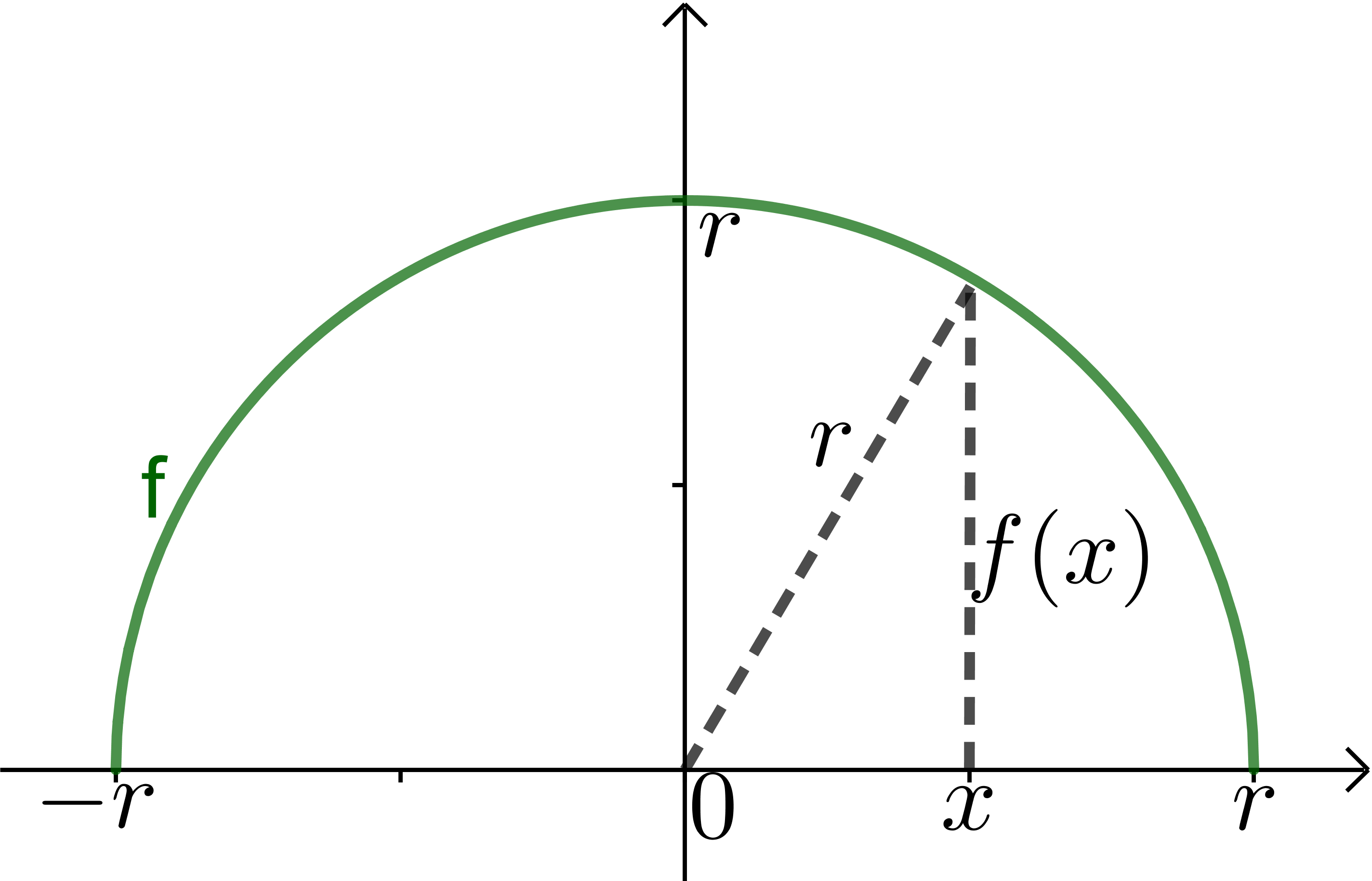
From the theorem of Pythagoras we know that
The square of this function is
and the antiderivative of this squared function is
Half the volume of the sphere is therefore
and the Volume of the sphere is therefore .