Proof of the theorem
There are two surprising facts about the proof of the fundamental theorem of calculus. First, it turns out that the proof is quite simple, and second, it does not involve the sum of bars, but ... differential calculus.
Recall the theorem we want to prove. For any function and some function with it is
To start the proof, we define as follows (see figure below):
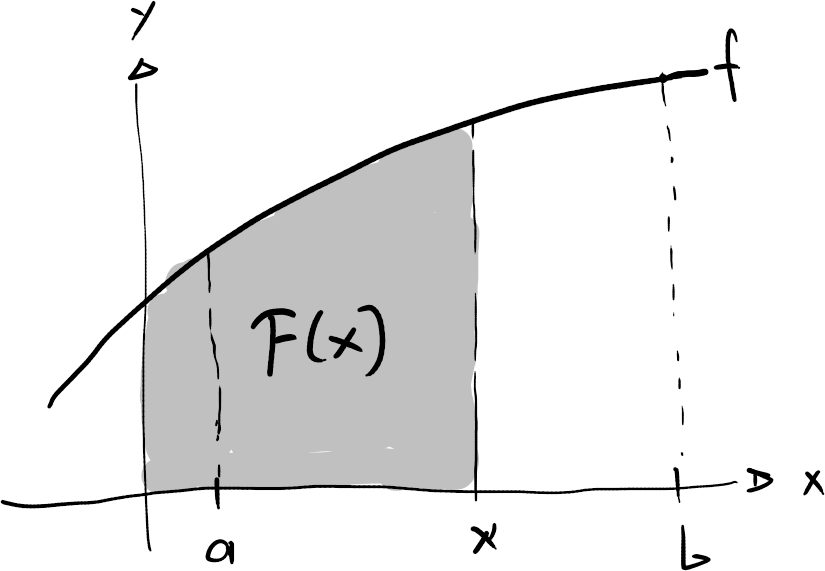
Now, this is a strange function indeed. It is neither defined by an algebraic rule, nor do we presently have the means to determine the exact output value for a given input value . However, even though we do not know the output value, there clearly is one, because the region under the curve between and has an area. So every input has an output, we just do not know the output value. Nevertheless, we can see that this function has a very interesting property:
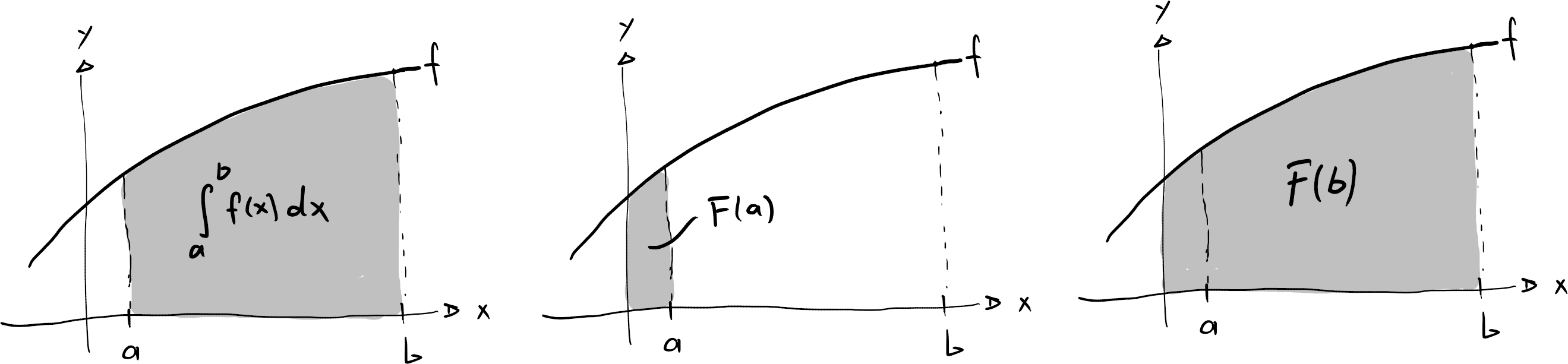
Why? First, we already know that the left hand side, the integral, is the signed area under the curve between and , which is the shaded area in the figure below (figure below, left). Second, is the area between and (figure below, middle), and is the area between and (figure below, right), so is also the area between and .
So if we can show that is an antiderivative of , for all , we have proved the theorem. To do so, we increase the input of by a small amount , so that we are now looking at . This is shown in the figure below:
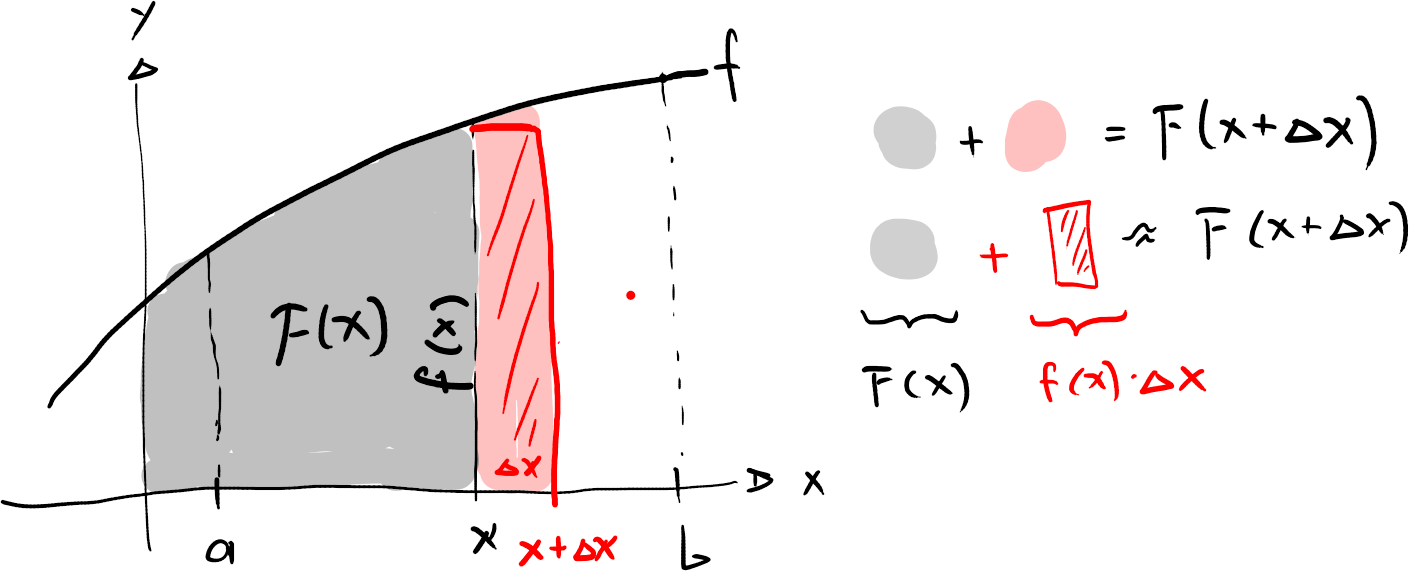
From this figure we see that
and it is intuitively clear that the approximation gets better and better for smaller and smaller . Taking on the other side, and dividing both sides by we obtain
The approximation above is not a general property of functions, but arises from our definition of as the area from to . But a general property of functions, as we have seen in differential calculus, is that the right hand side converges towards for . Indeed, the right hand expression is simply the difference quotient of , and difference quotients always converge to derivatives!
Thus, for we get
As this is correct for every input , we see that is indeed an antiderivative of . And this concludes the proof.