Right-angled triangles and Pythagoras
A triangle where one angle is is called a right-angled triangle (or right triangle). Angles of are also called right angles.
In the figure below we refer to the other two angles as and (greek letters for and ). The side lengths are , , and .

For a right-angled triangle the following is true:
- It cannot have a second angle (if you do not believe me, just try to draw one with two ).
- It always has one side which is longer than the other two sides. This side is opposite of the right angle (again, if you do not believe me, just draw some right-angled triangles and you will see ...). This longest side length is called the hypotenuse.
- The sum of the two angles and equals : where and are the other two interior angles different from . This follows from the fact that in any triangle the sum of its interior angles is always .
- both, and are in the interval
The theorem of Pythagoras
One of the most important property of right-angled triangles is called the theorem of Pythagoras:
In a right-angled triangle, the square lengths of the two smaller sides added together equals the square length of the longest side length:
Click right to see one of many proofs.
Proof
There are many proofs, here is one: Consider the large square below - it is obtained by copying the right triangle with sides , , and four times, rotating it by each time.
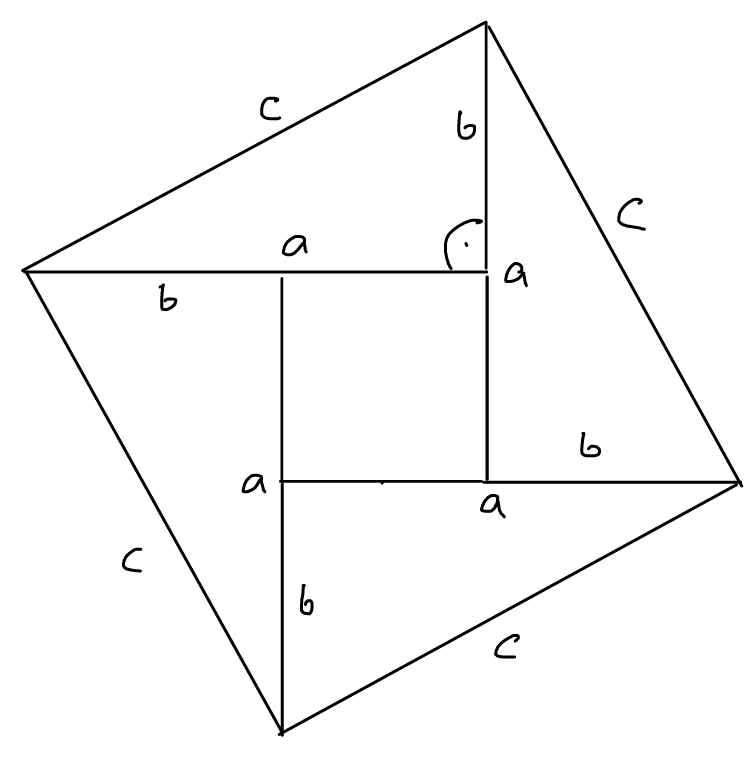
The area of the large square is , but so is the sum of the four triangles () plus the area of the small square in the middle (). So we have
Determine the missing side length:
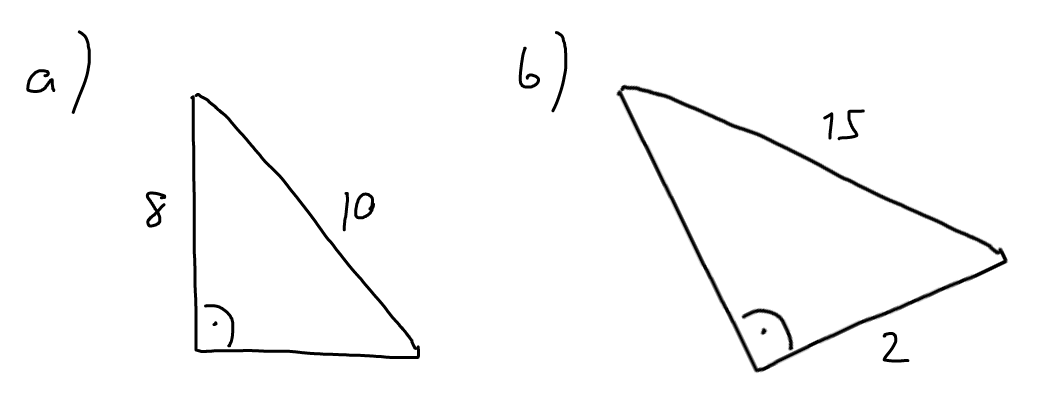
Solution
Denote by the missing side length.
Determine :
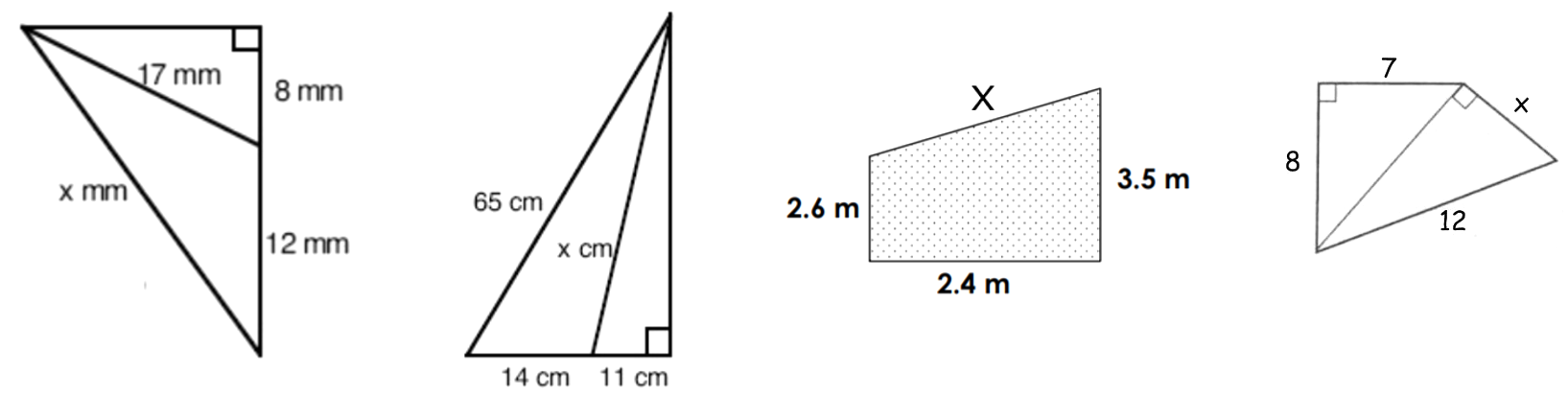
Solution
Recall that an equilateral means "gleichseitig" and isosceles means "gleichschenklig".
Determine (see figure below):
- the height and the area of the equilateral triangle with side length .
- the height and the area of the isosceles triangle with side length and .
- the diagonal and the area of the rectangle with sides and .
- the diagonal and the volume of the cuboid with sides , and .
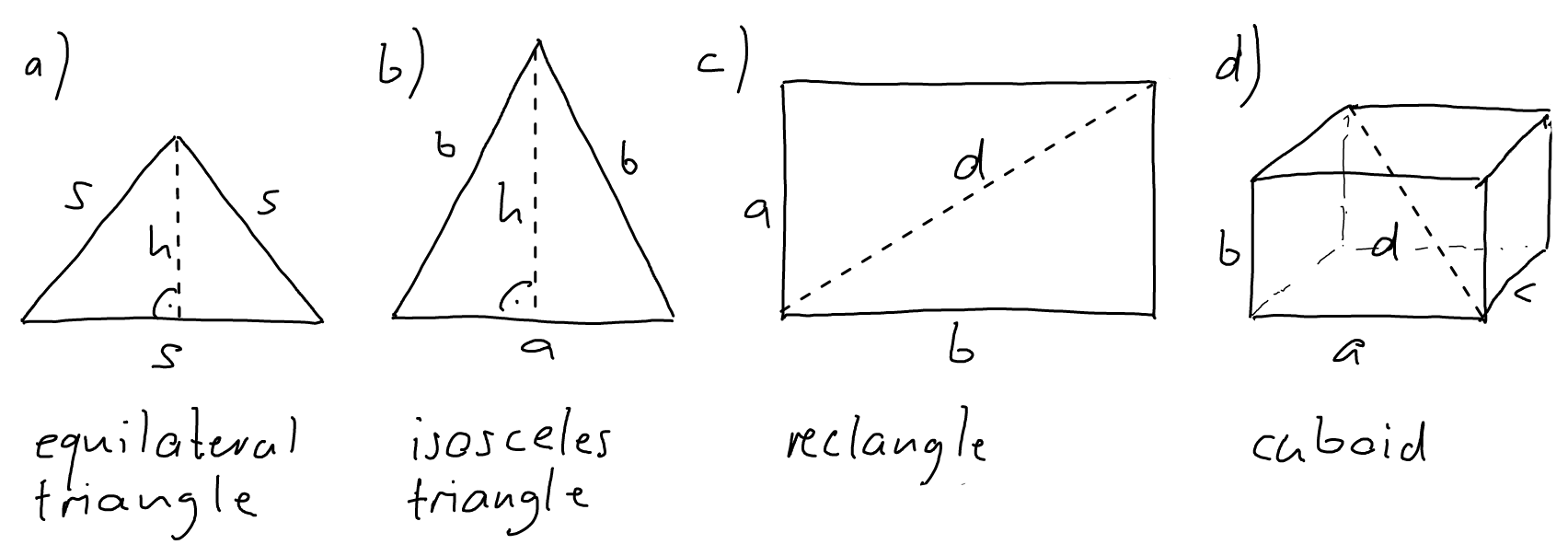
Solution
- Area
- Area
- Area
- See figure below. . Volume
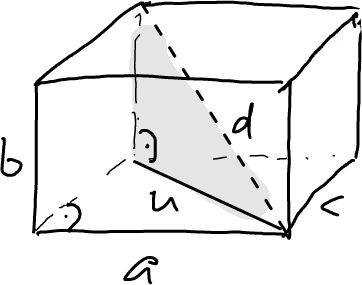
-
Consider a cuboid with side lengths and . Find a formula for calculating the length of the diagonal.
-
Consider an equilateral triangle of side length . Find a formula for calculating its area.
Solution
- . Thus, the area is .
Determine the height and volume of the right pyramid shown below. The base is a square with side length .
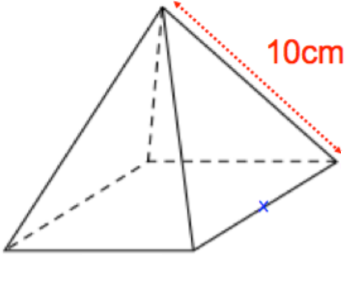
Solution
, with base . To find the height , we first find the diagonal of the base , which is . Thus, , and therefore .
Determine the height and volume of the right cone shown below. The base is a circle of diameter .
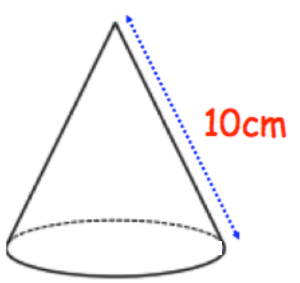
Solution
The radius of the circle is . We have , with base and . Thus, .
Determine the length of the spiral.
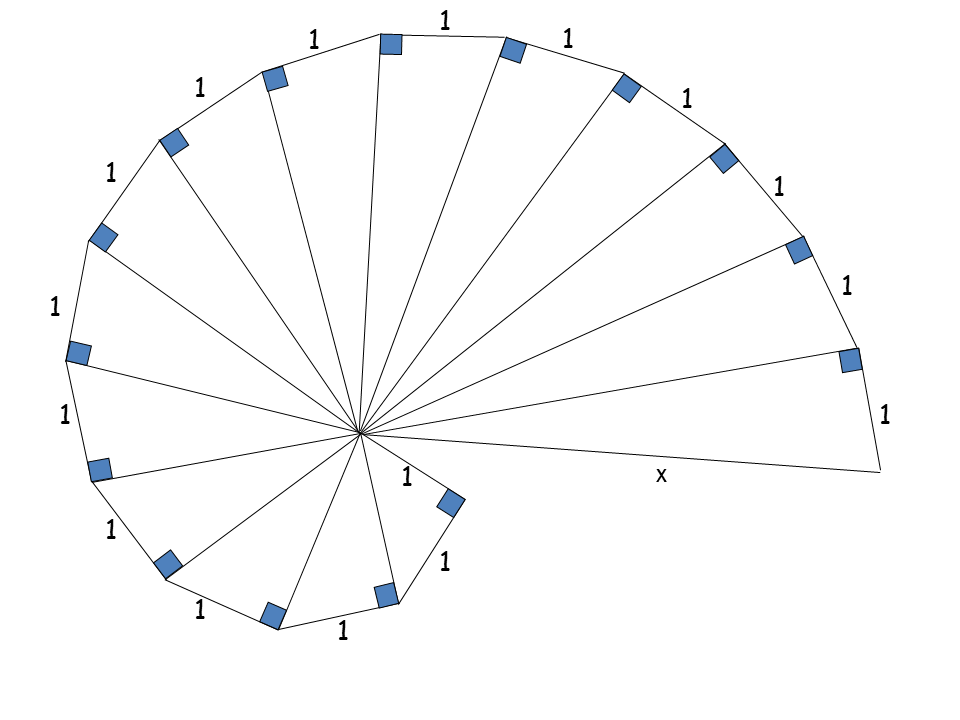
Solution
The first spoke ("Speiche") has length . The second spoke has length , the third spoke has length , and so on. So the last spoke has length .
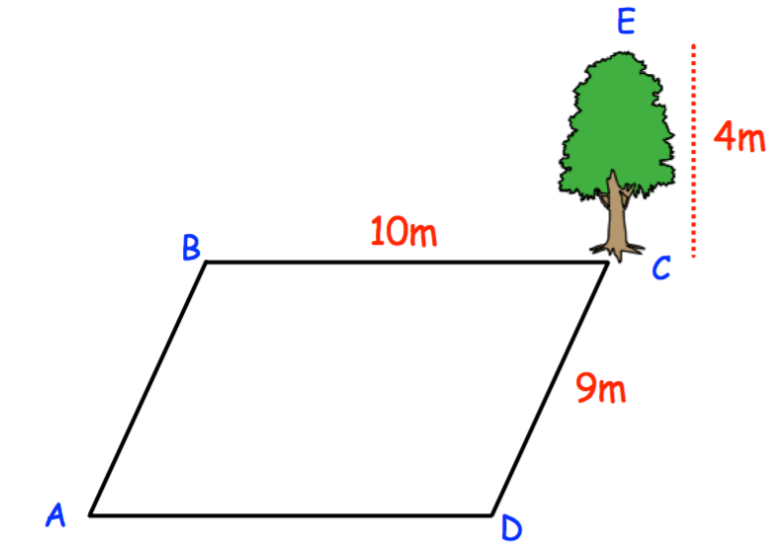
In the corner of a rectangular garden is a tree of height . Determine the distance from the corner of the rectangle to the top of the tree .
Solution
The diagonal of the rectangle is . Thus, the distance is .