Limits
We now discuss the "long-term behaviour" of sequences. Consider the sequence
We assume that we have a recursive or explicit method to determine each term of the sequence. We are interested in knowing what happens to if we make larger and larger (hence, when we move to the right in the sequence). We have already discussed some examples at the beginning of the section. Let's define it in more detail.
We say that the sequence is convergent if the values get closer and closer (but not necessary touch) a single real number as we make larger and larger. This single number is often denoted by , and is called the limit of the sequence. This is then written as follows:
or as
(say: "the limit of the sequence is as approaches infinity", or "the sequence converges to if approaches infinity").
If the sequence does not converge, that is, if it does not approach a certain value, we call it divergent. There are two possible ways a sequence can be divergent.
- Either the sequence does not approach a single value (e.g. by alternating forever between two values). Thus no (single) limit exists:
- or the sequence increases without upper bound, in which case we write or (that is, the limit is )
- or the sequence decreases without lower bound: or (that is, the limit is ).
Again the examples from the beginning of the chapter. Determine whether the sequences are convergent or divergent. If convergent, determine the limit of the sequence.
Also, give an example of a sequence that converges to .
Solution
- Divergent, with .
- Convergent, with .
- Divergent, the sequence does not approach a single number.
- Divergent, with .
A sequence that converges to is, for example, .
As a series is also a sequence, it can also be convergent or divergent. The limit of a series, if it exists, has an interesting interpretation. It is an infinite sum, that is, the sum of infinitely many numbers:
Let be the series of a sequences . We thus have
We can think of the limit as
Of course, as for any sequence, the limit or infinite sum can not exist, may be or actually be a real number.
Extra: Convergent sequences - a deeper look for the brave
Show
What exactly do we mean by converges towards a real number ? Intuitively, it is reasonably clear: is that number towards which the terms of the sequence move if we move to the right in the sequence. However, note that none of the terms has to actually be the value (see figure below):
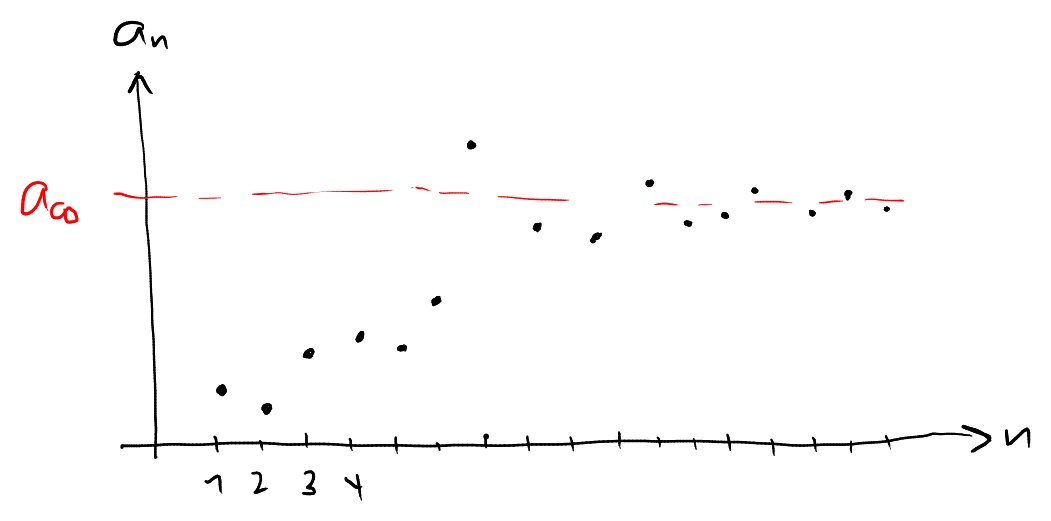
Let's describe this idea in mathematical terms:
The sequence converges to if for every small there exists a position in the sequence such that all subsequent terms are closer than to :
Side note: the above inequality is also often written like this:
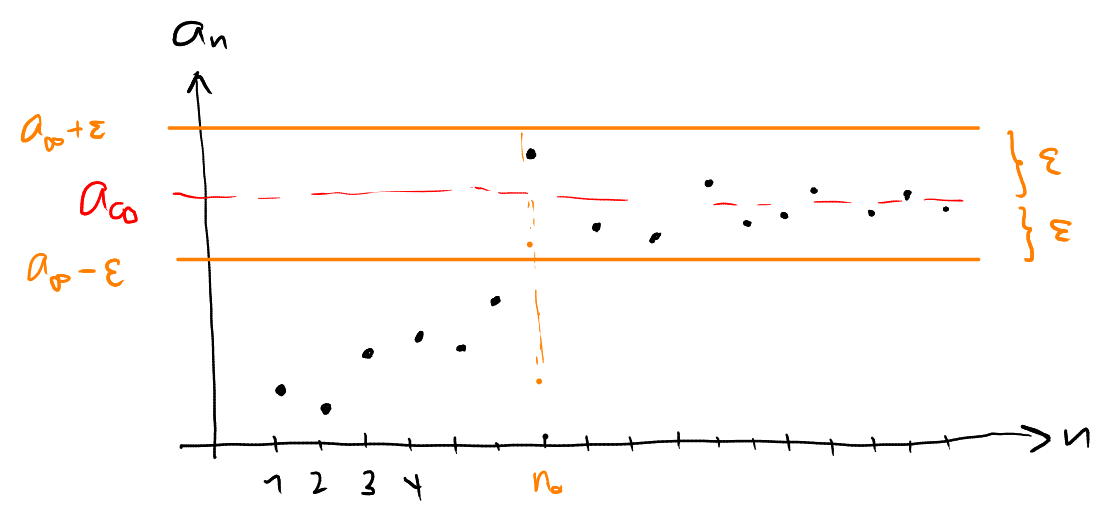
Intuitively, it is clear that the sequence
tends towards :
Therefore, for any value , no matter how small, there must be a position in sequence so that for any position to the right of (that is, ) it is
Determine such a for .
Solution
It is (für ). As for all , find an with
that is
Let's find such that
For all ist (that is ).
Extra: Divergent sequences - a deeper look for the brave
Show
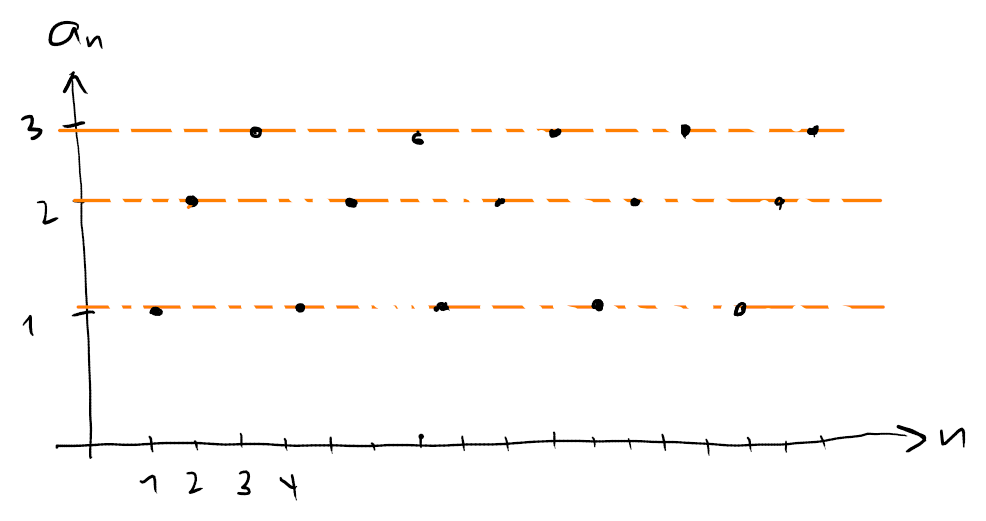
Divergent sequences do not approach a single number. This can mean that the sequence jumps back and forth between different numbers forever and ever (see figure below):
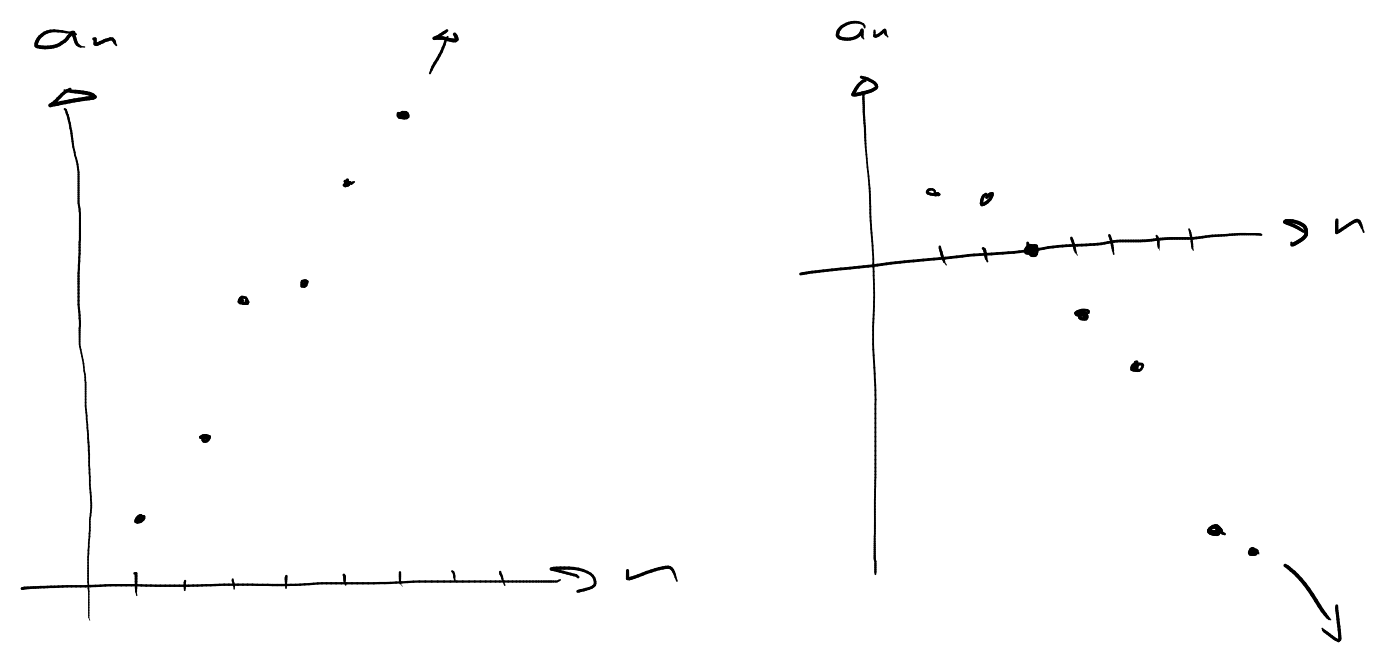
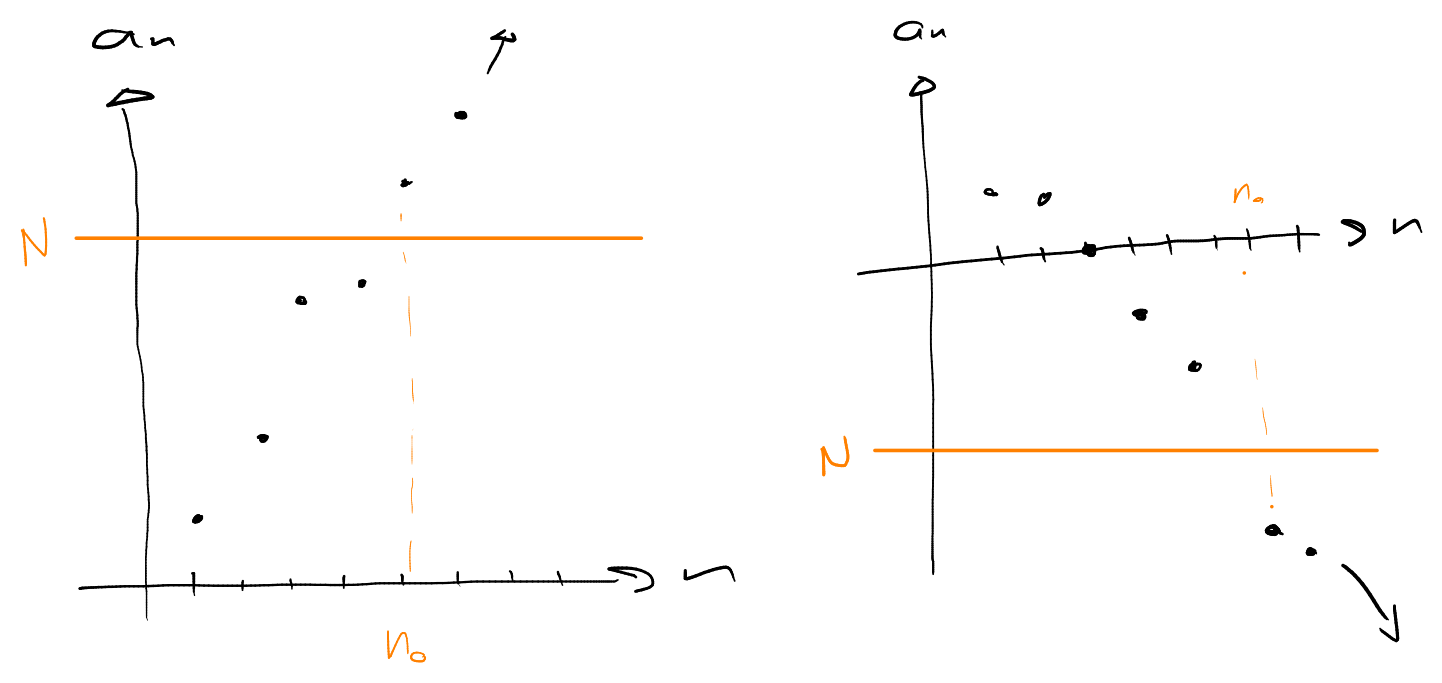
But it can also mean that the sequence tends towards or towards . Again, it is intuitively clear what we mean by this: A sequence tends towards if the terms become larger and larger without ever reaching a limit, that is, without an upper bound. And a sequence converges towards if the sequence terms become more and more negative without ever reaching a limit or lower bound (see Figure below).
To be more exact:
A sequence converges to if for any arbitrarily large number there exists a position in the sequence such that all subsequent terms are greater than :
A sequence converges to if for any arbitrarily large negative number there exists a position in the sequence such that all subsequent terms are smaller than :
The sequence of square numbers
is divergent and converges to . Thus, for any arbitrarily large value , we can find a such that
Find a for .
Solution
It is . We have to find an such that
This is .