Points and vectors
3d-Coordinate systems
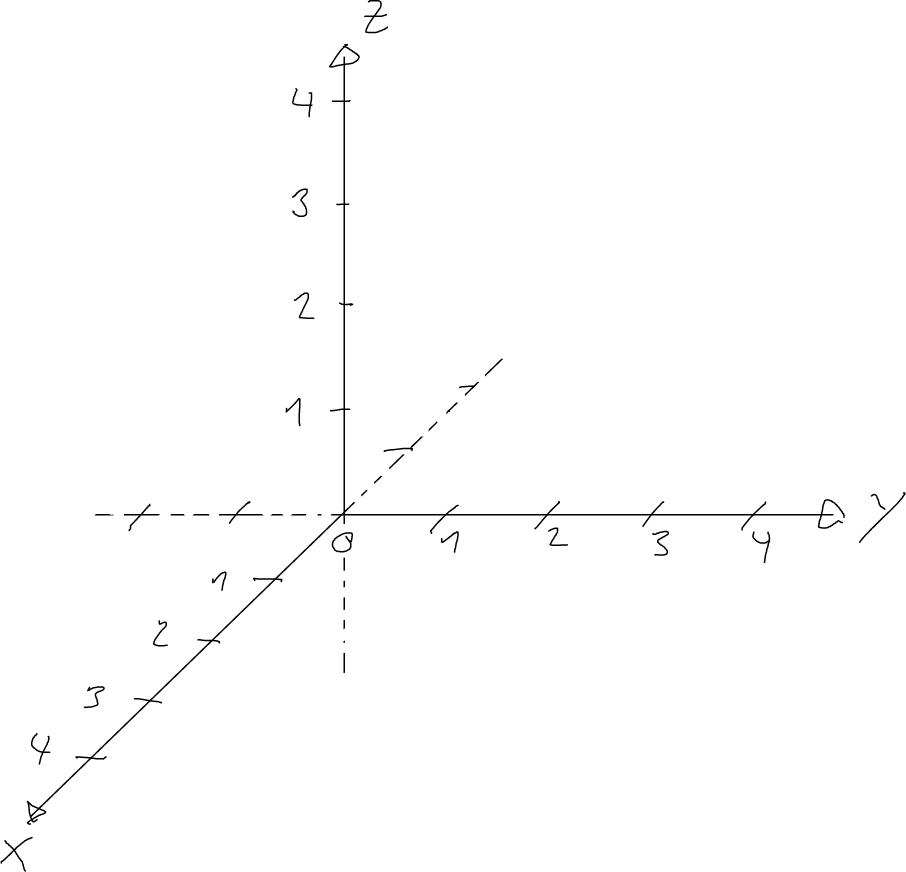
To describe geometrical objects in space with the help of coordinates, we need a three dimensional coordinate system for reference. We use the convention that:
- the -axis points forward
- the -axis points to the right
- the -axis points upwards
Points
A point with the coordinates and , written
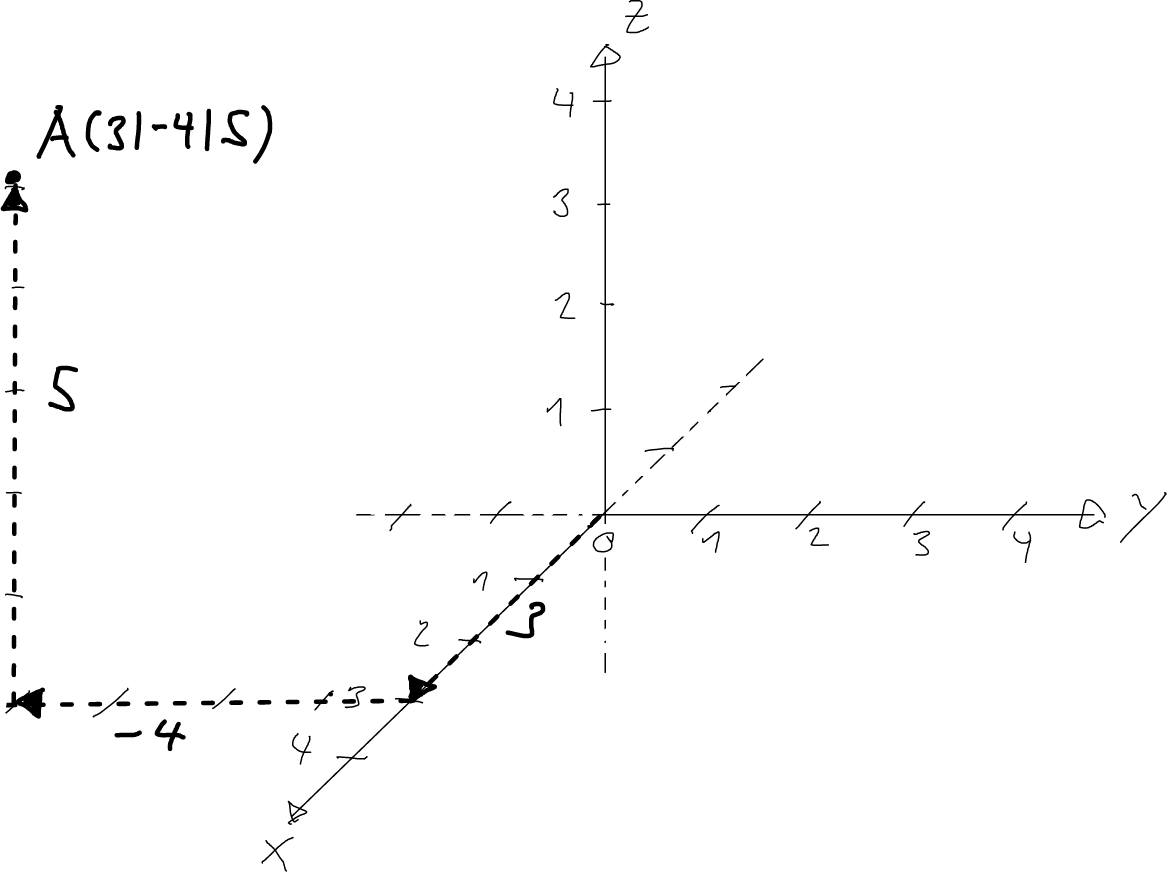
indicates a position in space relative to the coordinate system. For example, point can be found as follows: Starting at the origin,
- walk units along the -direction (towards me), and from there
- walk units along the -direction (to the right), and from there
- walk units along the -direction (upwards)
Negative coordinates are also allowed and indicate to move into the opposite axis direction. For example, moving (z=-3) units along the (z)-direction means moving units downwards.
Note:
- The point with the coordinates is called the origin of the coordinate system.
- We typically use capital letters to denote points
Vectors
A vector with components , and , written
represents an arrow in space. An arrow has a tail, a head, and a specific length and direction.
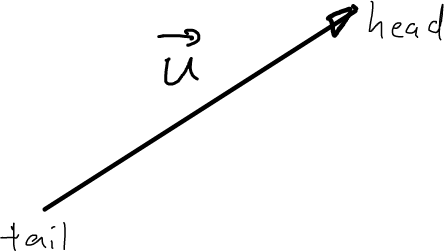
So how do three components define an arrow in space? We interpret the three numbers as instructions of how to get from the tail of the arrow to its head, walking along the three axes directions. For example, take the vector
We will draw the arrow as follows: Pick any location in space for the tail of the arrow, then find the arrow head by
- move units in -direction, from there
- move units in -direction, and from there
- move units in -direction
Warning
The three components of a vector do not tell you where the arrow is in space.
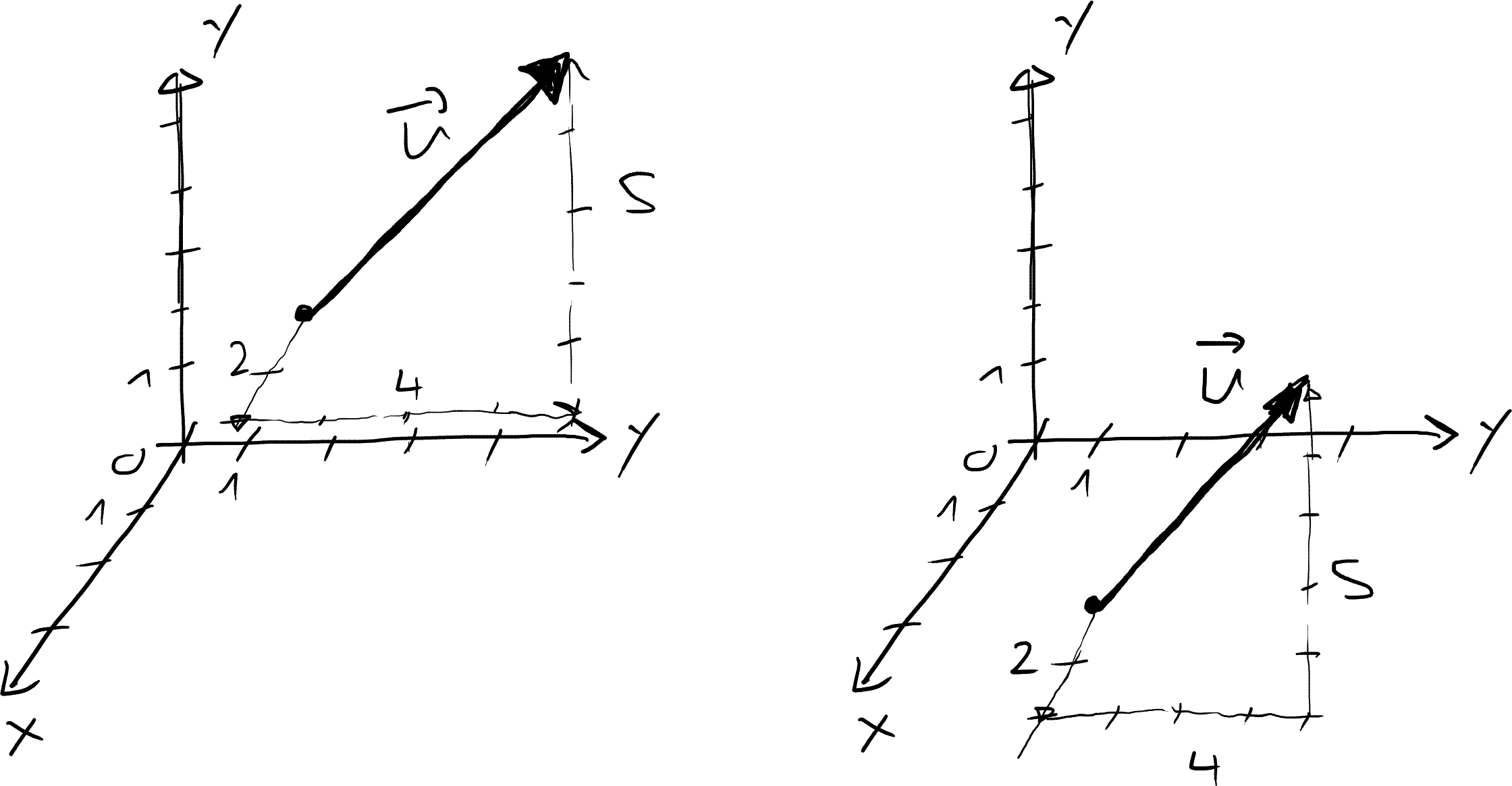
We have seen that a vector represents an arrow. The opposite is also true. For every arrow we draw in space, we can find the three components of a vector that represents this arrow - just find out how to get from the tail of the arrow to the head of the arrow by following along the -axis, -axis and -axis. Unfortunately, when looking at our drawings which are in 2d but represent 3d, it is not clear where a drawing of an arrow starts (tail) and where it stops (arrow). So we normally need to give the coordinates of these begin and end points. For example, assume that for the arrow the tail is at and the head at .
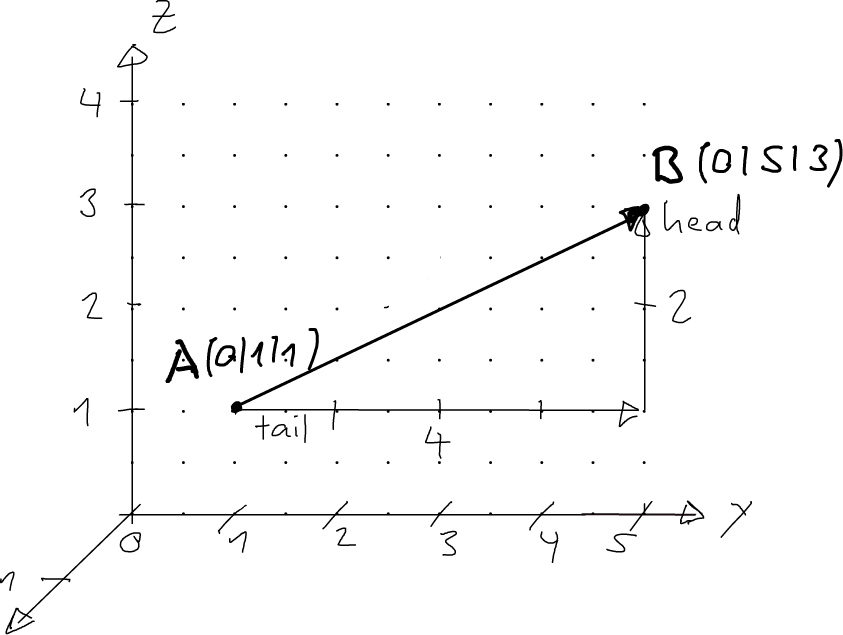
To get from to , we have to walk along the axis by units, along the -axis by units, and along the -axis by units:
So the vector representing this arrow is
Notes:
-
We typically use small letters with an arrow pointing to the right on top of it to denote vectors .
-
There is one exception: if the components of a vector arise from an arrow from a given point to a given point , the vector is often denoted by . In the example above, we could have written
-
Two vectors are called equal (identical vectors) if their corresponding -, -, and -components are equal.
Q1
Based on the figures, which coordinates of must be zero? is either on the -plane, -plane, -plane, -axis, -axis, or -axis.
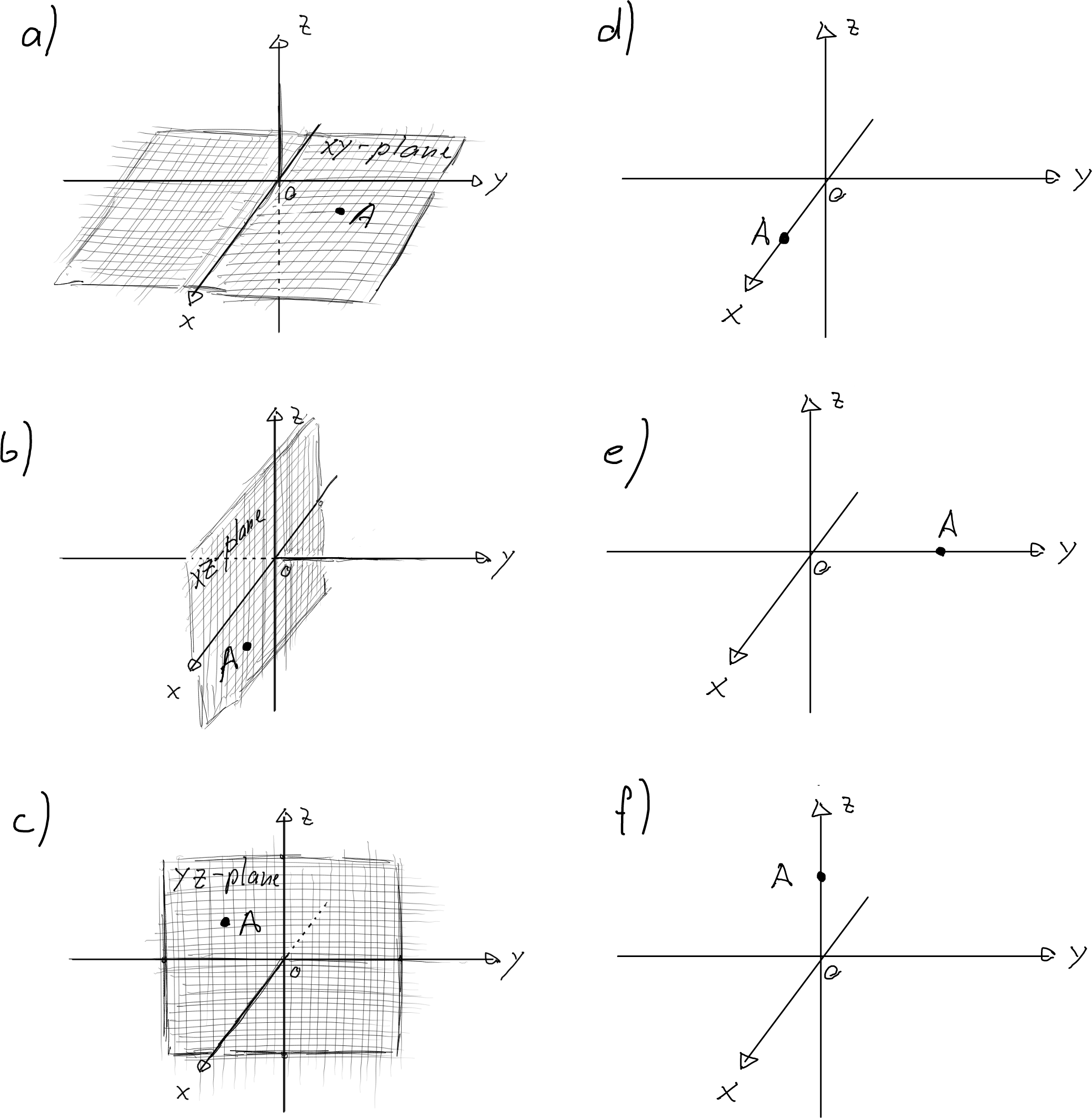
Q2
Indicate the following points in a 3d-coordinate system:
Q3
On which plane and/or axis are the following points:
Q4
Find the coordinates of all the corners of the cube of side length (shown below, left), and of the pyramid of height and base side length (shown below, right).
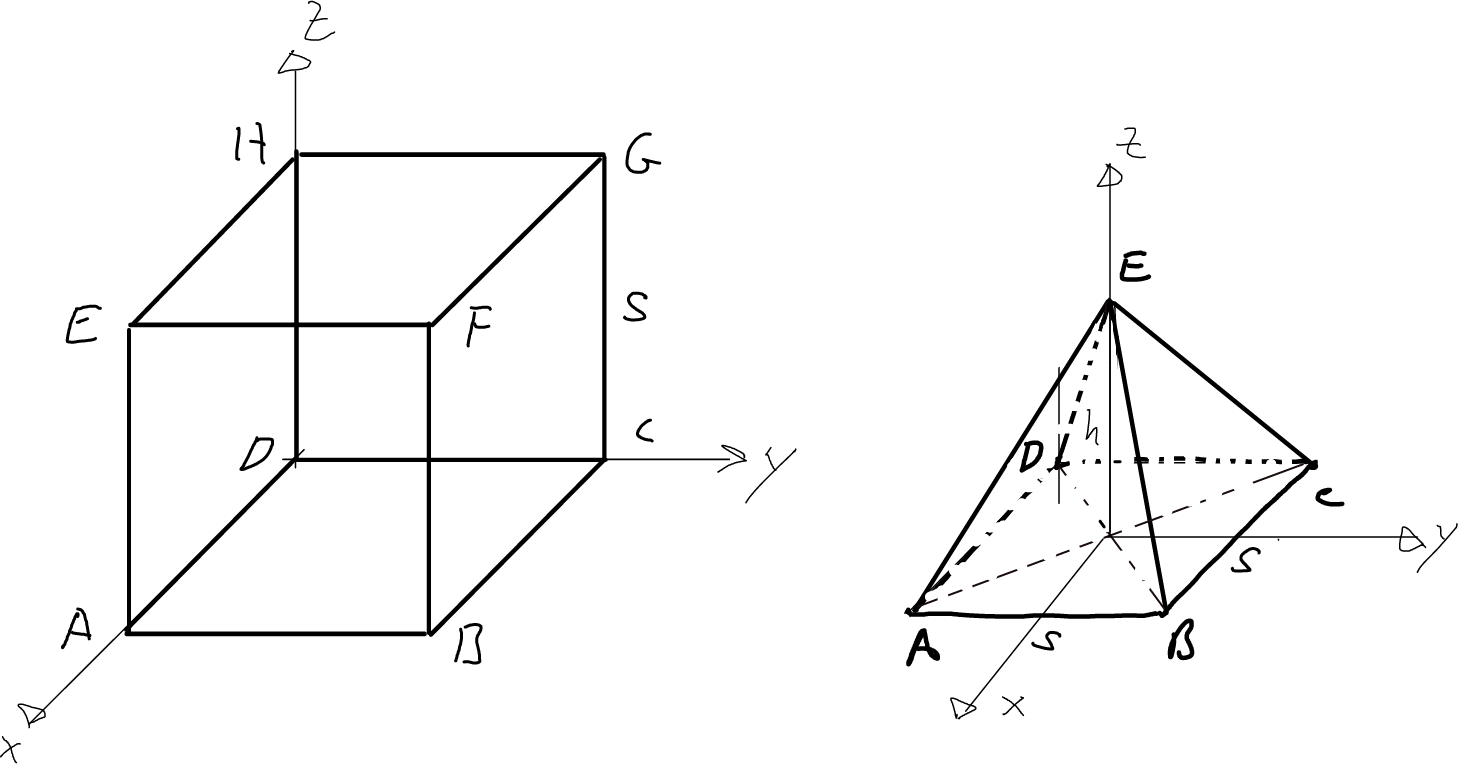
Q5
Draw the vectors and as arrows. Start anywhere in space.
Q6
Determine the vector from point to point :
- and
- and
- and
Q7
The arrow is attached to the point . Find the coordinates of the head of the arrow (let's call this point ). Starting at , what vector do I have to follow to get back to point ?
Q8
Consider the parallelogram with the vertices , , , and . What are the coordinates of point ?
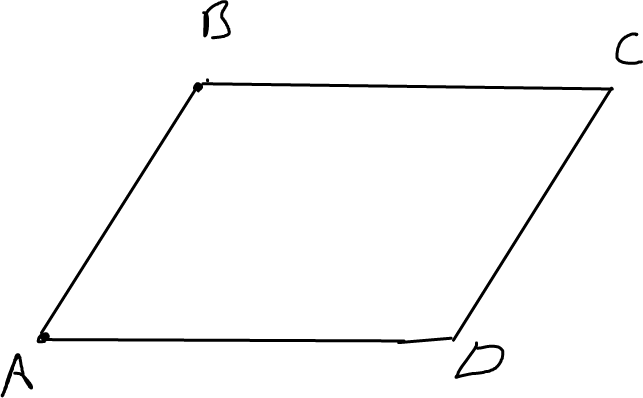
Q9
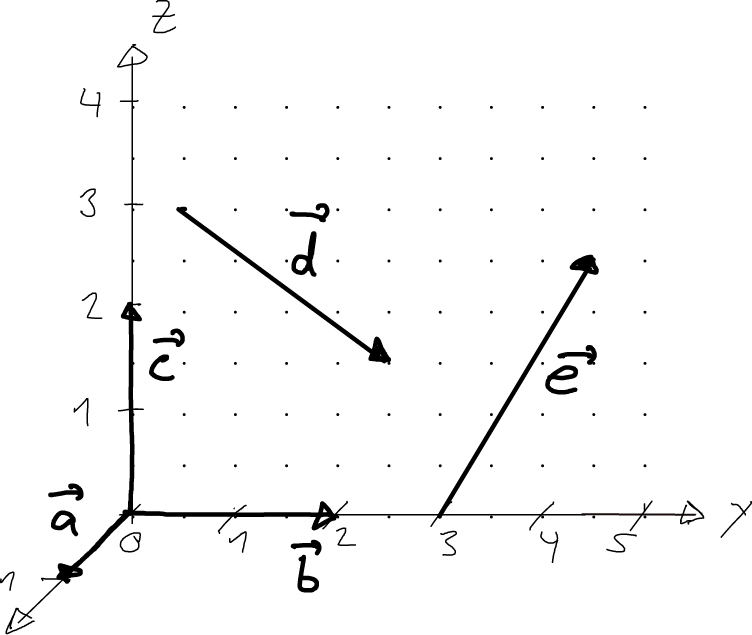
Determine the components of the arrows shown in the figure below. Vectors , , and are on the -axis, -axis, and -axis, and vectors and are in the -plane.
Q10
Consider the vectors and . Determine their lengths. Can you find a general formula for determining the length of a vector ?
Hint: Apply the theorem of Pythagoras (twice in the general case). Remember how we calculated the diagonal of a cube or cuboid.
Q11
Consider the vector . Find another vector that
-
points into the same direction, and has twice the length.
-
points in the opposite direction and has half the length.
-
More generally, given a vector , what are the components of the vector pointing in the same direction and is times longer?
Solution
A1
a) , b) , c) , d) , e) , f)
A2
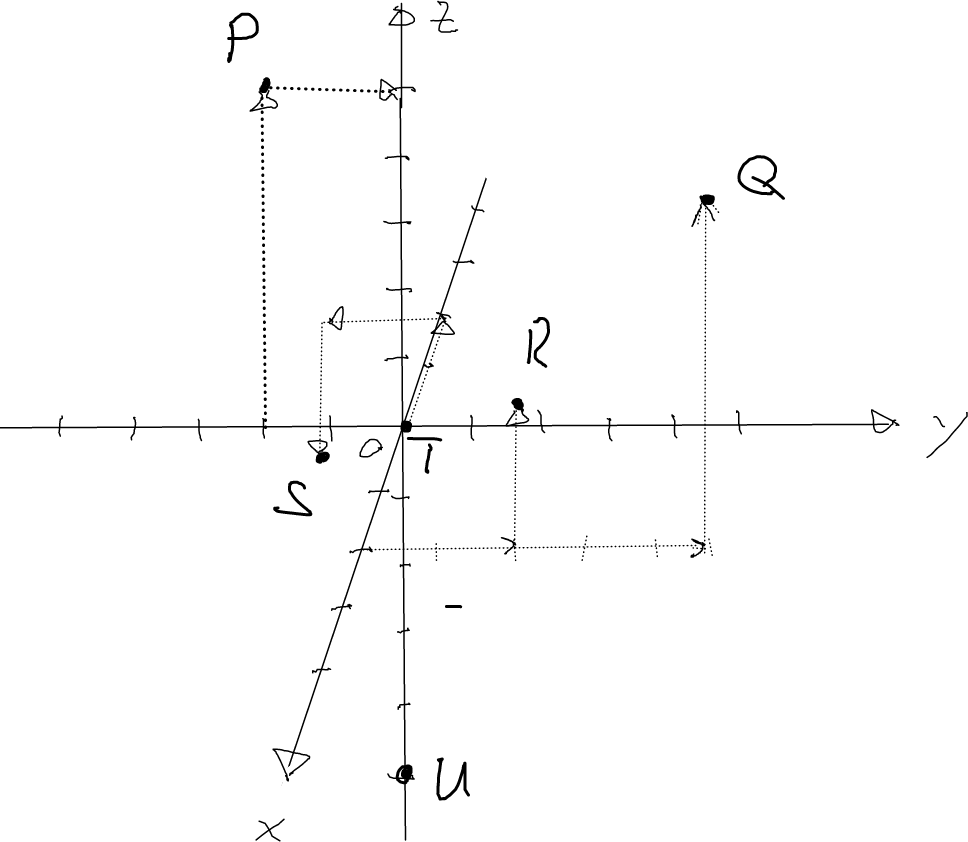
A3
: -plane, : -plane, : -axis, -plane, -plane.
A4
Cube: , , , , , , ,
Pyramid: , , , ,
A5
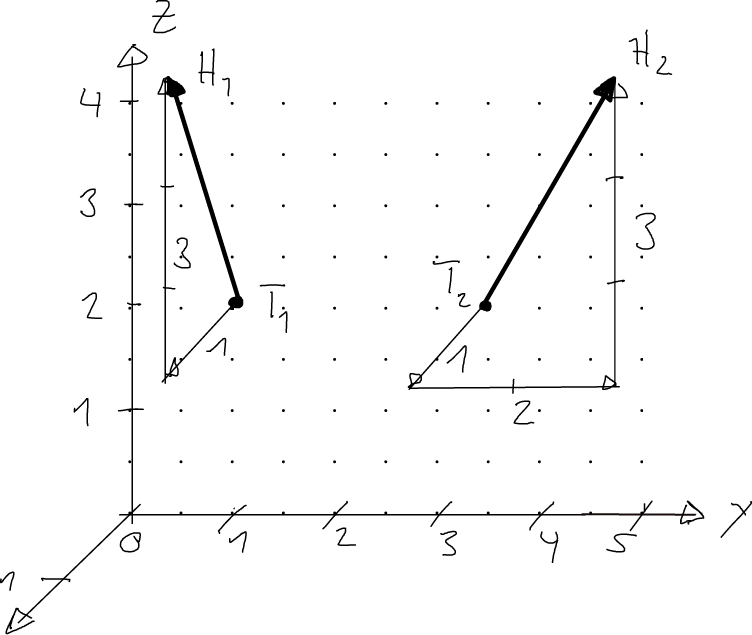
A6
a) , b) , c)
A7
A8
A9
, , , ,
A10
Length of is (Pythagoras) , length of is (applying Pythagoras twice) , and the length of vector is
A11
The vectors are , , and