Further problems
F1
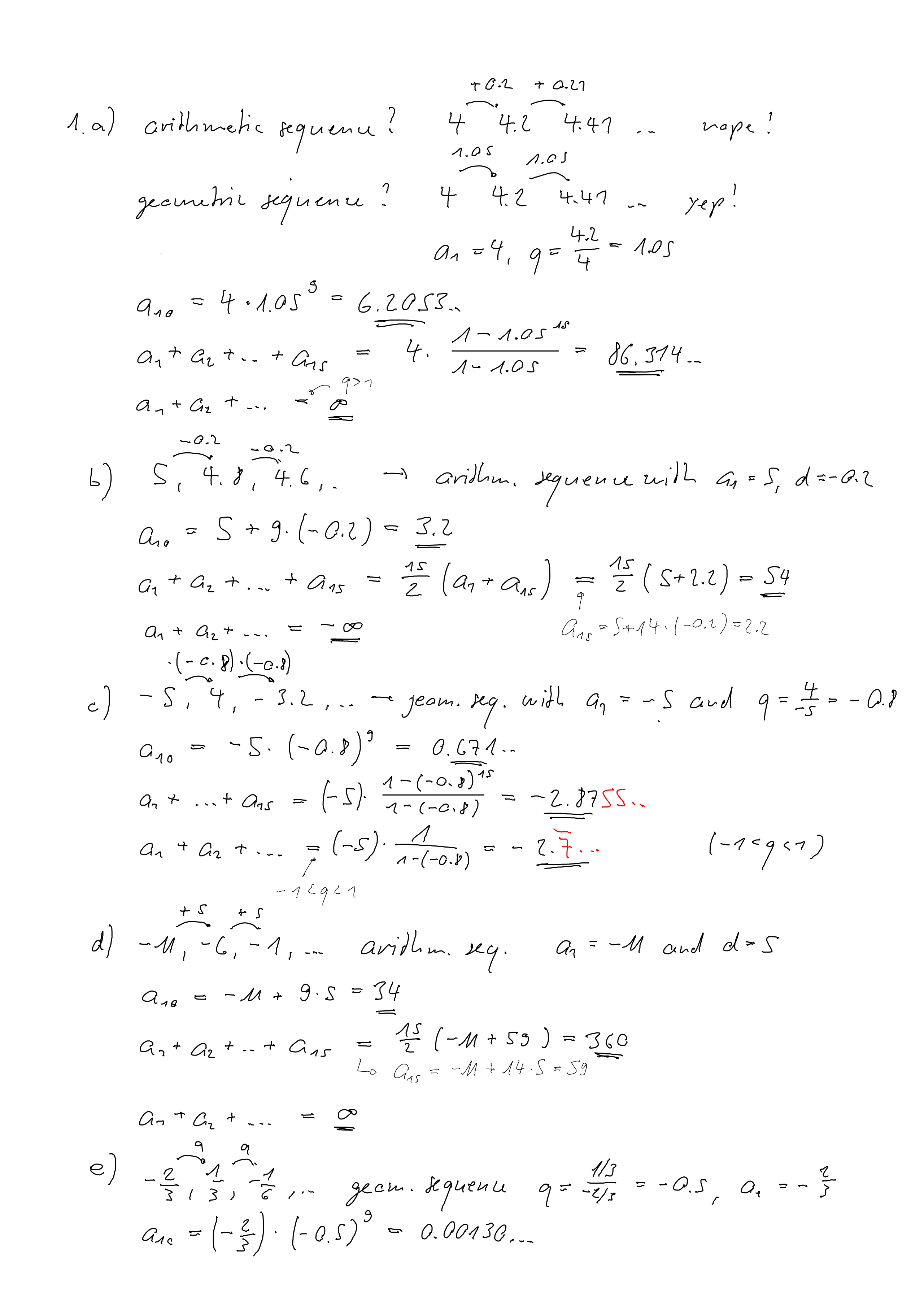
Consider the sequences below. Determine the 10th term, the sum of the first terms, and the infinite sum of the terms:
F2
Determine the sums
F3
A geometric object grows as follows (see sketch below). In generation it is a square of length . In each subsequent generation, more squares are added, with the side length shrinking by each time.
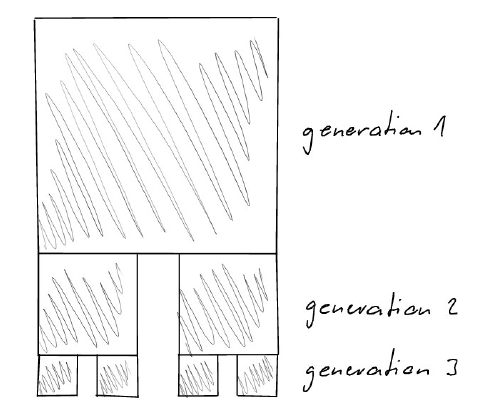
- In which generation does the attached square have an area smaller than for the first time?
- Determine the total area of the object in the th generation.
- Determine the total area of the object after infinitely many iterations.
F4
The object below consists of infinitely many equilateral triangles, the first triangle having side length . The side length is halved after every iteration.
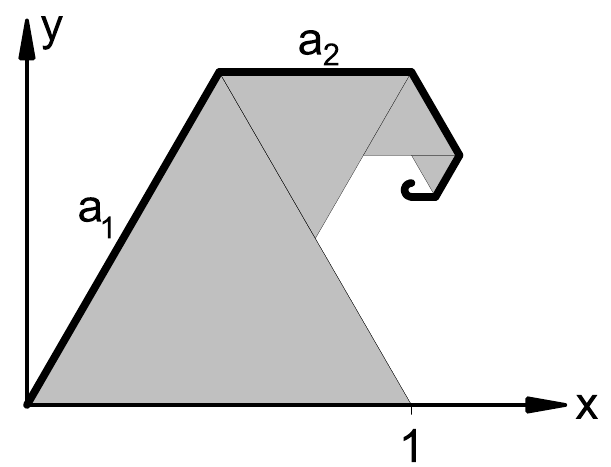
- Determine the length of the fat spiral
- Determine the total area of all triangles.
- After how many triangles is the area of the total area ?
F5
Snowflake or Koch-curve. An equilateral triangle has side length 1 (generation 1). Further equilateral triangles are attached as shown below.

-
Determine the perimeter of the object after an infinite number of iterations.
-
Determine the area of the object after an infinite number of iterations.
Solution