More general trees
It is straight forward to generalise the tree diagram in several ways without changing its properties (1-3). One possibility is to add more generations. Consider a random experiment with three events , , and . We can form the following tree:
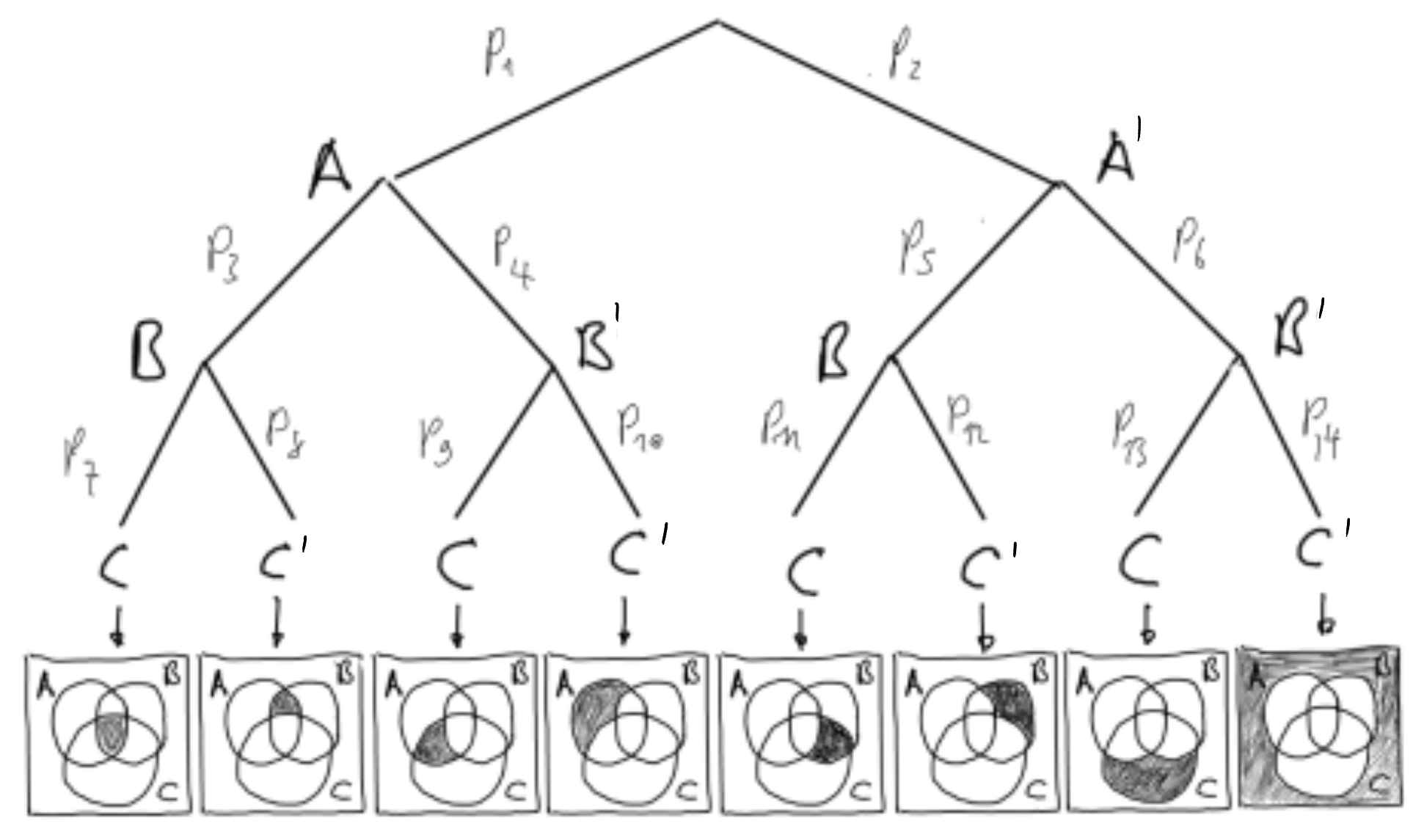
Here,
and all other probabilities are conditional probabilities. E.g. is the probability that occurs, given that has occurred
and is the probability that occurs given that and have occurred
The product of the branch probabilities is then the probability that , , and occurred simultaneously:
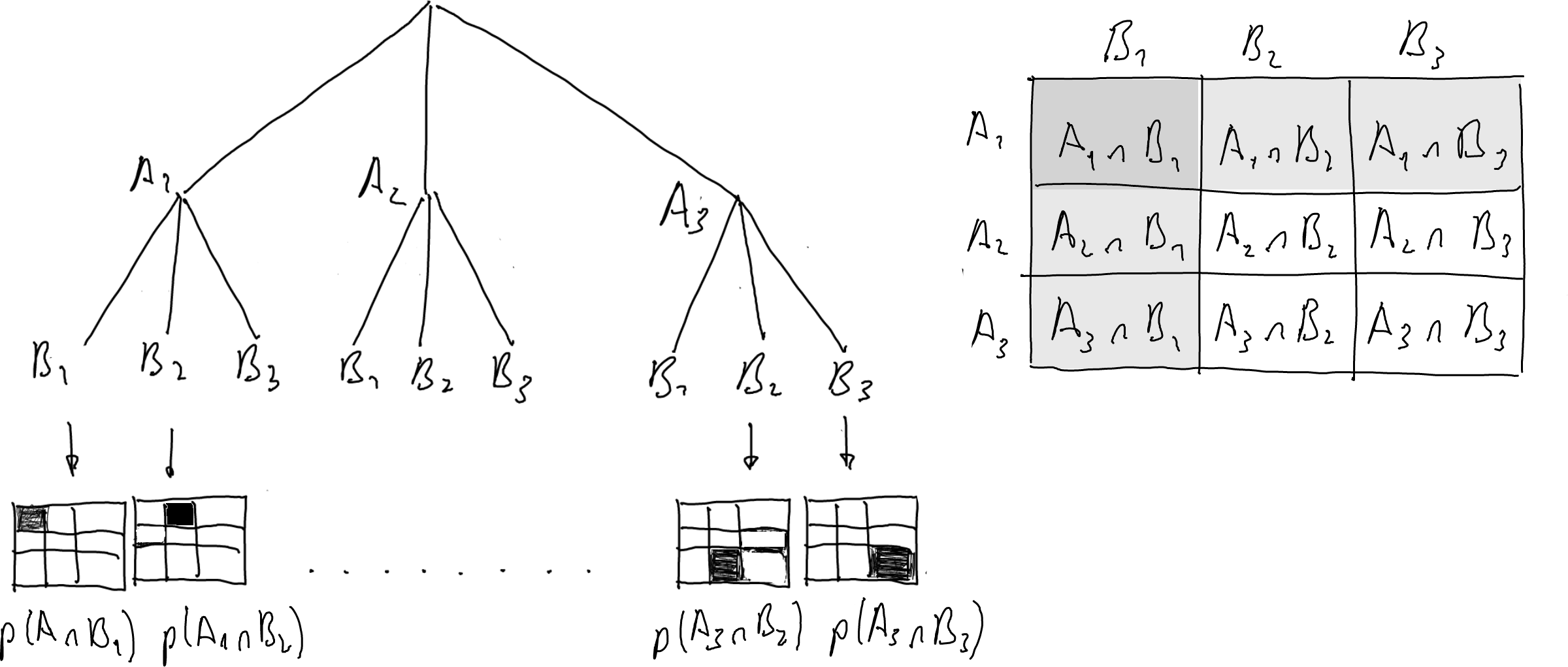
Another possibility to extend the tree is to use more than two branches per node. So, consider three events and which form a partition of the sample space , and another three events and which also form a partition of . Recall that a partition divides the sample space. Thus, whenever the experiment is performed, exactly one of the events and will occur, and also exactly one of the events , and will occur. Thus
and
(as was the case for the tree with two branches per node, where the partitions were and , and also and ). We draw the tree as follows:
And here are some exercises ...
Q1
In a town, of the population reads newspaper A, of these read newspaper B, and of these read newspaper C. A person is selected at random from the town. What is the probability that the person reads all three newspapers?
Q2
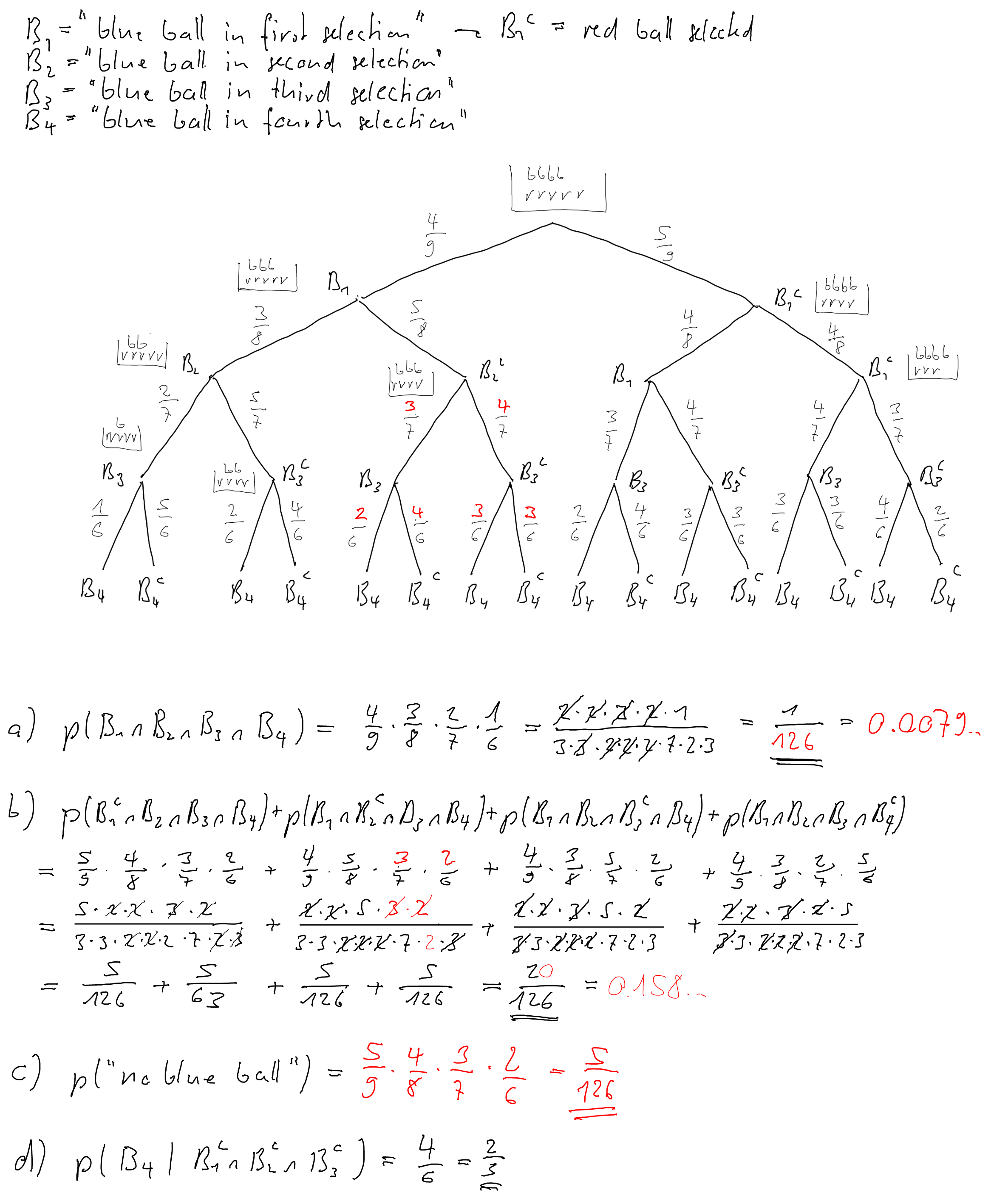
A box contains 4 blue balls and 5 red balls. Four balls are selected at random without replacement. What is the probability for selecting
- exactly blue balls.
- exactly blue balls.
- no blue ball.
- a blue ball given that the previous three balls were red.
Q3
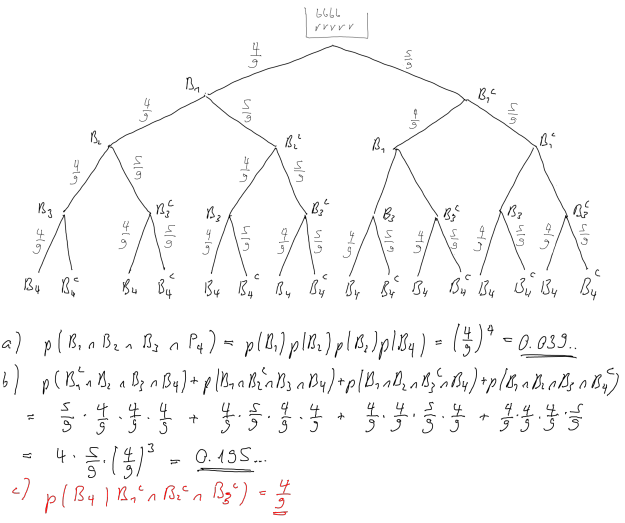
A box contains 4 blue balls and 5 red balls. Four balls are selected at random with replacement. What is the probability for selecting
- exactly blue balls.
- exactly blue balls.
- a blue ball given that the previous three balls were red.
Q4
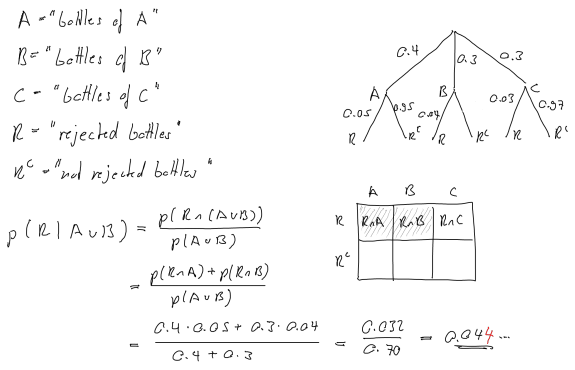
A small brewery has three bottling machines. Machine A fills of all bottles, machine B and C fill each. of the bottles filled by A, of the bottles filled by B, and of the bottles filled by C are rejected for some reason. If a bottle is filled by A or B, what is the probability that it is rejected?
Q5
A box contains 2 blue balls, 3 red balls and 4 yellow balls. Two balls are selected at random without replacement. What is the probability that
-
the selected balls have different colour?
-
the first ball is yellow given that the last ball is blue?
Solution
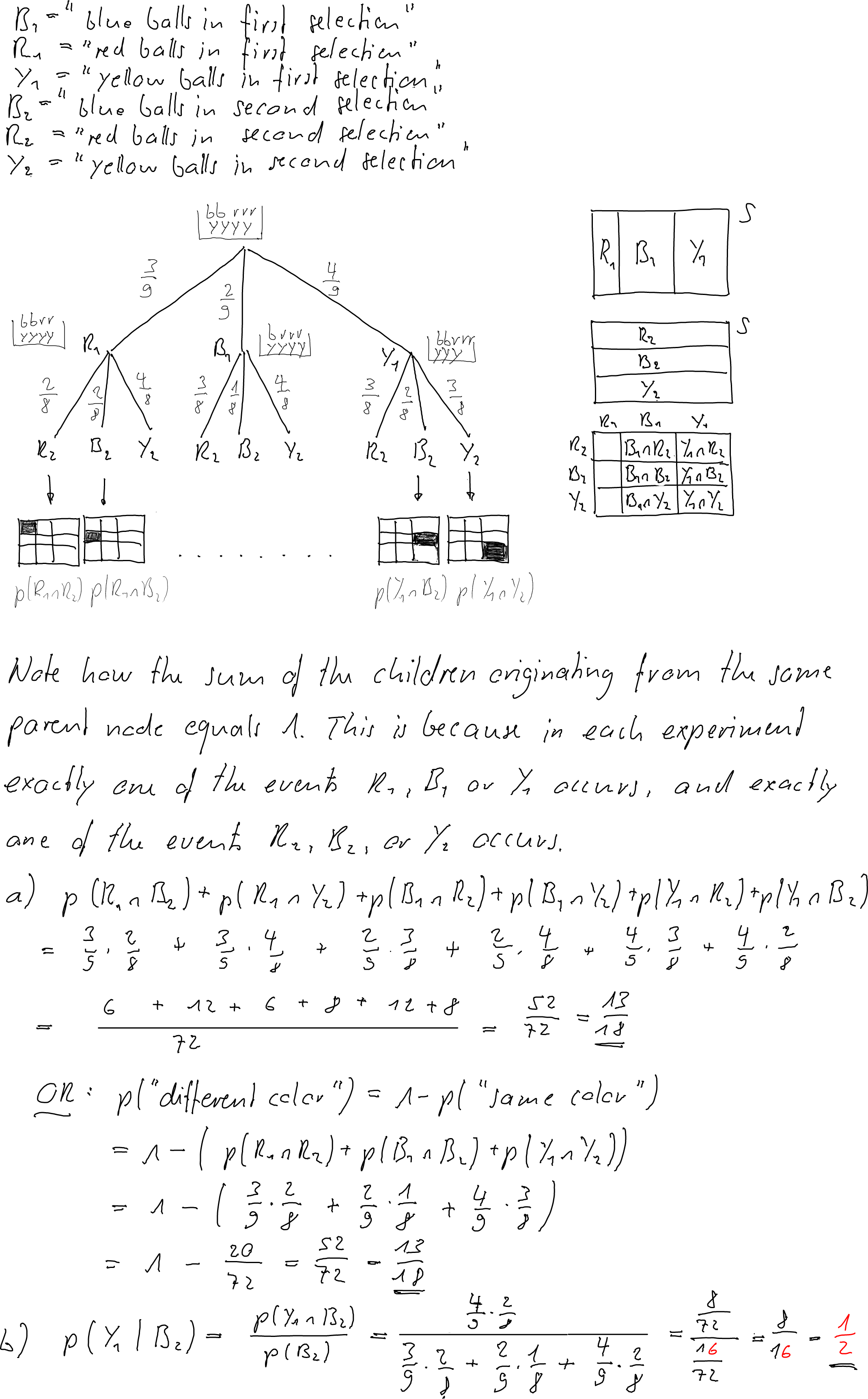
A1
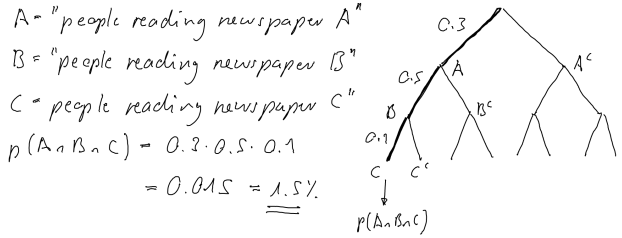
A2
A3
A4
A5