Tree representation of conditional probabilities
Consider a random experiment, and two events and . The tree representation of these events offers a natural way to work with the conditional probabilities:
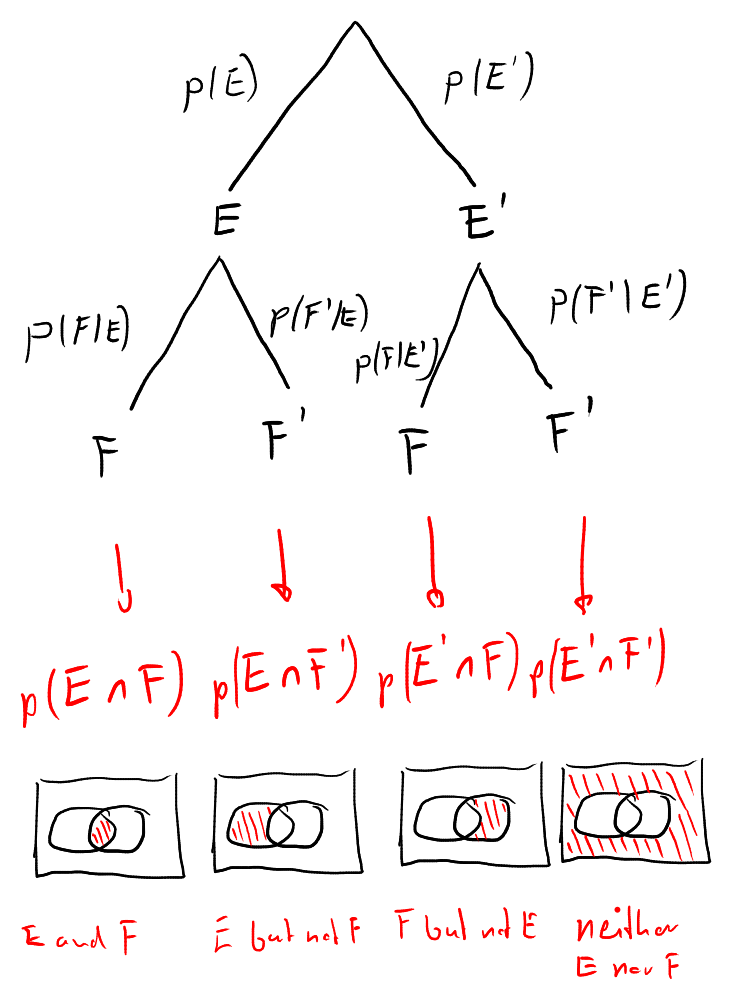
Let's start the tree with . Whether we start with or is usually clear from the problem at hand. In addition, we now draw certain probabilities along the branches.
In the first generation of the tree, we add the probability that occurs (left branch) and that occurs (right branch).
Given that occurs, we set in the next generation below the probability that occurs (left branch), and also that occurs (right branch), which are the conditional probabilities and .
Similarly, below we add the conditional probabilities , and .
In the context of a survey (see previous chapter), might be the percentage of Trump voters and of these, are male. Also, is the percentage of people not voting for Trump, and of these, percent are not male, and so on.
Arranging the tree in this way, it has some nice properties:
-
Adding the branch probabilities from the same parent equals :
-
Multiplication rule: Multiplying the branch probabilities along a path from the top to the bottom results in the probability that both the first event and second event on this path occur:
These are the path probabilities.
-
Sum rule: Adding the path probabilities leading to the same end event ( or ) results in the probability of this event (as is evident from the Venn-Diagrams shown at the bottom of the tree above):
All these properties are not new, we have already discussed them. The tree collects them in a nice way.
Let's make an example.
Experience shows that the probability for rain on any given day is 1/3. If it rains, the probability for heavy traffic is 1/2. If it does not rain, the probability for heavy traffic is only 1/4.
-
Determine the probability that tomorrow there will be heavy traffic.
-
If there is heavy traffic tomorrow, what is the probability that it will rain?
Solution
We define the events ="it rains", and ="heavy traffic". The experiment consists of choosing a day. We start by drawing the tree. We can either start with or with . Sometimes you have to try out which order works better. For this example we know the probability , we start therefore with , so that we have more branch probabilities which we can indicate in the tree.
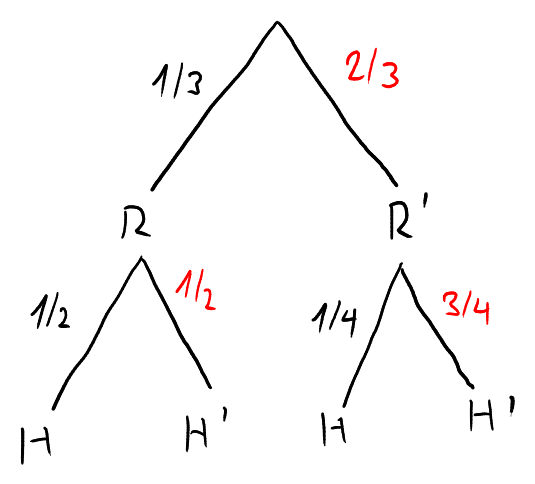
The black numbers indicate are the probabilities given in the text. We can complete the remaining branch probabilities using property (1) in the list above. These numbers are indicated in red.
-
To find , we have to follow all paths from the top to (paths and ), and add those path probabilities (property 2):
-
where was calculated in (1).
Q1
In a town, of the population read newspaper , and of these, 1/4 are females. Of all the people not reading newspaper A, 1/5 are females. A person is randomly selected. What is the probability that
- the person reads newspaper A and is male.
- the person is male.
- the person reads newspaper A if the person is female.
Q2
A hospital has 300 nurses. During the past year, 48 nurses earned a pay raise, At the beginning of the year, the hospital offered a special training seminar, which was attended by 138 of the nurses. 27 of the nurses who earned a pay raise attended the training seminar.
- What is the probability that a nurse who attended the seminar earned a pay raise?
- If a nurse is selected at random, what is the probability that the nurse attended the seminar and earned a pay raise?
Q3
A box contains 2 blue and 3 red balls. You select at random 2 balls, one after the other, without replacement.
- What is the probability to select balls of different colour?
- The second ball is red. What is the probability that the first ball was red as well?
Q4
You select at random 2 cards without replacement, one after the other, from a Swiss Jass deck of 36 cards. What is the probability to draw
- two kings?
- at least one king?
Q5
Suppose we send of our products to company A and of our products to company B. Company A reports that of our products are defective and company B reports that of our products are defective. Find the probability that a product is sent to
- company A and it is defective.
- company A and it is not defective.
- company B and it is defective.
- company B and it is not defective.
Q6
A small manufacturing company has rated of its employees as satisfactory () and as unsatisfactory (). Personnel records show that of the satisfactory workers had previous work experience () in the job they are now doing, while of the unsatisfactory workers had no work experience () in the job they are now doing. If a person who has had previous work experience is hired, what is the probability that this person will be an unsatisfactory employee?
Q7
A basketball team is to play two games in a tournament. The probability of winning the first game is . If the first game is won, the probability of winning the second game is . If the first game is lost, the probability of winning the second game is . What is the probability the first game was won if the second game is lost?
Solution
A1
="reading a newspaper", ="female". From the tree (shown below) follows
- (property 2)
- (properties 2 and 3)

A2
="pay raise", ="attending special training". Draw the tree (see figure below). Selecting at random is a Laplace experiment, so
and so on.

A3
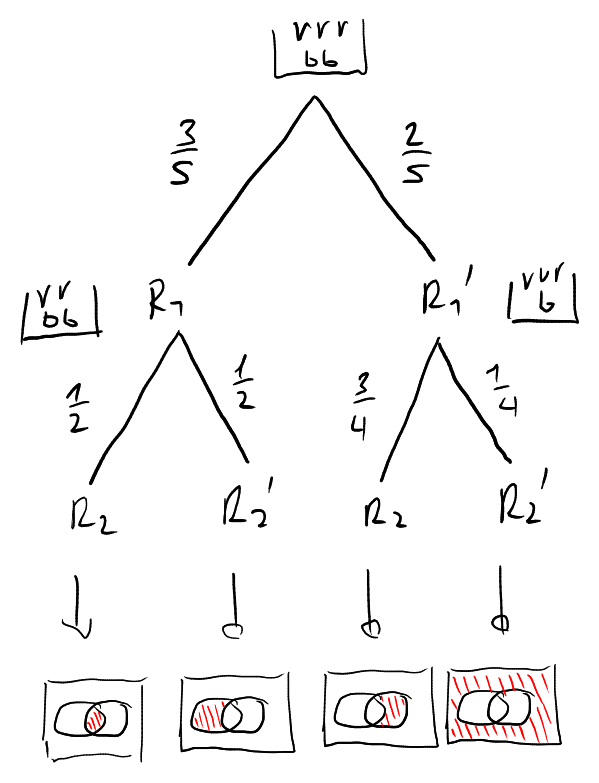
="red ball in first selection", ="red ball in second selection". Draw the tree (see figure below).
- Different color: Add the path probabilities of and :
A4
="king in first selection", ="king in second selection". Draw the tree (see figure below).
-
-
Add the probabilities of the paths and : .
Alternatively, we can first calculate the event "no king was selected", which is , and then calculate the opposite event, which is "at least one king was selected": .

A5
A6
A7
"win of first game", "win of second game".