The power functions
The power functions are functions of the form
where and are constants, and the exponent can be an arbitrary number. Note that for we obtain the vertex form of the quadratic function. Thus, power function are a generalisation of the quadratic functions.
Let's quickly discuss the trivial cases:
- for we have
which is a constant function,
- for we get the linear function
which is of the form .
For further discussion, we therefore assume that is different form and . In particular, we will discuss the cases where is either a natural number, a fraction, or a negative integer: () or a fraction () or a negative number ():
-
Power functions with exponent , where :
e.g.
-
Power functions with exponent , where :
e.g.
-
Power functions with exponent , where :
e.g.
Are these power functions? If so, determine , , and :
Solution
- , also
- , also
- , also
- This is an exponential function, as the input is in the exponent.
What do the graphs of power functions look like? We will first restrict ourselves to the reference functions (therefore A=1, v=0, B=0). Similar to the quadratic functions, the parameters , and have a geometrical interpretation:
- stretches the graph of the reference function along the -direction,
- moves the graph along the -direction, and
- moves the graph along the -direction.
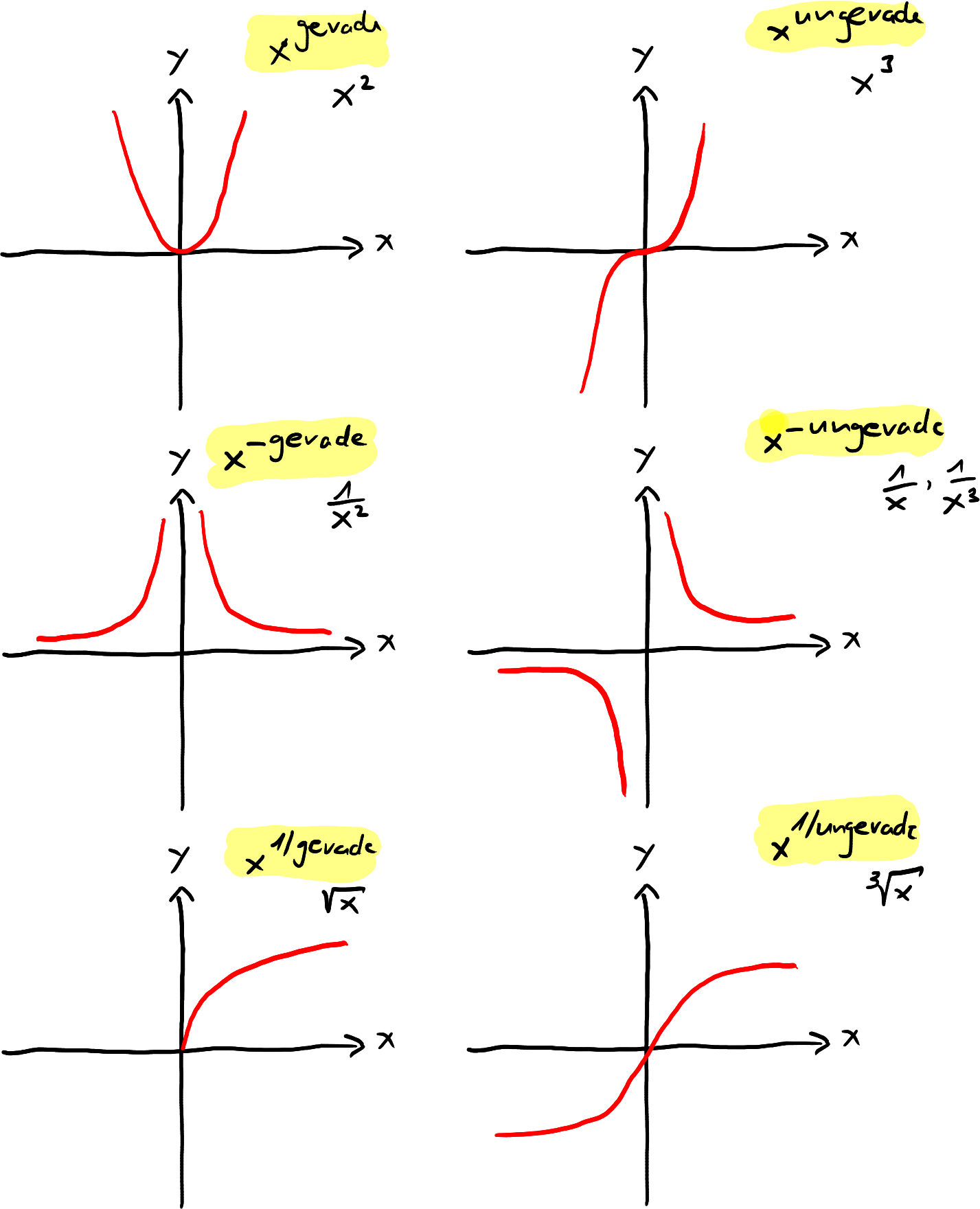
So we have three types of reference functions whose graphs we will now examine in more detail:
- , where The graph of these functions is called parabola.
- where The graph of these functions is called hyperbola.
- where
Q1
Draw for each exercise the graphs of the reference functions and into the same coordinate system using a table of values. Important: Take your time and really use a table of values, don't take shortcuts! You will learn a lot from it.
- and
- and What happens at ?
- and
Q2
Which graphs in Q1 have no -intercept, which have no -intercept? Can this be generalised to higher values of ?
Q3
Notice that some graphs in Q1 have a negative branch and others do not. Why? Can this be generalised to higher values of ?
Q4
Which graphs in Q1 pass through the point
Again, generalise for higher numbers of .
Solution
Let or or , where .
A1
Check your solutions using the Geogebra apps below.
A2
- : the graph passes through the origin and thus has an -intercept and a -intercept.
- : has neither an - nor a -axis intercept. At there is no -value (it would be or ).
- : the graph passes through the zero point and thus has an - and -intercept.
A3
The graph of has a negative branch only if is odd. This results from the fact that and .
A4
- : all but the hyperbolas.
- : all graphs
- : all power functions , ,
- : hyperbolas and parabolas with even.
- : none.
The following should now be solvable: For each of the cases given below, make a rough sketch of the graph in a coordinate system. Use for each case a different coordinate system.
Solution