The graph of power functions

If the quadratic function is represented in vertex form,

f(x)=A(xv)2+Bf(x)=A(x-v)^2+B

we have seen that the parameters AA, vv and BB show how the reference function r(x)=x2r(x)=x^2 has to be transformed to get to the graph of ff. The same applies to general power functions of the form

f(x)=A(xv)n+Bf(x)=A(x-v)^n+B

So the transformations we have to apply to get from the reference function r(x)=xnr(x)=x^n to the graph of ff,

  1. Stretch the graph of the reference function r(x)=xnr(x)=x^n by AA in the yy direction:

    x2Axnx^2 \rightarrow A x^n
  2. Then move the graph to the left (v<0v<0) or to the right (v>0v>0) by vv:

    AxnA(xv)nA x^n \rightarrow A(x-v)^n
  3. Then move the graph up (B>0B>0) or down (B<0B<0) by BB:

    A(xv)nA(xv)n+BA(x-v)^n \rightarrow A(x-v)^n+B

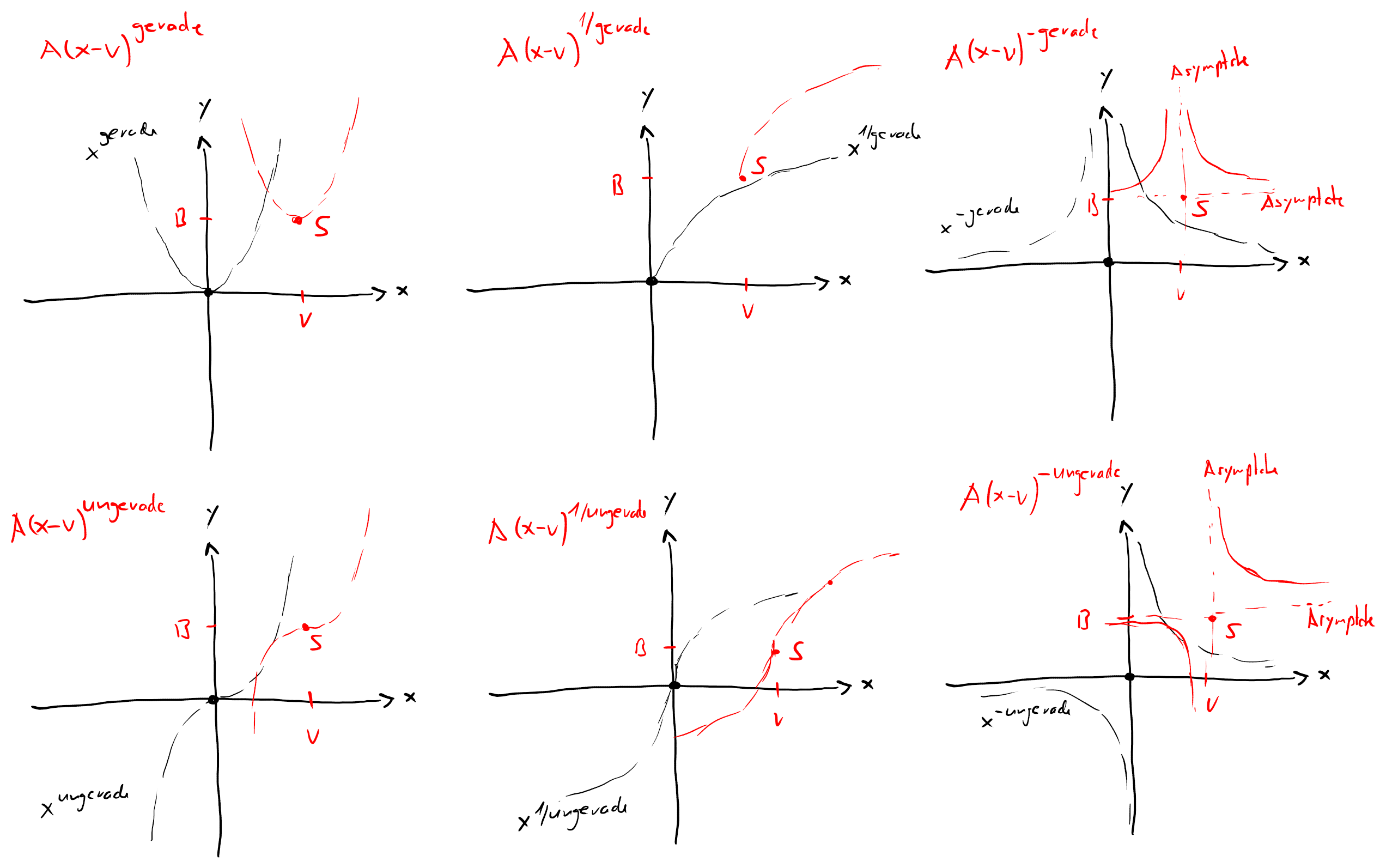
The picture below shows an overview of the transformed functions f(x)=A(xv)n+Bf(x)=A(x-v)^n+B for the different exponents nn. Note that we also indicate the point S(vB)S(v\vert B), which is simply where the coordinate orgigin (00)(0|0) ends up when transformed. For n=2n=\text{2}, the quadratic function, this is also the vertex SS.

Example 1

Sketch the graph of the function

f(x)=2(x1)31f(x)=2(x-1)^3-1

by transforming the reference graph. Also determine the xx- and yy intercepts.

Solution

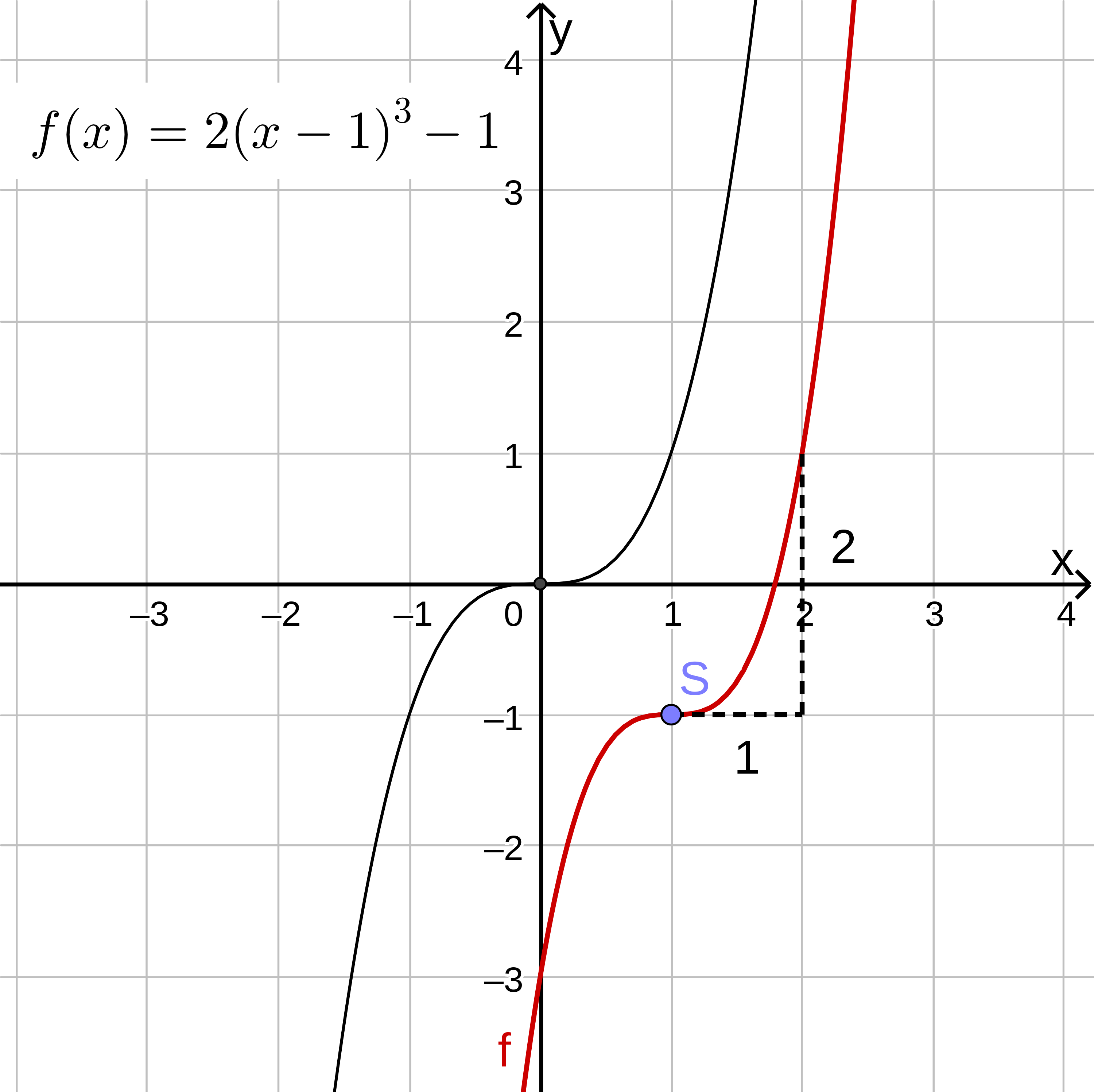
It is A=2,v=1,B=1A=2, v=1, B=-1, i.e. stretching the reference function (black curve) r(x)=x3r(x)=x^3 by a factor of 22 in the yy direction, then shifting it 11 to the right and 11 downwards.

yy-intercept: y=f(0)=2(1)31=3y=f(0)=2(-1)^3-1=\underline{-3} xx-intercept: find xx with

2(x1)31=0+1,:2(x1)3=0.5(.)1/3x1=0.51/3+1x=0.51/3+1\begin{array}{rlll} 2(x-1)^3-1 &=& 0 &\quad\vert +1, :2\\ (x-1)^3 &= &0.5 &\quad\vert (.)^{1/3}\\ x-1 &=& 0.5^{1/3} &\quad\vert +1\\ x &=& 0.5^{1/3}+1 & \\ \end{array}

Thus, it is x=1.793...x=\underline{1.793...}.

Example 2

Sketch the graph of the function

f(x)=3x+2+1f(x)=\frac{3}{x+2}+1

by transforming the reference graph. Also determine the xx- and yy-intercepts.

Solution

Because of

f(x)=3x+2+1=31x+2+1=3(x+2)1+1\begin{array}{lll} f(x) &= &\frac{3}{x+2}+1\\ &=& 3\cdot \frac{1}{x+2}+1\\ &=& 3\cdot (x+2)^{-1}+1\\ \end{array}

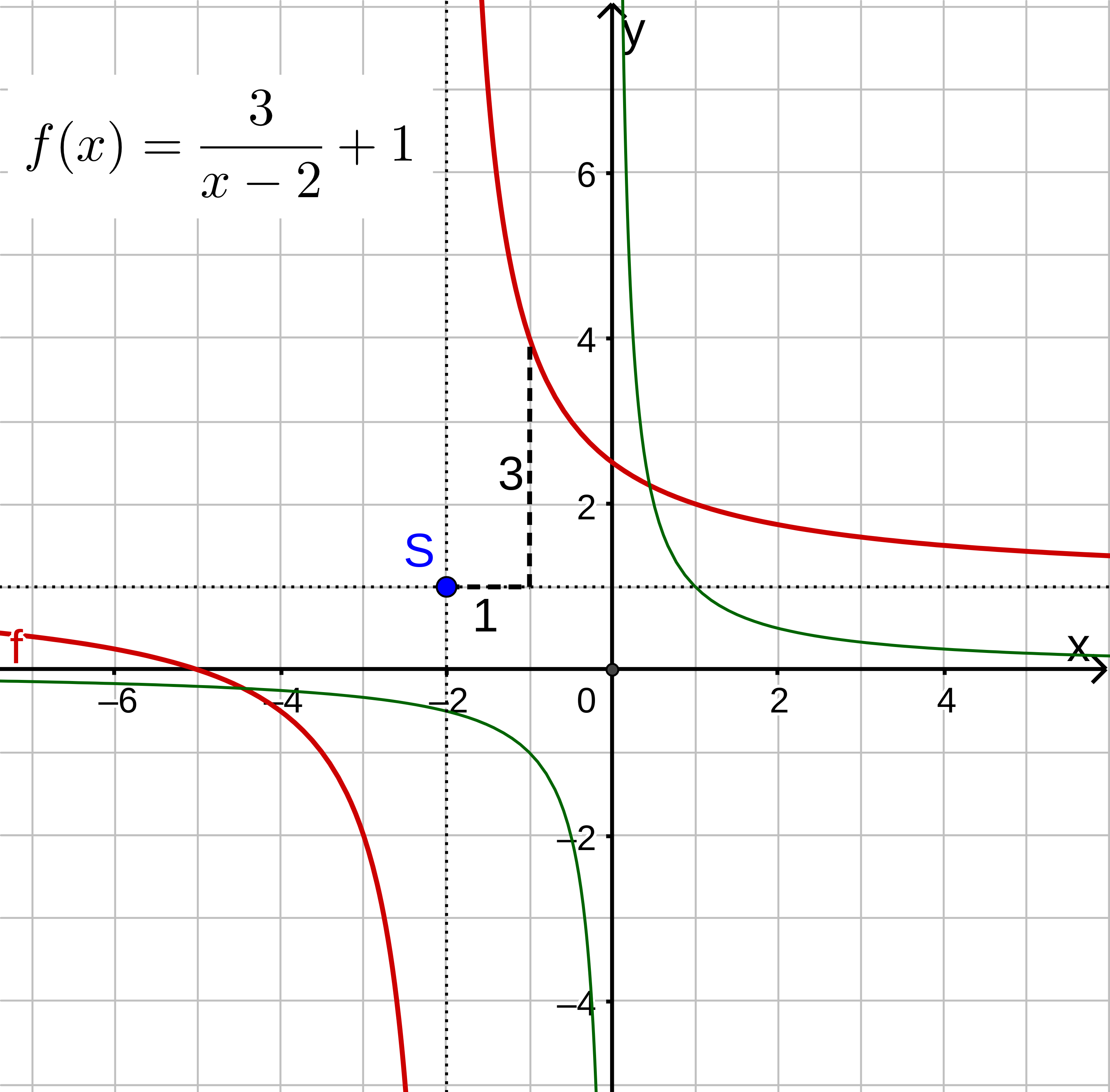
follows A=3,v=2,B=1A=3, v=-2, B=1, thus stretching the reference function (green curve) r(x)=1xr(x)=\frac{1}{x} by the factor 33 in yy-direction, then shift to the left by 22 and upwards by 11.

yy-intercept: y=f(0)=3x+2+1=2.5y=f(0)=\frac{3}{x+2}+1=\underline{2.5} xx-intercept: find xx with

3x+2+1=01,(x+2)3=(x+2)3=x2x=5\begin{array}{rlll} \frac{3}{x+2}+1 &=& 0 &\quad\vert -1, \cdot(x+2)\\ 3 &= &-(x+2) &\\ 3 &=& -x-2 &\\ x &=& \underline{-5} & \\ \end{array}
Exercise 1
Q1

Sketch the graph of the power functions below by transforming the reference function. With the help of the sketch, determine whether the graph has xx- and yy-intercepts. If so, determine them mathematically.

  1. f(x)=x1+2f(x)=\sqrt{x-1}+2
  2. g(x)=3(x+5)4g(x)=-3(x+5)^4
  3. h(x)=2x+1+1h(x)=\frac{2}{x+1}+1
  4. k(x)=38x134k(x)=3\cdot \sqrt[3]{8x-1}-4
Q2

Determine the function equation of the two power functions below. The reference functions are x\sqrt{x} and 1x2\frac{1}{x^2}.

Q3

Find the intersection between the graphs of the functions f(x)=x2f(x)=x^2 and g(x)=2xg(x)=\frac{2}{\sqrt{x}}.

Solution
A1

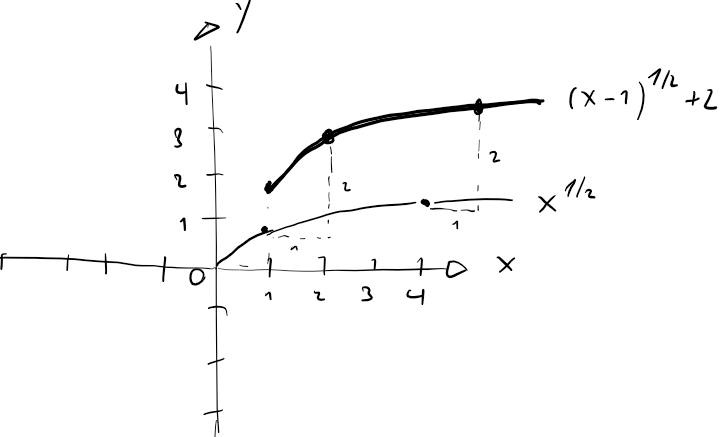
Function ff:f(x)=1(x1)1/2+2f(x)=1\cdot (x-1)^{1/2}+2, thus A=1,v=1,B=2A=1, v=1, B=2. the reference function r(x)=xr(x)=\sqrt{x} is not stretched in yy-direction, and shifted to the right by 11 and upwards by 22. Clearly there is not -x- and -y-intercept.
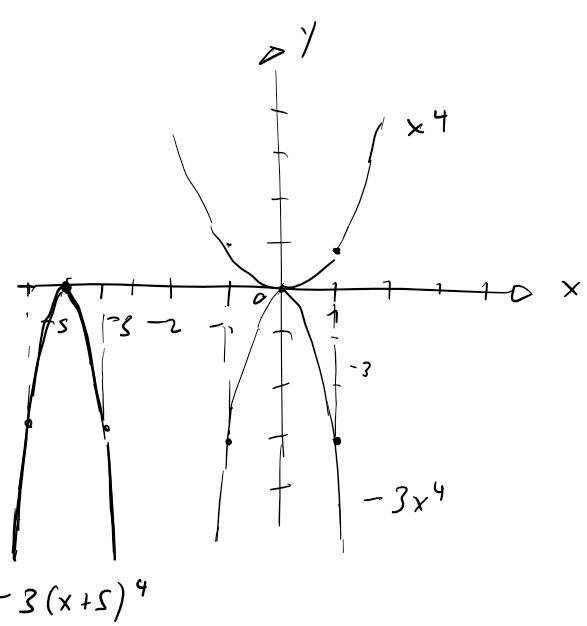
Function gg: g(x)=3(x+5)4+0g(x)=-3(x+5)^4+0, thus A=3,v=5,B=0A=-3, v=-5, B=0. The reference function r(x)=x4r(x)=x^4 is stretched in yy-direction by 3-3, that is, reflected about the xx-axis, and stretched by 33, and shifted to the left by 55. y-intercept: g(0)=354=1875g(0)=-3\cdot 5^4=\underline{-1875} x-intercept: 3(x+5)4=0-3(x+5)^4=0, also x+5=0x+5=0, also x=5x=\underline{-5}

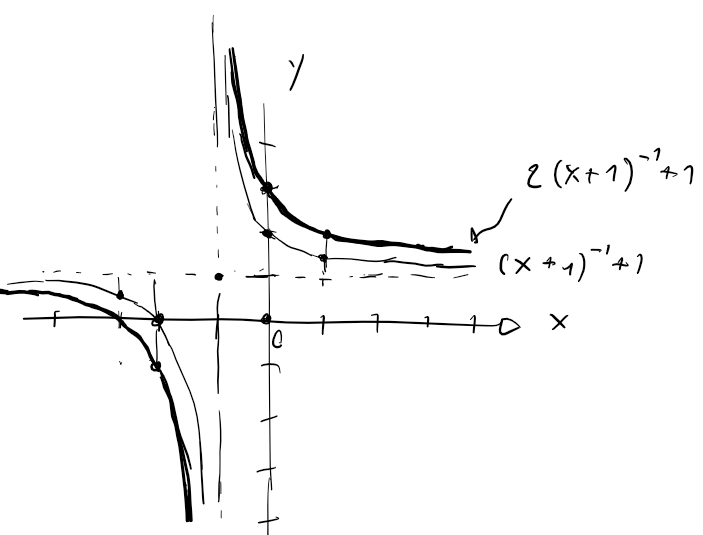
Function hh: h(x)=2(x+1)1+1h(x)=2\cdot (x+1)^{-1}+1, also A=2,v=1,B=1A=2, v=-1, B=1. The graph of the reference function r(x)=1xr(x)=\frac{1}{x} is stretched in yy-direction by the factor 22, shifted to the left by 11 and upwards by 11. yy-intercept: h(0)=3h(0)=\underline{3} xx-intercept:

2(x+1)1+1=01,:2(x+1)1=12(.)1x+1=(12)1x=3\begin{array}{llll} 2(x+1)^{-1}+1 &=& 0 & \quad\vert -1, :2\\ (x+1)^{-1}&=& -\frac{1}{2} & \quad\vert (.)^{-1}\\ x+1 &=& \left(-\frac{1}{2}\right)^{-1} &\\ x &=& \underline{-3} & \end{array}

Function kk: Because of

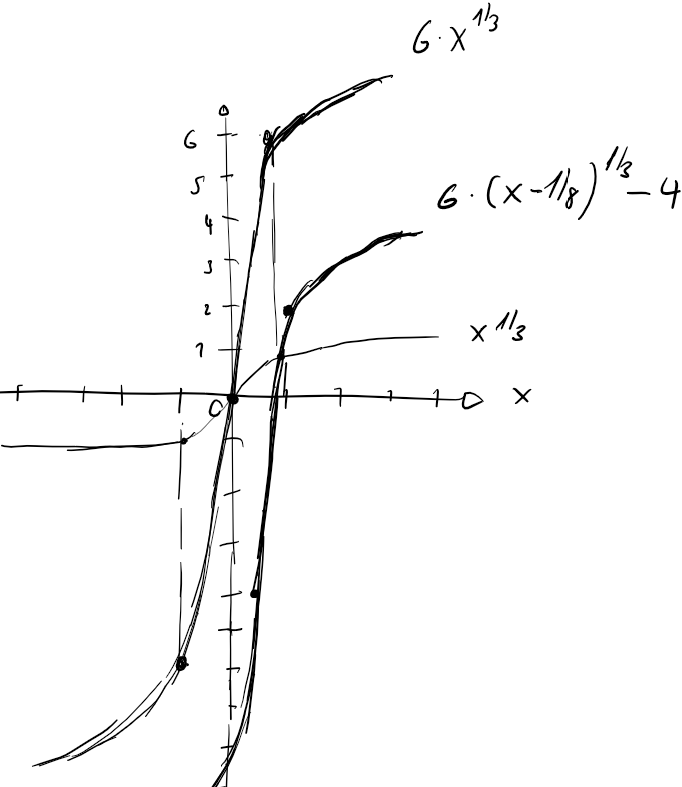
k(x)=3(8x1)1/34=3(8(x18))1/34=381/3(x18)1/34=6(x18)1/34\begin{array}{lll} k(x) &=& 3\cdot (8x-1)^{1/3}-4\\ &=& 3\cdot (8(x-\frac{1}{8}))^{1/3}-4\\ &=& 3\cdot 8^{1/3} \cdot (x-\frac{1}{8})^{1/3}-4\\ &=& 6 \cdot (x-\frac{1}{8})^{1/3}-4\\ \end{array}

follows A=6,v=18,B=4A=6, v=\frac{1}{8}, B=-4. The graph of the reference function r(x)=x3r(x)= \sqrt[3]{x} is stretched in yy-direction by the factor 66 shifted to the right by 1/81/8 and upwards by 44. yy-intercept: k(0)=3(1)1/34=34=7k(0)=3\cdot (-1)^{1/3}-4 =-3-4=\underline{-7}. xx-intercept:

3(8x1)1/34=0+4,:3(8x1)1/3=43(.)3,+18x=(43)3+1:8x=0.421\begin{array}{llll} 3(8x-1)^{1/3}-4 &=& 0 & \quad\vert +4, :3\\ (8x-1)^{1/3}&=& \frac{4}{3} & \quad\vert (.)^{3}, +1\\ 8x &=& \left(\frac{4}{3}\right)^{3}+1 &\quad\vert :8\\ x &=& \underline{0.421} &\\ \end{array}
A2

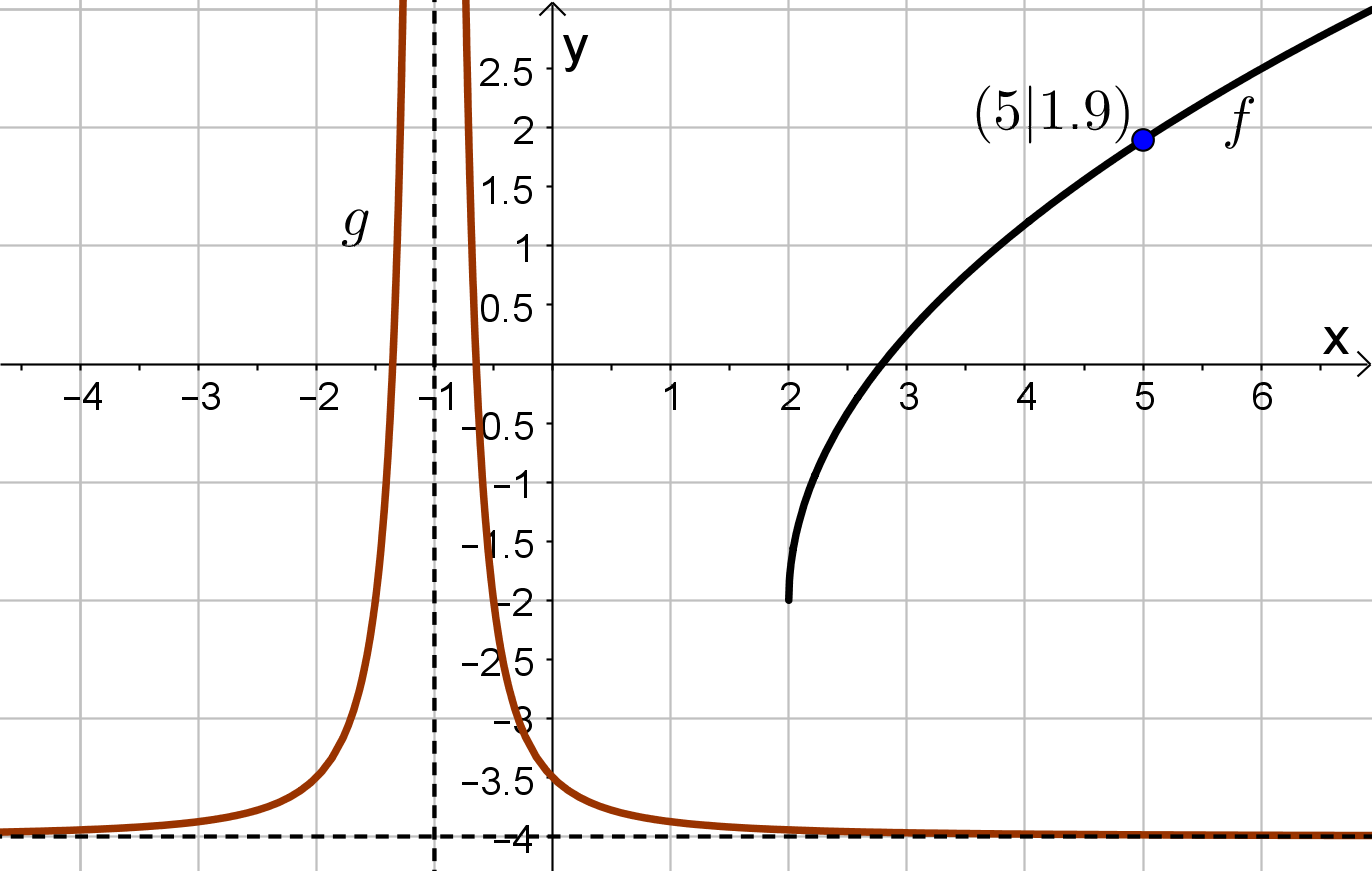
Graph ff: The reference function is r(x)=xr(x)=\sqrt{x} and from the picture we see that rr was shifted to the right by 22 and downwards by 22. Thus, we have

f(x)=A(x2)1/22f(x)=A\cdot (x-2)^{1/2}-2

To find AA, we use the fact that ff passes through the point B(51.9)B(5\vert 1.9), which means that

f(5)=1.9A(52)1/22=1.9+23A=3.9:3A=2.25...\begin{array}{llll} f(5) &=& 1.9 & \\ A\cdot (5-2)^{1/2}-2 &=& 1.9 &\quad\vert +2\\ \sqrt{3} A & = & 3.9 & \quad\vert :\sqrt{3}\\ A &=& 2.25... & \\ \end{array}

Thus we have f(x)=2.25x22f(x)=\underline{2.25\cdot \sqrt{x-2}-2}.

Graph gg: The reference function is r(x)=1x2r(x)=\frac{1}{x^2} and from the picture we see that rr was shifted to the left by 11 and downwards by 44. Thus

g(x)=A(x+1)24g(x)=A(x+1)^{-2}-4

To find AA, we use the fact that gg passes through the point B(03.5)B(0\vert-3.5), thus

g(0)=3.5A(1)24=3.5A=0.5\begin{array}{llll} g(0) &=& -3.5 & \\ A\cdot (1)^{-2}-4 &=& -3.5 &\\ A & = & 0.5 & \\ \end{array}

It follows g(x)=0.5(x+1)24g(x)=\underline{\frac{0.5}{(x+1)^2}-4}.

To find A=0.5A=0.5 we could also compare the graphs of rr and gg.

A3

Find xx with f(x)=g(x)f(x)=g(x):

x2=2xx2x=2x2.5=2(.)1/2.5=(.)2/5x=22/5\begin{array}{llll} x^2 &=& \frac{2}{\sqrt{x}}\\ x^2 \cdot \sqrt{x} &=& 2\\ x^{2.5} &=& 2 & \quad\vert (.)^{1/2.5}=(.)^{2/5}\\ x &=& 2^{2/5}\\ \end{array}

It is x=1.32x=\underline{1.32}. The yy-coordinate is therefore

y=f(1.32)=1.74y=f(1.32)=1.74

and the point of intersection is P(1.321.74)\underline{P(1.32\vert 1.74)}.