Optimisation
A common task is to find the best or worst outcome under some given constraints. This is called an optimisation problem. For example, how can we design a 1 litre water bottle with the least amount of material? Obviously that's interesting to know from an economical point of view, if you consider that material costs money, and if you want to produce a huge number of these bottles.
In this example, the condition that the bottle has to contain litre of water is called the constraint, and the amount of material required for any given design fulfilling this constraint is called the cost function. The aim is to find the design with the lowest (or sometimes the largest) cost.
You will solve this optimisation problem in one of the exercises below, for a can of Coke. Here we discuss another optimisation problem: using an A4-sheet, how can we construct a box with the largest possible volume?
Assume we have a piece of cardboard of length and width (A4). We are going to cut the corners as shown below in the figure, and form a box. Find the height of the box such that the volume of the box is as large as possible.
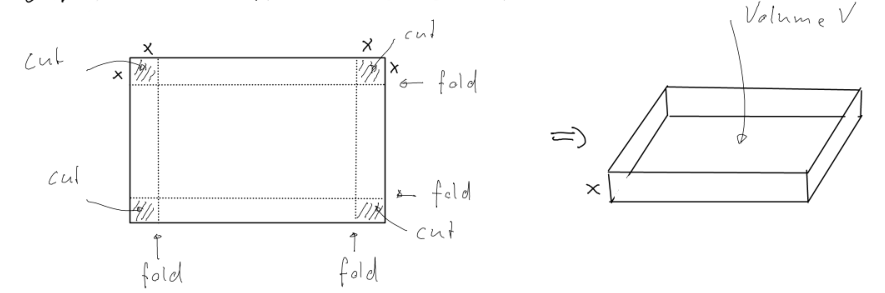
Clearly, the volume of the box, under the given constraint (using an A4 sheet and folding in the way explained above) is
This is the cost function. Its graph is shown below.
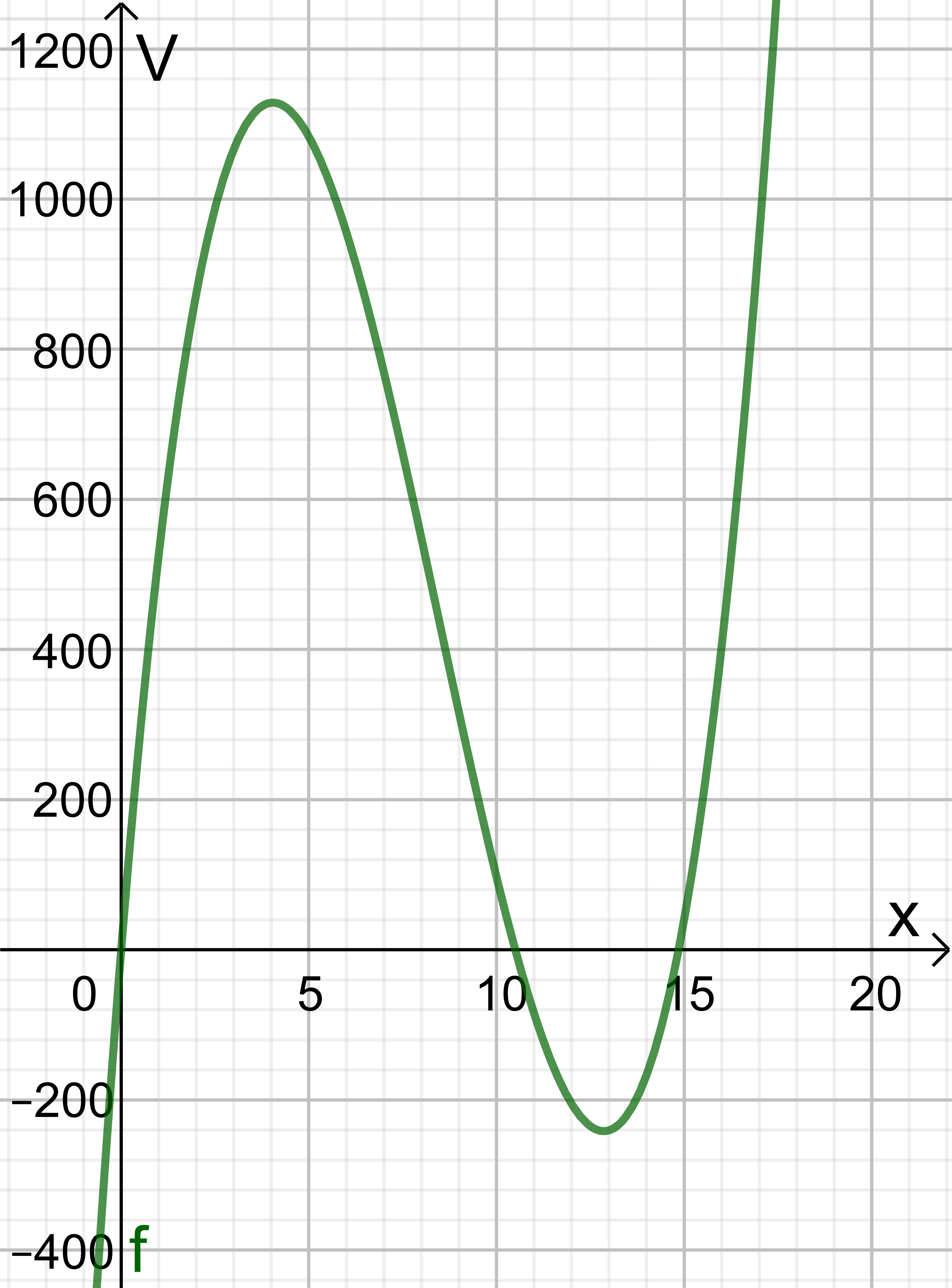
Note that the graph makes sense. If , the box has no height, so the volume is . If the height is (half the cardboard width), the box volume has to be as well. Any values bigger than can be ignored, as they make no sense in the present context.
Somewhere between these two values for , the volume will be maximally big, and based on the graph, this value will be somewhere close to . This is where the graph has its local maximum and the cost function (the volume) has its largest possible value.
To calculate the precise location of the local maximum, we can use differential calculus. All we have to do is to find the stationary points of . We already know from the figure that there will be two of them, and we also see that the smaller of these two values must be the local maximum.
We have to find with , that is, with
Using the midnight formula, we get the solutions
and
The optimal height of the box is therefore .
In principle we are done. But for the sake of it, just because we can, let us verify that is indeed the local maximum. We have
and therefore .
So yes, is the local maximum.
Remember: The cost (function) is the quantity you want to minimise or maximise.
Q1
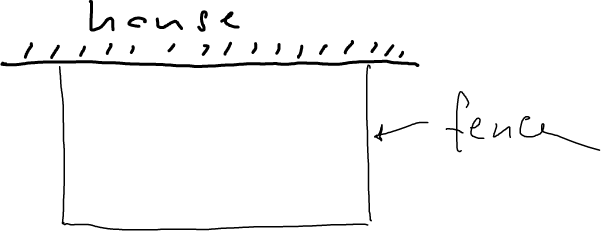
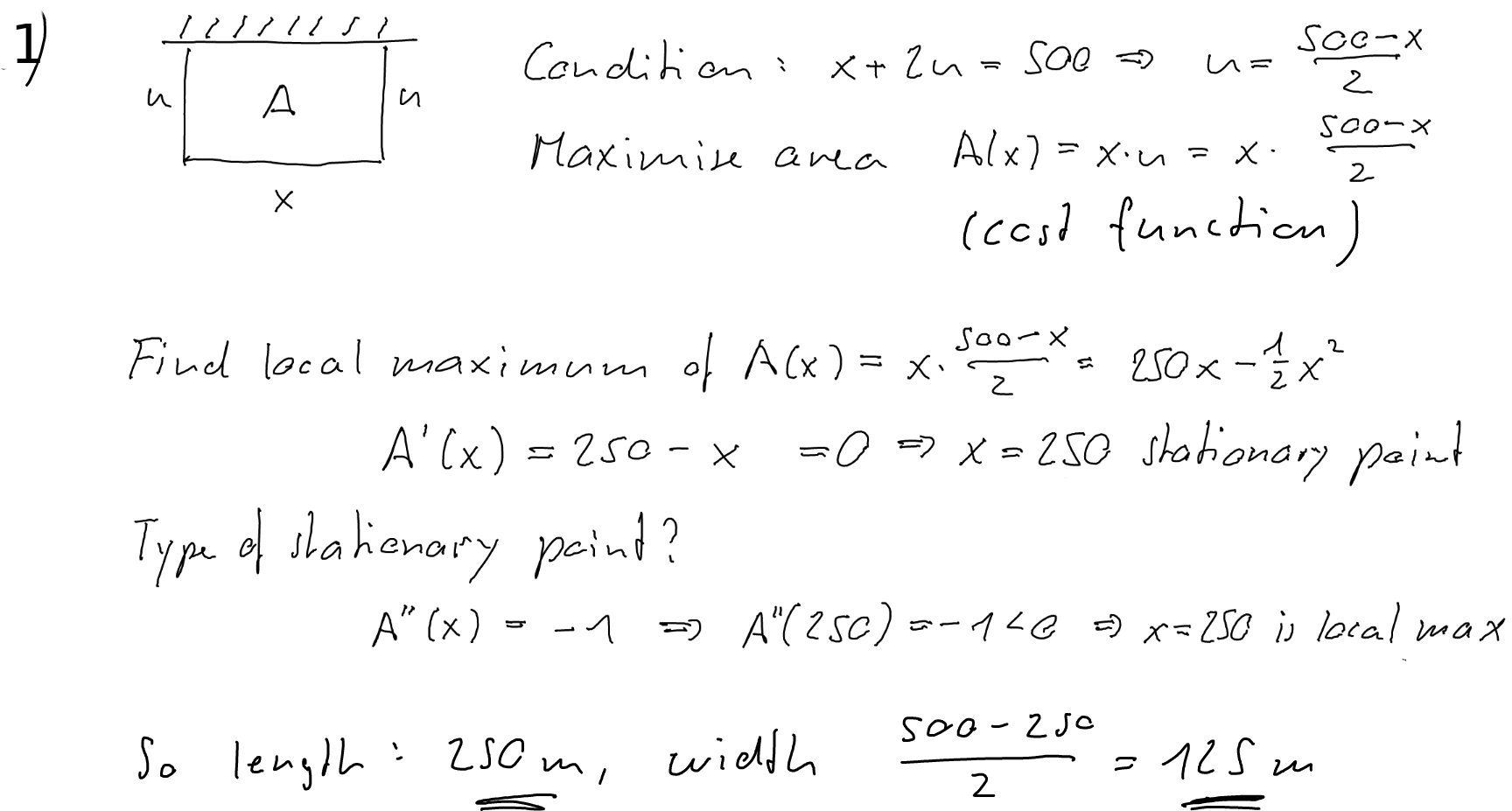
Given a fence of length , we want to enclose a rectangular area that is as big as possible. One side of the field is blocked by the farm house, so no fence is required for this side (see figure). Determine the dimension of the rectangle.
Q2
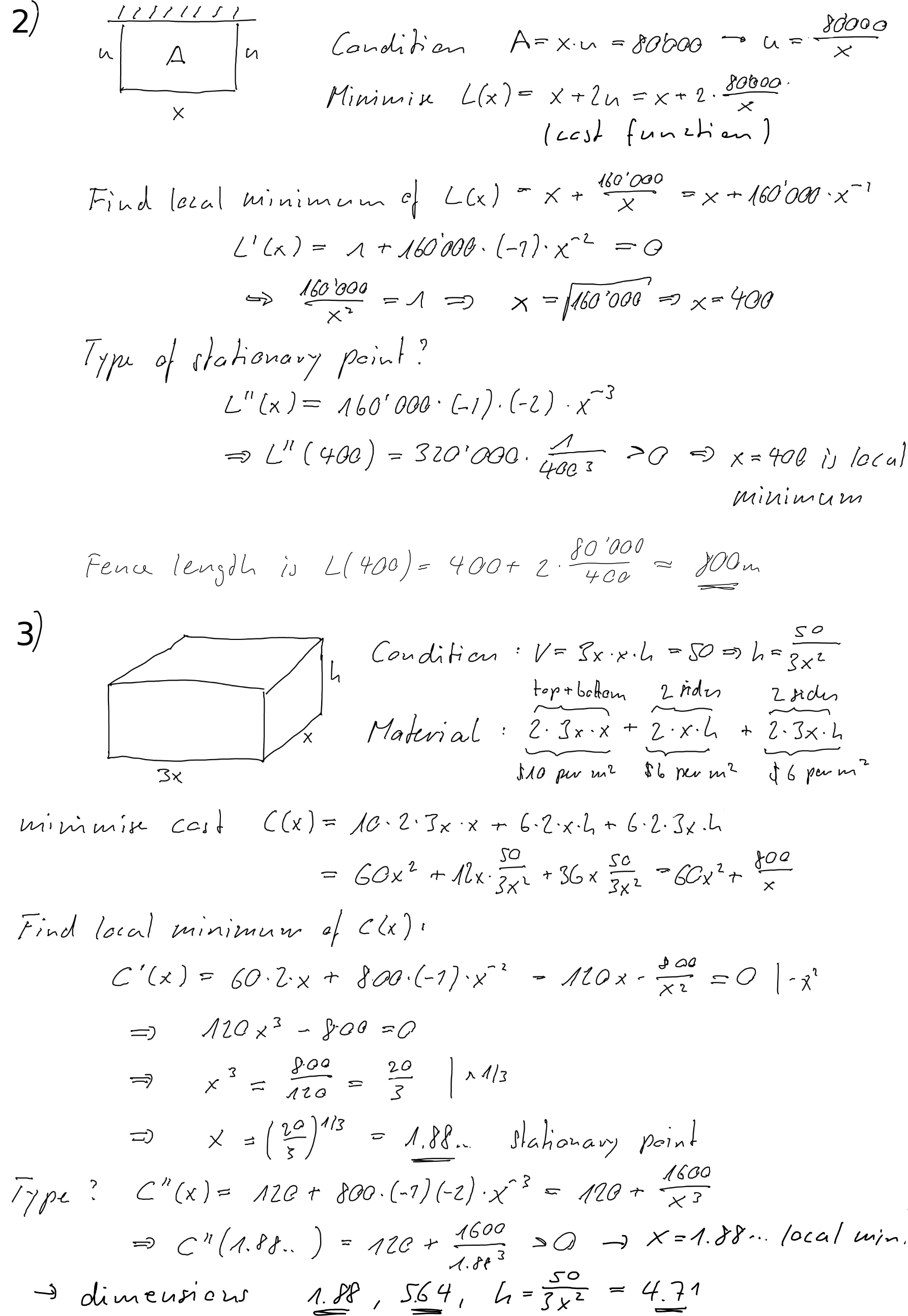
Consider a rectengular fence where one side is formed by the wall (see figure in Q1). Find the smallest possible fence length (three sides) to enclose an area of .
Q3
We want to construct a box whose base length is times the base width. The material used to build the top and bottom costs dollars per and the material used to build the sides costs dollars per . If the box must have a volume of , determine the dimensions that will minimize the cost to build the box.
Q4
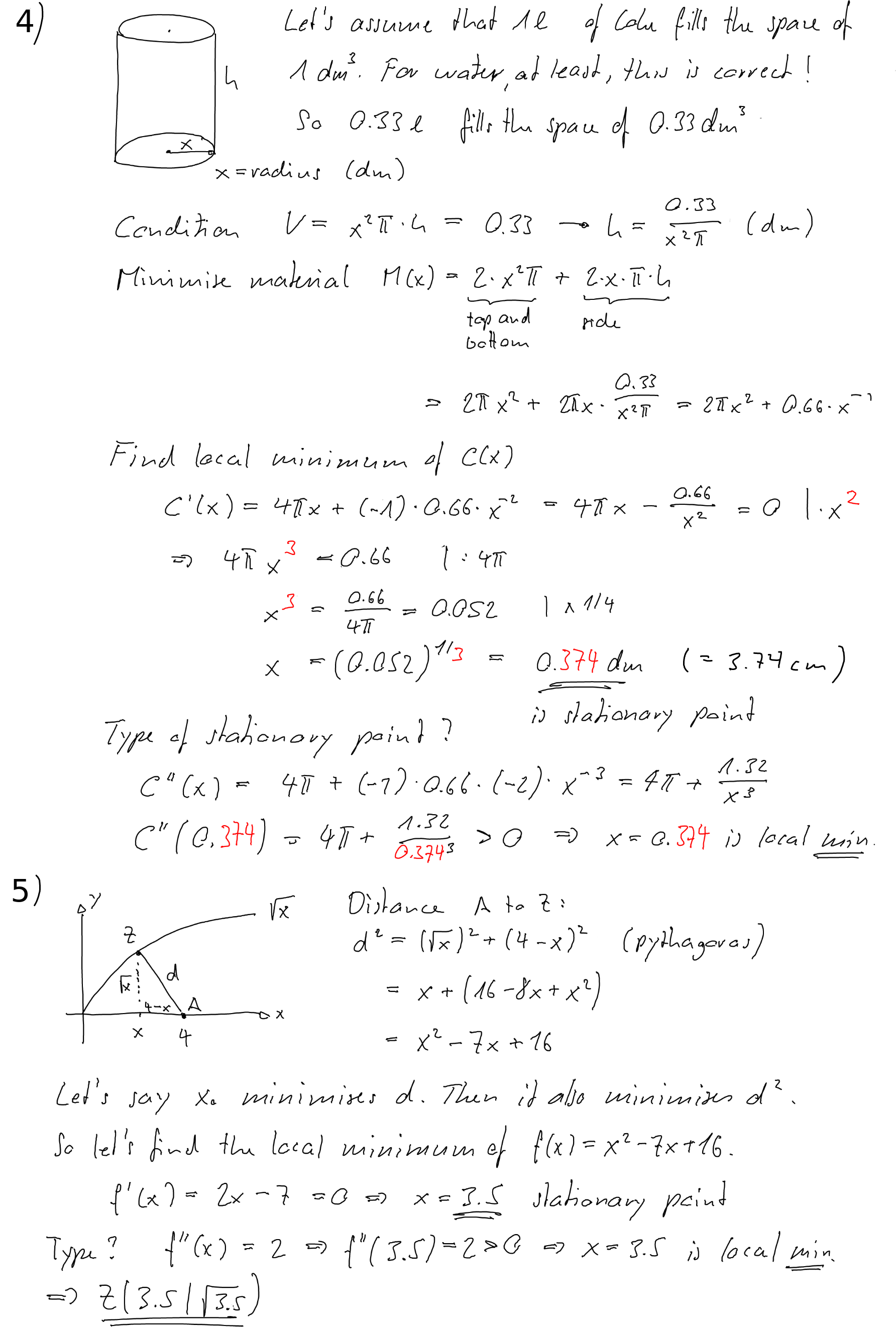
Coke Can Problem. A manufacturer needs to make a cylindrical can that will hold litres of coke. Determine the optimal radius of the can that will minimize the amount of material used in its construction.
Q5
Find the point on the graph of that is nearest to the point .
Q6
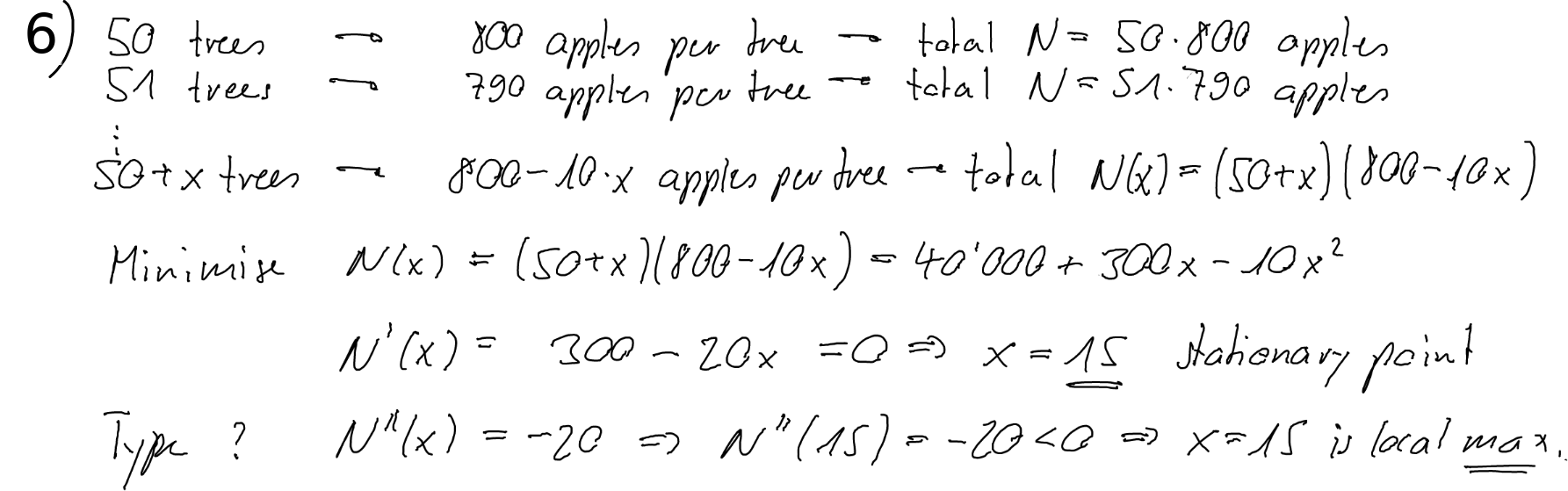
There are apple trees in an orchard. Each tree produces apples. For each additional tree planted in the orchard, the output per tree drops by apples. Find the optimal number of trees that should be added to the existing orchard in order to maximize the total output of trees?
Q7
Which cuboid with a square base and a volume of has a minimal surface area?
Q8
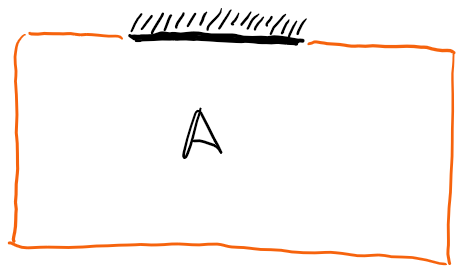
A rectangular area is to be marked out with a rope of length . Part of one rectangle side is formed by a long wall of a house, for which no rope has to be used (see picture). Find the largest possible area that can be formed.
Q9
The point is on the graph of the function in the first quadrant (that is, in the part of the coordinate system where the - and -coordinates are both positive). Find so that the rectangular area between the coordinate origin and is as large as possible.
Q10
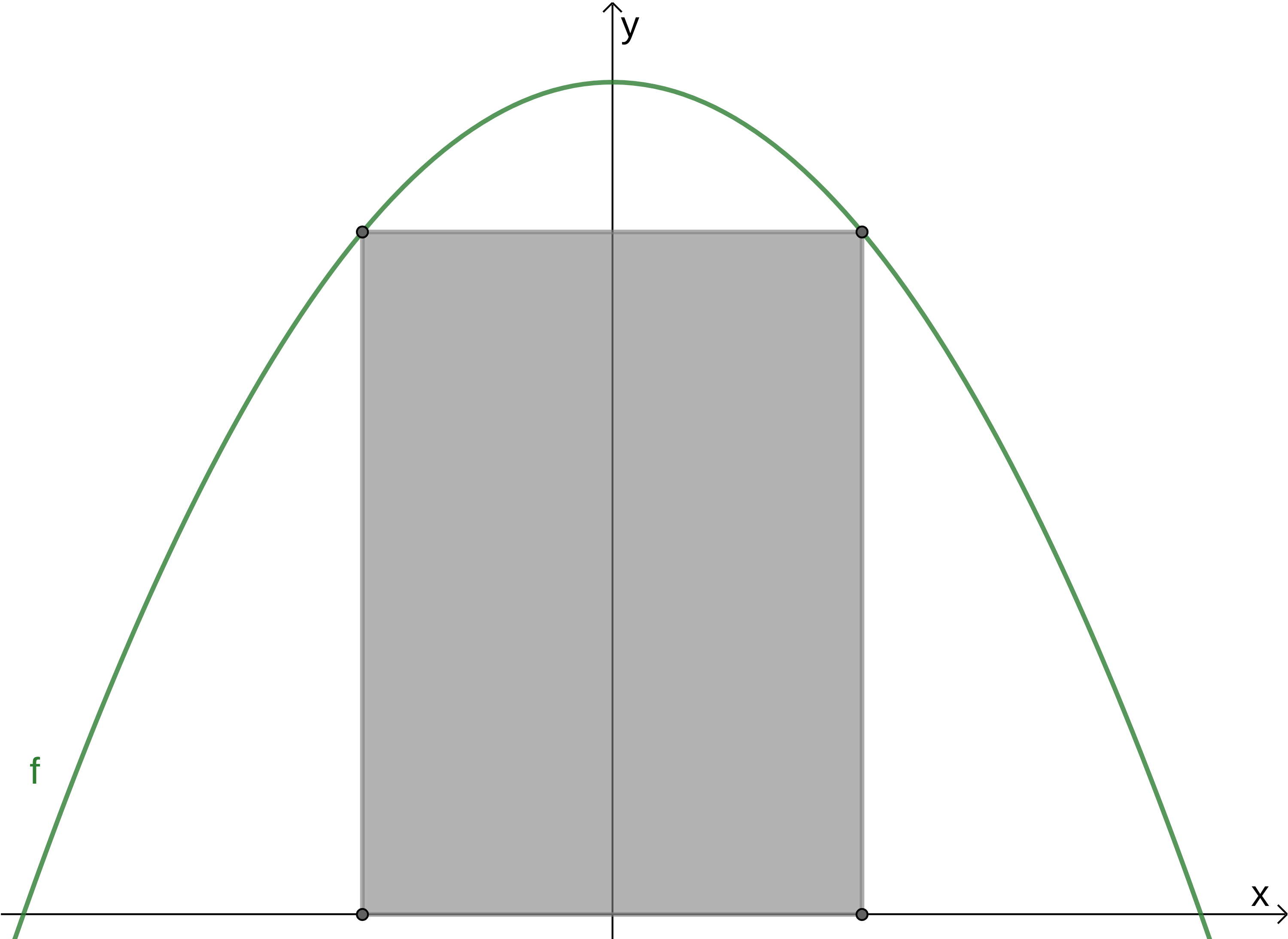
A rectangle has two points on the graph of and two points on the -axis (see picture below). Determine the rectangle with the maximum area that can be embedded between the -axis and the graph in this way (and is above the -axis). How big is the area?
Solution
A7
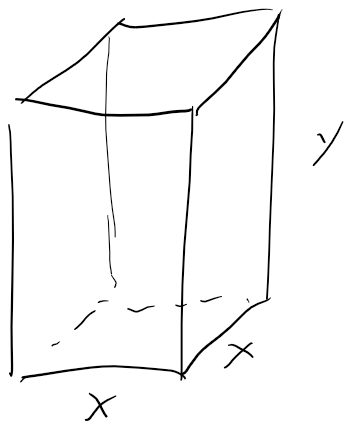
Volume:
Cost function:
Find local min:
Multiplying both sides by we get
And therefore . Thus, the solution is therefore a cube of side length .
Extra: check if local minimum.
A8
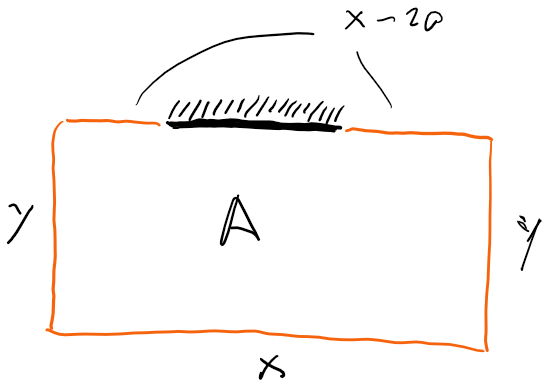
Rope length:
Cost function:
Find local max:
And thus and the maximal area is .
Extra: check if local maximum.
A9
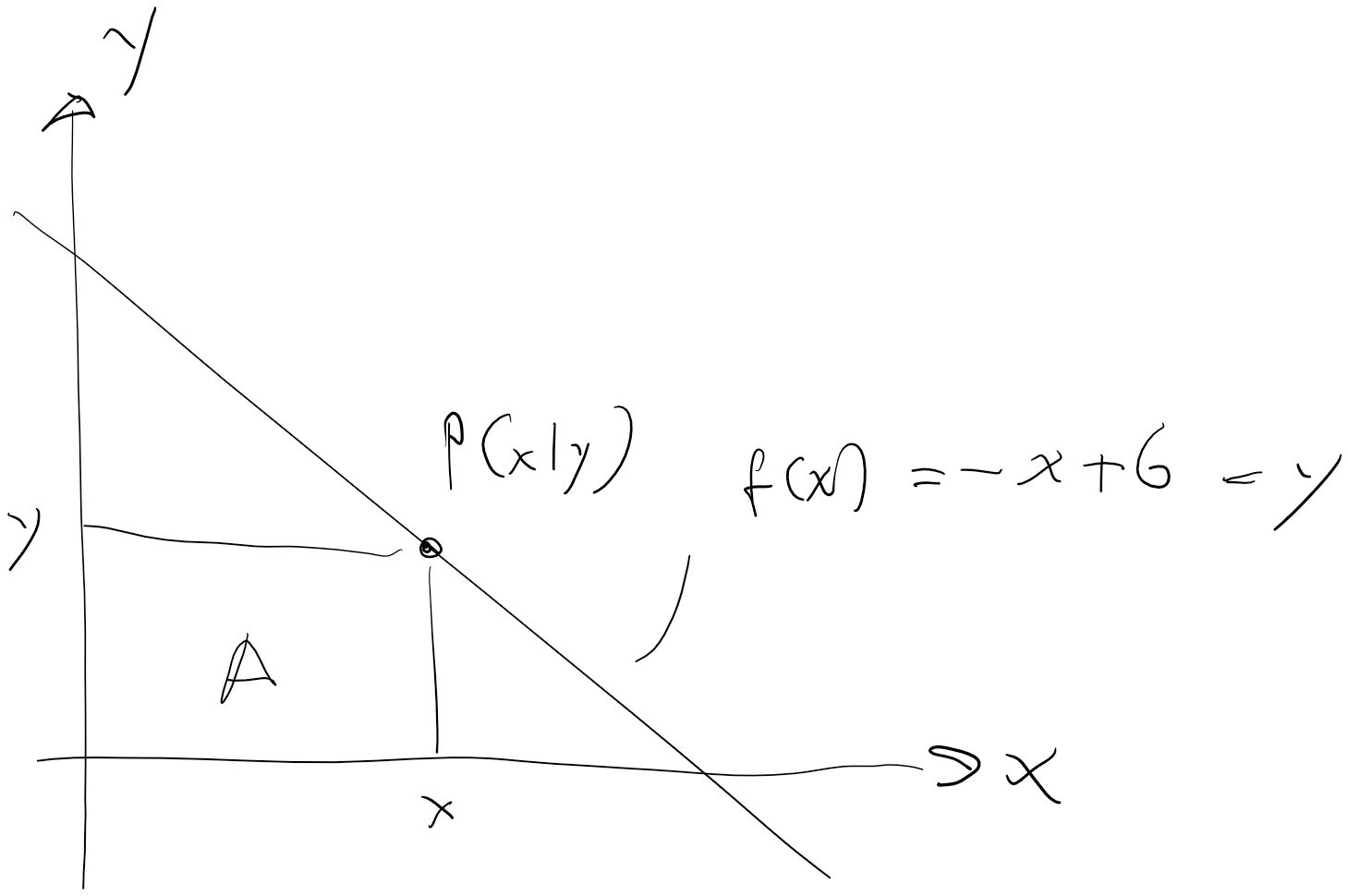
The condition is that hs to be on the graph , that is, the -coordinate of is given by
Cost function:
Find local max:
Thus and therefore .
Extra: check if local maximum.
A10
The width of the rectangle is , the height is . The area is therefore . We have to find the local maximum of this cost function. First let's expand : , thus
Is it really a maximum? Yes, because
thus local max!
The width of the rectangle is , the height is .