Inflection points
Consider a function and a point on the graph of . Recall that is local extremum (local maximum or minimum) if
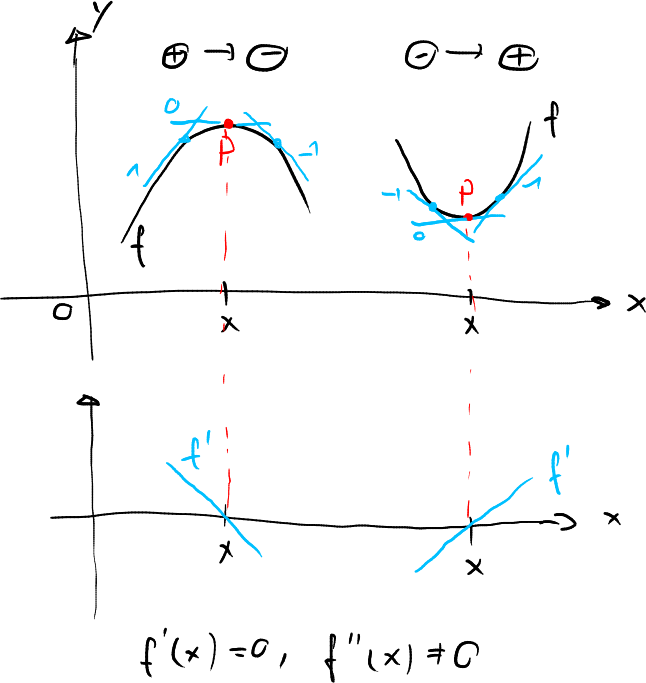
A local extrema is also called a turning point because the slope of the tangent turns at from a negative slope into a positive slope (local minimum) or from a positive slope into a negative slope (local maximum). So the slope changes the sign at . This is illustrated below.
Consider a function and a point on the graph of . If the slope does not change its sign at , but changes from increasing to decreasing (a change of increasing to decreasing trend), or from decreasing to increasing , we call an inflection point (see figure below).
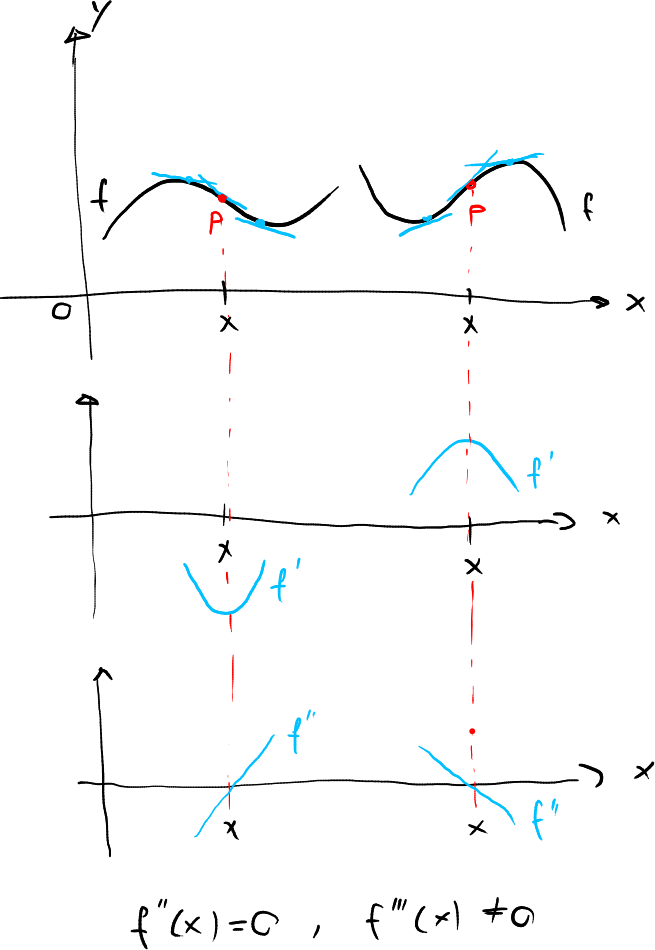
From the figure we see, that inflection points are in the middle of like structures.
Consider a function and a point on the graph of . We have the following:
Inflection point and second derivative.
If , visual inspection is necessary to check out if is an inflection point.
Note that an inflection point does not have to be a stationary point, because the tangent at does not have to be horizontal. If it is, the inflection point is a saddle point. In fact, an inflection point can be thought of as a saddle point where the horse is lashing out ... . So a saddle point is a very specific inflection point, one where the tangent is horizontal.
Assume that the output of a function is the location of a car at time (the input). Thus the slope is the instantaneous velocity and is the instantaneous acceleration of the car at time .
Assume you hit the brake so that the car gets slower and slower, and at time you hit the gas pedal, so the car is getting faster again. Then we have an inflection point at . Note that the car's acceleration must be at as it changes from being negative during braking (you are pressed into the safety belt) to being positive when you hit the gas pedal (you are pressed into the seat).
If the car actually stops at , we have a saddle point.
Find the inflection points (if there are any) of the function .
Solution
Find with , and then check if .
, thus . As , it follows that there is an inflection point at . It has the coordinates .