delete --- Further problems about harmonic oscillations
If not explicitly mentioned, all tasks are to be solved without a calculator.
Q1
Describe the geometric transformations to get from the graph of to the graph of . Then sketch the graph of using these transformations.
Q2
Let the graph of the function be stretched by a factor of in both the and directions, and then shifted to the left by 2. Determine the function equation of the obtained graph.
Q3
The graph of the function is first stretched by a factor of in the -direction, and then shifted to the right by . Sketch the graph by applying the transformations and determine the function equation of the graph obtained.
Q4
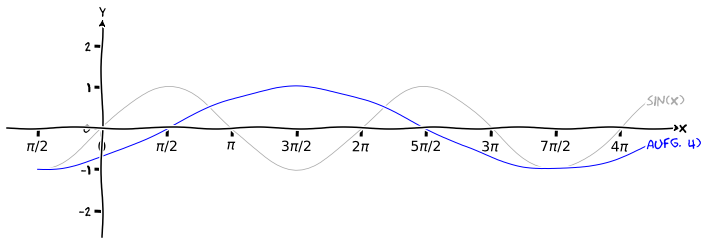
Sketch the graph again, but apply the transformations in reverse order. Do the two graphs agree? Determine the equation of this graph.
This exercise shows that the order of the transformations is important.
Q5
Which geometric transformation is performed for , and which for ?
Q6
Using sketches, consider which equations are correct. If an equation is not correct, correct the right-hand side so that it is correct.
Q7
Determine at least two -axis intercepts of the function
Q8
Determine at least two -axis intercepts of the function (here you need the calculator ...).
Q9
Reflect the graph of the function about the horizontal straight line at height . Determine the function equation of the mirrored graph.
Q10
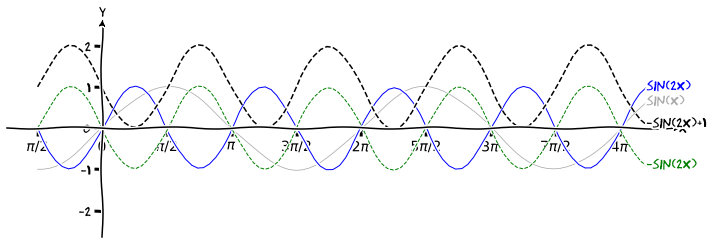
Determine the function equations of the following graphs:
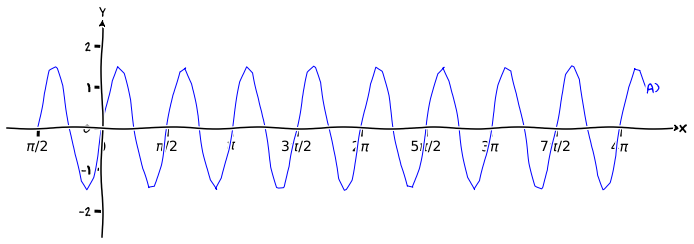
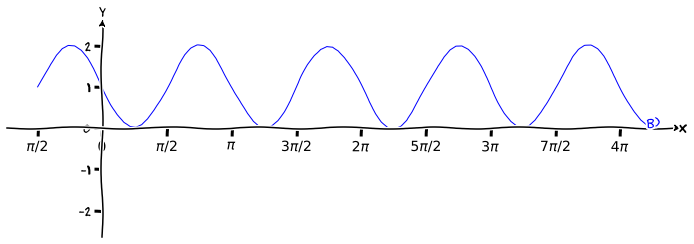
Q11
What geometric transformations are needed to transform the graph of the function to the graph of the function ? Sketch the graph of .
Q12
Apply the following transformations to the graph of the function :
- stretch in -direction by factor , then
- stretching in -direction by factor , then
- shift to the left by , then
- shift downwards by
Determine the function equation of .
Solution
A1
- Stretch in -direction by factor , then shift upwards by .
- Stretch in -direction by factor , then stretch in -direction by factor .
- , thus, stretch in -direction by factor , then stretch in -direction by factor , then shift to the left by , then shift down.
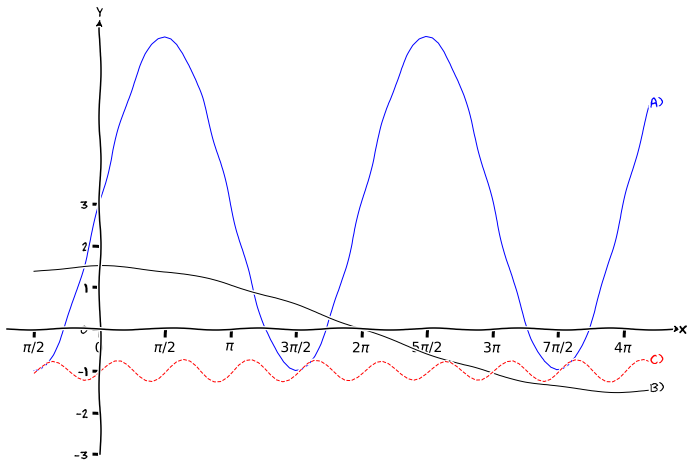
A2
, , . Thus (see graph below)
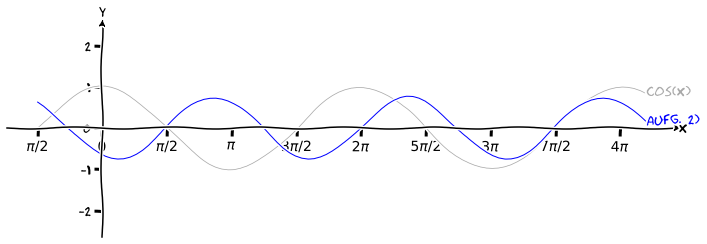
A3
, . Thus .
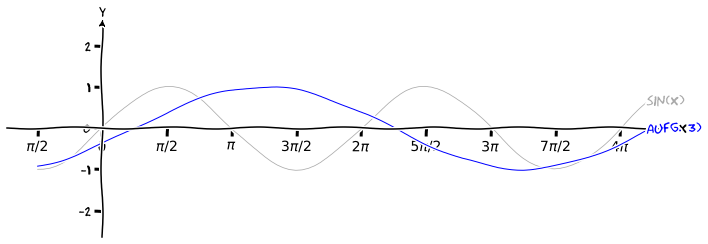
A4
Shifting to the right by , and then stretched in -direction by factor , we get the graph shown below. It is not the same graph as in A3 (it is shift a bit more to the right). The function equation is
To find the function equation, we first determine the geometric operations to get from to the graph of shown below, in the correct order:
- stretch in -direction by factor , then
- shift to the right by
Thus, and . It follows
A5
- , thus : the graph is stretched in -direction by , that is, reflected about the -axis.
- , thus : the graph is stretched in -direction by , that is, reflected about the -axis.
A6
Sketch the left graph and the right graph, and compare.
- is correct
- is wrong, it is
- is wrong, it is
- is correct
A7
It is , thus, is stretched in -direction by , then in -direction by , and then shifted to the right by .
The -intercepts of are
Applying the geometric transformation from above, the resulting -intercepts are
A8
Find with , thus
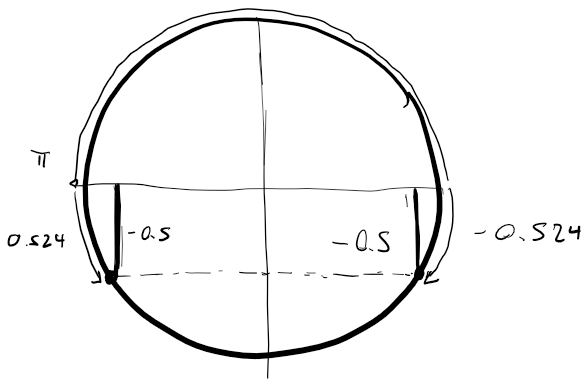
Let's first find the arc length with (see unit circle below). One value can be calculated using the calculators arcsin:
Another value is (see unit circle)
Thus, we have
and
Let's check: (rounding error), and (rounding error).
A9
Idea: First draw the mirrored graph and then consider what transformations are needed to get from to the mirrored graph.
The transformations are:
- reflect about -axis (), and then
- shift it up by ().
So we have .
A10
We start in each case with , and consider how we arrive at the graph shown by stretching and then by shifting.
- stretch in -direction by a factor of (), and in -direction by a factor of (). So .
- stretch in -direction by factor (), mirror at -axis (), shift upwards by (). So we have (see picture below).
A11
.
- stretch in -direction by a factor of
- stretch in -direction by a factor of
- shift to right by
- shift upwards .
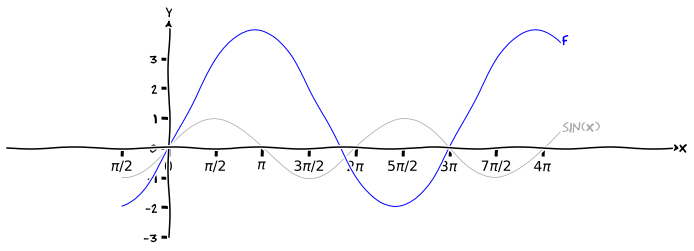
A12
Let's find and . , , and . Thus