delete -- Harmonic oscillations (update see german version)
Before we start, recall the geometric transformations "stretching" and "shifting". Here are some exercises.
Draw a coordinate system, and indicate the point . Then apply (draw) the following transformations to :
- stretch in -direction by the factor , and
- stretch in -direction by the factor , and
- shift to the right/left/up/down by
Also, determine the coordinates of the transformed points.
Draw the graph of the function . Then apply (draw) the following transformations to the line . You do this by stretching or shifting each point on the line:
- stretch the graph of in -direction by the factor , and
- stretch the graph of in -direction by the factor , and
- shift the graph of to the right/left/up/down by
Also, determine the function equations of the transformed lines.
Draw the graph of .
- stretch the graph by a factor of in -direction, then
- stretch in by a factor of in -direction, then
- shift it to the right by , and finally,
- shift it upwards by .
Try to find the function equation of the transformed curves (this might be difficult, and will be discussed below in more detail).
Harmonic oscillations are simply stretched and shifted sine, cosine and tangent functions. Recall that we have discussed how to transform quadratic functions in this way.
A function of the form
is called a harmonic oscillation. It is the sine function (see previous chapter) with some additional parameters , , and . Indeed, we obtain for and the normal sine function .
With the additional parameters we can change the shape of the sine wave. We can make the waves larger, wider, flip them or shift them left or right or up and down. Each parameter is responsible for one of these transformations. Let's explore this further in the following exercise.
Use a table of values to sketch the graphs and into the same coordinate system. Also draw the graph into the same coordinate system and try to figure out with what geometric transformation we get from to , and from to .
Also determine for each and the value of the parameters und .
-
und
-
und
-
und
-
und
Solution
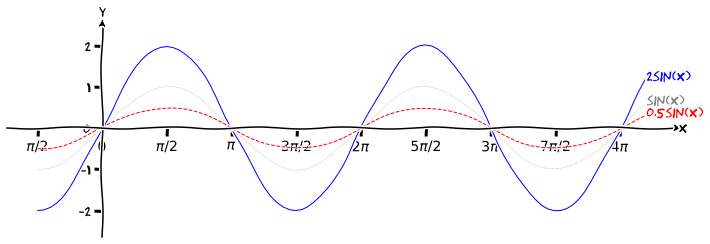
and ,
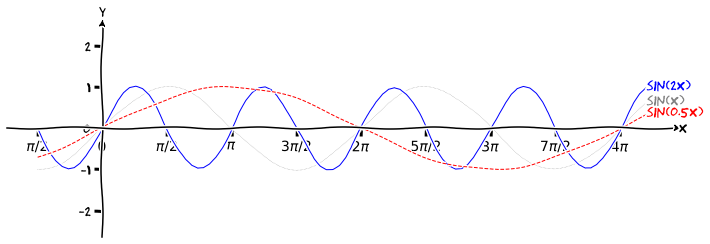
, and ,
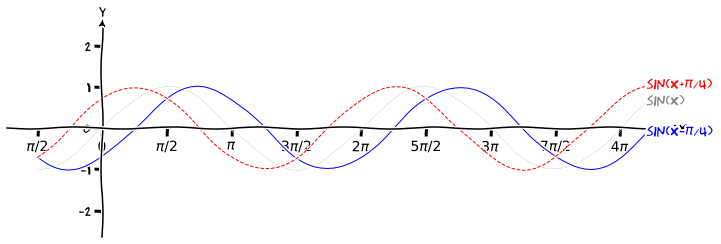
, and and ,
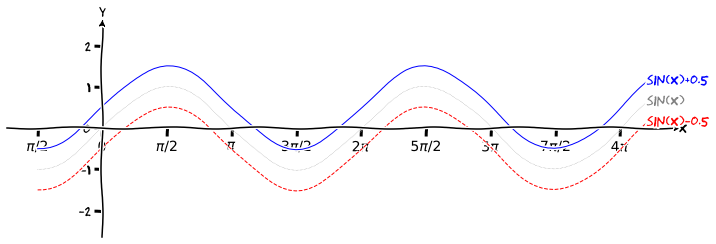
, and
The following is evident from the exercise above. Let and . The parameters and describe geometric transformations to get from the graph of to the graph of :
- stretches the graph of by a factor in the -direction.
- : Graph is stretched by the factor of in -direction (elongation).
- : Graph is stretched by the factor of in -direction (compression).
- stretches the graph of by the factor in -direction.
- : Graph is stretched by the factor of in -direction (compression).
- : Graph is stretched by the factor of in -direction (elongation).
- shifts the graph of by in the direction.
- : Graph is shifted to the right by .
- : Graph is shifted to the left by .
- shifts the graph of by in the direction.
- : Graph is shifted upwards by .
- : Graph is shifted downwards by .
The same is true for the graphs of the functions and . Let's generalise:
Consider the function
We obtain the graph of by applying the following transformations to the graph of :
- : stretch in direction by factor
- : stretch the new graph in direction by factor
- : shift the new graph to the right () or the left () by .
- : shift the new graph up () or down () by .
The order you execute these transformations is important, you have to start with the stretching in - or -direction, followed by shifting in - or -direction. However, the order of the two stretching transformations could be changed, and also the order of the two shifting transformations. But it is probably best to follow the order shown above, which corresponds to the order of the parameters in the formula!

Note that exactly the same geometric transformations and interpretations of and apply to the other trigonometric functions and , or indeed for any function :
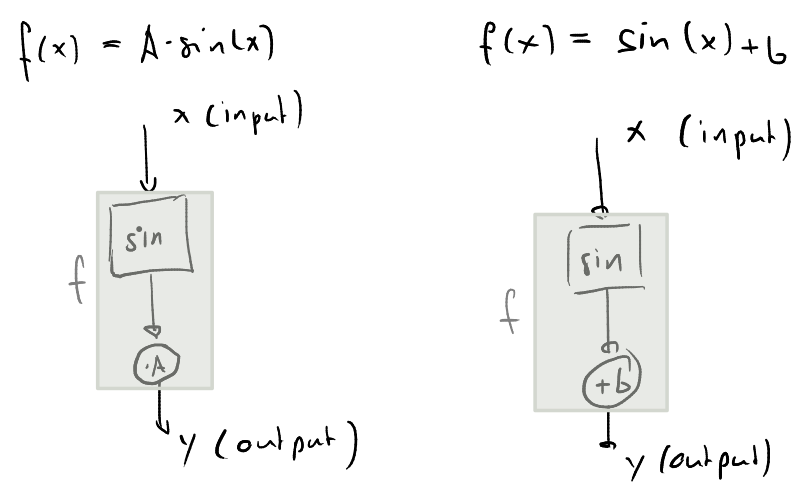
The effect that parameters and have on the graph should be clear. Both modify the output of the function by either multiplying the output by or adding to the output (see figure below). Because the output is the -coordinate of the points on the graph, we immediately see that the graph of is stretched in -direction by or shifted up or down by .
Less clear is the effect of and , both of which modify the input before it is fed into the function (see figure below).
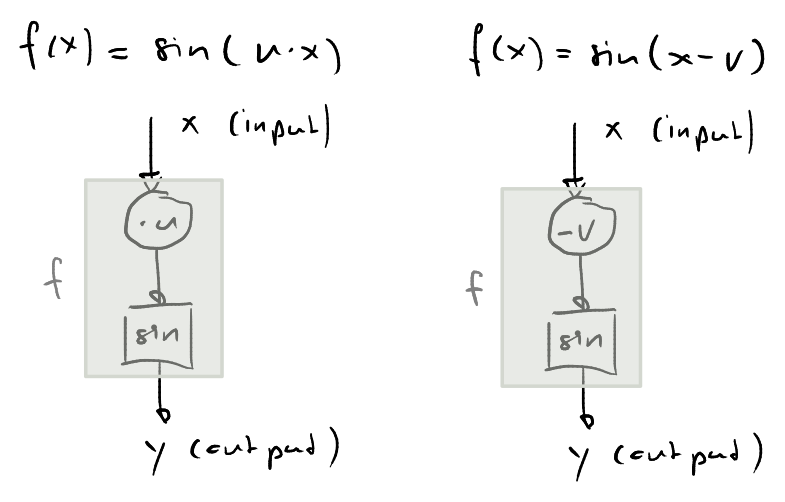
In fact, the effect of these modifications are quite counter-intuitive. For example, (that is, ) is a compressed version of the -graph, and not an elongated version, and (that is, ) moves the -graph to the left, and not to the right, which is quite unexpected. We can understand this by investigating the effect of the parameters and on the -intercepts of . This is shown in the example below:
We already know that the -intercepts of the function are
Determine the -intercepts of the function below by solving the equation
- , that is,
- , that is,
- , that is,
Determine in each case the geometric transformation that has to be applied to get from the -intercepts of to the -intercept of .
Solution
-
: We have to find with
We know this is the case if equals to . Thus find with
So if in an -intercepts of , then is an -intercept of . Clearly, the new -intercepts are obtains by stretched the old ones the factor in -direction.
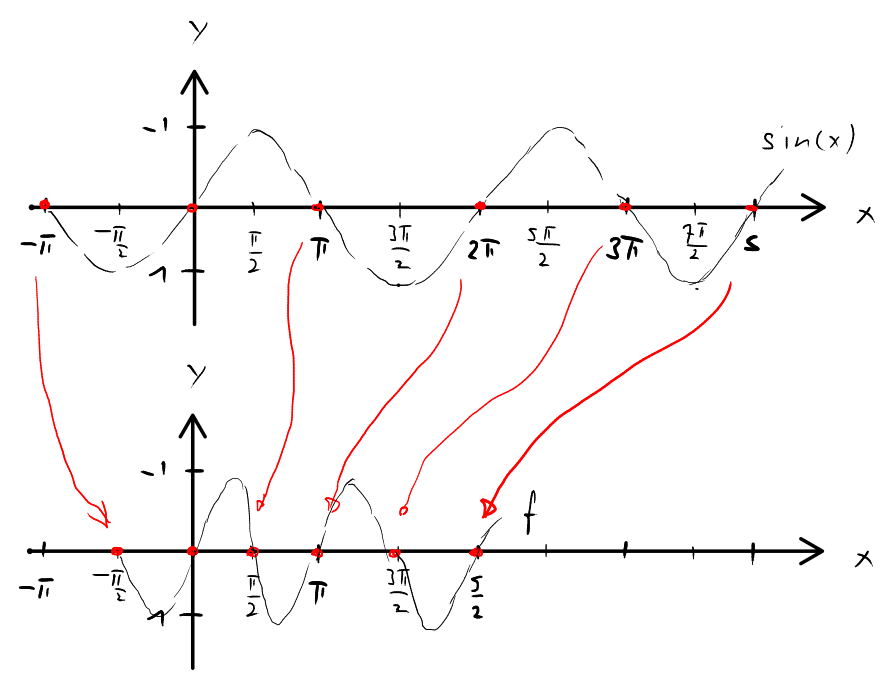
- : Similar, if is an -intercept of , then is an -intercept of if
and thus
So clearly, the -intercepts of are obtained by stretching the -intercepts of by the factor .
- : Similar, if is an -intercept of , then is an -intercept of if
and thus
So clearly, the -intercepts of are obtained by shifting the -intercepts of to the right by .
- : Similar, if is an -intercept of , then is an -intercept of if
and thus
So clearly, the -intercepts of are obtained by shifting the -intercepts of to the left by .
Another "strange" thing that needs some explaining is that the shift parameter is in a bracket
However, arguing in the same way as in the example above, we see that only if this is the case is it true that is "shifting to the right (or left) by . See the example below.
Consider the function . By solving the equation
show that we obtain the -intercepts of by stretching the -intercepts of by , and then shifting those to the right by .
Solution
Indeed, if is an -intercept of , that is, , then is an -intercept of if
because then we have . Thus, solving for , we get
In other words, we obtain the -intercepts of by stretching the -intercepts of by in -direction, and then shifting those to the right by .
Note that for the function we stretch the graph of in -direction by the factor , and then shift the resulting graph to the right by . Why? Because we can factor out the in the term and get
And now some exercises ...
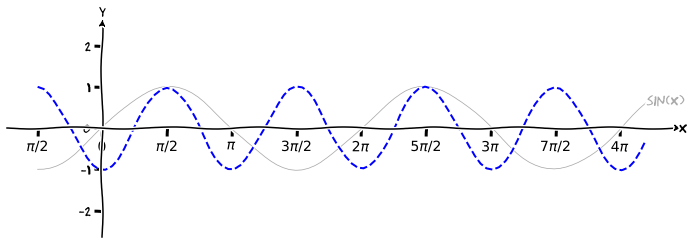
Find the function equation of the harmonic oscillation shown below (blue stippled line). To do so, identify the correct geometric transformations to get from the graph of (shown in gray) to the graph of .
Solution
No stretching in -direction, no shifting up or down.
-
Stretch in -direction by
-
Shift to the right by . Thus . Thus,
Find the geometric transformations to get from the graph of to the graph of ?
Draw the graph of by applying these transformations to the graph of .
Solution
We first write
so that we see that , and . Thus, the geometric transformations applied to the graph of are
- stretch in -direction by the factor , then
- stretch in -direction by the factor , then
- shift to the right by , then
- shift upwards by .
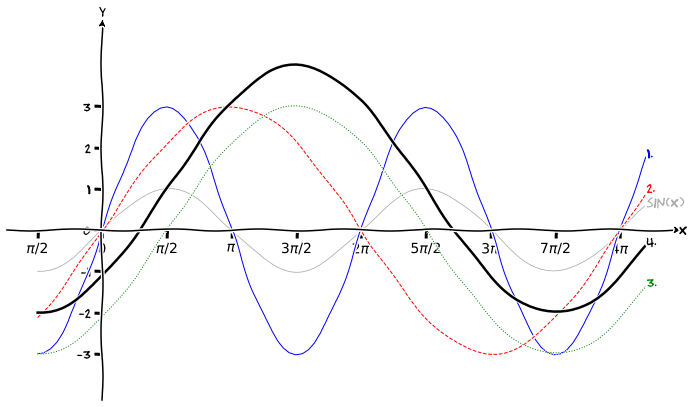
Find the -intercepts of the function using two methods:
-
calculation
-
geometrical
Solution
-
Calculation: has the -intercepts at
Thus, is an -intercept of if
and we see that -intercepts have to be
-
Geometrical: By writing , we see that , and . Thus the graph of is stretched in -direction by . Because has the -intercepts
the stretched graph has the -intercepts
Moreover, the stretched graph is moved to the right by , thus the new -intercepts are at
And indeed, we get the same -intercepts are before.