Why calculus?
Calculus consists of two parts: differential calculus and integral calculus. These two parts are used to solve complicated problems with a simple strategy:
First, divide the problem into little parts (differentiation), then solve the problem for these little parts, which is often easier, and then assemble the solved little parts to obtain the solution of the complex problem (integration).
We start the discussion with differential calculus, followed by integral calculus. But before we do this, let us give an example of how the strategy of dividing and assembling can solve a problem.
We know that the circumference of a circle of radius is . Use this information to infer the area of a circle of radius .
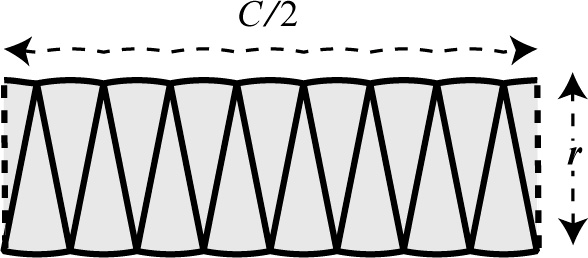
It was Archimedes who determined the area of a circle using this method.
In an another approach we divide the circle into concentric rings, which we straighten and arrange the resulting "rectangles" along the -axis.
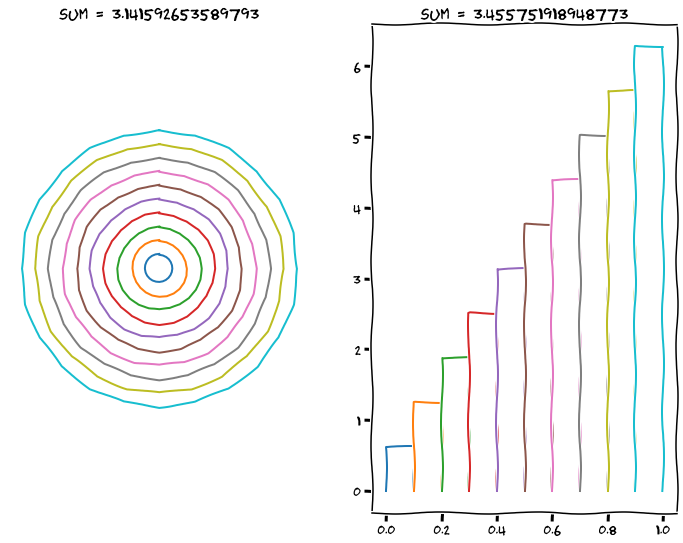
And this concludes this example.
Johann Kepler (1571 - 1630) studied the motion of our planets. He found that each planet moves along an ellipse around the sun, but with varying speed - the closer to the sun, the higher was the speed of the planet. But according to what rule did the speed change? Kepler found that a planet moves such that it covers an equal area any given time interval.
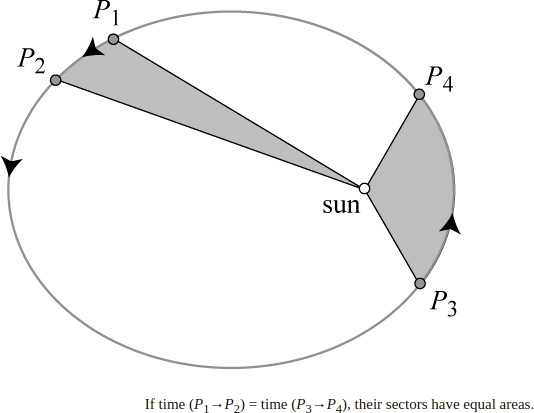
In order to find this law, he had to determine the area bounded by curved lines. Using a similar method as above, he divided the shaded region in small sections (which he approximated with triangles) and summed the triangle areas to find the total area.
And a final example.
A car moves along a straight road with a constant speed of . At time is the car at position . The speed-time diagram is therefore a horizontal line, as shown below (left):
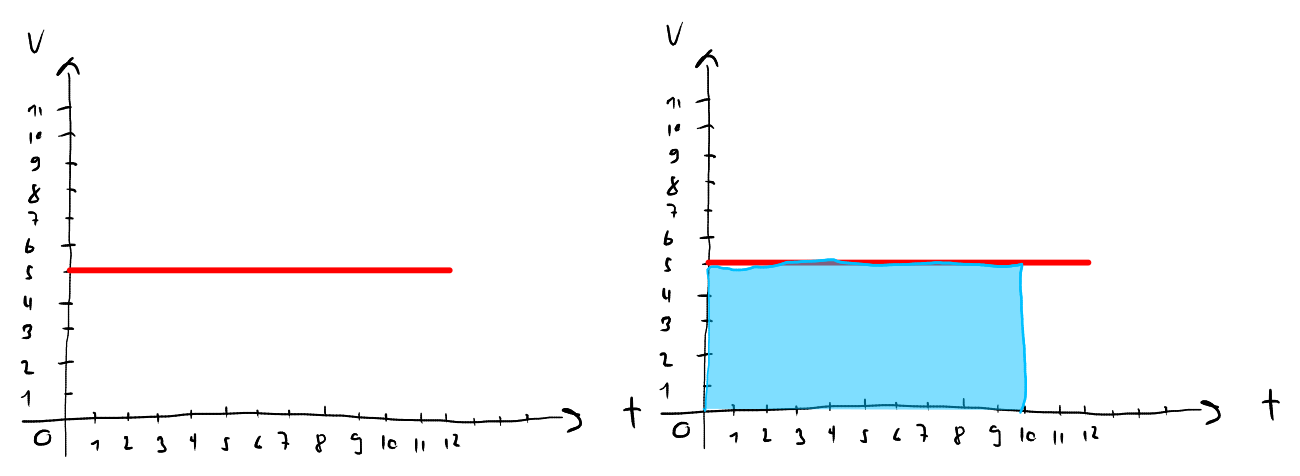
Where is the car after ? Because of
we know that this position is at . Note that the distance covered by the car in these is just the area below the horizontal line in the speed-time diagram (see picture above, right).
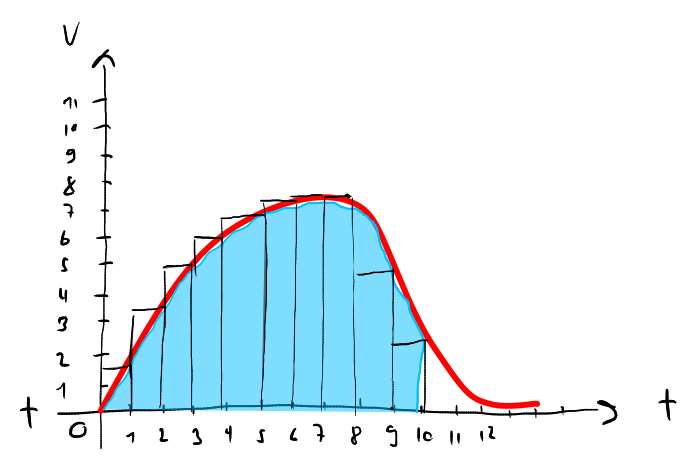
The same is true if the car moves at a variable speed along the road, for example like in the speed-time diagram shown below (left, the function is , which is not of further interest):
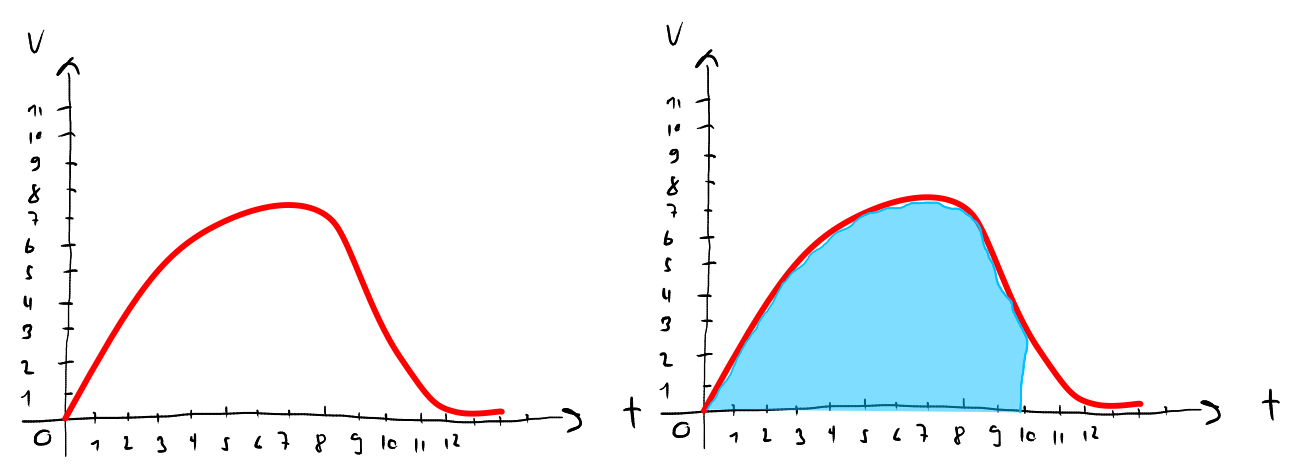
It is still true that the distance covered by the car during the time is given by the area under the curve in the speed-time diagram (see above, right). So we have to determine this area.
As as we have already done in the previous examples, we do this by dividing the area into small sub-areas (bars), and then sum these bar areas (see figure below). How we can do this, and how we can obtain the exact area in this way is discussed in calculus.
Another question we will also discussed is the meaning of an instantaneously changing velocity. Indeed, according to the curved graph above, the speed of the car changes from one moment to the next. How do we define a velocity at some moment in time? Velocity, by definition, is the distance travelled per some duration of time, not at some time. Again, calculus offers here a solution.