Tangents
Two important concepts in differential calculus are the tangent (this section) and the secant (next section).
Motivation
Finding the slope of a tangent is a fundamental problem in calculus because it allows us to describe the instantaneous rate of change of a curve at a specific point.
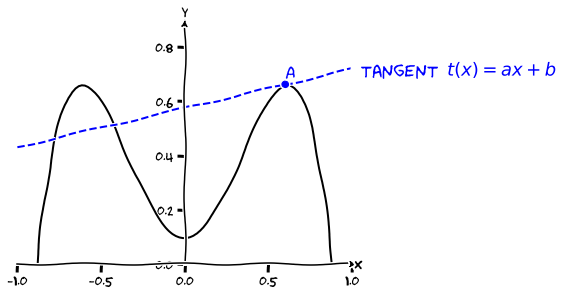
Consider a smooth curve (that is, a curve without corners) and a point on this curve. The tangent to this curve at point is the straight line that touches but does not cross the curve at . Thus, close to , the straight line stays on the same side of the curve. The equation of the tangent is the linear function
The equation of the tangent is the graph of a linear function
whose graph (a straight line) is the tangent. Recall that is the slope of the linear function, that is, the slope from the tangent.
Insight
While a tangent line is defined by having a touchpoint, it can intersect the curve elsewhere many times.
In rare cases we can determine the equation of the tangent directly, without the apparatus of calculus we will develop soon. See the example below:
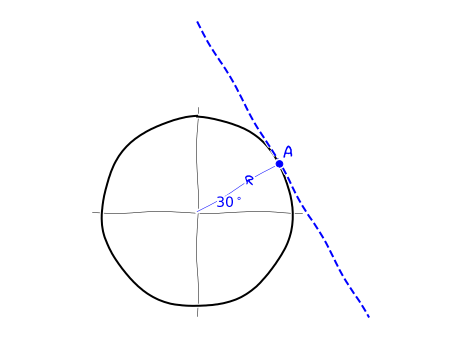
Let's find the tangent to a circle. Consider a circle with a radius of and a centre at . Point is on this circle at angle . Determine the equation of the tangent to the circle at .
Hint: SOHCAHTOA
Solution
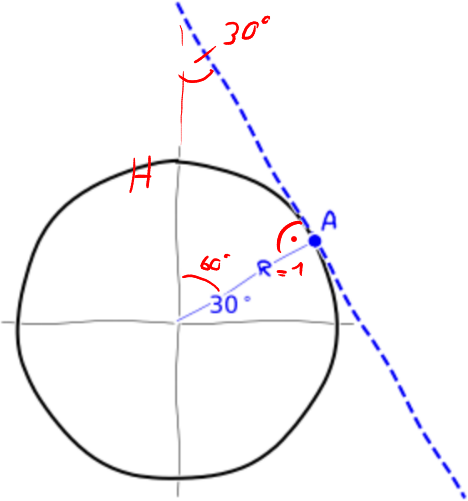
Note that at the radius and the tangent form a right angle. Thus we can apply SOHCAHTOA.
The equation of the tangent has the general form . For the slope it is (see figure below)
But we have to take the negative value for the slope, because the straight line is decreasing.
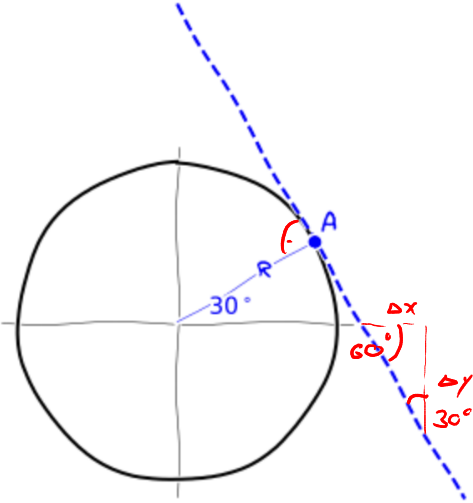
And if we regard as the hypotenuse (see picture below), we see that
and thus
Thus, the equation of the tangent is