Stationary points
We are often interested in the location of the highest and lowest points on the graph of a function (see for example the section about optimisation), or other special points.
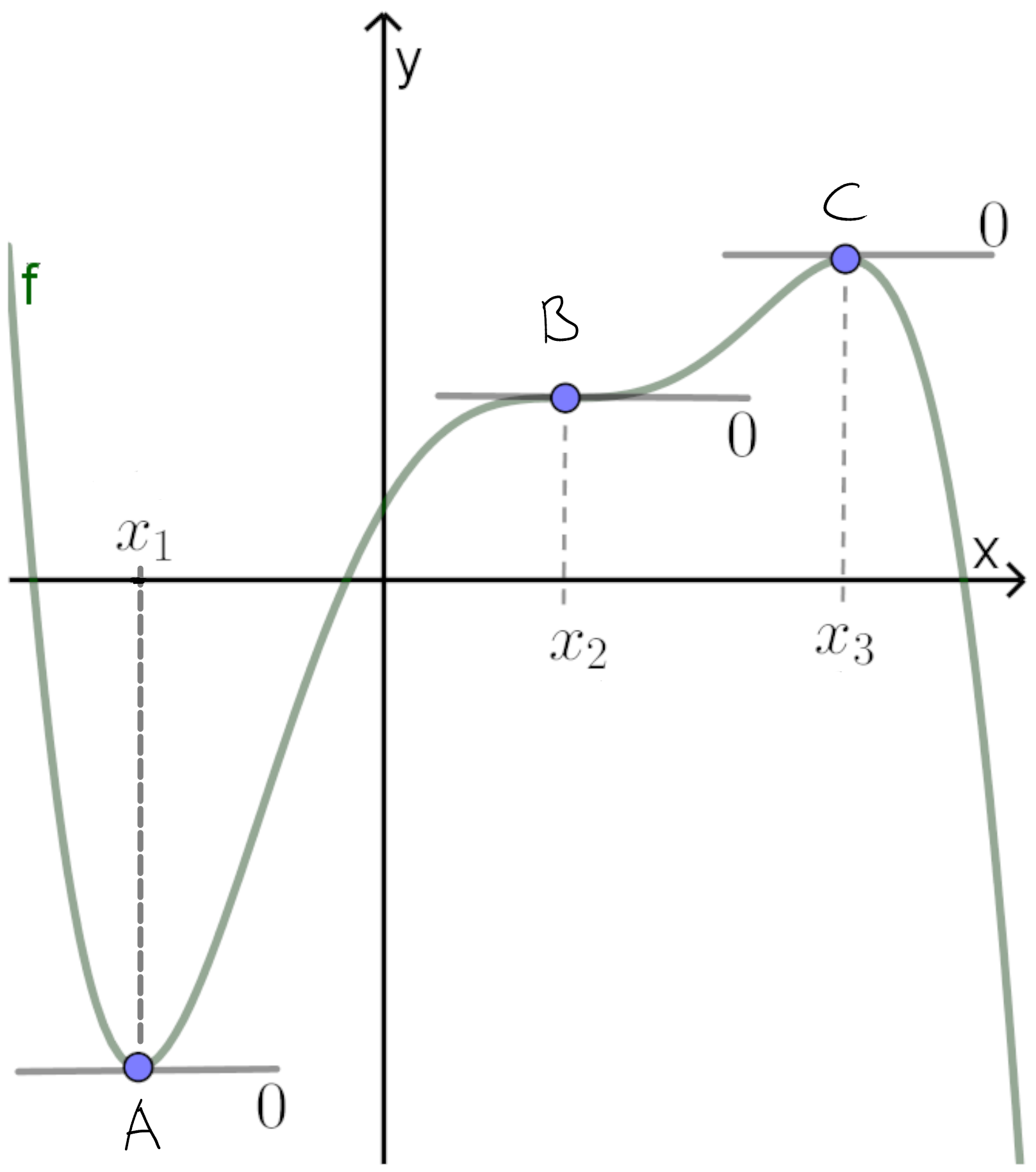
Consider the graph below. We call point a local minimum (or a high point), and point a local maximum (or a low point). We also call or a local extremum (or turning point). The plural forms are local maxima, local minima, and local extrema. Note that and are the highest and lowest points only in a local environment, that is, forms the top of a hill, and is at the bottom of a valley. Or to be more formal, is a local maximum because if we move along the graph away from this point (to the left or right) we go downwards. And is a local minimum because moving along the graph away from this point we go upwards.
Points on the graph where the tangent is horizontal are called stationary points. Local maxima and local minima are clearly stationary points. Their is also a third type of stationary point, called a saddle point, in the figure it is point . Moving along the graph to the left from such a point, we go downwards, moving to the right we go upwards (or vice versa).
Let's summarise:
Consider a function , and a point on the graph of . A point on the graph with -coordinate is a stationary point, if the tangent at is horizotnal, that is, we have
Stationary point at point with -coordinate
A stationary point is either a local extremum (local maximum or minimum), or a saddle point.
Find the stationary points of the function by calculation. Then draw the graph in order to classify the stationary points as local maximum, local minimum or saddle point.
Solution
To find the -coordinate of the stationary points, determine all values of with
Because , we have to find all values of with
Use the midnight formula to solve the equation or alternatively, observe that I can write
from which follows that and . With and , we get the stationary points and . From the drawing (not shown) follows that is a local maximum and is a local minimum.
Can we somehow determine the type of stationary point (maximum, minimum, saddle point)? This might be convenient if we cannot draw the graph, or if there are so many stationary points that it is hard to identify and classify all of them (e.g. plot the graph of the function ).
Fortunately, there are some simple criteria to classify stationary points.
Assume that is a point on the graph of the function . Then we have the following is true:
Classifying stationary points.
Proof
In order to see this, let's first have a closer look at the "hills" and "valleys" of a graph , and how their derivatives look like (see below). You can see that in the case of a valley, the graph of has a positive slope at the deepest point , that is, , and in the case of a hill, the graph of has a negative slope at the highest point , that is, .
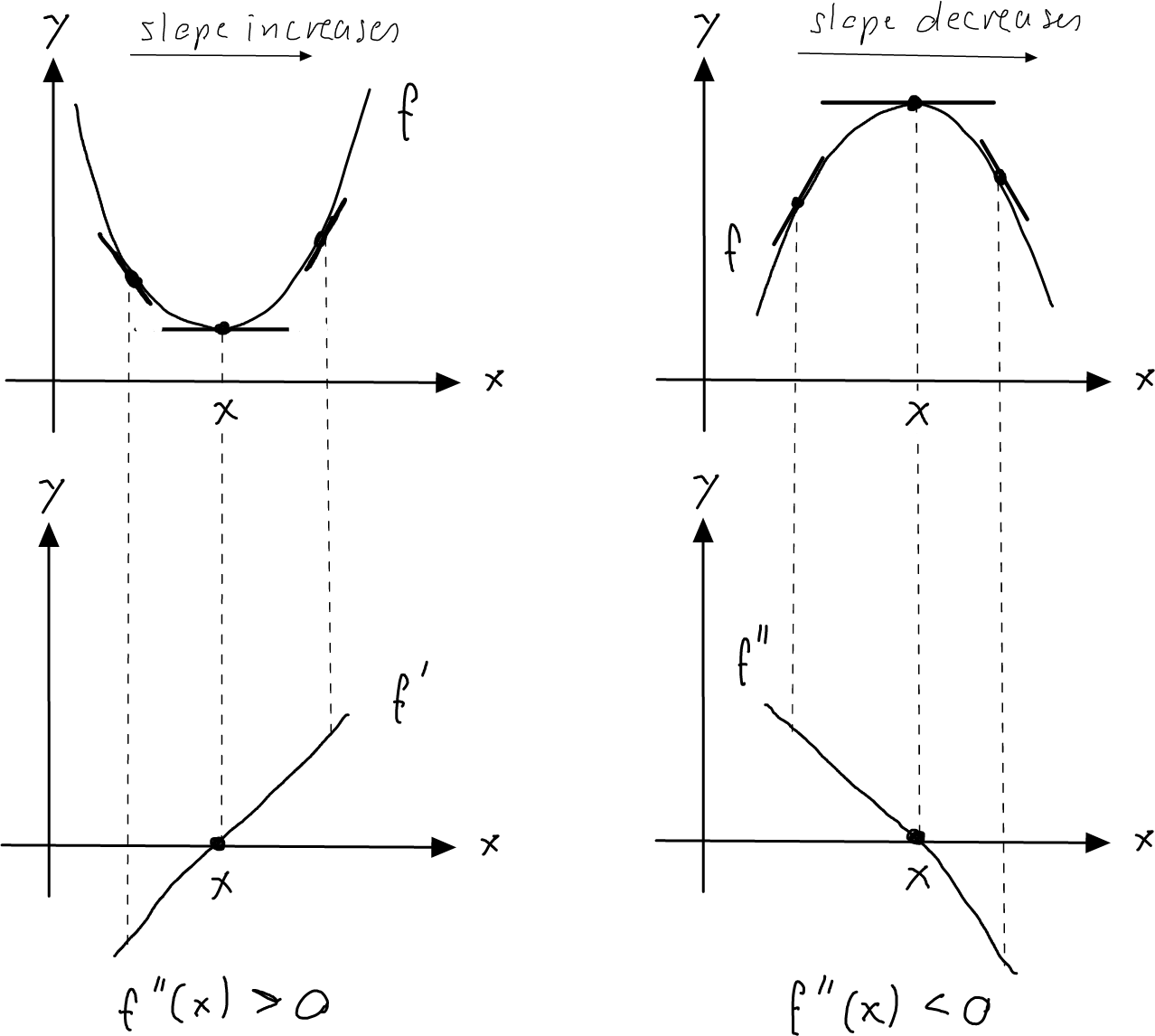
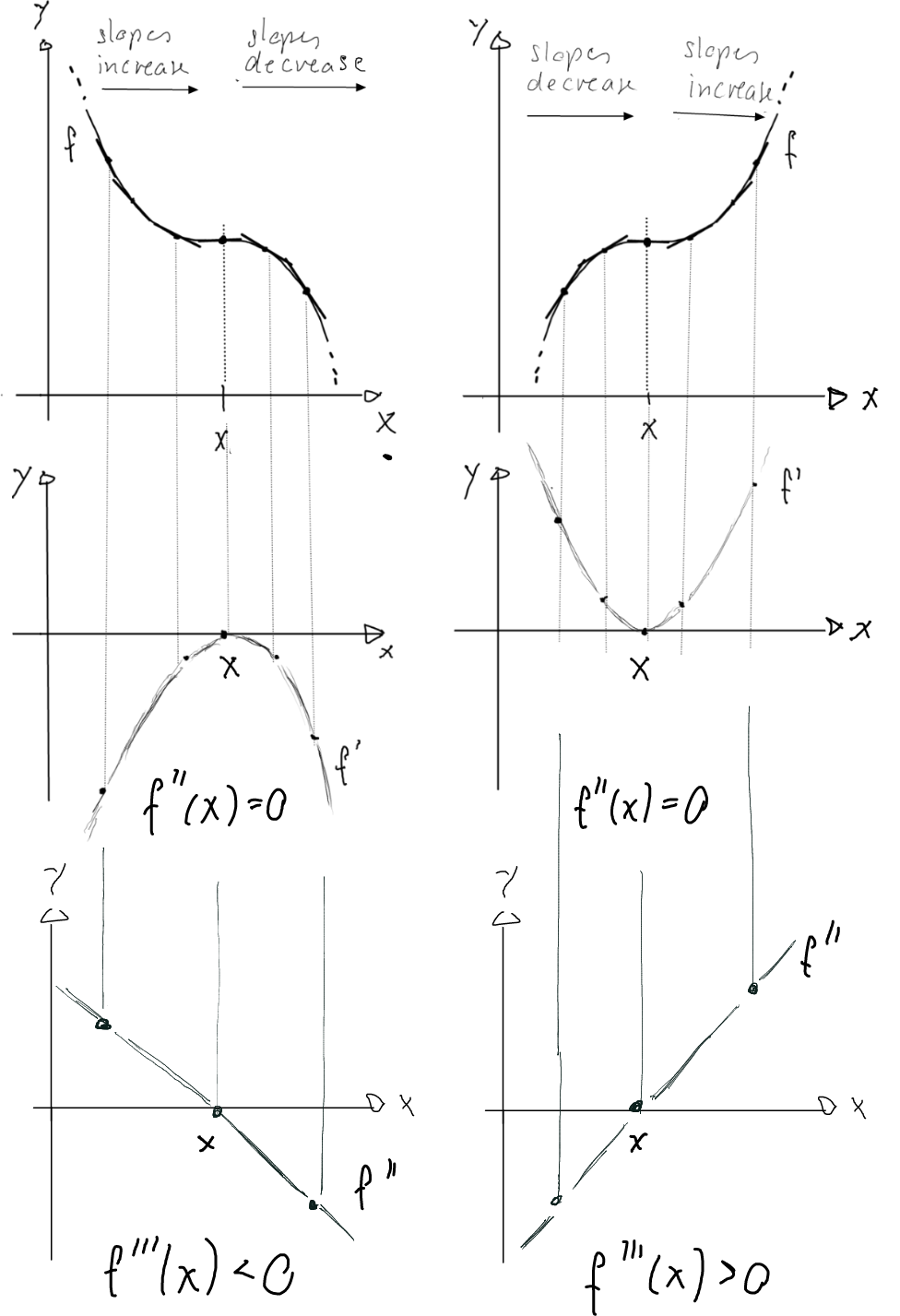
Looking at a saddle and inspecting the derivative, we see that has a horizontal tangent at the saddle point , and thus , but clearly .
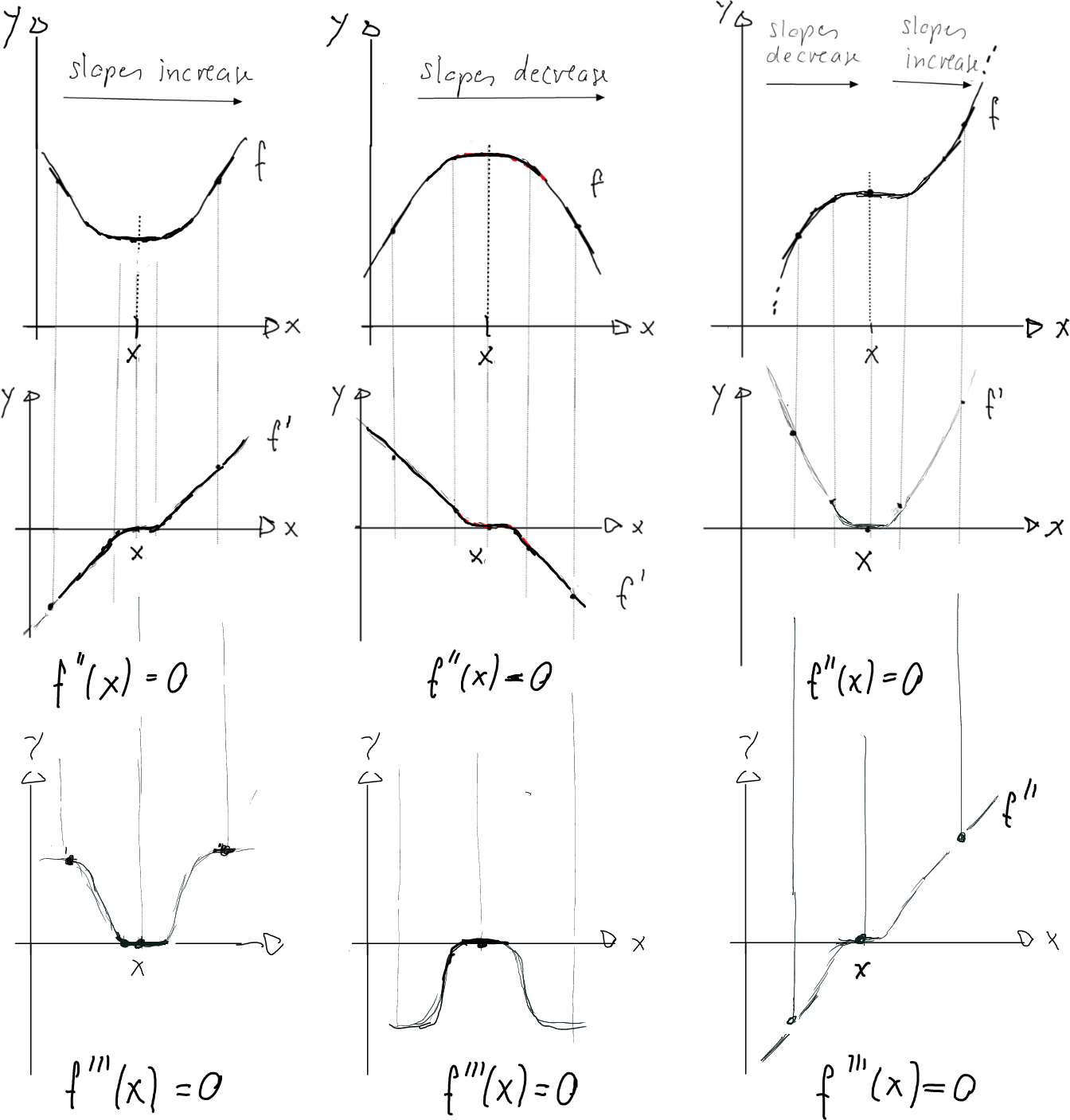
Finally, it if could either be a flat hill, flat valley, or flat saddle point (see figure below). In this case we have to draw the graph to decide if is a local maximum, local minimum, or saddle point.
- Determine by calculation the stationary points, and classify them using the criteria given above. Draw the graph with the calculator to verify your results.
- Consider the function , where is a fixed, but unknown number (a so called parameter).
-
Show that has a stationary point at for all values of .
-
For what values of does have a local maximum, a local minimum, or a saddle point at ?
-
Solution
-
It is
- Find stationary point : , thus . Type? Because local minimum.
- Find stationary point : , thus .Because and it is a saddle point.
- Find stationary point : , thus .Type? Because and . Draw graph "flat" local maximum.
- Find stationary point : , thus .Type? Because local maximum, local minimum, local minimum.
-
, ,
- For every fixed value of we have is stationary point for all values .
- at there is a local maximum for , and a local minimum for . For it is and , so at there is a saddle point.