Higher order derivatives

Definition 1

Consider a function ff and its derivative ff'. The derivative is often called the first derivative or first order derivative. As ff' is again a function, we can determine its derivative as well. We call this new function the second derivative or second order derivative. It is denoted by ff^{\prime\prime} (say: ff double prime). The third derivative or third order derivative is the derivative of the second derivative, and so on:

f = derivative of ff = derivative of ff = derivative of ff(4) = derivative of ff(5) = derivative of f(4)......\boxed{\begin{array}{ll} f^\prime & \text{ = derivative of $f$}\\ f^{\prime\prime} & \text{ = derivative of $f^{\prime}$}\\ f^{\prime\prime\prime} & \text{ = derivative of $f^{\prime\prime}$}\\ f^{(4)} & \text{ = derivative of $f^{\prime\prime\prime}$}\\ f^{(5)} & \text{ = derivative of $f^{(4)}$}\\ ... & ...\\ \end{array}}

Thus we have

Equation 1
fffff(4)f \overset{\prime}{\rightarrow} f^\prime \overset{\prime}{\rightarrow} f^{\prime\prime} \overset{\prime}{\rightarrow} f^{\prime\prime\prime} \overset{\prime}{\rightarrow} f^{(4)} \overset{\prime}{\rightarrow} \dots

Higher order derivatives

Example 1

Determine the sixth order derivative of the function f(x)=x4f(x)=x^4.

Show

f(x)=4x3f(x)=43x2=12x2f(x)=122x1=24xf(4)(x)=241x0=24f(5)(x)=0f(6)(x)=0\begin{array}{lll} f'(x) & = 4 x^3 &\\ f^{\prime\prime}(x) & = 4 \cdot 3 x^2 & = 12 x^2 \\ f^{\prime\prime\prime}(x) & = 12\cdot 2 x^1 & = 24 x \\ f^{(4)}(x) & = 24\cdot 1x^0 & =24 \\ f^{(5)}(x) & = 0 & \\ f^{(6)}(x) & = 0 & \\ \end{array}

Note that in the example above, f(x)=4x3f'(x)=4x^3 is the formula for calculating the slope of the tangents to the graph of ff. And similar, f(x)=12x2f^{\prime\prime}(x)=12x^2 is the formula for the slope of the tangents to the graph of ff', and f(x)=24xf^{\prime\prime\prime}(x)=24x is the formula for the slope of the tangents to the graph of ff^{\prime\prime}.

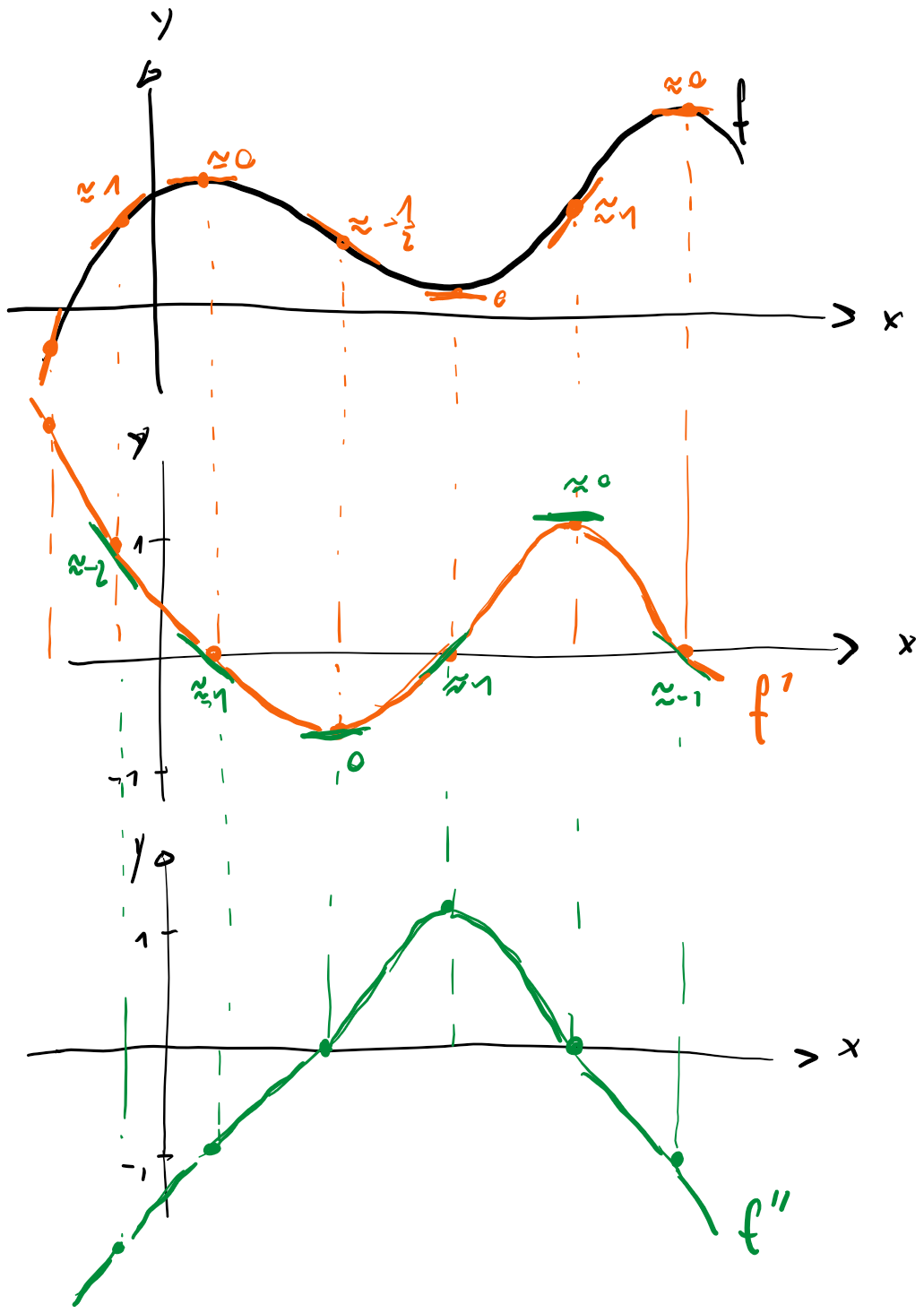
We can also find the higher order derivatives graphically. Given the graph of a function ff, we first sketch the graph ff', then using this graph to sketch the graph of ff^{\prime\prime}, and so on.

Example 2

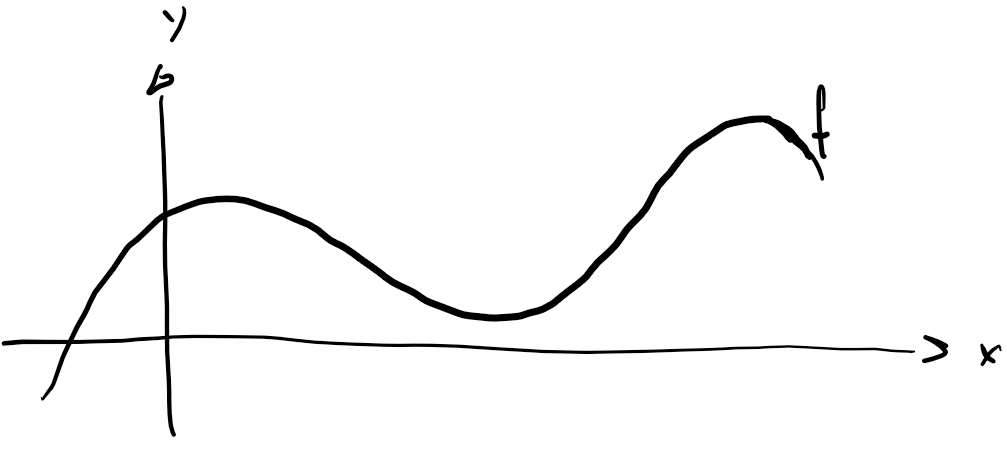
The graph of a function ff is shown below. Copy the graph (more or less), and sketch the graphs of ff' and ff^{\prime\prime}.

Solution
Exercise 1
  1. Determine f(4)f^{(4)}:

    1. f(x)=x7f(x)=x^7
    2. g(x)=exg(x)=e^x
    3. h(x)=sin(x)h(x)=\sin(x)
    4. k(x)=ln(x)k(x)=\ln(x)
    5. m(x)=xxm(x)=\sqrt{x}\cdot x
  2. Consider the function f(x)=3x45x3+2x2+1f(x)=3x^4-5x^3+2x^2+1. Determine f(1)f^{\prime\prime\prime}(1).

Solution
  1. It is
    1. f(x)=x7f(x)=7x6f(x)=76x5=42x5f(x)=425x4=210x4f(4)(x)=2104x3=840x3f(x)=x^7\rightarrow f^\prime(x)=7x^6\rightarrow f^{\prime\prime}(x)=7\cdot 6x^5=42x^5 \rightarrow f^{\prime\prime\prime}(x)=42\cdot 5x^4=210x^4\rightarrow f^{(4)}(x)=210\cdot 4x^3=\underline{840 x^3}
    2. g(x)=exg(x)=g(x)=g(x)=g(4)(x)=exg(x)=e^x \rightarrow g^\prime(x)=g^{\prime\prime}(x)=g^{\prime\prime\prime}(x)=g^{(4)}(x)=\underline{e^x}
    3. h(x)=sin(x)h(x)=cos(x)h(x)=sin(x)h(x)=cos(x)h(4)(x)=(sin(x))=sin(x)h(x)=\sin(x) \rightarrow h^\prime(x)=\cos(x)\rightarrow h^{\prime\prime}(x)=-\sin(x) \rightarrow h^{\prime\prime\prime}(x)=-\cos(x) \rightarrow h^{(4)}(x)=-(-\sin(x))=\underline{\sin(x)} ... and it begins again!
    4. k(x)=ln(x)k(x)=1x=x1k(x)=1x2=x2k(x)=(2x3)=2x3k(4)(x)=2(3x4)=6x4=6x4k(x)=\ln(x) \rightarrow k^\prime(x)=\frac{1}{x}=x^{-1}\rightarrow k^{\prime\prime}(x)=-1x^{-2}=-x^{-2} \rightarrow k^{\prime\prime\prime}(x)=-(-2x^{-3})=2x^{-3} \rightarrow k^{(4)}(x)=2(-3x^{-4})=-6x^{-4}=\underline{-\frac{6}{x^4}}
    5. m(x)=xx=x1.5m(x)=1.5x0.5m(x)=0.75x0.5m(x)=0.375x1.5m(4)=0.5625x2.5m(x)=\sqrt{x}\cdot x = x^{1.5} \rightarrow m^\prime(x)=1.5x^{0.5} \rightarrow m^{\prime\prime}(x)=0.75 x^{-0.5} \rightarrow m^{\prime\prime\prime}(x)=-0.375x^{-1.5} \rightarrow m^{(4)}=\underline{0.5625 x^{-2.5}}
  2. f(x)=3x45x3+2x2+1f(x)=12x315x2+4xf(x)=36x230x+4f(x)=72x30f(1)=72130=42f(x)=3x^4-5x^3+2x^2+1 \rightarrow f^\prime(x)=12x^3-15x^2+4x \rightarrow f^{\prime\prime}(x)=36x^2-30x+4 \rightarrow f^{\prime\prime\prime}(x)=72x-30 \rightarrow f^{\prime\prime\prime}(1)=72\cdot 1-30=\underline{42}