Vector operations

Adding a vector to a point

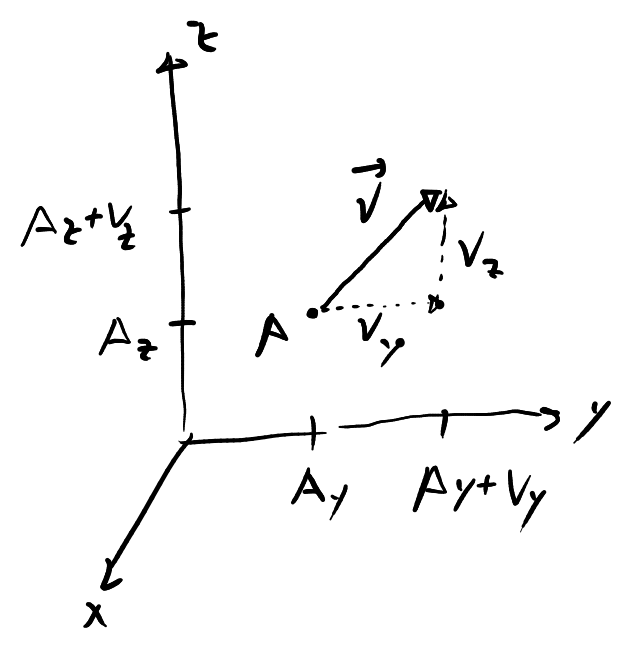
Consider a point AA and a vector v\vec v. What do we mean with Adding a vector to a point? If we start at point AA and follow the instructions given by vector v\vec v

ABAx+vxAx+vxAy+vyAy+vyAz+vzAz+vz\begin{array}{lcl} A & \rightarrow & B \\ \hline A_x & \overset{+v_x}{\rightarrow} & A_x+v_x \\ A_y & \overset{+v_y}{\rightarrow} & A_y+v_y \\ A_z & \overset{+v_z}{\rightarrow} & A_z+v_z \\ \end{array}

we end up at new point with the coordinates

(Ax+vxAy+vyAz+vz)(A_x+v_x \vert A_y+v_y \vert A_z + v_z)

We denote this new point by

A+v\boxed{A+\vec v}

or, if give it a new name, e.g. BB, we write

B=A+vB = A+\vec v

Adding two vectors

Consider two vectors u\vec u and v\vec v. The sum of the two vectors, denoted by

u+v\boxed{\vec u+\vec v}

is a new vector with the components

u+v=(ux+vxuy+vyuz+vz)\vec u+\vec v = \left(\begin{array}{r} u_x+v_x\\ u_y+v_y\\ u_z+v_z \end{array}\right)

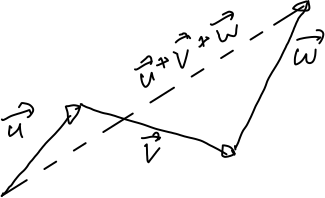
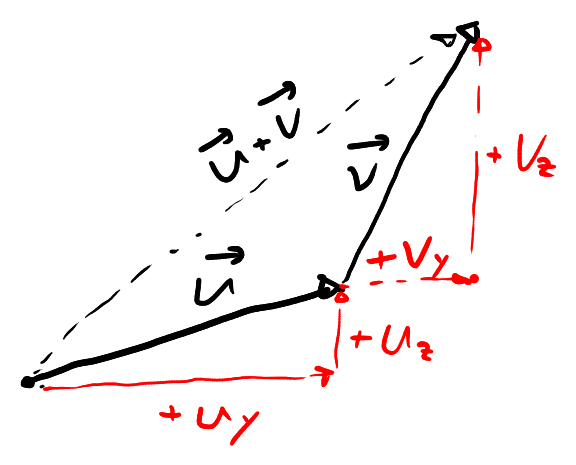
What is the relationship between the arrows represented by u\vec u, v\vec v, and u+v\vec u+\vec v? We can actually construct an arrow of u+v\vec u+\vec v with the help of the arrows of u\vec u and v\vec v as follows:

This construction is called completing the triangle.
Note: To find the arrow that is represented by the sum of three vectors u+v+w\vec u+\vec v+\vec w, we form a chain of the arrows (attach the tail of v\vec v to the head of u\vec u, and the tail of w\vec w to the head of v\vec v) and form the arrow from the tail of u\vec u to the head of

Subtracting two vectors

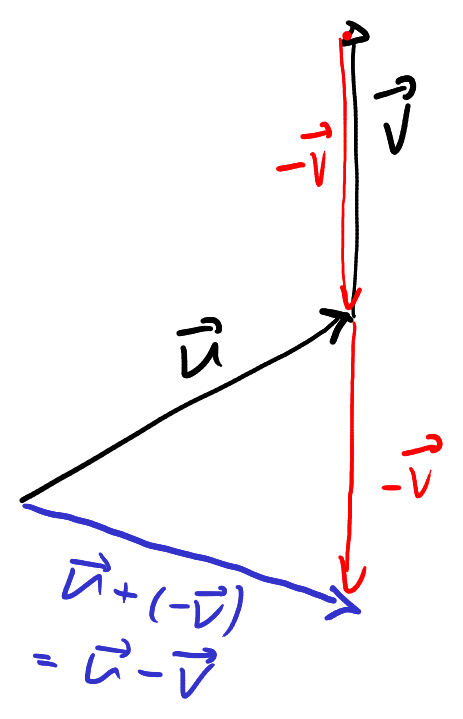
The subtraction of \vec v from \vec u is defined as adding to u\vec u the opposite vector of v\vec v:

uv=u+(v)\boxed{\vec u-\vec v = \vec u+ (-\vec v)}

The components are therefore

uv=(uxvxuyvyuzvz)\vec u - \vec v = \left(\begin{array}{r} u_x-v_x\\ u_y-v_y\\ u_z-v_z \end{array}\right)

It also follows that we can construct the arrow representing the vector uv\vec u-\vec v by simply completing the triangle of the vectors u\vec u and v-\vec v. Recall that the arrow of v-\vec v is obtained by reflecting the arrow of v\vec v about its tail.

Multiplication of a vector with a scalar

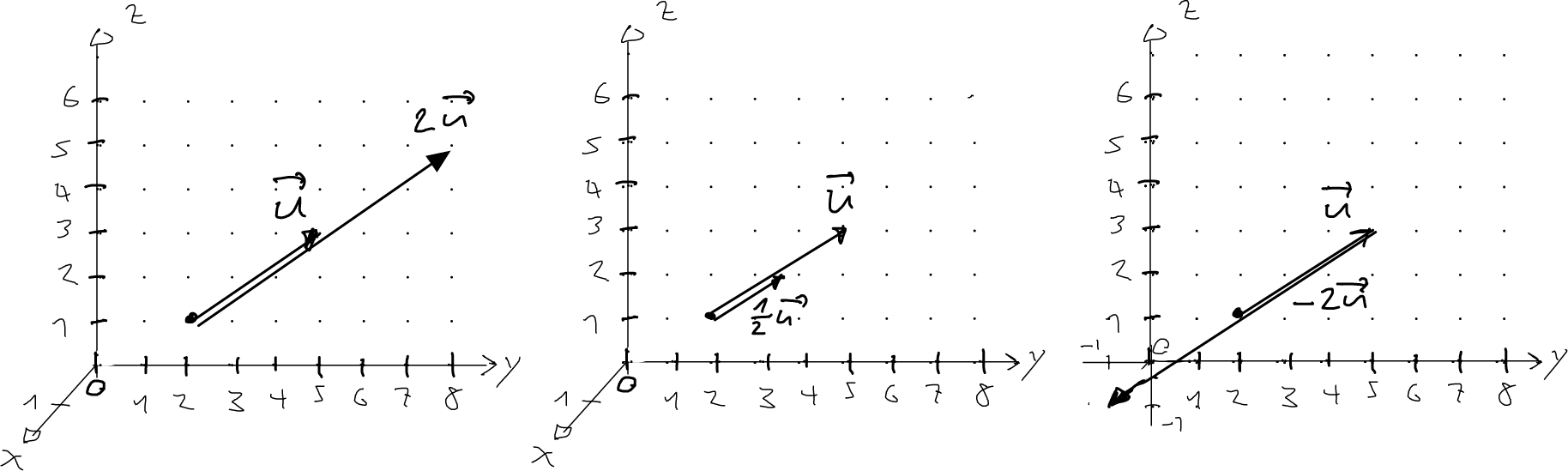
Consider a vector u\vec u and a constant cc, where cc can by any real number. In the context of vectors, a number is called a scalar. The multiplication of c with \vec u, denoted by

cu\boxed{c\cdot \vec{u}}

is defined as the vector with the components

cu=(cuxcuycuz)c\cdot \vec u = \left(\begin{array}{r} c\cdot u_x\\ c \cdot u_y\\ c \cdot u_z \end{array}\right)

Thus each component of u\vec u is multiplied by the constant cc. Make sure you understand that

Exercise 1
Q1

Consider the vector u=(221)\vec{u}=\left(\begin{array}{r} -2\\ 2\\ -1 \end{array}\right) Determine the vector v=3u\vec{v} = 3\cdot \vec{u} and verify that the magnitude of v\vec v is 33 times bigger than the magnitude of u\vec{u}.

Q2

Show that 0a0\cdot \vec{a} is the zero vector.

Q3

Show that 4(5a)=20a4\cdot (5\cdot \vec{a})=20\cdot \vec{a}

Q4

Show the following:

  1. a+b=b+a\vec{a}+\vec{b}=\vec{b}+\vec{a}
  2. a+(b+c)=(a+b)+c\vec{a}+(\vec{b}+\vec{c})=(\vec{a}+\vec{b})+\vec{c}
  3. ba\vec{b}-\vec{a} is the opposite vector of ab\vec{a}-\vec{b}
  4. a+a=2a\vec{a}+\vec{a}=2 \vec{a}
  5. 4a+6a=10a4 \vec{a} + 6 \vec{a} =10 \vec{a}
  6. 4a6a=2a4 \vec{a} - 6 \vec{a} =-2 \vec{a}
  7. 3(a+b)=3a+3b3 (\vec{a} +\vec{b}) =3 \vec{a}+3 \vec{b}
Q5

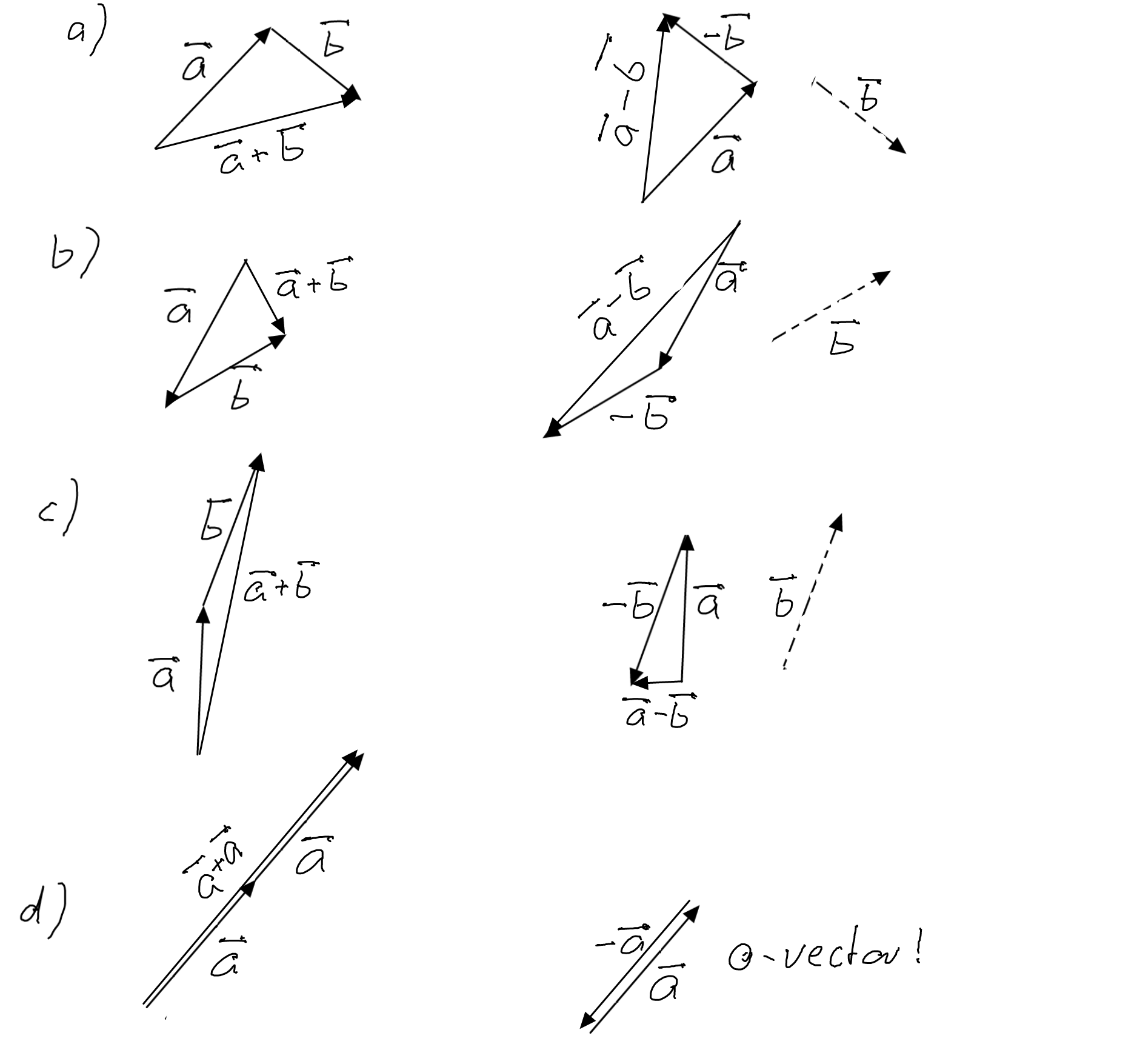
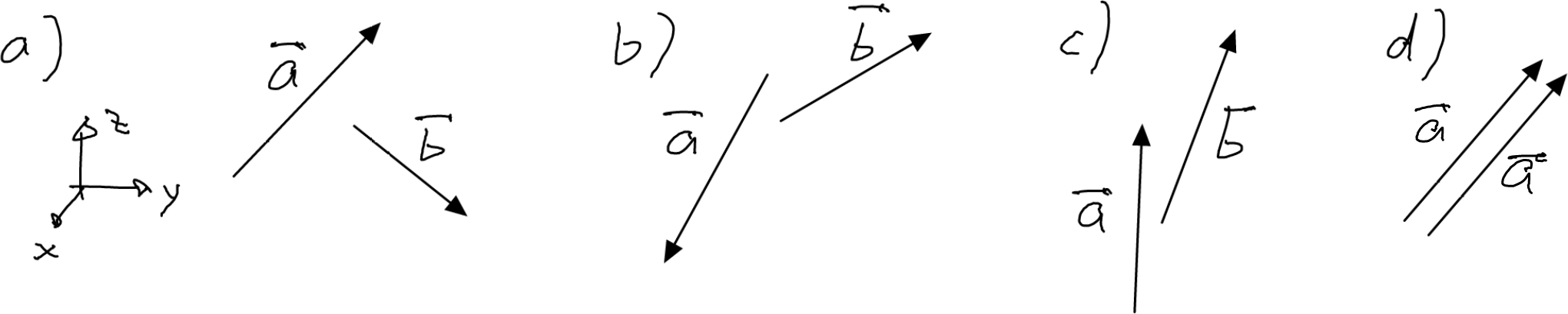
Construct arrows that represent the following vectors: a+b\vec{a}+\vec{b}, ab\vec{a}-\vec{b}, where all the arrows are in the yz-plane.
Q6

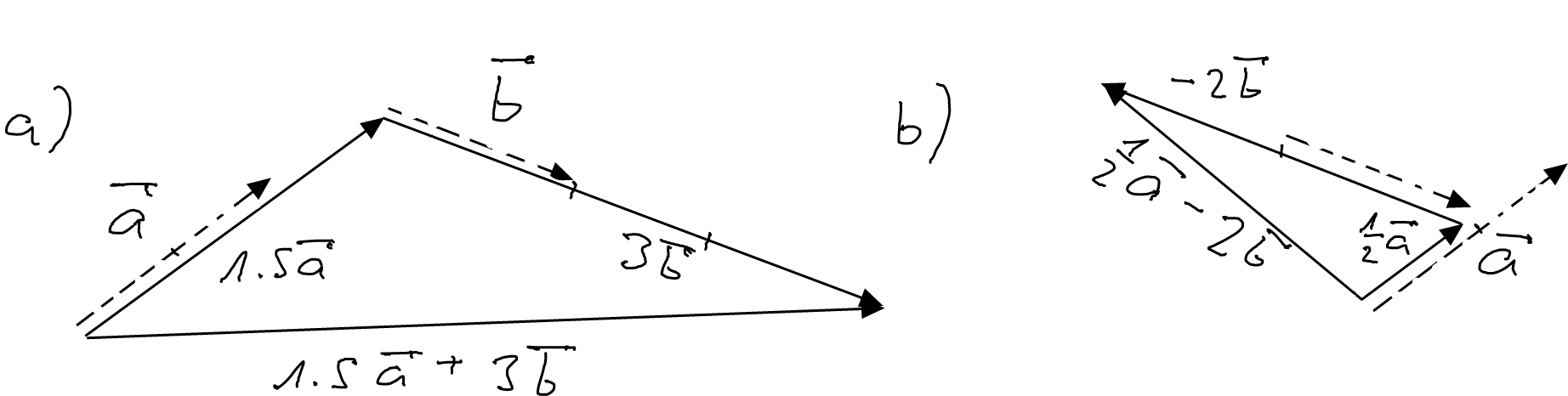
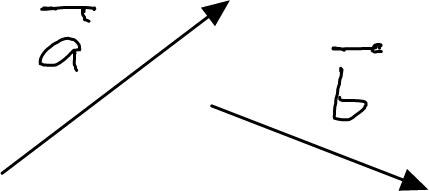
Construct arrows that represent the following vectors: 1.5a+3b1.5\vec{a}+3\vec{b}, 0.5a2b0.5\vec{a}-2\vec{b}, where all the arrows are in the yz-plane.
Q7

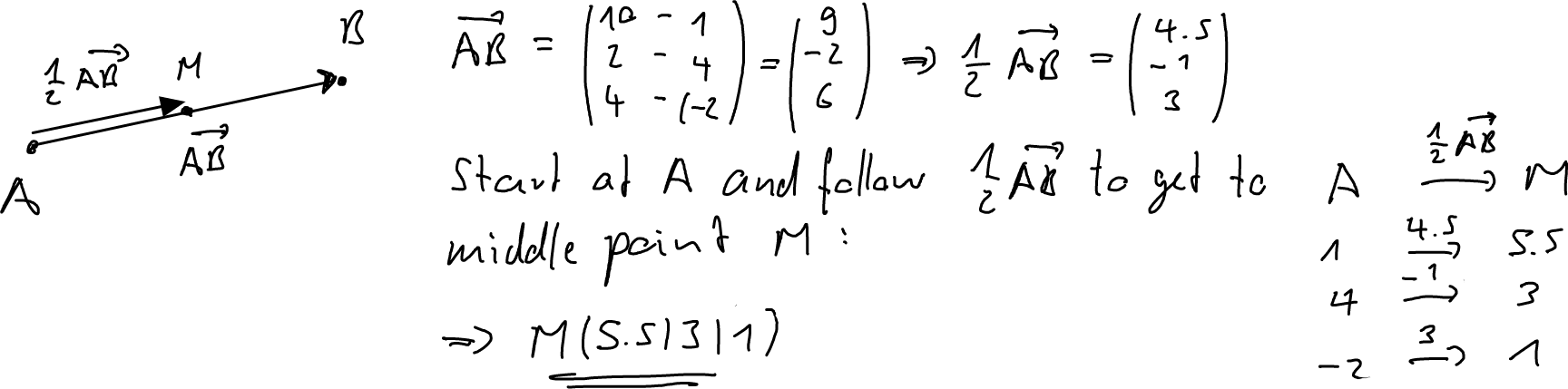
Find the point in the middle between the two points A(142)A(1\vert 4\vert -2) and B(1024)B(10 \vert 2 \vert 4).

Q8

Consider the vectors a=(121)\vec{a}=\left(\begin{array}{r} 1\\ -2\\ 1 \end{array}\right) and b=(231)\vec{b}=\left(\begin{array}{r} 2\\ 3\\ -1 \end{array}\right).

  1. Determine a+b\vert \vec a + \vec b \vert and show that this is not a+b\vert \vec a \vert + \vert \vec b \vert.

  2. Indeed, use a figure to show that for any two vectors a\vec a and b\vec b it is always true that a+ba+b\vert \vec a + \vec b \vert \leq \vert \vec a \vert + \vert \vec b \vert. For what vectors is a+b=a+b\vert \vec a + \vec b \vert = \vert \vec a \vert + \vert \vec b \vert?

  3. Determine ab\vert \vec a - \vec b \vert. Again, show that abab\vert \vec a - \vec b \vert \neq \vert \vec a \vert - \vert \vec b \vert.

  4. Determine the unit vector of a\vec a (that is, a vector of length one pointing in the same direction as a\vec a).

Solution
A1

u=(2)2+22+(1)2=3\vert\vec{u}\vert=\sqrt{(-2)^2+2^2+(-1)^2}=3, v=3u=(663)v=(6)2+62+(3)2=9\vec v = 3\cdot \vec u = \left(\begin{array}{r} -6\\ 6\\ -3 \end{array}\right) \rightarrow \vert \vec{v}\vert =\sqrt{(-6)^2+6^2+(-3)^2}=9. So indeed, three times bigger.

A2

0a=(0ax0ay0az)=(000)0\cdot \vec{a}=\left(\begin{array}{r} 0\cdot a_x\\ 0\cdot a_y\\ 0\cdot a_z \end{array}\right) = \left(\begin{array}{r} 0\\ 0\\ 0 \end{array}\right)

A3

4(5a)=4(5ax5ay5az)=(20ax20ay20az)=20a4\cdot (5\cdot \vec{a})= 4\cdot \left(\begin{array}{r} 5\cdot a_x\\ 5\cdot a_y\\ 5\cdot a_z \end{array}\right) = \left(\begin{array}{r} 20\cdot a_x\\ 20\cdot a_y\\ 20\cdot a_z \end{array}\right)= 20\cdot \vec{a}

A4
  1. a+b=(ax+bxay+byaz+bz)=(bx+axby+aybz+az)=b+a\vec{a}+\vec{b}=\left(\begin{array}{r} a_x+b_x\\ a_y+b_y\\ a_z+b_z \end{array}\right) =\left(\begin{array}{r} b_x+a_x\\ b_y+a_y\\ b_z+a_z \end{array}\right) =\vec{b}+\vec{a}
  2. a+(b+c)=a+(bx+cxby+cybz+cz)=(ax+bx+cxay+by+cyaz+bz+cz)\vec{a}+(\vec{b}+\vec{c})=\vec{a}+\left(\begin{array}{r} b_x+c_x\\ b_y+c_y\\ b_z+c_z \end{array}\right) = \left(\begin{array}{r} a_x+b_x+c_x\\ a_y+b_y+c_y\\ a_z+b_z+c_z \end{array}\right) and similar, (a+b)+c=(ax+bxay+byaz+bz)+c=(ax+bx+cxay+by+cyaz+bz+cz)(\vec{a}+\vec{b})+\vec{c}=\left(\begin{array}{r} a_x+b_x\\ a_y+b_y\\ a_z+b_z \end{array}\right)+\vec{c}=\left(\begin{array}{r} a_x+b_x+c_x\\ a_y+b_y+c_y\\ a_z+b_z+c_z \end{array}\right), so the same vectors.
  3. ba=(bxaxbyaybzaz)=((axbx)(ayby)(azbz))=(ab)\vec{b}-\vec{a}=\left(\begin{array}{r} b_x-a_x\\ b_y-a_y\\ b_z-a_z \end{array}\right)=\left(\begin{array}{r} -(a_x-b_x)\\ -(a_y-b_y)\\ -(a_z-b_z) \end{array}\right)=-(\vec{a}-\vec{b}), and this is the opposite vector of ab\vec{a}-\vec{b}
  4. a+a=(ax+axay+ayaz+az)=(2ax2ay2az)=2a\vec{a}+\vec{a}=\left(\begin{array}{r} a_x+a_x\\ a_y+a_y\\ a_z+a_z \end{array}\right)=\left(\begin{array}{r} 2 a_x \\ 2 a_y\\ 2 a_z \end{array}\right)=2 \vec{a}
  5. 4a+6a=(4ax+6ax4ay+6ay4az+6az)=10a4 \vec{a} + 6 \vec{a} =\left(\begin{array}{r} 4a_x+6a_x\\ 4a_y+6a_y\\ 4a_z+6a_z \end{array}\right) = 10 \vec{a}
  6. 4a6a=(4ax6ax4ay6ay4az6az)=2a4 \vec{a} - 6 \vec{a} =\left(\begin{array}{r} 4a_x-6a_x\\ 4a_y-6a_y\\ 4a_z-6a_z \end{array}\right) =-2 \vec{a}
  7. 3(a+b)=3(ax+bxay+byaz+bz)=(3(ax+bx)3(ay+by)3(az+bz))=(3ax+3bx3ay+3by3az+3bz)=3a+3b3 (\vec{a} +\vec{b}) = 3\left(\begin{array}{r} a_x+b_x\\ a_y+b_y\\ a_z+b_z \end{array}\right) = \left(\begin{array}{r} 3(a_x+b_x)\\ 3(a_y+b_y)\\ 3(a_z+b_z) \end{array}\right) = \left(\begin{array}{r} 3a_x+3b_x\\ 3a_y+3b_y\\ 3a_z+3b_z \end{array}\right) =3\vec{a}+3 \vec{b}
A5
A6
A7
A8
  1. a+b=(310)a+b=32+12+02=10\vec a + \vec b = \left(\begin{array}{r} 3\\ 1\\ 0 \end{array}\right) \rightarrow \vert \vec a + \vec b \vert = \sqrt{3^2+1^2+0^2}=\sqrt{10}. But a+b=6+1410\vert \vec a \vert + \vert \vec b \vert = \sqrt{6} +\sqrt{14} \neq \sqrt{10}.
  2. Follows immediately from the completion of the triangle figure. The equation holds if the two vectors are parallel and pointing in the same direction.
  3. ab=(152)ab=(1)2+(5)2+22=30\vec a - \vec b = \left(\begin{array}{r} -1\\ -5\\ 2 \end{array}\right) \rightarrow \vert \vec a - \vec b \vert = \sqrt{(-1)^2+(-5)^2+2^2}=\sqrt{30}. But ab=61430\vert \vec a \vert - \vert \vec b \vert = \sqrt{6} -\sqrt{14} \neq \sqrt{30}
  4. As a=6\vert \vec a \vert =\sqrt{6}, the length of arrow a\vec a is 6\sqrt{6}. As multiplying a\vec a the scalar c=16c=\frac{1}{\sqrt{6}} makes the arrow cc times "longer", the resulting length will be 11. Thus, the unit vector is 16a=(1/62/61/6)\frac{1}{\sqrt{6}}\cdot \vec a = \left(\begin{array}{r} 1/\sqrt{6}\\ -2/\sqrt{6}\\ 1/\sqrt{6} \end{array}\right)