Special vectors
The zero vector
The zero vector is the vector with the components
Moving from head to tail along the zero-vector means moving not at all, as the tail and head occupy the same location. Clearly, the magnitude of the zero vector is .
The unit vector
Generally speaking, a unit vector is a vector of magnitude . The unit vector of another vector is the vector that points into the same direction as and has magnitude .
The opposite vector
Consider a vector
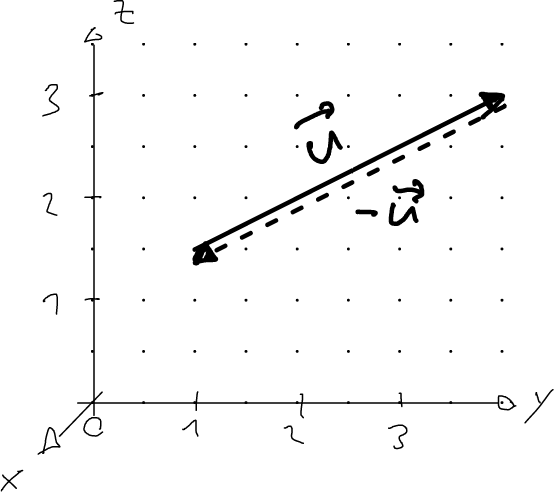
The opposite vector of , written , has the components
Clearly, the components of the opposite vector of describe how to get from the head to the tail of the arrow represented by .
The position vector of a point
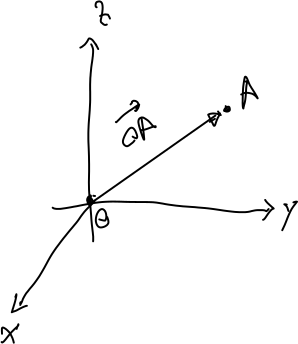
The vector from the coordinate origin to a point is called the position vector of , and clearly has the components
Instead of we also use the notation .
Q1
Determine the opposite vector of .
Q2
- Determine the magnitude of the zero vector.
- How many other vectors of magnitude do exist?
Q3
- Determine a unit vector with at least non-zero components.
- How many unit vectors exist? If you attach the arrow of all these vectors to the origin, what geometrical object is formed by the arrow heads?
Q4
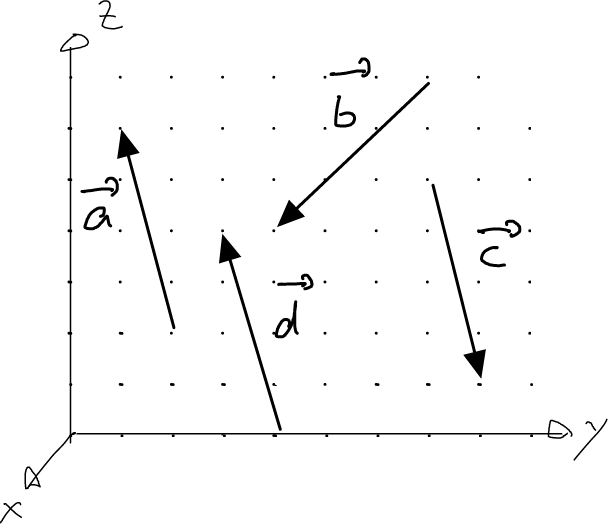
Consider the arrows in the -plane shown below.
- Which of these arrows are formed by the opposite vector of ?
- Which of these arrows have the same components?
- Also, determine the components of all the arrows, and also of .
Q5
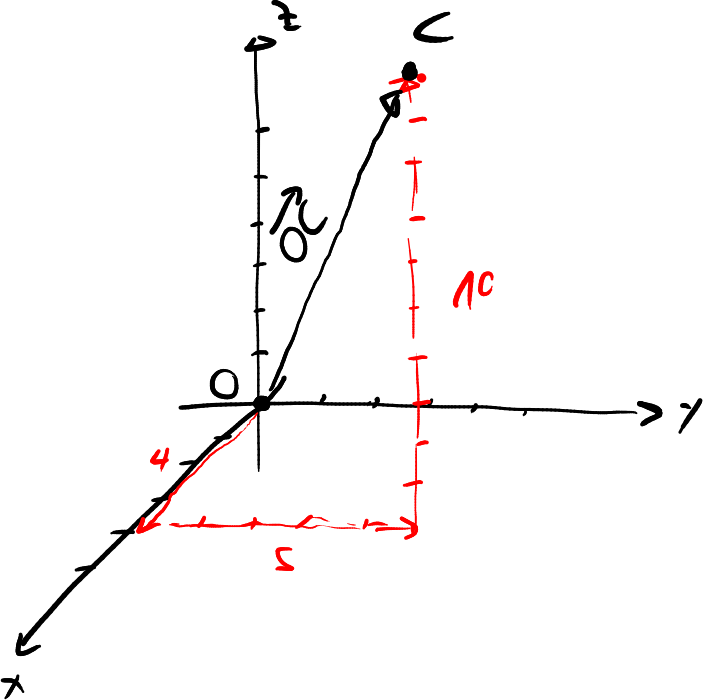
Determine the position vector of and indicate it in a 3d-Coordinate system.
Solution
A1
A2
- and thus .
- It is the only one. Because if any component of a vector is different from zero, then and thus .
A3
-
e.g. for we have the condition
Choose, for example, (or any other value between and ), then it follows
And thus
-
There are infinitely many unit vectors (as there are infinitely many arrows of length , all pointing in different directions). Attached to the origin, the arrow heads for a sphere of radius .
A4
- , , ,
A5