Exponential functions

The exponential function is of the form

f(x)=bax\boxed{f(x)=b\cdot a^x}

where aa and bb are parameters. aa is (as always) called the base, and is a positive number

a>0a>0

The value for bb is a real number different from zero. It is important to note that the input xx is in the exponent, and this gives this function its name. So,

f(x)=3xf(x)=3^x

is an exponential function (with base is 33), while

f(x)=x3f(x)=x^3

is not, because the input xx is now in the base as is called a power function.

Example 1
f(x)=10xbase 10,b=1g(x)=32xbase 2,b=3h(x)=exbase e=2.71...(Euler’s constant),b=1k(x)=30.34xbase 0.34,b=3\begin{array}{llll} f(x)&=&10^x & \text{base } 10, b=1\\ g(x)&=&3\cdot 2^x & \text{base } 2, b=3 \\ h(x)&=&e^x & \text{base } e=2.71...(\text{Euler's constant}), b=1 \\ k(x)&=&3\cdot 0.34^x & \text{base } 0.34, b=3\\ \end{array}

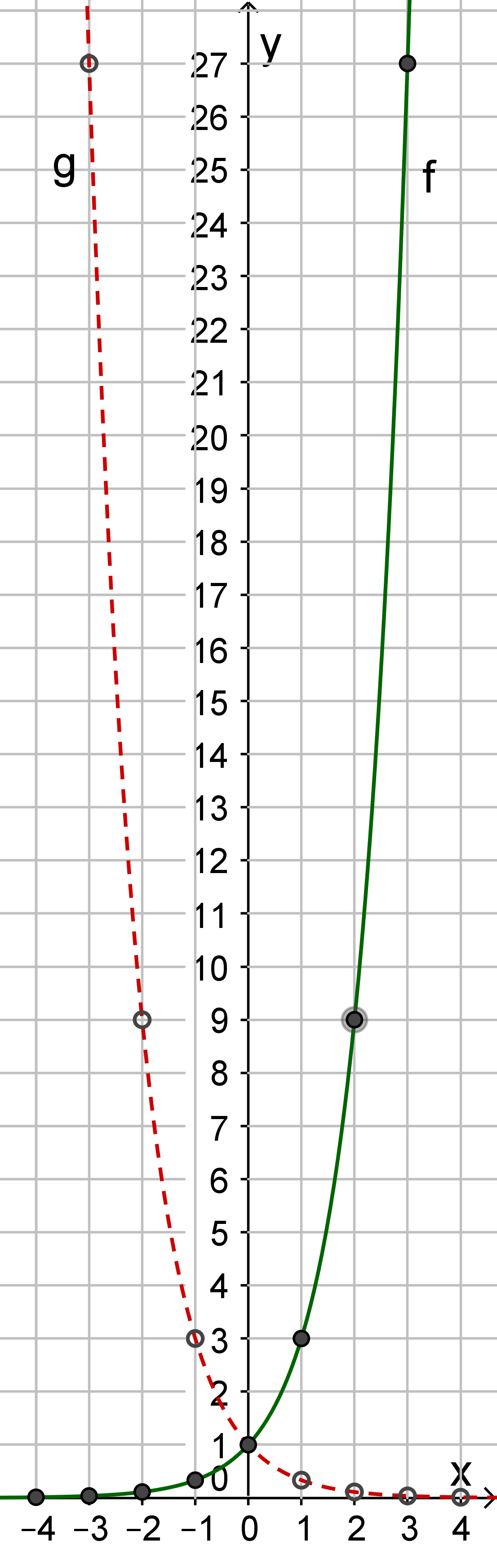
The graph of the two exponential functions

f(x)=3xf(x)=3^x

and

f(x)=(13)xf(x)=\left(\frac{1}{3}\right)^x

are shown below:

xf(x)=3xg(x)=(13)x636=136=1729(13)6=1(13)6=11/729=729535=135=1243(13)5=1(13)5=11/243=243434=134=181(13)4=1(13)4=11/81=81333=133=127(13)3=1(13)3=11/27=27232=132=19(13)2=1(13)2=11/9=9131=131=13(13)1=1(13)1=11/3=3030=1(13)0=0131=3(13)1=13232=9(13)2=19333=27(13)3=127434=81(13)4=181535=243(13)5=1243636=729(13)6=1729\begin{array}{r|l|l} x & f(x)=3^x & g(x)=\left(\frac{1}{3}\right)^{x}\\ \hline -6 & 3^{-6}=\frac{1}{3^6}=\frac{1}{729} &\left(\frac{1}{3}\right)^{-6}=\frac{1}{\left(\frac{1}{3}\right)^{6}}=\frac{1}{1/729}=729\\ -5 & 3^{-5}=\frac{1}{3^5}=\frac{1}{243}&\left(\frac{1}{3}\right)^{-5}=\frac{1}{\left(\frac{1}{3}\right)^{5}}=\frac{1}{1/243}=243\\ -4 & 3^{-4}=\frac{1}{3^4}=\frac{1}{81} &\left(\frac{1}{3}\right)^{-4}=\frac{1}{\left(\frac{1}{3}\right)^{4}}=\frac{1}{1/81}=81\\ -3 & 3^{-3}=\frac{1}{3^3}=\frac{1}{27}&\left(\frac{1}{3}\right)^{-3}=\frac{1}{\left(\frac{1}{3}\right)^{3}}=\frac{1}{1/27}=27\\ -2 & 3^{-2}=\frac{1}{3^2}=\frac{1}{9}&\left(\frac{1}{3}\right)^{-2}=\frac{1}{\left(\frac{1}{3}\right)^{2}}=\frac{1}{1/9}=9\\ -1 & 3^{-1}=\frac{1}{3^1}=\frac{1}{3}&\left(\frac{1}{3}\right)^{-1}=\frac{1}{\left(\frac{1}{3}\right)^{1}}=\frac{1}{1/3}=3\\ 0 & 3^{0}=1&\left(\frac{1}{3}\right)^{0}=0\\ 1 & 3^{1}=3&\left(\frac{1}{3}\right)^{1}=\frac{1}{3}\\ 2 & 3^{2}=9&\left(\frac{1}{3}\right)^{2}=\frac{1}{9}\\ 3 & 3^{3}=27&\left(\frac{1}{3}\right)^{3}=\frac{1}{27}\\ 4 & 3^{4}=81&\left(\frac{1}{3}\right)^{4}=\frac{1}{81}\\ 5 & 3^{5}=243&\left(\frac{1}{3}\right)^{5}=\frac{1}{243}\\ 6 & 3^{6}=729&\left(\frac{1}{3}\right)^{6}=\frac{1}{729}\\ \end{array}

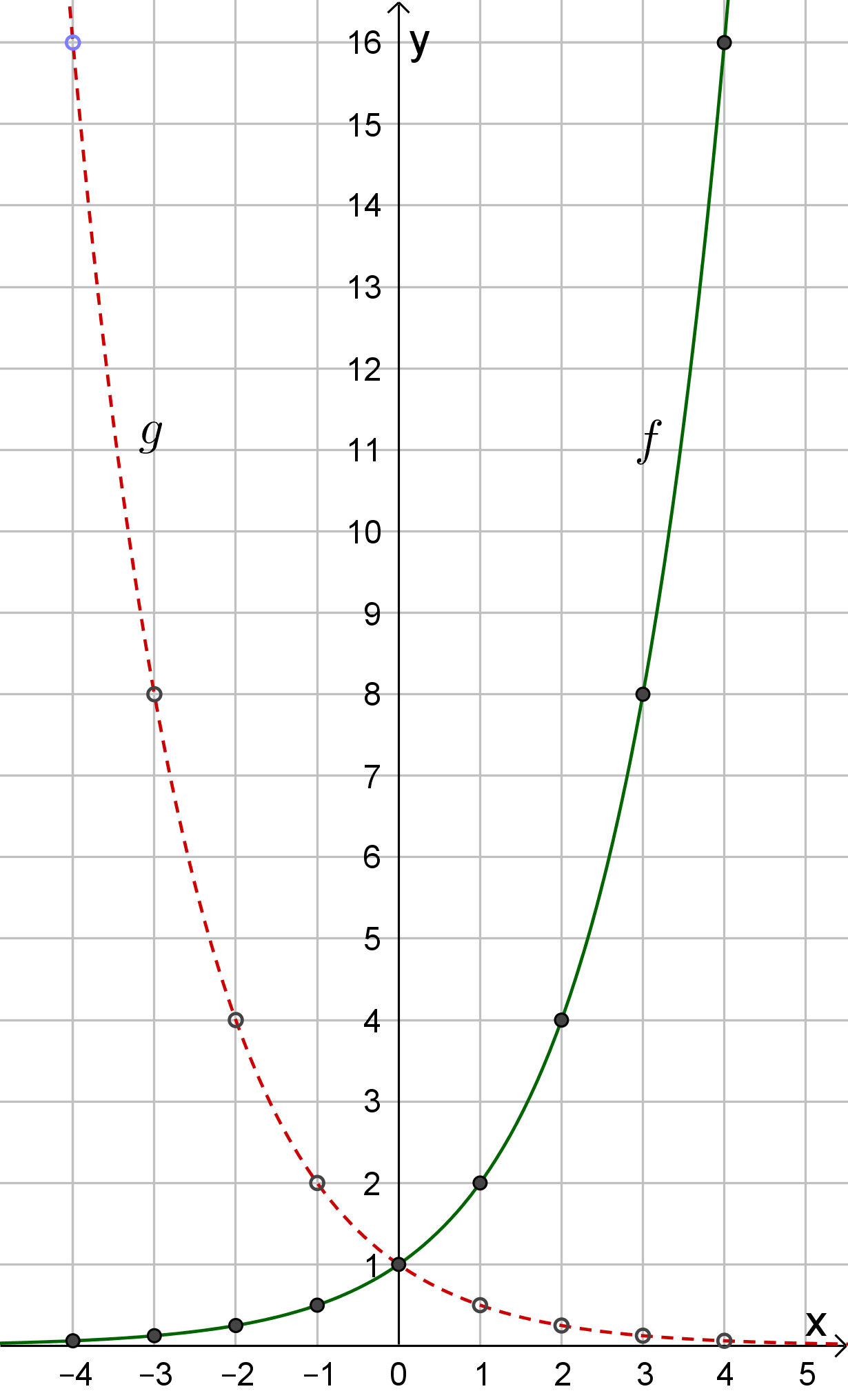
From the graphs above, we can observe some features which are generally true for exponential functions f(x)=baxf(x)=b a^x:

  1. The graph of an exponential function approaches but never touches the xx-axis. The reason is that axa^x is never 00, whatever number we choose for xx. Thus, exponential functions have no xx-intercept.
  2. The yy-intercept is bb, as f(0)=ba0=b1=bf(0)=b\cdot a^0 =b\cdot 1=b.
  3. For a base bigger than 11, the graph grows from left to right, while for a base between 00 and 11 the graph falls from left to right.
  4. For every step of length 11 to the right does the height of the graph (yy) change by a factor aa. For the example above, f(x)=3xf(x)=3^x, at x=0x=0 it is y=1y=1, and at x=1x=1 the height yy is three times bigger, and at x=2x=2 again three times bigger, and so on. You can also inspect the table of values to see this behaviour.

Is a function of the form

g(x)=34(x1)/2g(x)=3\cdot 4^{(x-1)/2}

also an exponential function? Indeed it is, because we write

g(x)=3412(x1)=3(41/2)x1=32x1=32x21=322x\begin{array}{lll} g(x)&=&3\cdot 4^{\frac{1}{2}\cdot (x-1)}\\ &=&3\cdot \left(4^{1/2}\right)^{x-1}\\ &=&3\cdot 2^{x-1}\\ &=&3\cdot 2^x \cdot 2^{-1}\\ &=& \frac{3}{2}\cdot 2^x\end{array}

In fact, every function of the form

f(x)=ba(xu)/v\boxed{f(x)=b\cdot a^{(x-u)/v}}

is an exponential function.

Exercise 1
  1. Sketch the graph of the function f(x)=2xf(x)=2^x and g(x)=(12)xg(x)=\left(\frac{1}{2}\right)^x using a table of values.

  2. Bring the functions below into the form baxb\cdot a^x

    1. f(x)=327x/31f(x)=3\cdot 27^{x/3-1}
    2. g(x)=40.12x+1g(x)=4\cdot 0.1^{2x+1}
    3. h(x)=(e)2xh(x)=(\sqrt{e})^{2x}
    4. k(x)=232xk(x)=\frac{2}{3^{2x}}
    5. u(x)=2x0.54x/2u(x)=2^x-0.5\cdot 4^{x/2}
  3. Bring the function f(x)=38xf(x)=3\cdot 8^x into the form b2uxb\cdot 2^{ux}.

Solution
  1. We have
  2. It is
    1. f(x)=327x/31=327x/3271=3127(271/3)x=193xf(x)=3\cdot 27^{x/3-1}=3\cdot 27^{x/3}\cdot 27^{-1}=3\cdot \frac{1}{27}\cdot (27^{1/3})^x=\underline{\frac{1}{9}\cdot 3^x}
    2. g(x)=40.12x+1=40.12x0.11=0.4(0.12)x=0.40.01xg(x)=4\cdot 0.1^{2x+1}=4\cdot 0.1^{2x}\cdot 0.1^1=0.4\cdot (0.1^2)^x=\underline{0.4\cdot 0.01^x}
    3. h(x)=(e)2x=(e0.5)2x=exh(x)=(\sqrt{e})^{2x} = \left(e^{0.5}\right)^{2x}= \underline{e^{x}}
    4. k(x)=232x=232x=2(32)x=2(19)xk(x)=\frac{2}{3^{2x}}=2\cdot 3^{-2x}=2\cdot \left(3^{-2}\right)^x = \underline{2\cdot \left(\frac{1}{9} \right)^x}
    5. u(x)=2x0.54x/2=2x0.5(41/2)x=2x0.52x=0.52xu(x)=2^x-0.5\cdot 4^{x/2} = 2^x-0.5\cdot \left( 4^{1/2} \right)^x = 2^x- 0.5\cdot 2^x =\underline{0.5\cdot 2^x}
  3. f(x)=38x=3(23)x=323xf(x)=3\cdot 8^x=3\cdot (2^3)^x=\underline{3\cdot 2^{3x}}