Construction of polynomials
Let us now consider how to construct polynomials which must have given zeros (or -axis intercepts).
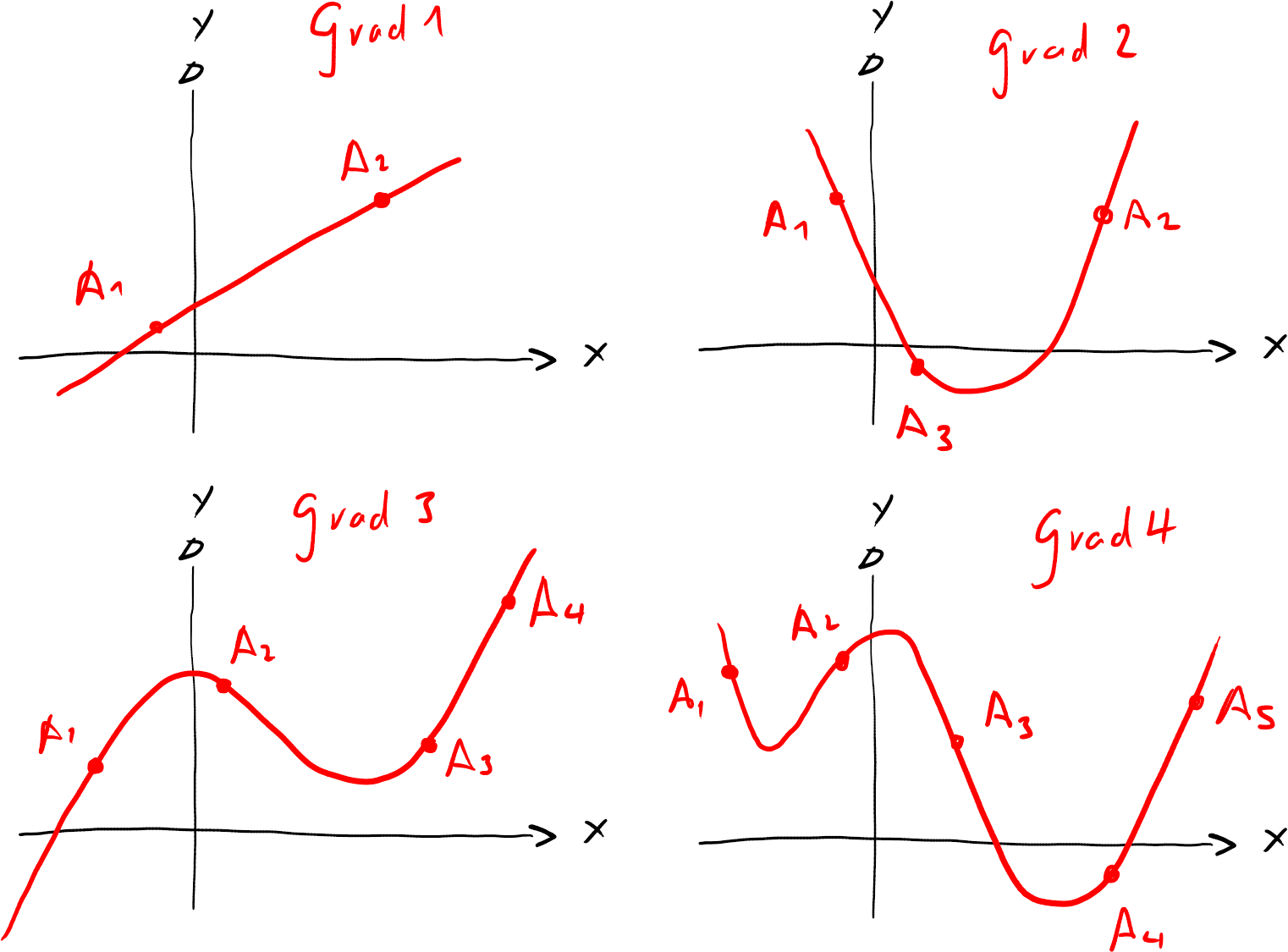
For example, consider the following graphs of polynomials. In the polynomial on the left, the -axis crosses every hills and every valley. In the polynomial on the right, this is not the case. The -axis crosses only the last valley.
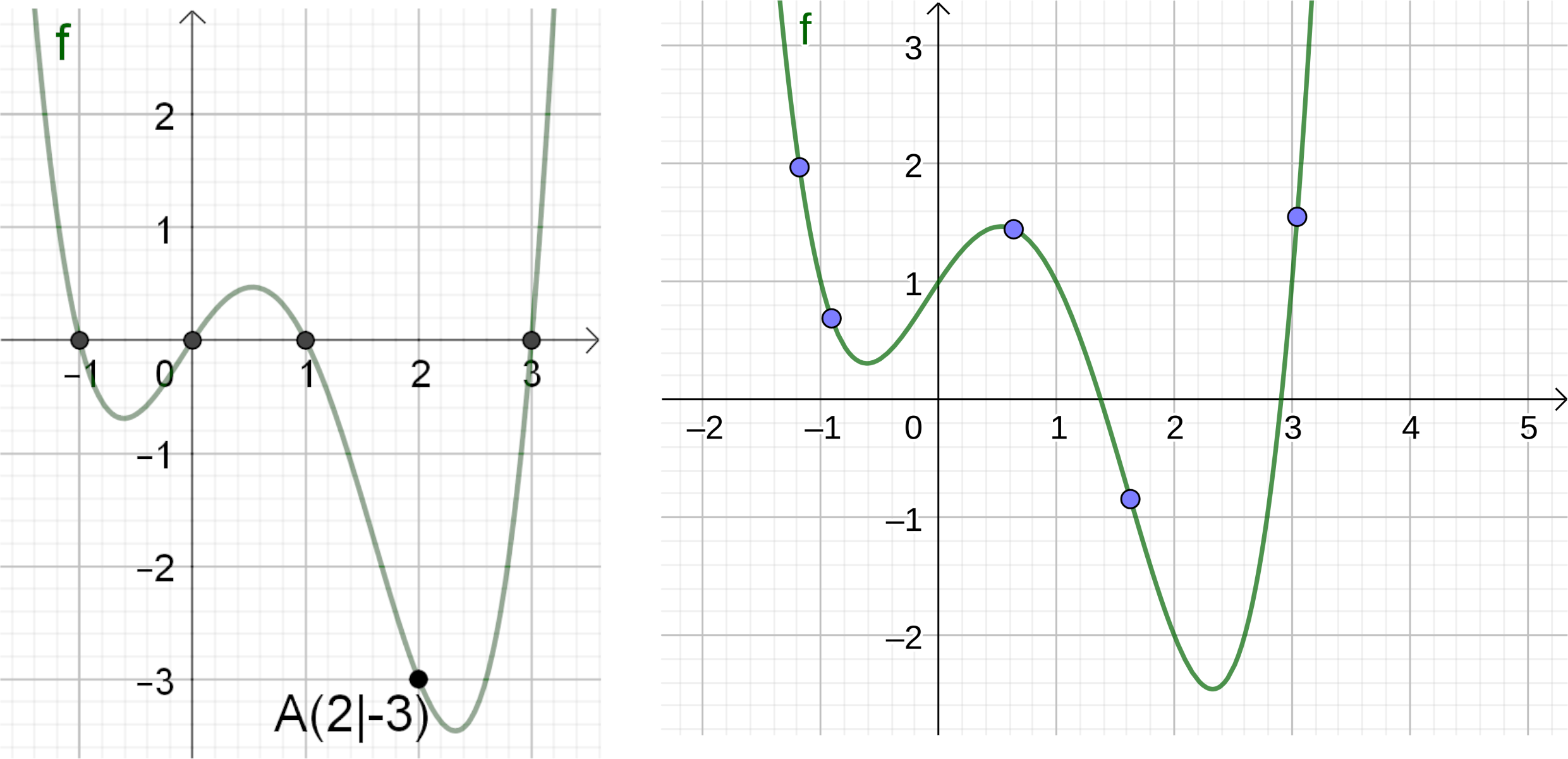
For the left polynomial, the function equation can indeed be found quite easily. But we need to know all the zeros and another point . For the right polynomial, the function equation can also be found, but it is a little more complicated. We need the coordinates of points that lie on the graph, and then we have to solve a system of equations with equations.
We first discuss the simpler case on the left, then the more complicated case on the right. In general, we are interested in finding polynomials that are as simple as possible, i.e. polynomials with the smallest possible degree.
The -axis crosses all valleys and hills
In the example above (left), the -axis crosses all hills and valleys. From the graph we also see that the zeros or -intercepts are:
It is quite easy to write down a function equation which has exactly these zeros: we simply multiply factors of the form
with each other. So in the example above:
We also multiply these function by some value (stretching of the graph in -direction), whose value we will determine later. Let us verify that the function has the correct -intercepts. Indeed:
Let us also verify, that the function is a polynomial. This is done in the exercise below.
Check that is a polynomial by multiplying it out. What is the degree?
Solution
It is a polynomial of degree because factors of the form are multiplied.
Now let us return to finding the correct value . The value of stretches the function in -direction. Every different value of defines a function with the -intercepts and , but it should be clear that only one of these graphs will pass through the point .
To find , we use the fact that
because the graph of passes through the point . Replacing in
the by , we get
Thus, the function equation of is
Let's summarise as a theorem:
Let the graph of a polynomial be given such that the -axis crosses all hills and valleys. Furthermore, assume we know all the zeros or -intercepts of
and also another point on the graph. Then the function equation of is given by
where must be chosen such that
Furthermore, the polynomial has the degree .
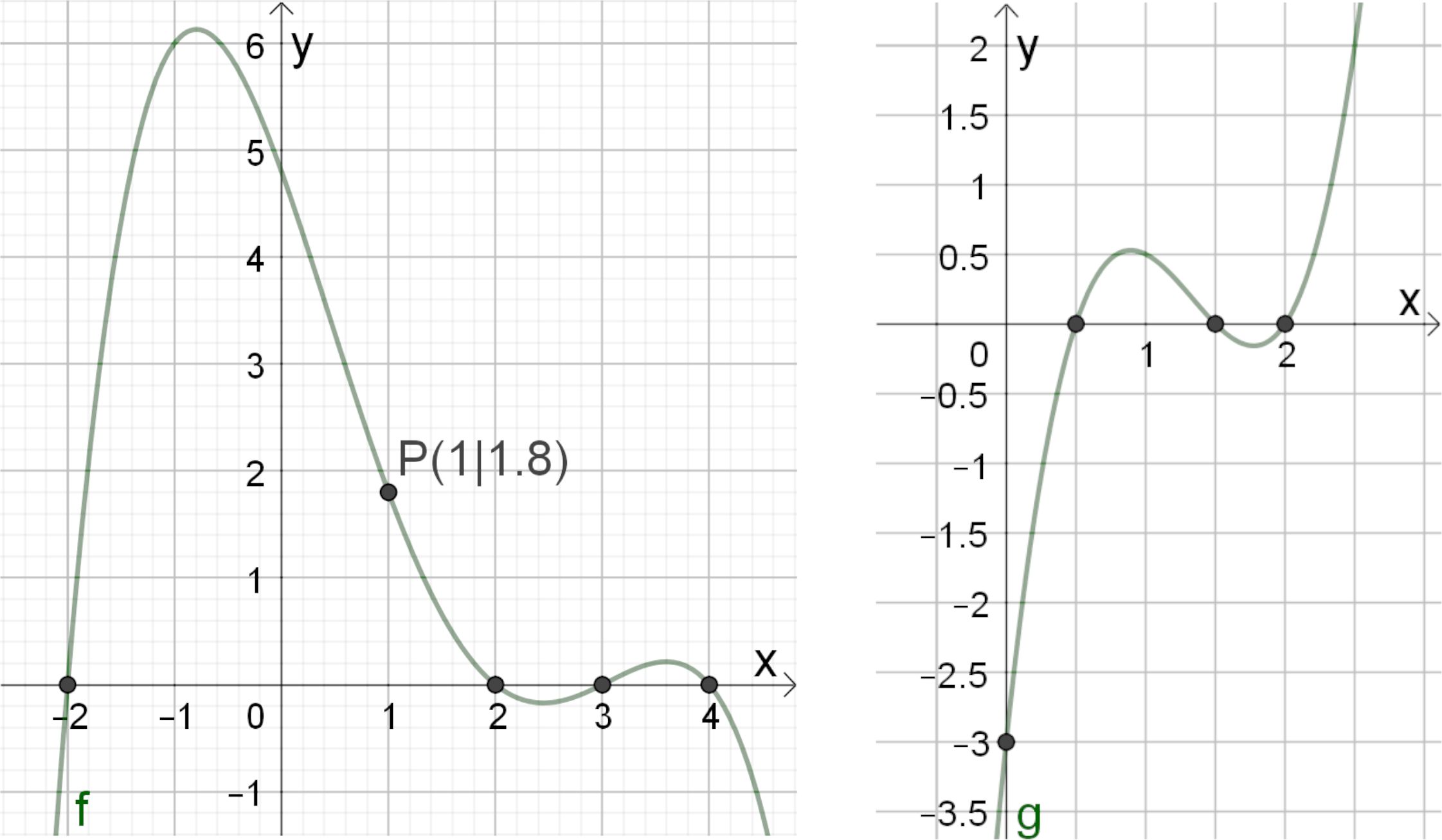
Determine the function equations of the polynomials and shown below.
Solution
function :
and because
we get . Thus
function :
and because
follows . It is
There is one special case to consider. What if the -axis does not cross a hill or a valley, but only touches the top of the hill or the bottom of the valley? Then it becomes more difficult. In the simplest case, we can imagine that the point of contact simply consists of two zeros which are almost on top of each other (see below, right):
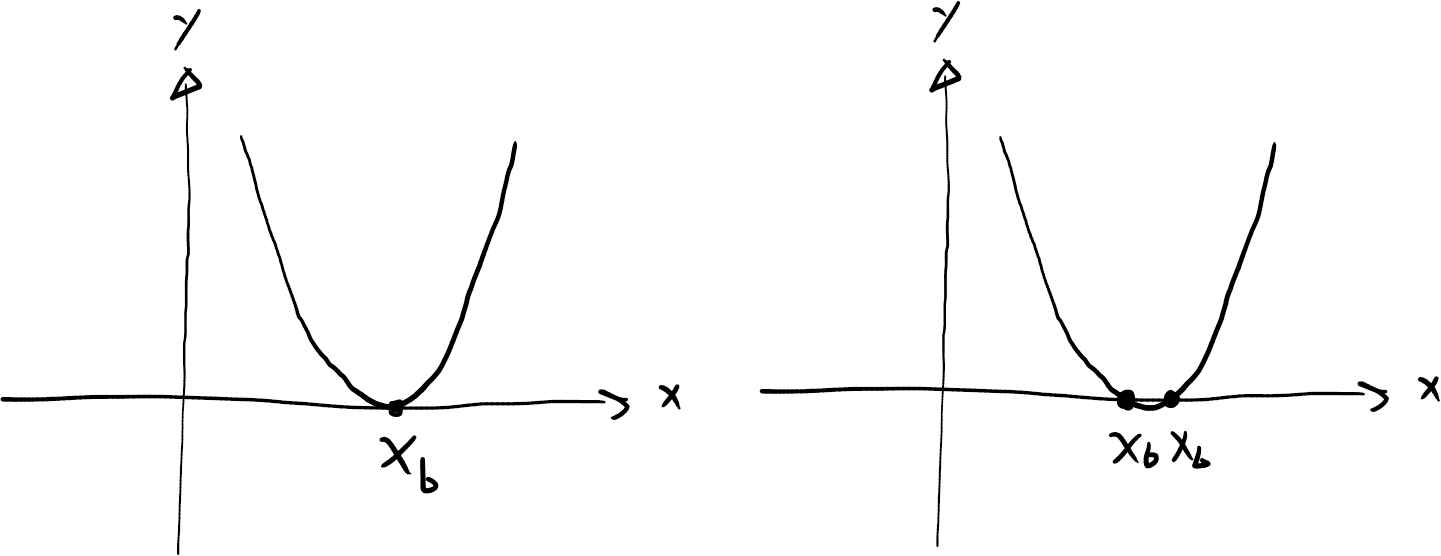
Each -intercept then gives rise to two factors
For example, if a polynomial has the zeros , where is a touch point, we get the function equation
If is also a touch point, then the function equation results
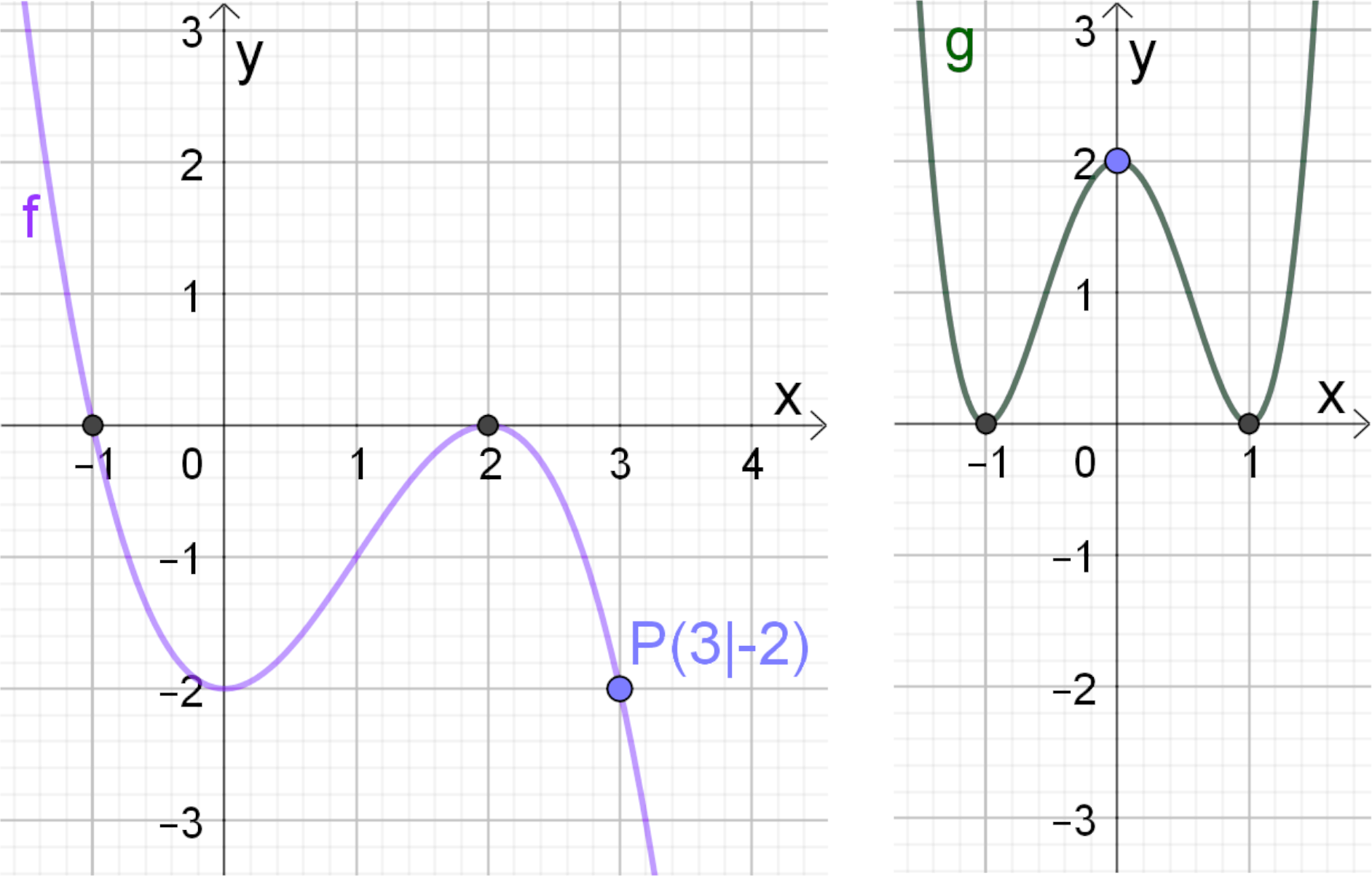
Determine the function equation of the polynomials and shown below.
Solution
function : Since the graph has a touch point at , the following holds:
and because of
it follows that . It is therefore
function : Since the graph has touch points at and , the following holds.
and because of
it follows
The -axis does not cross all valleys and hills
If the -axis does not cross all valleys or hills, of even if it does but we do not know all the -intercepts, then we cannot use the method described above for finding the function equation. We have to use another method, we assume that we know enough points through which the graph passes. This method also works in the situation where we could apply the first method. So it is more general, but also more time intensive.
Given different points ,..., , we want to find a minimal polynomial that should go through these points (see figure below):
-
For two points () this must be a straight line (so has degree ):
-
For three points () this must be a quadratic function (so has degree ):
-
For four points () this must be a polynomial of degree :
-
For five points () this must be a polynomial of degree :
-
etc.
Given we know these points, how can we find the coefficients of the polynomial? This is illustrated in the examples below.
Find a polynomial of minimum degree that passes through the following points: .
Solution
Three points are given, so we can use a polynomial of degree :
Since all points lie on the graph of , it must hold:
So we have to solve a system of three linear equations each of which as three three unknowns. We know how to do this. From the middle equation (II) it follows
and if we replace with in the other two equations (I, III), we get two equations with two unknowns:
From the lower equation follows
and dividing both sides by we get
Substituting this into the upper equation we get
We can now calculate the value of using :
And with
it follows that
Find a polynomial of minimum degree that passes through the following points: .
Solution
We need a polynomial of degree , so
So we have to solve the following system of equations:
If we substitute in all equations, we get the three equations:
From (II) follows
and substituting this into (I, III) we get the two equations
From (ii) follows
and if we divide both sides by , we get
Substituting in (i) we have
and with
and
we get