Sequences and Series
1. Definition of a sequence and a series
- What is a sequence, what is a series of a sequence? Explain.
- The sequence is given by
the sequence is given by
- Which representation is called explicit, which recursive?
- Determine for the first 4 terms.
- Determine for the first 4 terms.
- The sequence is given by
- Determine the first terms. What is the name of this sequence?
- Determine , where is the series of the sequence.
- The sequence is given by
- Determine the first terms. What is the name of this sequence?
- Determine , where is the series of the sequence.
Show
Solution 1
- A sequence is a list of numbers or terms: Often we are interested in the sum of the first terms: where , thus and so on. We call this new sequence the series of the sequence
- We have
- is explicit, is recursive.
- (the odd numbers)
- (the odd numbers)
- We have
- (geometric sequence)
- We have
- (arithmetic sequence)
2. Arithmetic and geometric sequences
Consider the two sequences
and
- Which of these sequences is arithmetic, which geometric? Why? What is the common difference, what is the common quotient?
- Calculate and .
- Determine the explicit form for both sequences. Explain why these formulas hold.
- Calculate with the explicit formulas and .
- For which is greater than for the first time?
- For which is greater than for the first time?
- Which sequence describes linear growth, which exponential growth? And what are the respective functional equations describing this growth?
Show
Solution 2
- is an arithmetic sequence, because from one term to the next always the same number is added (). is called the common difference, because it is is a geometric sequence, because from one term to the next always the same factor is multiplied (). is called the common quotient, since it is
- , .
- We have (since from to the number is added exactly ()-times to ) and (since from to the number is multiplied exactly ()-times with ).
- ,
- Find with It follows . So the answer is .
- Find with So . Apply the logarithm to both sides. It follows So the answer is .
- The arithmetic sequence describes linear growth. At "time" the "population size" is , at "time" the "population size" is . It follows The geometric sequence describes exponential growth. At "time" the "population size" is , at "time" the "population size" is . It follows
3. Geometric and arithmetic series (finite sums)
- What is the summation formula for summing the first terms of an arithmetic sequence ?
- What is the summation formula for summing the first terms of a geometric sequence ?
- Calculate for the sequence . For which is greater than for the first time?
- Calculate for the sequence . For which is greater than for the first time?
- Calculate the sum (assuming that the numbers form an arithmetic sequence).
- Calculate the sum (assuming that the numbers form a geometric sequence).
Show
Solution 3
- The summation formula for an arithmetic sequence is (half of times the of the first and last term).
- The summation formula for a geometric sequence is where is the common quotient of .
- , also Find with : As we have , find with Solve the equation for This is a quadratic equation. Using the midnight formula, we get und . Thus the solution is .
- With follows Find with , that is, find with It follows Applying the logarithm on both sides, we get Thus, the solution is .
- First, find : We know that , thus It follows . Now we have
- First, find : We know that , thus and it follows (apply logarithm). Therefore we have
4. Limits of arithmetic and geometric sequences
- What does it mean if a "sequence converges", and a "sequence diverges"? What is the limit of a sequence? Explain.
- Give examples of convergent sequences with
- limit
- limit .
- Give examples of divergent sequences that
- strive to ,
- strive to ,
- alternate between and .
- alternate between increasing and alternating positive and negative numbers.
- When does an arithmetic sequence converge?
- When does a geometric sequence converge? If the geometric sequence converges, what is its limit?
Show
Solution 4
- If we keep increasing and the terms tend towards a certain numerical value , we say that the sequence converges (more precisely: converges towards ). The numerical value is called the limit of the sequence, and we write or or a bit more casual If a sequence does not converge (for example, if the terms oscillate between two values, or tend towards or ), we say that the sequence diverges.
- A few examples:
- converges to .
- is convergent (converges to )
- A few examples:
- is divergent (tends towards ).
- is divergent (tends to )
- is divergent (alternates between and )
- alternates between increasing positive and negative numbers.
- Arithmetic sequences never converge, so they are always divergent. In fact, they always tend to or . This is easily seen by inspecting the explicit form . An except is the uninteresting case where the common difference . In this case, the sequence is convergent.
- Geometric sequences converge only if holds for the common quotient . If this is the case, then converges to . For all other values of ( bigger or equal than or smaller or equal to ) tends toward , towards , or shows some kind of oscillatory behaviour (e.g. check out sequences and above).
5. Limits of arithmetic and geometric series (infinite sums)
- Consider a sequence and its series . Give an interpretation of .
- When is the infinite sum of an arithmetic sequence finite?
- When is the infinite sum of a geometric sequence finite? How is this sum calculated?
- Calculate the infinite sum , where the numbers form
- an arithmetic sequence.
- a geometric sequence.
- Calculate the infinite sum where the numbers form a geometric sequence:
Show
Solution 5
- We have Thus, the limit of the series is the sum of the infinite many terms of the sequence . In short, is an infinite sum. If converges, the sum is finite. If diverges, the sum is either or , or does not exist (for oscillatory behaviour).
- Never, as the terms of an arithmetic sequence tend to or . Thus, the sum of these terms can not be finite. The exception is the uninteresting case where all terms of the sequence are zero.
- Only for . Then we have where is the common quotient of the sequence . This formula follows from the summation formula Indeed, for , the value converges towards for , so Important: Obviously you can insert any -value into the formula and you will get a value. But only if will this value correspond to the infinite sum of the geometric sequence. See the example below.
- We have:
- and as it follows .
- We have:
- and thus it is not . It follows that the infinite sum is not finite (indeed it is ). Note that we can still use the formula . But the result is wrong and is not the infinite sum.
- and from follows .
- and does not hold. So the infinite sum is not finite, and also not or . Indeed, the terms become larger and larger (in the positive as well as in the negative range). Again note that we can still apply the formula . But this is not the infinite sum.
6. Geometric problems
- The following are the first three figures of an infinite sequence of figures. Figure 1 is a square of side length 3. To get figure 2 three squares of side length are added, and so on. The limit figure consists of infinitely many squares.
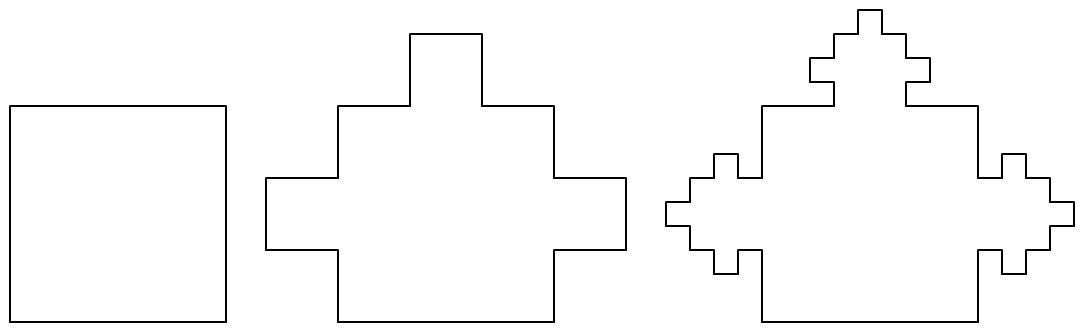
- determine the area (sum of the square areas) of .
- in which figure is the height of the object the height of ?
- Adding smaller and smaller equilateral triangles as shown in the figure below, we obtain a limit object consisting of infinitely many equilateral triangles. The first triangle has side length . After each iteration, the side length is halved.
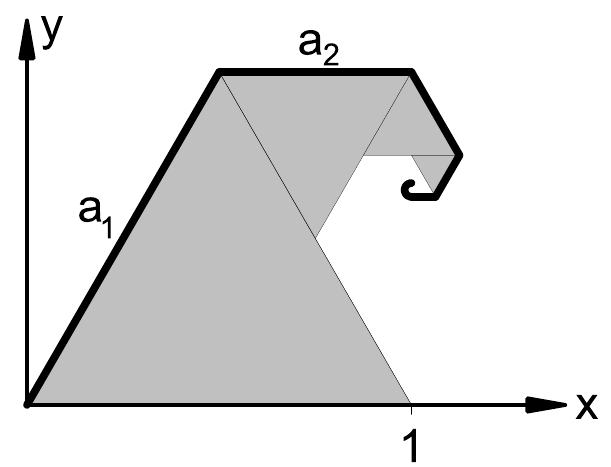
- Which equilateral triangle has for the first time a side length smaller than ?
- Determine the length of the fat spiral .
- Let be the sum of the first side lengths. For which is for the first time greater than ?
- Determine the area of .
- When is the sum of the first triangle areas for the first time bigger than of the area of ?
Show
Solution 6
- It is:
-
The total areas of the objects (from left to right) are
So we see that the underlyung sequence of this series is
Thus and therefore the total area is
-
The total height in each generation is
Thus the underlying sequence of this series,
is geometric with and it follows for the total height
Now, find with
thus
And it follows (apply logarithm), thus .
-
- We have:
- The side lengths , form a geometric sequence with . It is Find with , thus It follows .
- The length of the bold spiral is The sum forms a geometric sequence with , and because if follows
- Find with . We have Thus, it is .
- The triangle areas have height (Pythagoras): The triangle area are therefore and we see that this is a geometric sequence with . Because of if follows
- . Find with This it is .