Basic properties of event probabilities
Here are some useful properties about event probabilities. We will need them again and again.
Consider three events , and of a random experiment. denotes the sample space of the random experiment.
- if and are mutually exclusive.
- if , and are pairwise mutually exclusive. It is straight forward to generalise to an arbitrary number of pairwise mutually events.
Give a proof of the statements above.
Solution
-
The event contains not outcomes, and as a random experiment always produces exactly one outcome, this event never happens. The relative frequency of the occurrence of this event is therefore zero, thus .
-
The event contains all possible outcomes, and as a random experiment always produces one outcome, this event occurs every time. So .
-
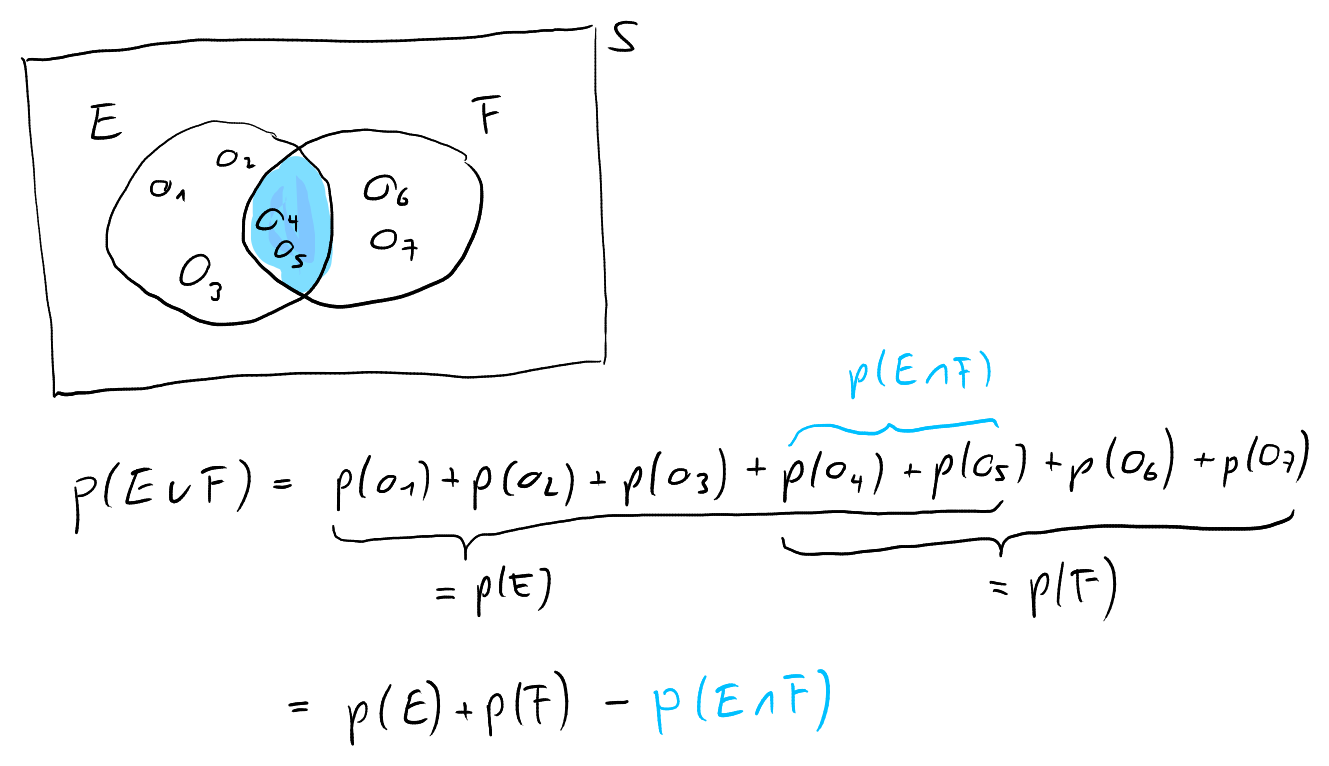
The statement follows from the figure below:
-
As and are mutually exclusive, if is not possible that and also occur in the same experiment. Thus and therefore, with (3),
Note that we can also argue that because .
-
The events and are mutually exclusive, and therefore
Another argument, is as follows: Let us repeat the experiment times. Because , and will never occur in the same experiment, the percentage of times that occurs must be the sum of the percentages .
-
It is and because and are mutually exclusive, we have , and thus .
We could also proof the statement directly. Let's repeat the experiment times ( large). For every repetition either or the opposite event will occur. Thus , and therefore .
Note that the above statements become obvious if we represent the events in a Venn-diagram, and identify the circle areas with the probability of an event to happen. The rectangle indicating has area .
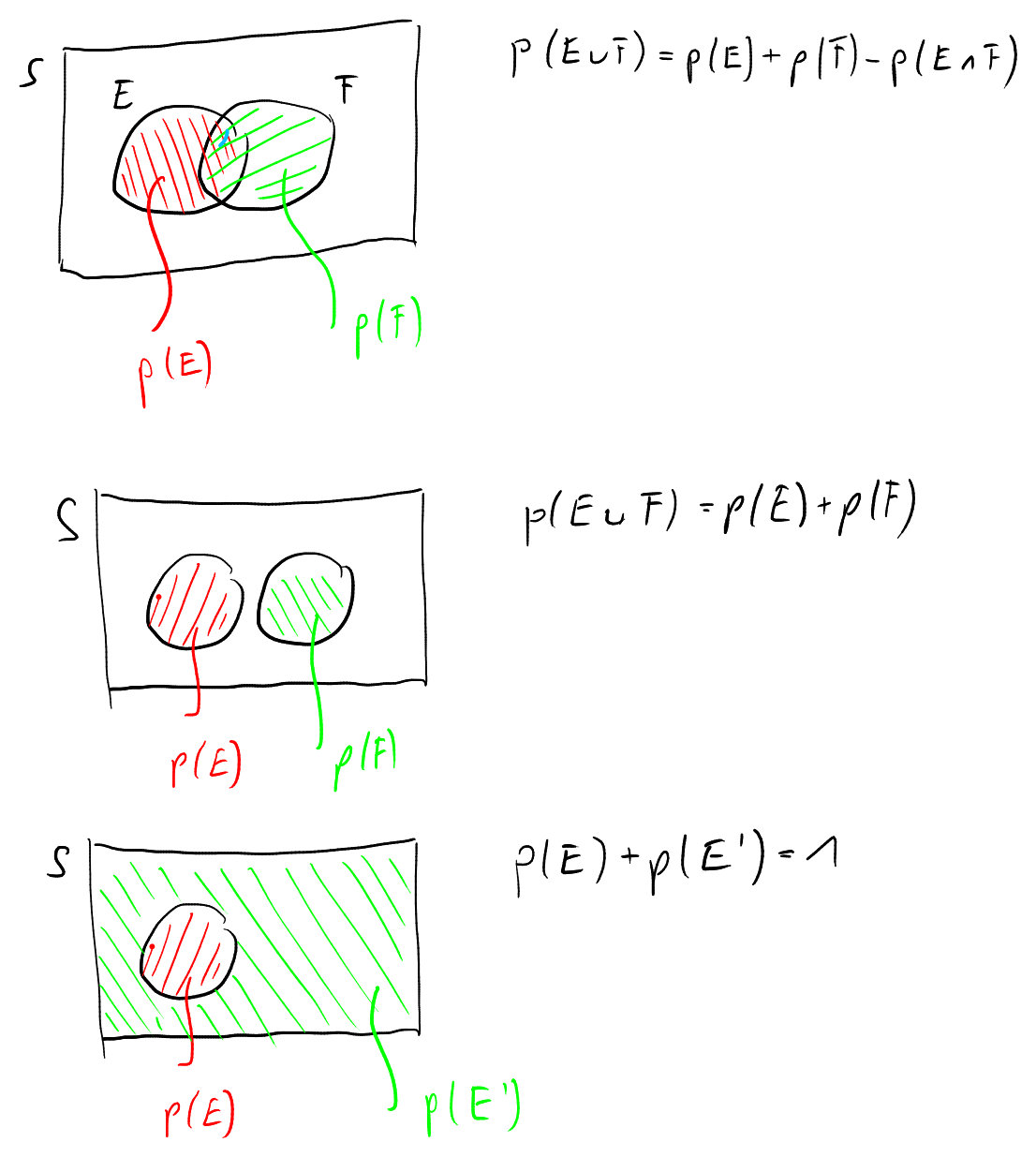
Using Venn-diagrams in this way helps to solve problems as well. See the exercise below.
Consider a random experiment where event has probability to occur, and event has probability to occur. The probability that and occur in the same experiment is . Determine the probability that
-
or occur.
-
does not occur.
-
occurs and does not occur.
-
neither nor occur.
Solution
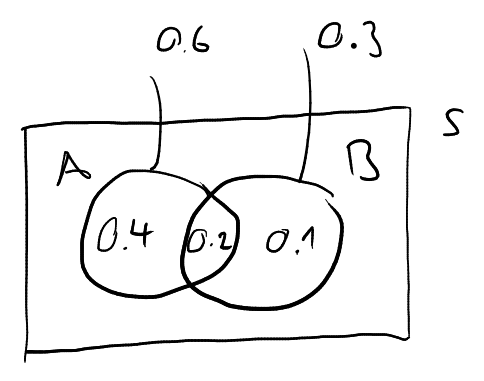
Draw the Venn-diagram and indicate the probabilities, starting with the intersection .