Event probability in Laplace experiments
The calculation of event probabilities in Laplace experiments is quite simple. Assume that a Laplace experiment has outcomes, and event contains of those outcomes, say .
As each outcome has the probability to occur, and the probability of an event is the sum of its outcome probabilities, we get
Thus, we have the following theorem:
Consider a Laplace experiment with possible outcomes and an event which contains of those outcomes. Then
Using set notation, we have , where is the sample space, and , so we can rewrite the formula above as
And if we think of the outcomes in as "desired", we can write
Apply the formula to the following problems. Important: always consider whether we really have a Laplace experiment before us. Otherwise the above formula does not apply.
Q1
A fair die is rolled once. Determine the probability that the resulting number is even.
Q2
A fair coin is tossed twice. Determine the probability for at least one head.
Q3
A fair die is rolled twice. Determine the probability that the sum of the two observed numbers is between and (including and ).
Q4
In a group of people, are tall. A person is selected at random, where each person can be chosen with the same probability. Determine the probability that you select a tall person.
Q5
In a class of students, everyone plays chess, tennis, or nothing. It is found that of the students play both tennis and chess, play tennis only, and play nothing. A student is selected at random from the group, where each student can be chosen with the same probability. Find the probability that the student
- plays both tennis and chess.
- plays chess only.
- does not play chess.
Q6
In a group of people, have green eyes. A person is selected at random, where each person can be chosen with the same probability. What is the probability that this person has green eyes?
Q7
A town has newspapers. of the population read newspaper A (and perhaps other newspapers), read newspaper B (and perhaps other newspapers), and read newspaper C (and perhaps other newspapers). read newspapers A and B (and perhaps another one), read newspapers A and C (and perhaps another one), and read newspapers B and C (and perhaps another one). read all three newspapers, the rest does not read at all.
A person is selected at random from the town, where each person can be chosen with the same probability.
-
What is the probability that the person reads exactly one newspaper?
-
What is the probability that the person does not read any newspaper?
Solution
A1
Laplace experiment with and . Thus .
A2
Laplace experiment with and . Thus
A3
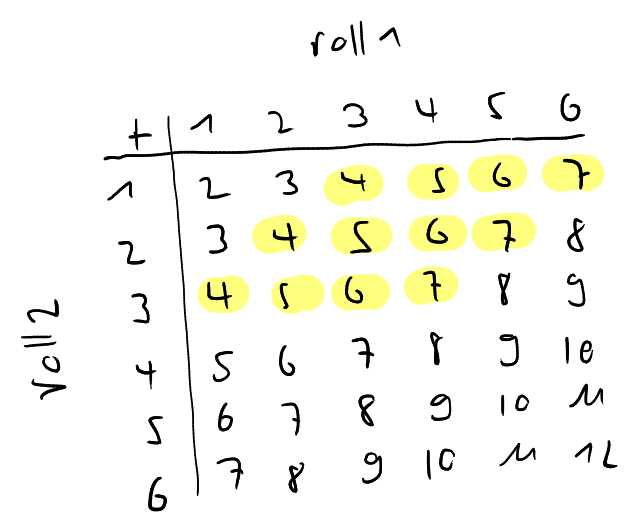
Laplace experiment with and (see figure below). Thus,
A4
It is a Laplace experiment, as each person has the same probability to be selected. The possible outcomes are the people, so ="the people"=, . Assume that the tall ones are persons , so , and thus . It follows
A5
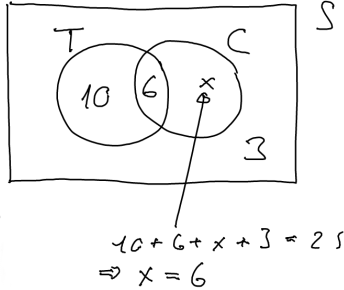
="the students"=, . Each outcome (a student) has the same probability to occur Laplace experiment. Event ="students playing tennis" (e.g. ), event ="students playing chess" (e.g. ). See figure below.
A6
Laplace experiment, and ="green eyes". Assume, for example, that there are people in the group, so will have green eyes, so , and . You can assume any other number of people in the group, and you will still get .
A7
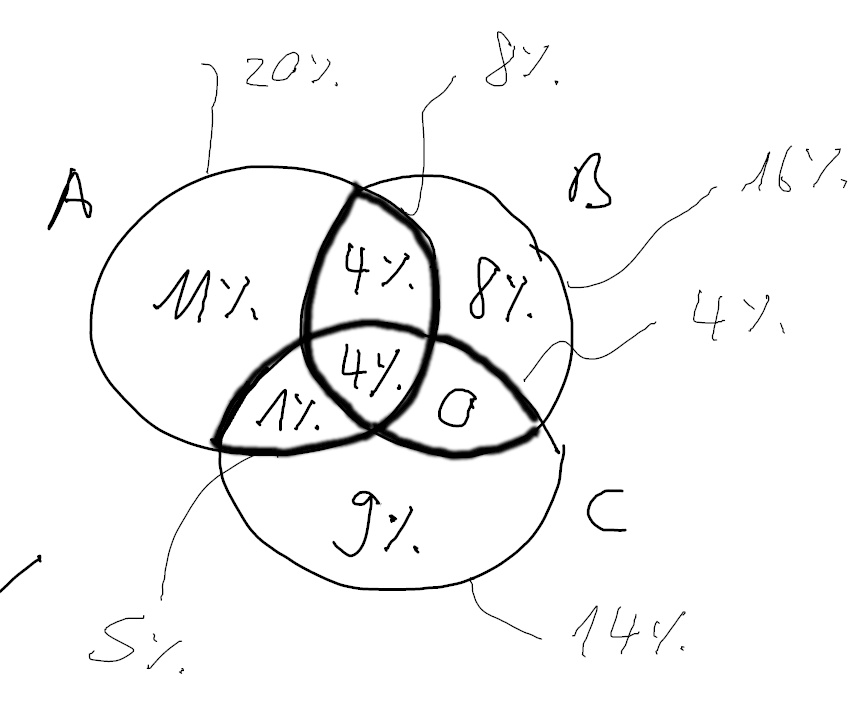
Draw a Venn-diagram, and indicate the probabilities, starting with the (see figure below).