Random experiments
Nature seems to allow for processes, procedures or experiments whose final outcome cannot be predicted with absolute certainty. The branch of mathematics that investigates and models this uncertainty and randomness is called probability theory. Probability theory rests on the fundamental observation that although the outcome of an experiment may be unpredictable, in the long_run (i.e. by repeating the experiment many times) predictable patters emerge.
An important subfield of probability theory is statistics. As data is often uncertain (e.g. measurement errors, or incomplete surveys), any interpretations and conclusions based on a data set is therefore only valid with a certain likelihood. Probability theory helps to calculate this likelihood.
We start with the notion of a random experiment. A random experiment is some procedure or process which we can repeat under the same conditions again and again. In addition, the experiment has at least two possible outcomes. Each time we perform the experiment, exactly one of those possible outcomes will occur. However, although the experiment is performed under exactly the same condition, it is not possible to predict, which of these outcomes will occur until the experiment is done.
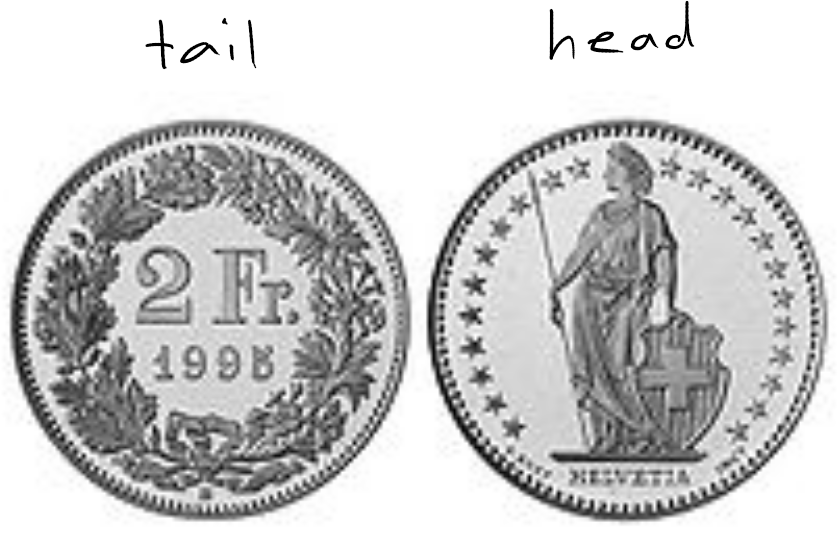
Flipping a coin
The coin has two outcomes which we call tail () or head (). As we know from experience, it is not possible to predict which outcome will show. Note that in principle it is also possible that the coin lands on its edge. Sometimes we will consider this possibility, but only if mentioned explicitly.
Rolling a die
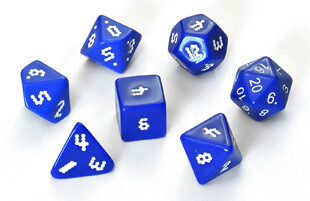
A die (plural "dice") is a cube with each of its six faces marked with a different number of dots ("pips") from to . We also use other dice with more, or less, than faces.
Random selection
Consider a bag with items (e.g. balls of different colors). If we say that we select an item at random, we mean that each object has the same chance to be selected (e.g. by selecting blindly, and assuming that we cannot distinguish the Objects in any way by touching them).
For example, in surveys we want to interview people which were selected at random from a larger group ("bag") of people ("balls") to avoid bias. This concept will become relevant when we discuss statistics. So you already see a first connection between probability and statistics.

Note that it is actually not clear at all that a coin flip can be repeated under the exact same conditions. Air pressure might change, or I do not use the exact same hand motion for flipping, and so on. In fact this point can be made for all the experiments we use in this course. To keep things simple we assume that all these little changes will have no influence on the outcome of the experiment, so we can ignore these imperfections and assume that exact repeatability is possible. But clearly this is an approximation, although often enough a good one in the sense that it reflects the reality close enough. But see also the section "A deeper look at randomness".
Often we perform several random experiments, one after the other, and want to know more about the outcome of all these experiments. A typical example is flipping a coin three times, and we want to know how likely it is that each time head () occurs. Or we first flip a coin and then roll a dice, and want to know the likelihood that we observe followed by a . Let's define such experiments properly:
A random experiment that consists of performing a chain of other random experiments is called a multi-stage random experiment.
- flipping a coin three times is a -stage random experiment
- flipping a coin followed by rolling a die is a -stage random experiment
- selecting balls from the basket of balls is a -stage random experiment
-
Almost all experiments can be expressed as flipping a coin, rolling a die, or selecting randomly from a bag. Indeed, even flipping a coin or rolling a die can be seen as a selection problem. How?
-
Express "rolling a die three times" as a -stage random selection problem.
Solution
- A bag contains balls labelled from to . Randomly selecting a ball is the same as rolling a die.
- Randomly select a ball and note the number, return the ball, select another ball and note the number again, return the ball and select again a ball. This is the same as rolling a dice three times.