Set theory in a nutshell
Set theory is an elegant framework often used in probability theory. So here is a small refresher.
Consider different objects , of which we select some. To be concrete, assume that the objects are the numbers to , and the selected objects are the numbers from to . The set with the elements is denoted by
Equality of sets
The order of occurrence is not important, and identical objects count only as one, so we have
In other words, to sets are equal, if the contain the same elements, no matter how often they occur.
Special sets
-
The empty set is the set that contains no element, and is denoted by
-
The set containing all the elements, is called the universal set.
Magnitude
The magnitude of is the number of different elements in , and is denoted by , so we have
Set relations
-
The number is an element of , written
while the element is not an element of , written
-
Any selection of elements of , such as , is a set as well, and is called a subset of , written
But
Note that every set is its own subset, , and the empty set is always a the empty set is always a subset, . The set is also a subset of .
Set operations
Given two subsets and of , we can form a new set, which correspond to the logical statements NOT, AND, and OR:
-
The complement of , written
is the set of elements in that are
NOTin . In a Venn-diagram, this is set is represented by the region outside of circle . -
The intersection of and , written
is the set of elements that is in
ANDin . In a Venn-diagram this set is represented by the intersection of the two circles and . -
The union of and , written
is the set of elements that is in
ORin . In a Venn-diagram this set is represented by the union of the two circles and .
Disjoint subsets
We say that two sets and are disjoint if they do not intersect, that is, if
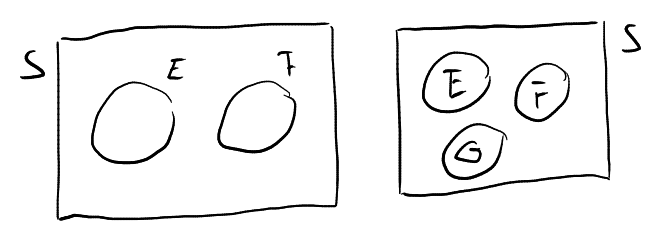
We say that the subsets and are pairwise disjoint if each pair is disjoint, that is, , , . Clearly, disjoint and pairwise disjoint subsets do not have elements in common (see figure below).
It is straightforward to generalise this to an arbitrary number of events.
Partitions
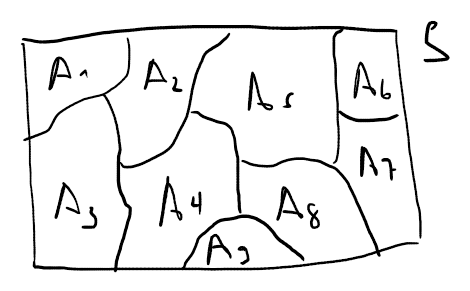
Consider subsets of . We say that these subsets form a partition of , if the subsets are pairwise disjoint:
and the union of these subsets is :
The Venn-diagram looks like a puzzle.
Here are two partitions of :
Q1
, , and .
- Determine the sets , , , and .
- Is ?
- Is ?
Q2
is a subset of the universal set . Determine , , , , and .
Q3
Consider two sets and with . Determine and .
Q4
Consider the universal set and two subsets and of . Do the following subsets form a partition of ?
- and
- and
Hint: draw the Venn-Diagram.
Q5
Show that for any two subsets and in the following is true:
Simplify the formula for the case where and are disjoint.
Hint: draw the Venn-Diagram.
Q6
Assume that is a partition of . Show that
Q7
Show that
Solution
A1
- , , , and
- .
A2
, , , , and
A3
and
A4
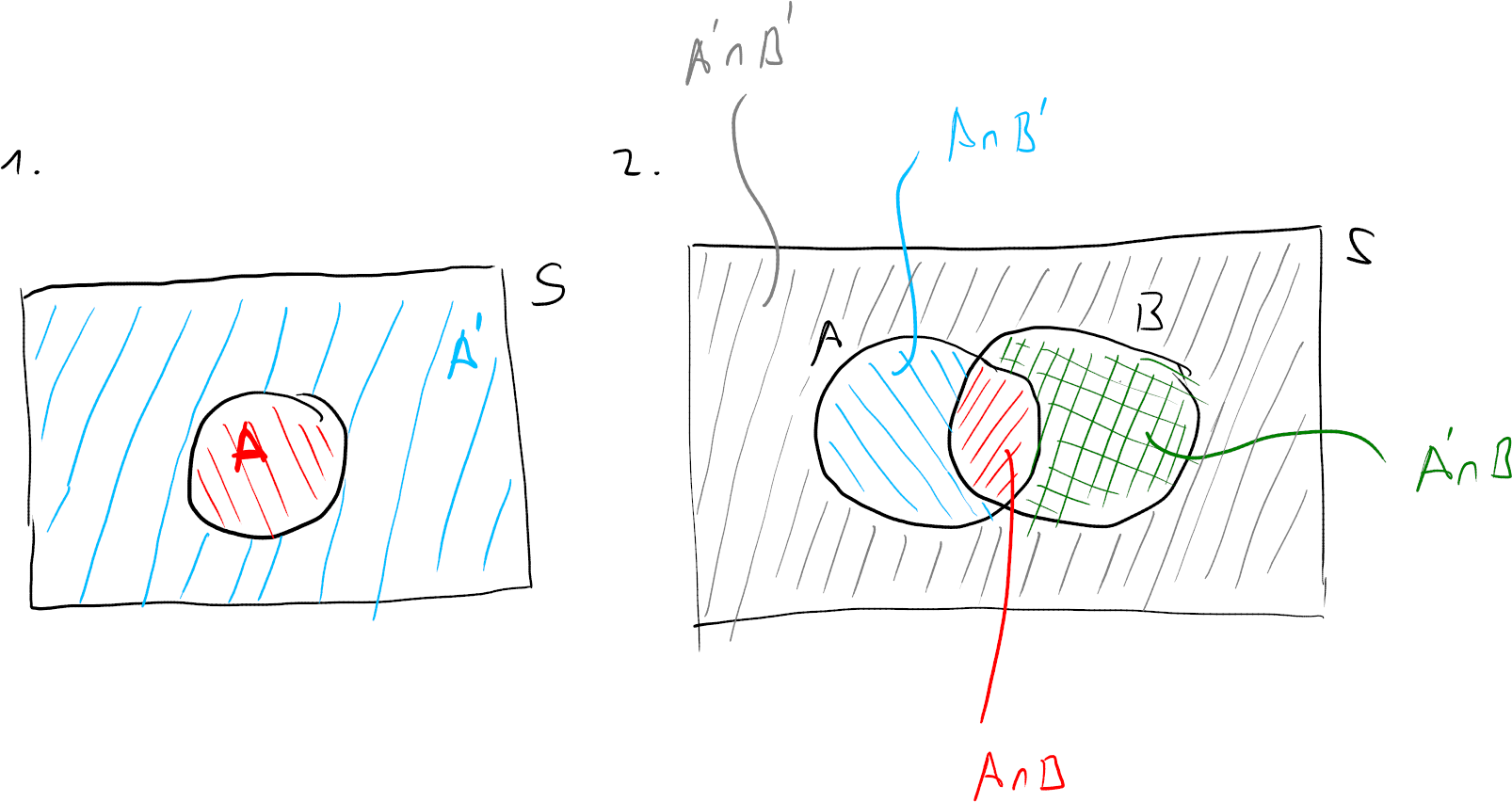
See figure below.
- Yes
- Yes
A5
See figure below.

If and are disjoint, it is , and therefore
A6
It is a generalisation of A5. Because , ..., do not overlap, it is
But the union of these sets is . Thus, it is
A7
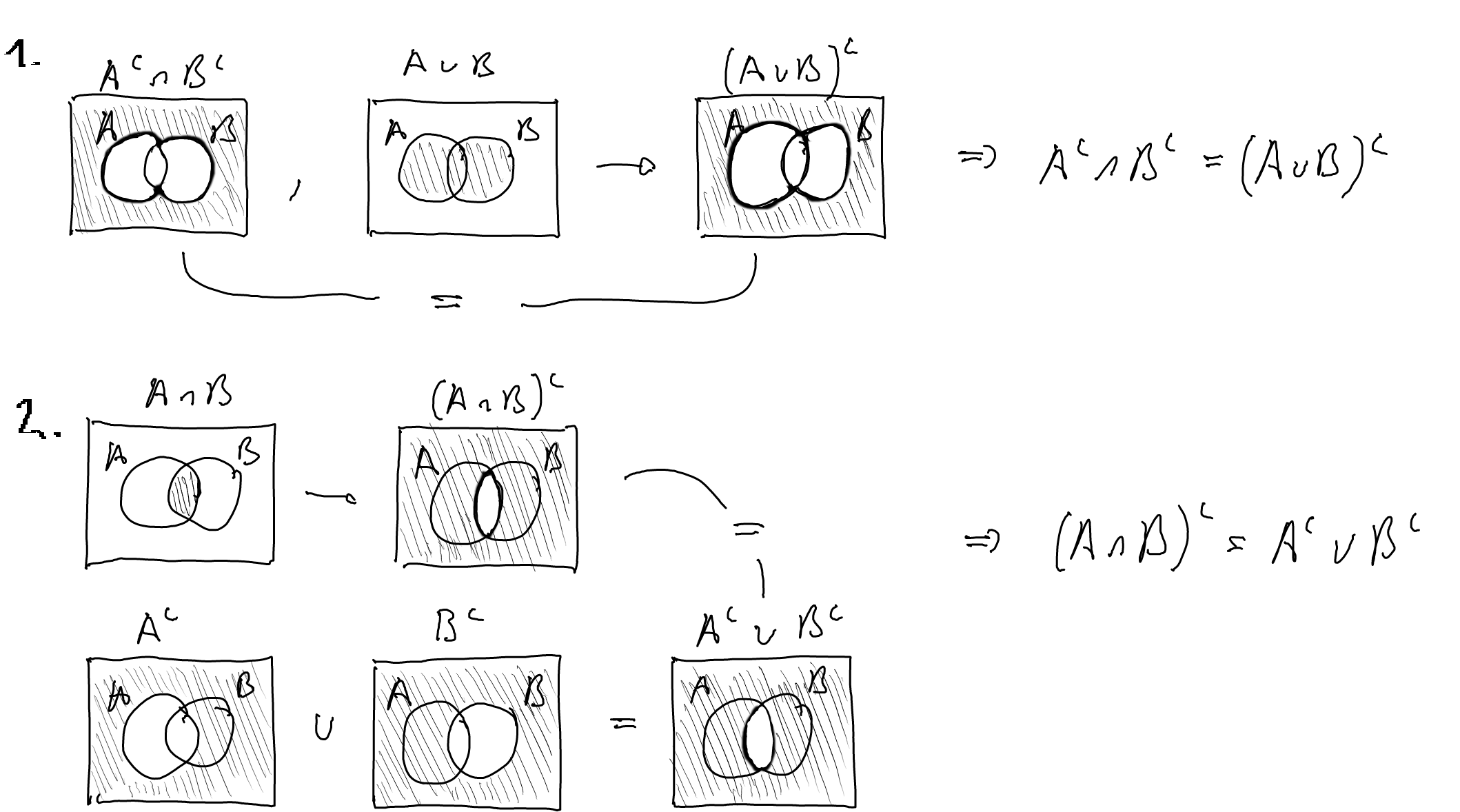
See figure below.