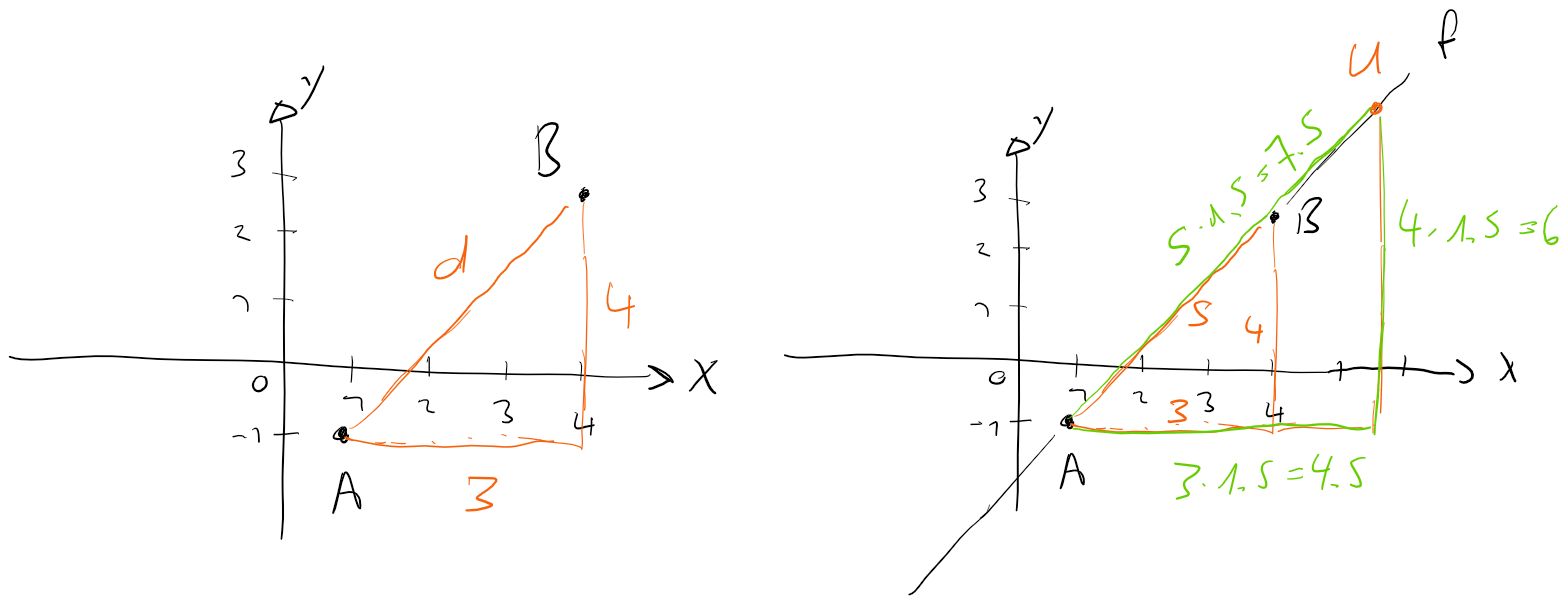
Linear functions and geometry problems
The figure below shows possible ways to reflect a line about the -axis, the -axis and the coordinate origin.
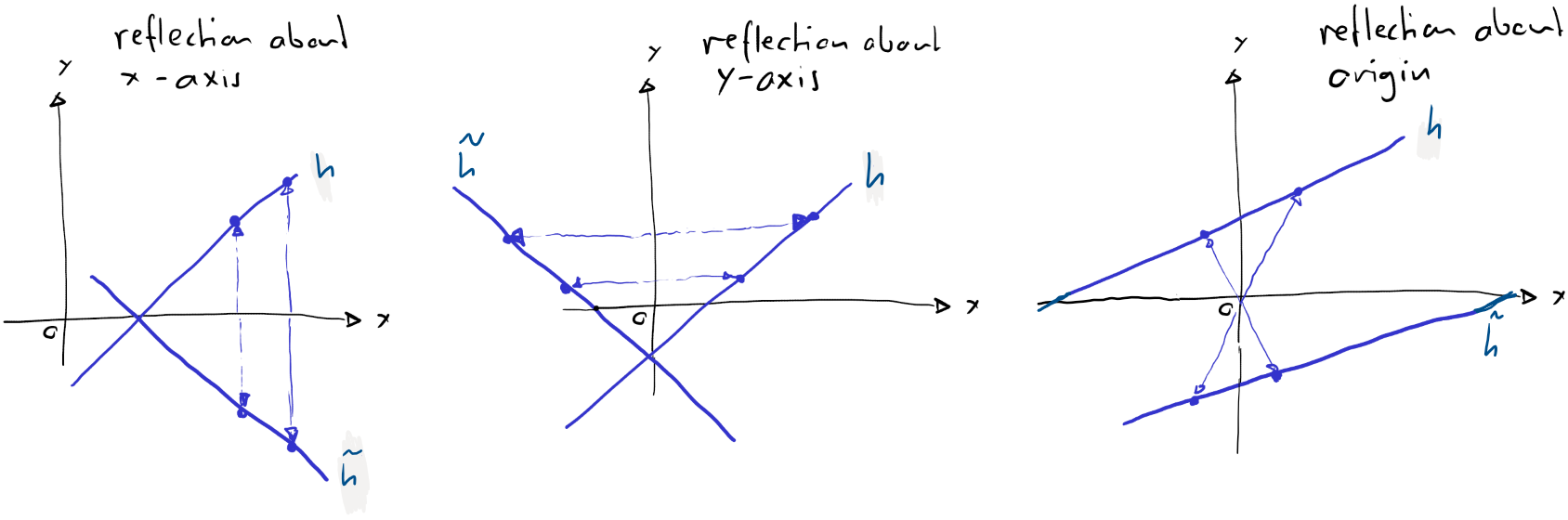
Consider the functions and .
- The graphs of and are reflected about the -axis. Determine the function equations of the reflected graphs.
- The graphs of and are reflected about the -axis. Determine the function equations of the reflected graphs.
- The graphs of and are reflected about the origin. Determine the function equations of the reflected graphs.
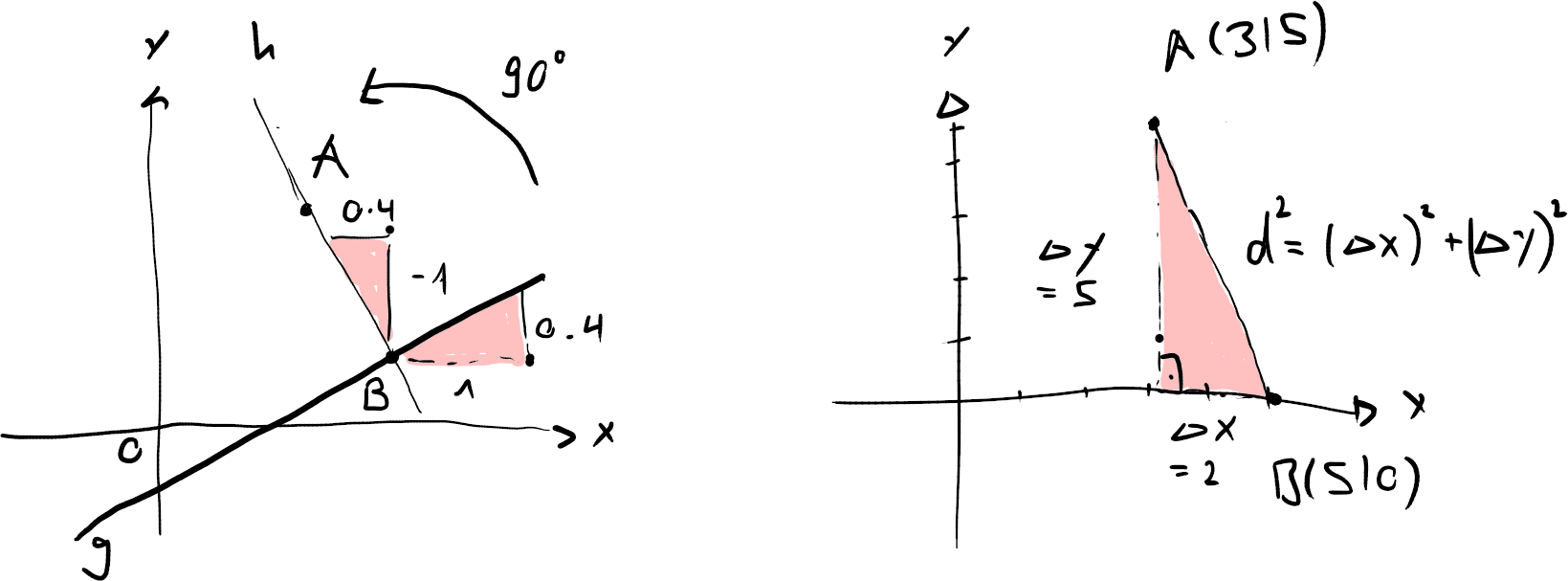
Hint: Figure out how the slope triangles are affected by these transformations (see figure below, where a line is reflected to get line ).
Solution
Denote by and the reflected graphs.
- From the figure we can see that the original slopes change the sign, and the new lines have the same -intercepts as the old ones. Thus,
- From the figure we can see that the original slopes change the sign, and the same is true for the -intercepts. Thus,
- From the figure we can see that the original slopes do not change the sign, but the -intercepts change the sign, thus
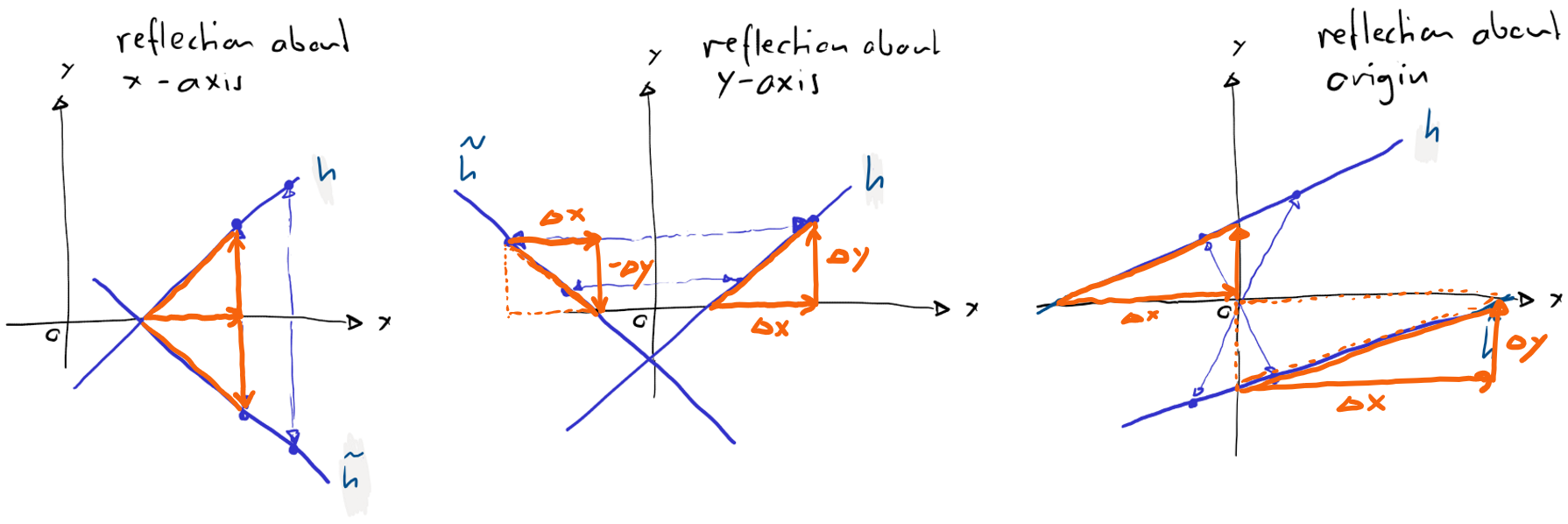
Another approach could be to reflect two points of the original graph , and then find the function equation of the new straight line that passes through these two reflected points.
Consider the function . The graph of a linear function is parallel to the graph of . Find the function equation of for the following three cases: The graph of
-
passes through the origin
-
passes through the point
-
crosses the -axis one unit to the right where graph crosses the -axis.
Solution
Line has the same slope as , , thus .
- -intercept , thus
- Because is on the graph of it follows . Thus and therefore . It follows .
- First, let's find the -intercept of : Find with . The graph of crosses the -axis one unit to the right of , so at . Thus, with , and it follows and
Consider the point and the function . From all the points on graph find the one (let's call it ) which is closest to point . Also, determine this distance. Hint: Sketch the situation. What angle is formed between the line and the line through and ?
Solution
Denote the line passing through and by . From the figure (see below) it follows that and must form a right angle, otherwise will not be the point closest to . So let us calculate the coordinates of point by first finding the function equation of , and then intersection and .
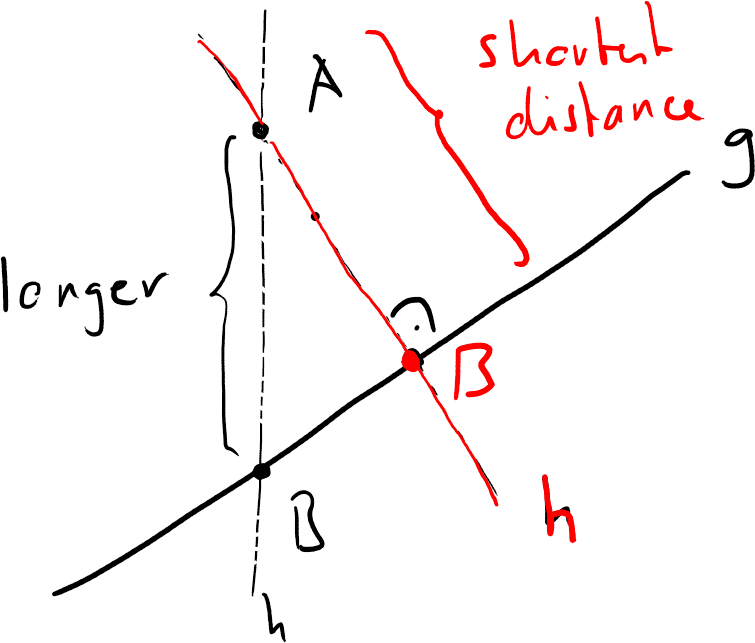
Function equation of : As and form a right angle, the slope of must be (see figure below, left)
We thus have
As passes through , we also have
Coordinates of : We intersect and , thus we have to find an with
and therefore the -coordinate is
Thus we have . You might have guessed these coordinates from the drawing, but you should be able to calculate them as well!
Distance between and : Now we can use the theorem of Pythagoras to calculate the distance from to (see figure below, right): .
Consider the triangle , where , , and . A straight line passes through and is orthogonal to the base . Determine the function equation of . Also, determine the area of the triangle.
Solution
Denote the line passing through and by (see figure below).
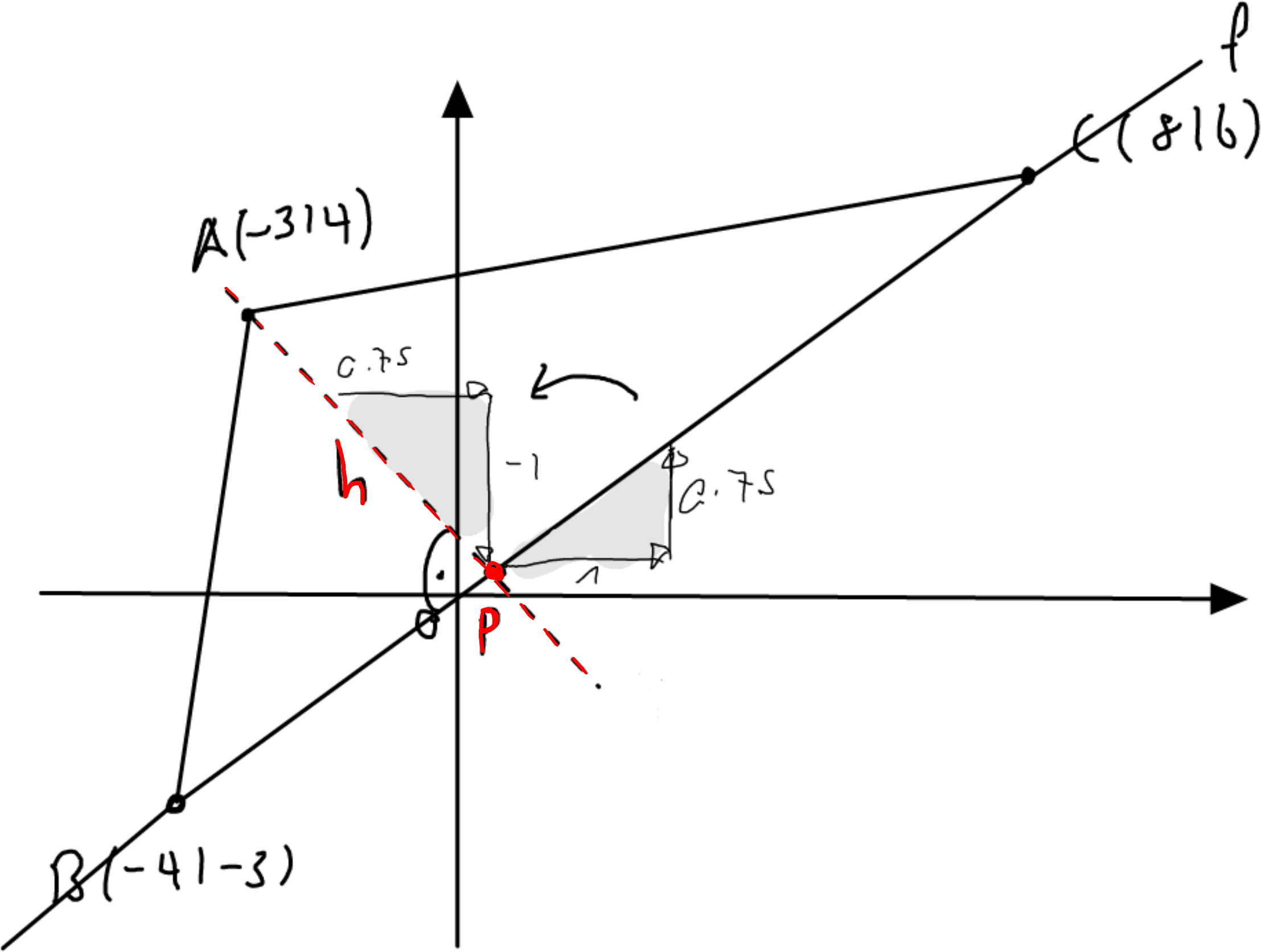
The two lines and intersect at point , and form a right angle. So let us first find the function equation of , and then the function equation of .
Function equation of : We have , with
The slope of line is , because
and because is on the straight line, we have
Thus we have
Function equation of : We have and because and are orthogonal, we have (see figure)
Thus it is
And because is on , we have
and thus it is
Area of triangle: We need the height of the triangle, and the length of the base. The height can be found by determine the distance from to , where is the intersection point between and . So find with , thus , and it follows , and therefore . Thus has the coordinates .
The distance between and can be found using the theorem of Pythagoras:
The length of the base can also be found using the theorem of Pythagoras:
Thus, the triangle area is
Two walkers are separated by . At time (hours) they start walking towards each other. One walks with speed , the other with speed . Where and when do they meet?
Hint: Solve this problem by representing the two walkers as lines in the same coordinate system, and think about the geometrical interpretation of "the walkers meet".
Solution
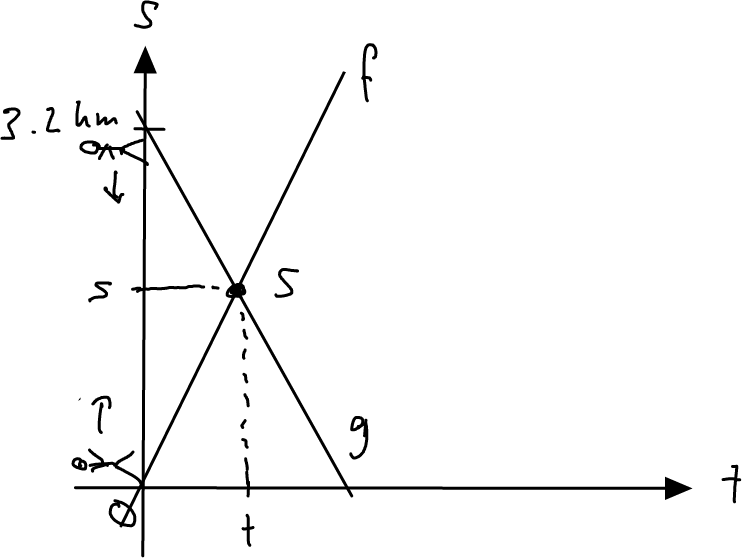
Assume one walker starts at the origin (), the other at from the origin. As we know the walking speed, we can determine where each walker is at every point in time : walker 1 has position , and walker 2 has position (see figure below). They meet at the intersection point of the two graphs, because there both walkers have zero distance between them.
Thus to out when that is, we have to find a value for with
Where do they meet? At position
from the origin.
Consider the triangle with the vertices , and .
- Show that the triangle has a right angle at .
- Determine the area of the triangle.
- Find a point such that forms a rectangle.
- Find the point of intersection between the diagonals of the rectangle .
Check your solutions with the Geogebra App (Calculator Suite).
Solution
Draw the situation!!!
- First, find the slopes of the triangle sides and : We see that and therefore the lines form a right angle. Thus, the triangle has a right angle at .
- As the triangle has a right angle at , the area is where denotes the length of triangle side from to , and is the length of the triangle side form to . We can use Pythagoras to find those lengths: Thus, the area is
- We know how to get from point to point , just move along the slope triangle between and , e.g.: In the same way we can get from to . So starting at , move to the left and upwards. We get the point
- Denote the diagonal from to by , and the diagonal from to by . Let's find the function equation of the diagonals, so that we can intersect them. Thus, To find , we use that is on the graph of : Thus, we get Similar, to find the function equation of , we set Thus, To find , we use that is on the graph of : Thus, we get Finally, we have to solve the equation to get the -coordinate of the intersection point between and . The -coordinate is Thus, we have .
Determine the function equation of the straight line , where
-
is parallel to the -axis and has -intercept .
-
passes through the point and has slope .
-
passes through the point and has -intercept .
-
passes through the points and .
-
has a slope of and an -intercept of .
-
has an -intercept and is orthogonal to the straight line that intersects the -axis at and the -axis at .
Solution
Thus . Because of follows
Thus, .
Consider the straight lines , , and , with the equations
-
Draw the lines into the same coordinate system.
-
Are and parallel? Why?
-
Find the intersection point between and , and denote it by .
-
Find the intersection point between and , and denote it by . Likewise, find the intersection point between and and denote it by .
-
Find the intersection point between and , and denote it by . Likewise, find the intersection point between and and denote it by .
-
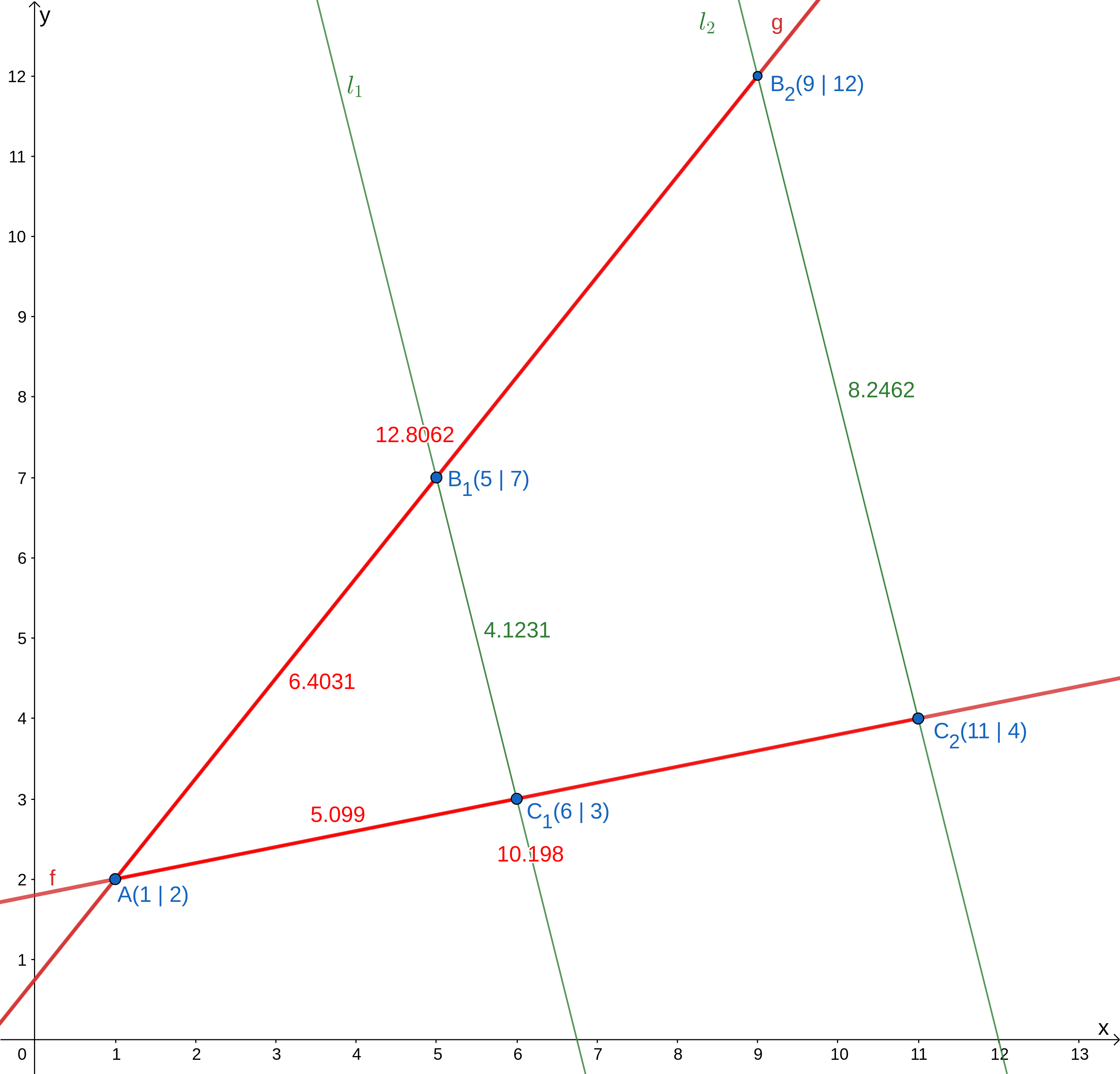
Determine the distances , , , , and . Note that the notation means "the distance between the points and ".
-
Show that the following fractions are equal:
Indicate those distances in the drawing. The fact that these three fractions are equal is called the intercept theorem.
Solution
No computations are shown, just the results.
- See below
- Because the have the same slope.
- See below
- See below
- See below
- See below
- The fraction is always .
The straight line passes through the points and .
-
Find the function equation of .
-
Determine the distance between and .
-
Find a point on such that its distance from is times bigger than the distance of from .
-
Find a point on such that its distance from is times bigger than the distance of from .
Solution