Some geometrical facts
Let's summarize some of the geometrical properties we have observed in the last section. Let's start with parallel and orthogonal straight lines:
Theorem 1
Consider two straight lines and with slope and .
- and are parallel, if they have the same slope:
- Two lines are orthogonal (that is, they for a right angle), if the product of the two slopes is : (instead of the condition can we also use or ).
Exercise 1
Consider two linear function and . Are they parallel, orthogonal, or neither?
-
and
-
and
-
and
Solution
- parallel, because same slope
- orthogonal, because
- neither, because the have not the same slope, and their product is not .
We also have looked at the intercept theorem, which comes in handy from time to time. Let us state it here in more detail:
Theorem 2: Intercept theorem
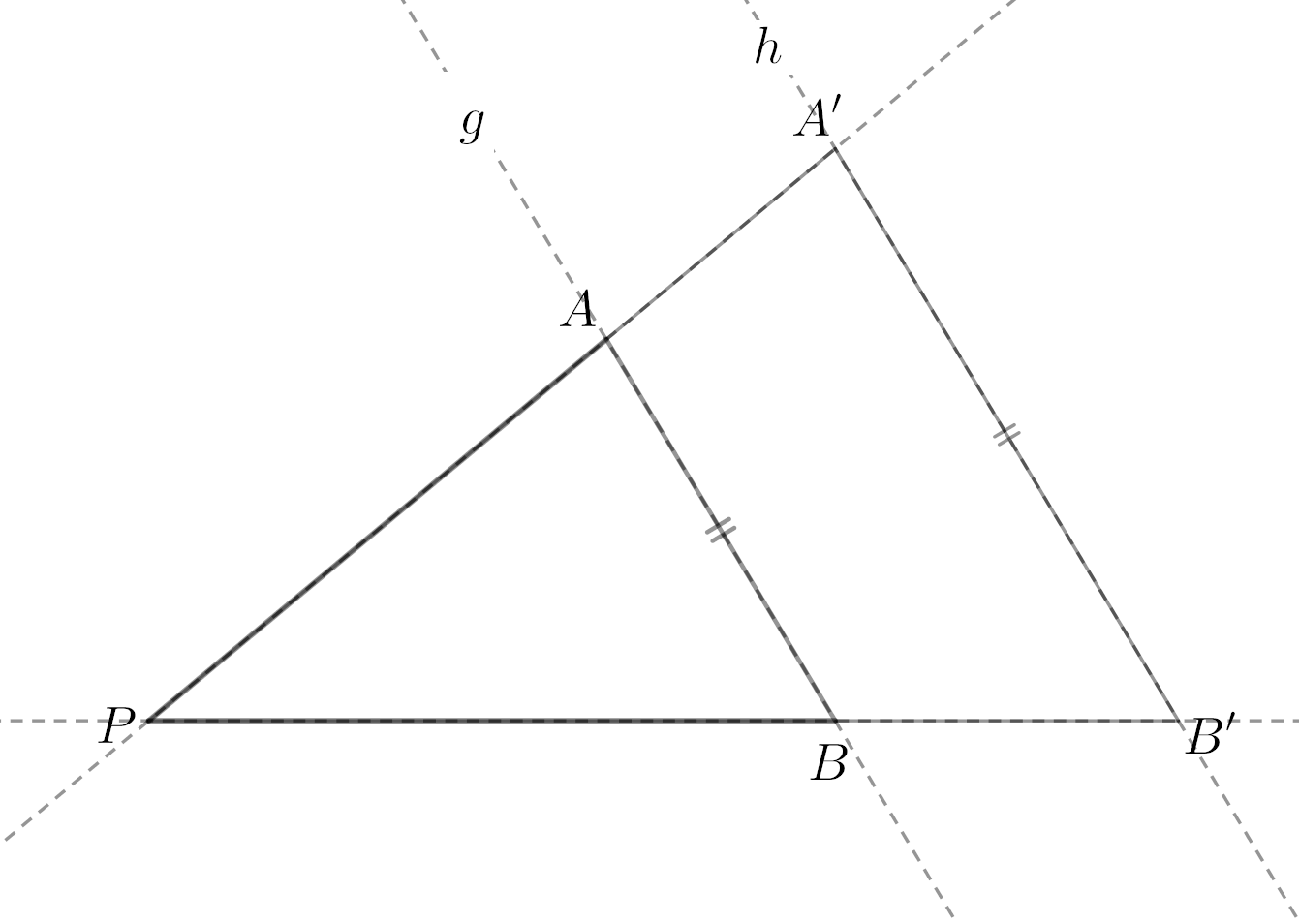
Consider two lines that intersect at point , and two lines and that traverse these two lines, resulting in the intersection points , , and (see figure below). The following is then true:
Here, with we mean the distance between and , and so on.
Exercise 2
Use the intercept theorem to determine the length in the figure below.

Solution
.