Geometrical interpretation of systems of linear equations
Consider the following three system of linear equations, and solve them:
Solution
Let's replace the in the second equation by . We get
and thus . It follows .
Solution
Let's replace the in the second equation by . We get
So we get
So every fulfils this equation, which means that there are infinitely many solutions.
Solution
Let's replace the in the second equation by . We get
So we get
So every we try ends up with a contradiction. Thus there is no that can fulfil the equation. So no solution.
Is there a better way to see way a system of linear equation sometimes has one solution (and is there only one?), sometimes no solution, and sometimes infinitely many solutions?
Things become more clear if we take a geometrical view of what it means to solve a system of linear equations. Take system 1, which we copy here again:
Let us rewrite the equations as follows:
Now, one way to solve this system is to write
thus to find we have to solve the equation
We could do that, and would find again and inserting this value in one of the equations for , say , we get . But the point we want to make here is a different one. Forget for the moment about solving system of linear equations, and lets go back to finding the point of intersection, let's call it , between the two functions
To find the -coordinate of , we have to find an such that
or
Observe that we solve exactly the same equation as above, so , and the -coordinate is .
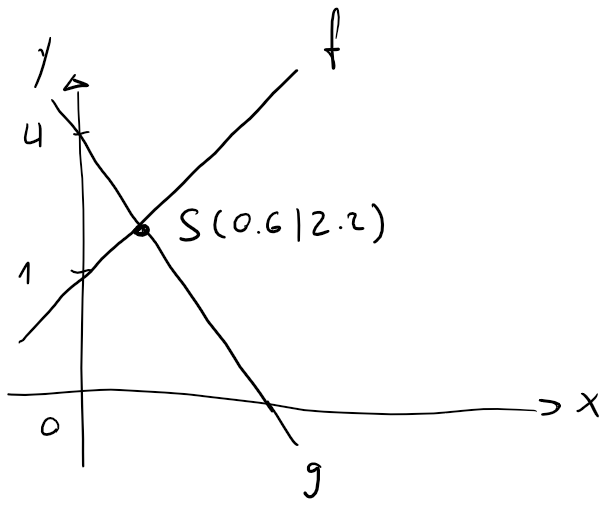
In other words:
The solution of a system of two linear equations (with two unknowns) is the point of intersection between two straight lines.
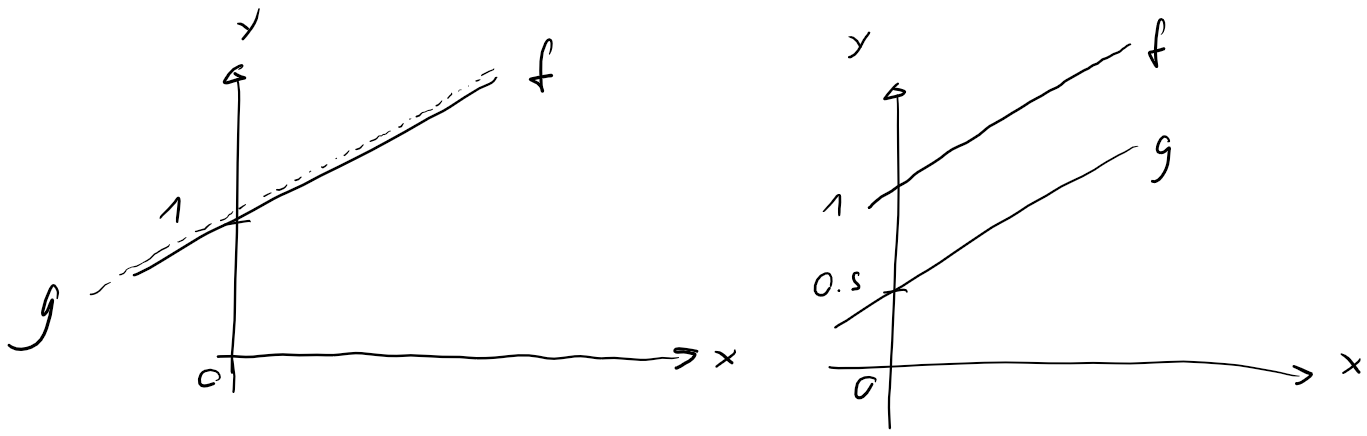
Thus, a system of linear equations has exactly one solution (if the lines intersect), infinitely many solutions (if the lines overlap), and no solution (if the lines are parallel).
Determine the number of solutions of systems 2 and 3 by investing if the corresponding straight lines are intersecting, parallel or overlapping.
Solution
For system 2
and . So the straight lines (the graphs of and ) are overlapping. So there are infinitely many solutions (all points on the line ). One solution, for example, is and . Another one is and , and so on.
For system 3
and . So the straight lines (the graphs of and ) are parallel but not overlapping (they have the same slope but different -intercepts). So there is no solution.