The chain rule
We already know the derivative of simple functions. For example, we have seen that for the sine function we have
More difficult is the case where the argument of the sine function is another function, e.g.
or
Both are examples of a chain of functions (see:drefcomposition): if you want to determine the value of you need to apply two functions, first one, then the other: first you have to feed into the first function (called the inner function) to calculate and then you have to feed this result into the second function (called the outer function) to calculate . In short:
More generally, if we denote the inner function by , and the outer function by , can be written as a composition of and :
Thus we have the chain
In order to determine the derivative of such a chain of functions, we must first always identify the inner and outer functions. Let's practise that first.
-
Determine the inner and outer function of the following functions:
-
Determine two different inner and outer functions for the function
Solution
- We have
- Solution 1: . Solution 2:
Note that sometimes there is more than one possibility to assign inner and outer functions. In general it will be clear from the context which one you should take.
So how can we find the derivative of a chain of functions? Let's return to our example
Our first instinct is to set
as we already know that
This is not totally wrong, but also not totally right (uncollapse to see that it can't be correct). Let's call this the naive approach.
Show
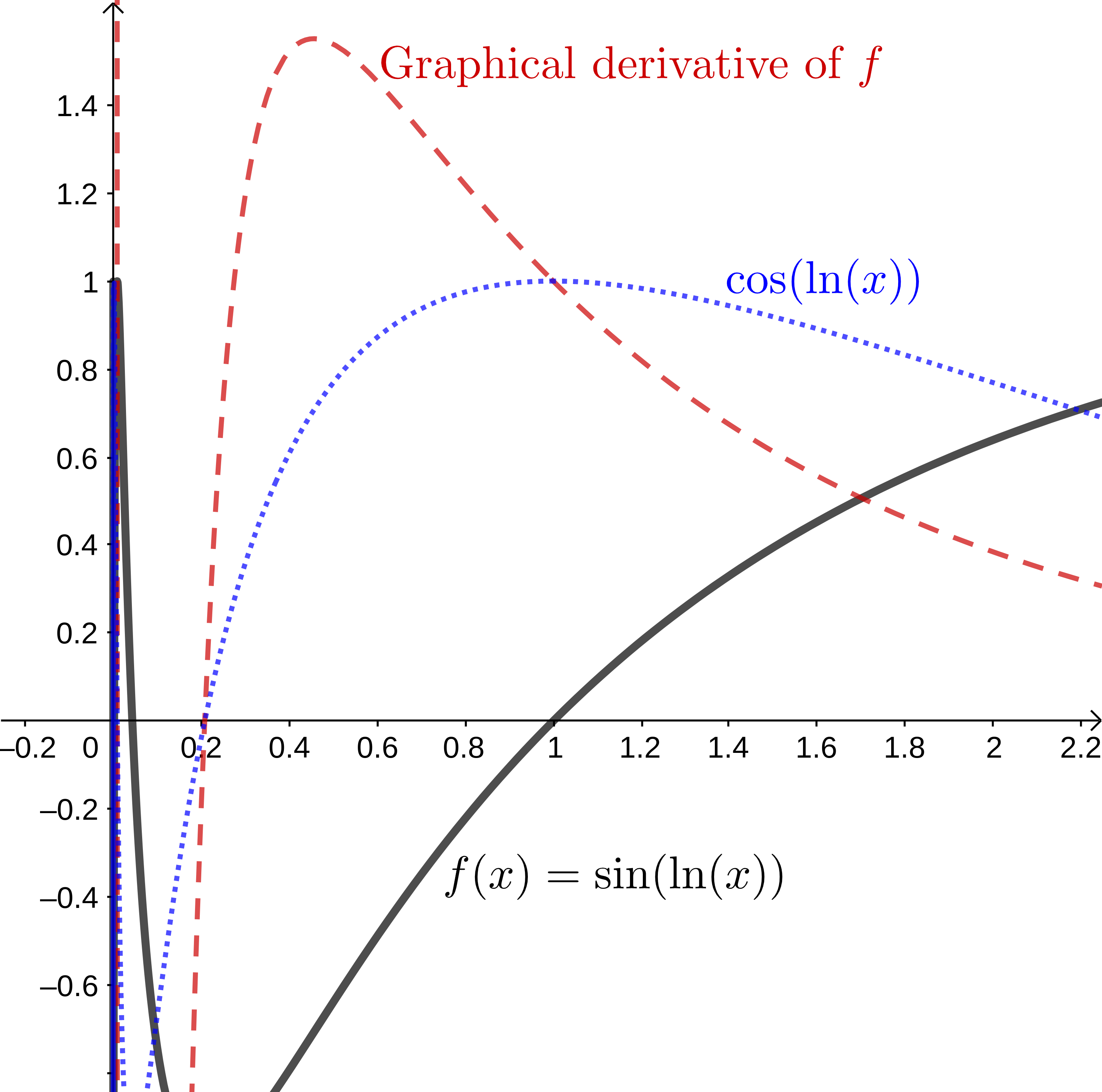
To get the correct derivative, we have to multiply the naive approache with a correction factor, and this correction factor is always the derivative of the inner function, in this case . Thus, the correct derivative is
Let's summarise this and also generalise
Assume we have a function that can be thought of as a chain (or composition) of two functions and , that is . The we can find the derivative of as follows:
Chain rule to find the derivative of a composition of functions.
This is the so called chain rule. In words:
-
Form the "naive" derivative of
-
Apply the correction factor
Proof
We have . We know that
The differential quotient of is therefore
Now, we also know that
With and we therefore get
Inserting this into the difference quotient above, we get
And this is of course also true for .
Determine :
-
Use the methods indicated to determine the derivative of .
- (expanding, product rule, chain rule)
- (power rule, product rule, chain rule)
- (power rule, product rule, chain rule)
-
Determine :
-
Consider a function written as a quotient of two other functions and :
Show with the help of the chain rule, that the following is true:
For obvious reasons, this is called the quotient rule.
Solution
- We have
- Expanding: Chain rule: Product rule:
- Power rule: Chain rule: Product rule:
- Power rule: Chain rule: Product rule:
- It is
- (note that )
- (note that , so we need the chain rule again to find ). Of course you can also use the product rule.
- We have to use the product rule and the chain rule:
- , we have and , thus .
- , we have to use the product rule and the chain rule. with and . Applying the chain rule for , we get , applying the chain rule for we get . Thus, we have
- We have Applying the product rule and the chain rule, we get