Number sets
Each number has an exact position on the number line (a straight line). Conversely, each position on the number line corresponds to a number.

We can divide the numbers into different groups:
The natural numbers
These are the numbers you use to count things.
The natural numbers can be further divided, e.g.:
- The even numbers ("gerade" Zahlen): All natural numbers that are divisible by 2 without a remainder ("Rest").
- The odd numbers ("ungerade Zahlen"): All natural numbers which are not even. Divided by , the odd numbers have a remainder of .
- The square numbers:
- The multiples of :
- The divisors of : (pronounce it as "divisors") The result of the division has to be a natural number!
- The prime numbers: All natural numbers with two different divisors ( and the number itself).
Note: is not counted as a natural number. However, we can use the notation
to include the .
The integers
If and the "negative" natural numbers are added to the natural numbers, we get the integers:
Note that we say "negative 2" and not "minus 2".
The rational numbers
If we add to the integers all the fractions , we get the rational numbers:
Any integer can of course also be represented as a fraction: . The integers are therefore automatically included in the above definition.
Note that is called the numerator and the denominator, and the small horizontal line is called the fraction line. We say " over ". But for small denominators we also say, for example,
- "one-half"
- "one-third"
- "two-third"
- "one-fourth"
- "two-fourth"
- and so on.
Note that because of it follows that each integer is also a rational number.
The "Q" stands for "quotient".
The irrational numbers
All numbers which are not rational numbers, that is, all numbers which we cannot write as a fraction. We will not introduce a symbol for this set. It can be shown that (say "pai") and are irrational numbers.
The real numbers
All numbers on the number line, that is, the rational and irrational numbers.
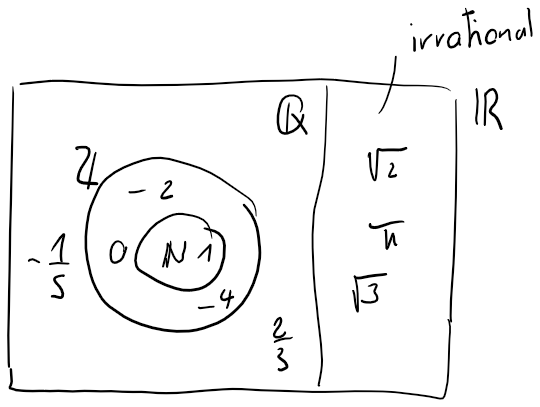
Draw a Venn-diagram showing the relationship between the different number sets and .
Solution
We have :
The decimal representation of numbers
We can also write the numbers with the help of a decimal point. For example:
- (say "one point zero")
- (say "negative two point zero")
- (say "two point 5")
- (say "zero point 6 repeated")
- (the three dots mean "and so on")
Observe that the rational numbers have a terminating or repeating decimal representation, while this does not seem to be the case for the irrational numbers like or . Indeed, this is a general rule, which we will not prove:
A number is rational exactly when its decimal representation is finite or repeating.
So, finding the decimal representation of an irrational number is impossible. Read also the following article about this topic.
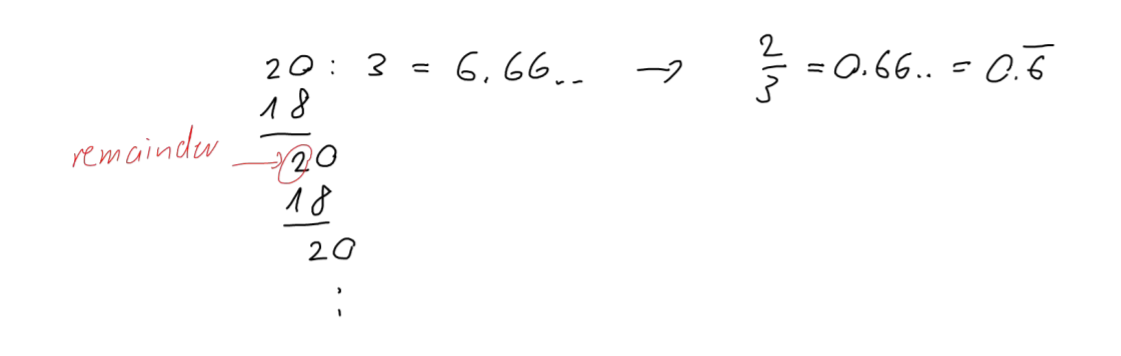
In contrast, finding the decimal representation of rational numbers is straight forward using a division. Here is an example:
Find the decimal representation of :
It is also possible to find the fraction for a terminating or repeating decimal number.
Express the following numbers as a fraction :
Solution
- Multiply the number by , and subtract from it the number itself: But we also have Thus, we have and it follows that
- Same trick, but this time we multiply by : But we also have that Thus, we have and it follows that
-
To which ("smallest") number set does the following number belong?
-
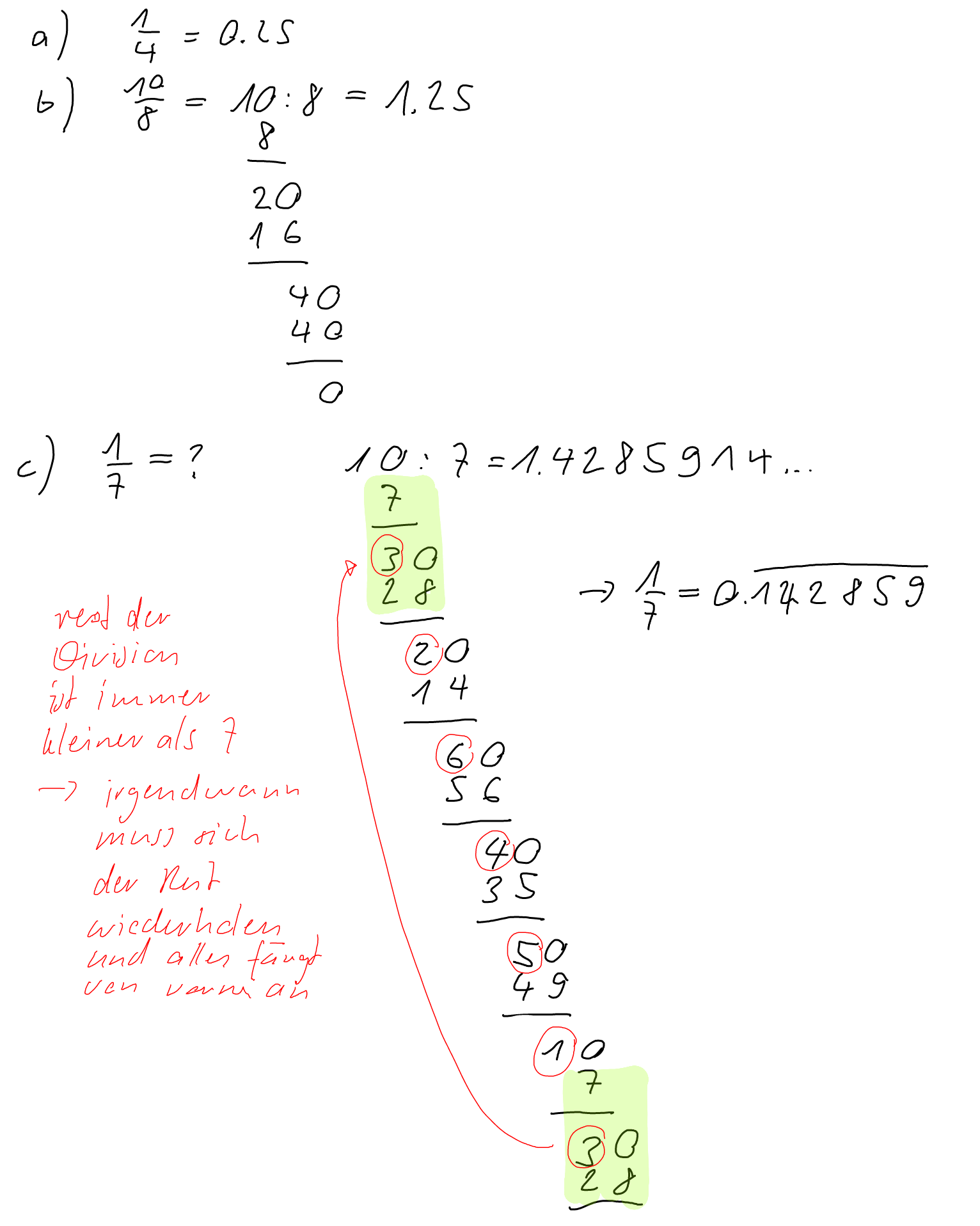
Determine the decimal representation of the following numbers:
-
Is there a number that contains every natural number? If so, this would mean that this number contains every single book that was and will be written ... .
-
Write as a fraction
-
Show that equals .
Solution
- It is
- (because it is a terminating decimal number)
- (because it is a repeating decimal number)
- (because it is a repeating decimal number)
- . This is an irrational number, because it is a non-terminating, not-repeating decimal number.
- See the picture below
- Yes, e.g.
- It is Thus and therefore
- Let's write as a fraction: Thus we have and therefore