Inequality and intervals
Inequality between two numbers
We use the inequality symbols and to compare the size of two real numbers. For example, the following statements are correct:
- : say " is less than ".
- : say " is less than or equal to " Note that the statement is correct, but the strict version is not.
- : say " is greater than ".
- : say " is greater than or equal to ". Again, the statement is correct, but the stricter version is not.
We can also use inequality symbols to define subsets of the number sets. Here are some examples:
-
is the set of all natural numbers with . Using a more formal notation, we could write
It is
-
is the set of all natural numbers with . Using a more formal notation, we could write
It is
-
is the set of all integers with . Using a more formal notation, we would write
It is
-
is the set of all natural numbers with . Note that with this notation we mean that and (that is, is between and , where is in the set, but is not). Using a more formal notation, we write
It is
Of course we can replace with any other number set such as .
Determine the elements of set :
-
is the set of all natural numbers with .
-
-
is the set of all rational numbers with and .
-
Solution
Intervals
Intervals are segments (or subsets) of the number line (the real numbers). For example, all numbers between and form an interval. Emphasis is on all numbers, so not just the natural numbers between to , or just the fractions between and , but also the irrational numbers such as or .
We use square brackets to indicate intervals, and distinguish between intervals which do or do not include the borders:
-
The set of all real numbers between and , including the borders and . Thus, we have
-
The set of all real numbers between and , including the left border but without the right border ). Thus, we have
-
The set of all real numbers between and , without the left border but including the right border ). Thus, we have
-
The set of all real numbers between and , without the left and right borders). Thus, we have
More generally, if and denote two real numbers, where is greater than or equal to , we can define the intervals and . They all denote the set of all real numbers between and , but depending on how we write the square brackets, the borders and are included or not.
Note that the borders can also be an infinitely big number (which we denote by and . We then have
-
The set of all real numbers greater than or equal to :
-
The set of all real numbers greater than :
-
The set of all real numbers less than or equal to :
-
The set of all real numbers less than :
-
The real numbers
and are borders which are never included, as they are not real numbers.
Express the segments drawn below on the number line by intervals. Several intervals may have to be linked by set operations. The dotted segments in 3 and 4 means that they go on and on.
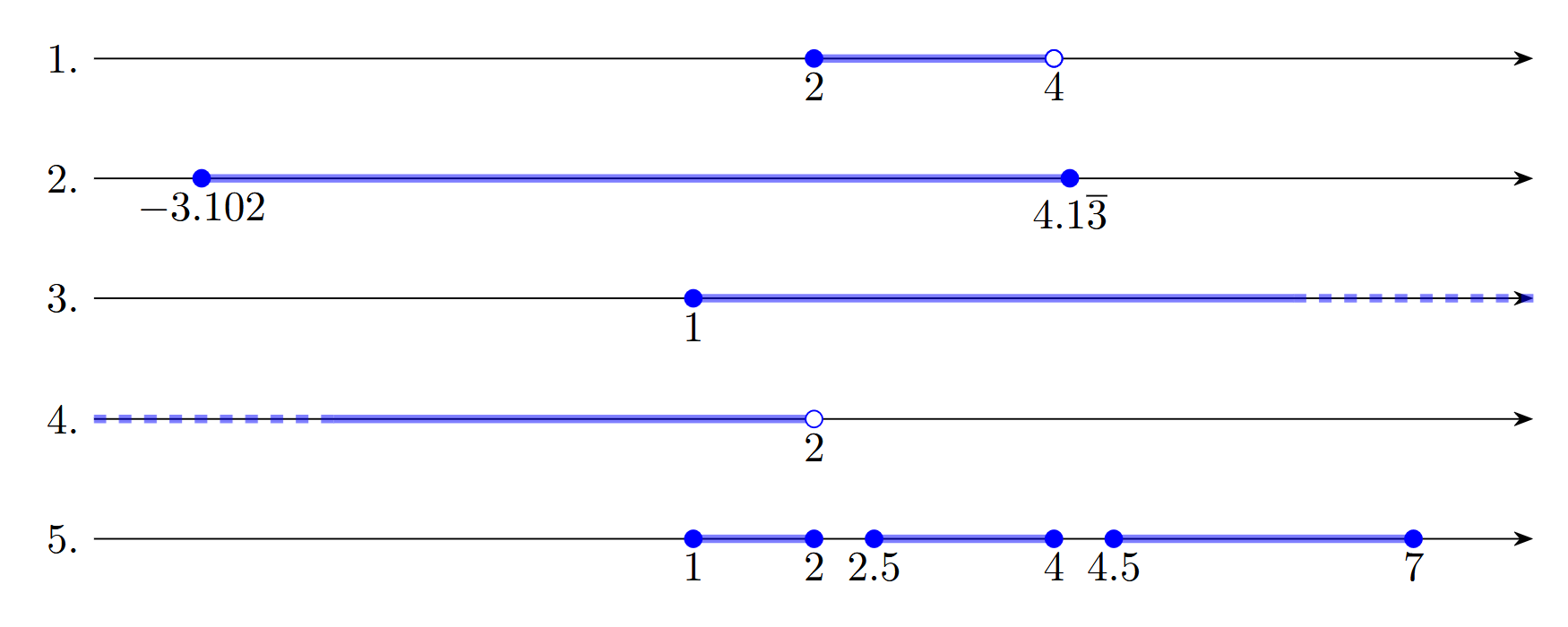
Solution
Express the following sets using intervals or the union of intervals. Hint: Indicate the sets on the number line. Also note that for intervals the universal set is always .