The sine, cosine and tangent
In trigonometry, we are particularly interested in the side-length ratios
of right-angled triangles, from which we know that one interior angle is .

These length ratios have particular names. The ratio is called the sine, the ratio is called the cosine, and the ratio is called the tangent. And because the reference angle is , we use the notation for the sine, for the cosine, and for the tangent. Thus, in summary, we have the following:
Consider a right-angled triangle where one interior angle different from is . We then use the following notation for the three different length ratios:
In short, SOHCAHTOA. Memorise it! Say "sine of ", "cosine of ", and "tangent of ".
Of course we could consider other length ratios as well ( and ) but these can be calculated from the ones above, so we do not specifically discuss them. For example, if we know for a right angled triangle that , it follows and thus .
We will see later, why all these ratios are useful. But let us first discuss them a bit further. They actually have many interesting properties!
A. Length ratios are equal for all right-angled triangles with same angles
Let us start by assuming that someone draws on a paper a right-angled triangle with an of . Assume we cannot see this paper. What can we say about the side-length ratios and of this triangle? Or in our new notation, what can we say about , and ?
Well, you might say that this depends on the exact details of the triangle, such as its exact size and shape. So you would have to actually see the triangle to answer this question. But actually this is not true! We explain now why this is so.
First, because it is a right-angled triangle, and one of the angle is , we know that the other remaining angle is . This means that the shape of this triangle is specified. If five people draw in isolation ten right-angled triangles where one angle is , they will all look very similar. They may be oriented differently, but if we cut them out, we could all arrange them such that the angle is to the left, the is at the top, and the angle is to the right, as shown below:
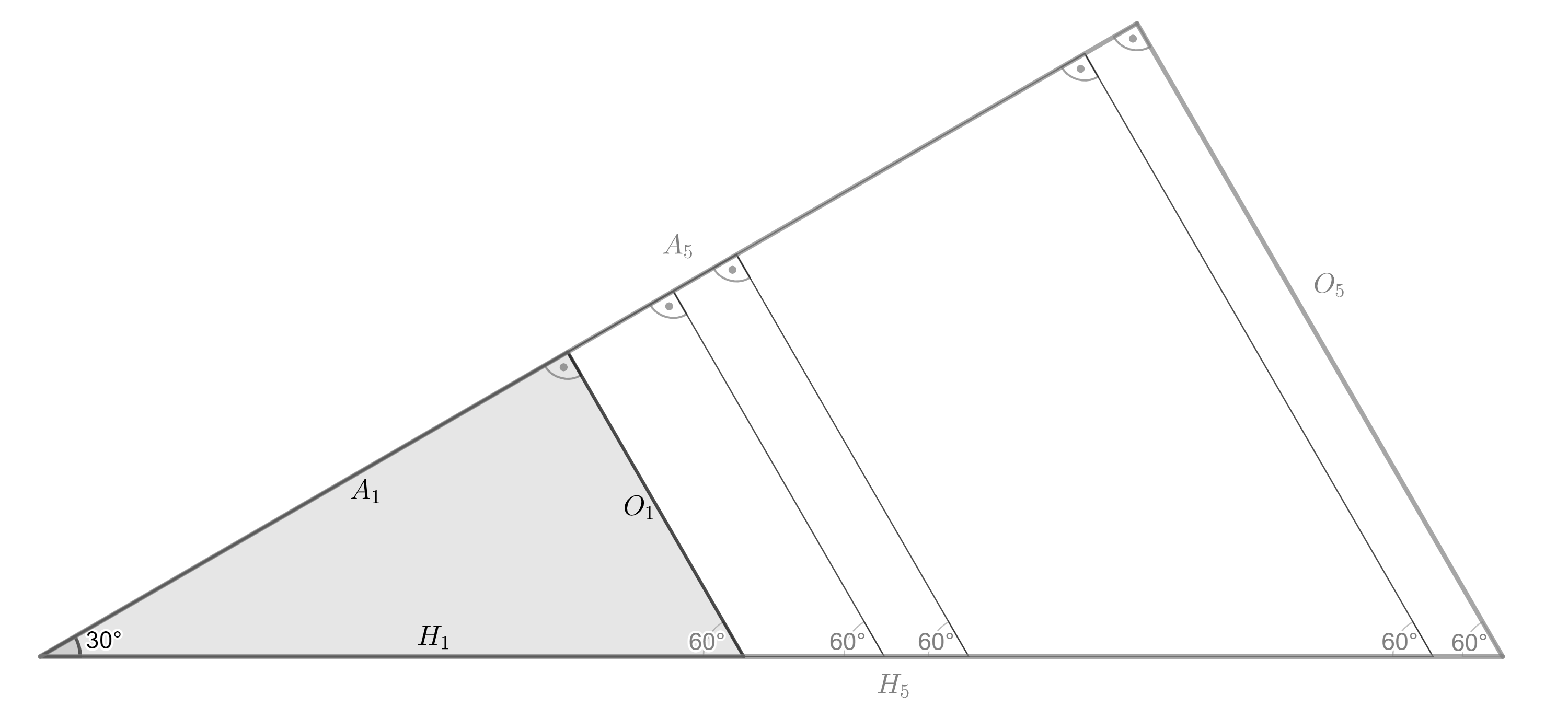
So the only difference between these ten triangles is the size. Some triangles will be bigger, some will be smaller. As a side remark, geometrical objects with the same shape are called similar. If they have the same shape and size, we call them congruent. So all the five triangles drawn by these five people will be similar triangles.
Second, the size differences are such that the corresponding length ratios of all five triangles are equal. Indeed, if we were to measure the side lengths of each of those triangles, the length ratios will be the same for each of them:
Thus, we can say that , and are the same for all right-angled triangles with .
The equality of these ratios actually follows from the intercept theorem, which we have discussed briefly in section 24. Click right to see the argument.
Show
Let us make the argument for triangles 1 and 5. Because the sides and are parallel, the intercept theorem tells us that
Thus, it follows
And this shows the equality.
To bring the point home, let us verify the quality by measuring the side lengths for ourselves:
Measure the side lengths of the triangle and triangle above. Determine for both triangles the length ratios and . Verify that these ratios do not change and are close to the ratios shown above.
Of course, every argument we made about right-angled triangles with are also valid for right-angled triangles of an arbitrary angle . But depending on the value of the length ratios will change! Let us summarise:
For every right-angled triangle with an interior angle , the length ratios , and stay the same.
B. How to find the precise values of the length ratios
Consider a right-angled triangle with an interior angle . We want to find the length ratios and . How can we do this?
One method is to draw one such triangle, measure the side lengths of , , and , and the calculate
Unfortunately, this method is not precise. But luckily, most calculators have stored the length-ratios for all angles between and . The keys are, surprise, also called sin, cos and tan. For example, if you take the calculator and type sin(30), we get the value , for cos(30) we get the value , and for tan(30) we get the value . That's how I have calculated the length ratios in the previous subsection A.
A right-angled triangle has a hypotenuse of . Find the other side lengths if one angle is
Solution
With and follows that
To find , we can use two different methods:
- You can either use the theorem of Pythagoras: Also
- Or we can use the cosine:
-
Determine , , by drawing and measuring side lengths. Then find the exact values using the calculator.
-
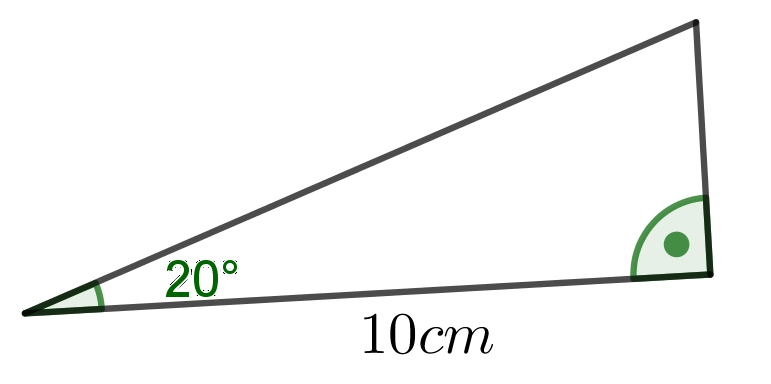
Determine the missing side lengths and the missing angle (exact values).
-
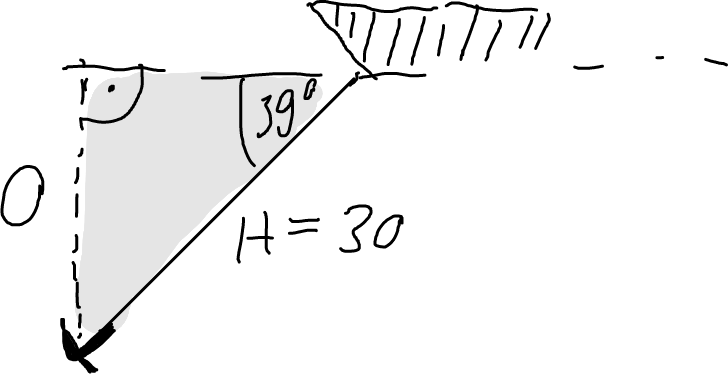
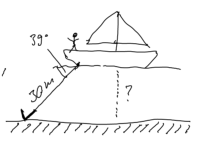
You are on a boat and cast the anchor. You can measure the angle of the chain that is attached to the anchor (), and you know the length of the chain (). How deep is the water?
Solution
- For the estimate, draw a right-angled triangle with angle and label the side lengths relative to . Then measure the side lengths , , and , and form the ratios , , . To find the exact values, use the calculator: , ,
- . To find the third side length, we can use one of the other trigonometric functions, or Pythagoras. With Pythagoras, we have . The third angle is .
- The depth of water is in the right-angled triangle with reference angle , and . So .