Further problems 4

Exercise 1
Q1

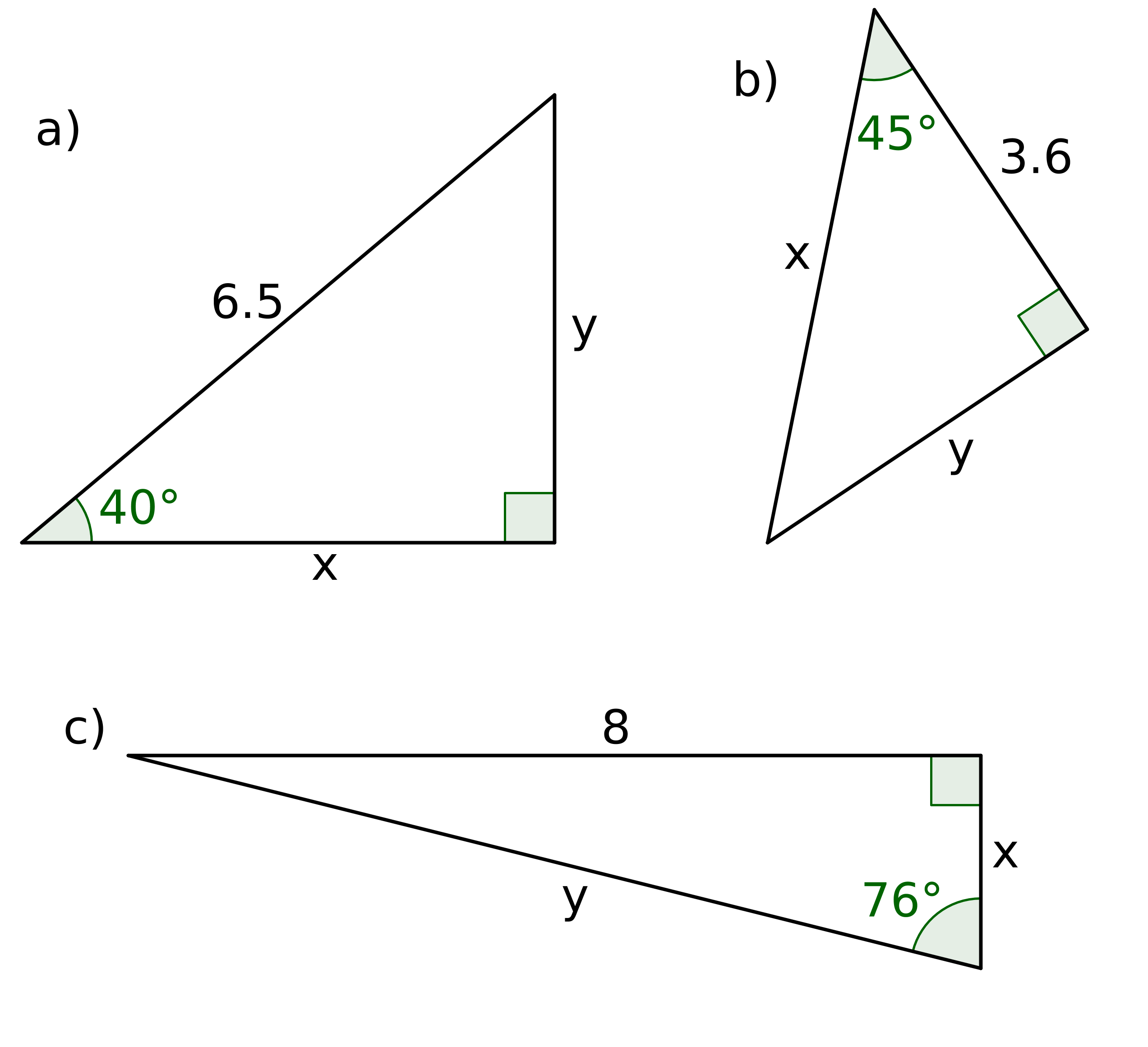
Calculate all unknown side lengths and angles:
Q2

For the angles α=30,45\alpha=30^\circ, 45^\circ, and 6060^\circ it is possible to calculate the exact values of sin(α),cos(α)\sin(\alpha), \cos(\alpha) and tan(α)\tan(\alpha). That is, find the exact values without using the calculator keys sin, cos, and tan. Then fill out the table below:

α=30α=45α=60sin(α)cos(α)tan(α)\begin{array}{|l|l|l|l|}\hline & \alpha=30^\circ & \alpha=45^\circ & \alpha=60^\circ \\\hline \sin(\alpha) & & & \\\hline \cos(\alpha) & & & \\\hline \tan(\alpha) & & & \\\hline \end{array}

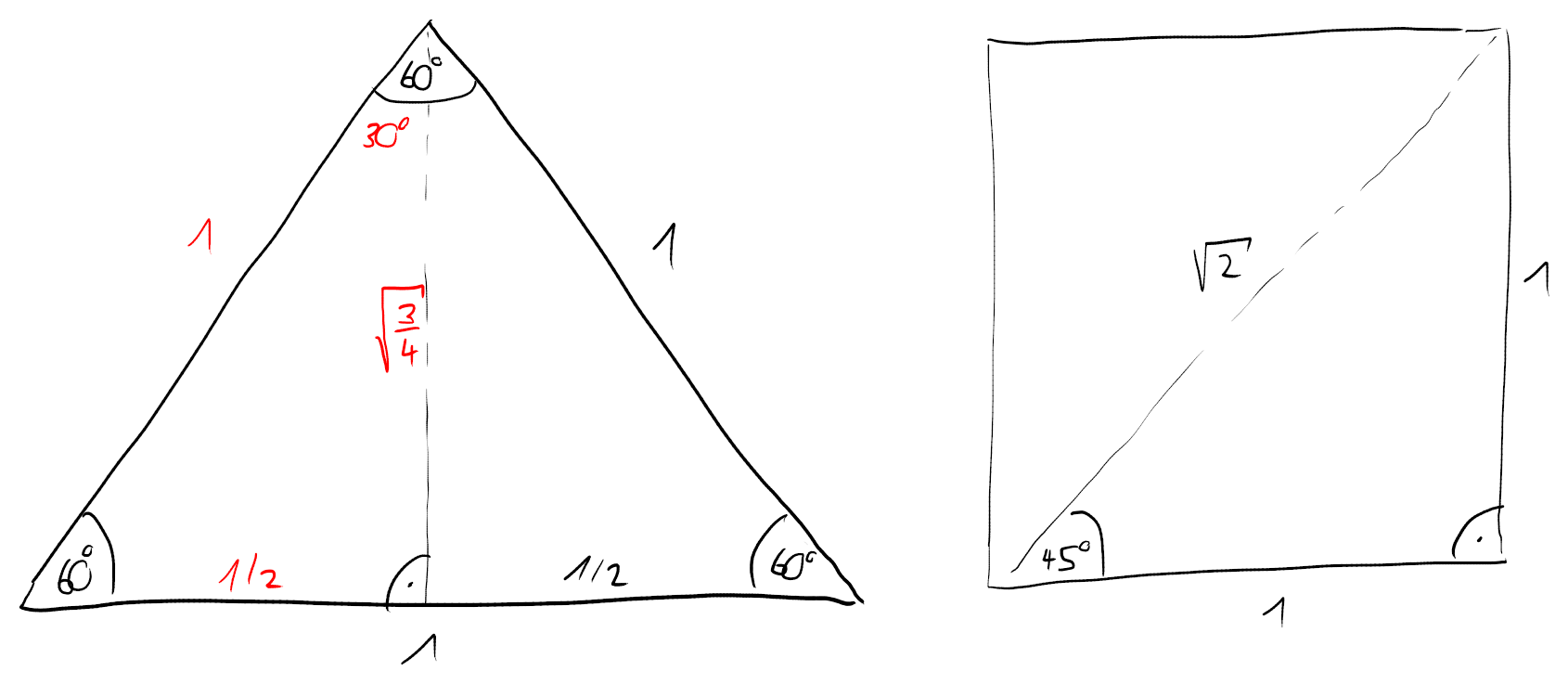
Hint: you need an equilateral triangle, and also a right-angled triangle with equal opposite and adjacent sides ...

Q3

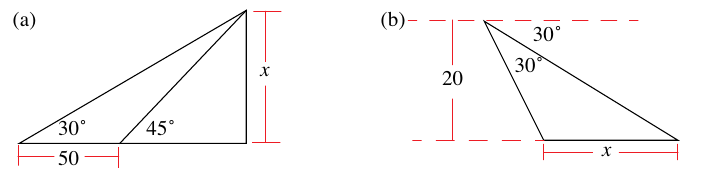
Calculate the value of xx in each of the following:

Q4

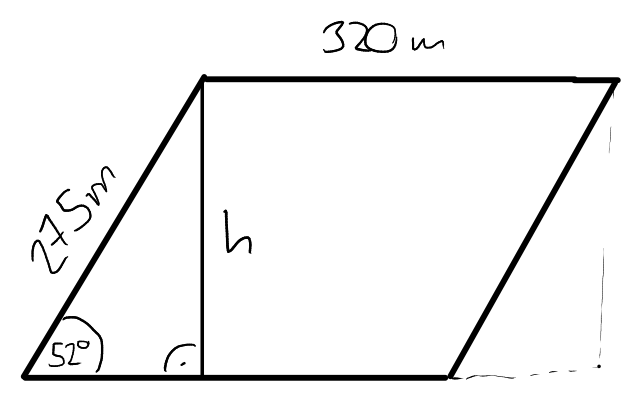
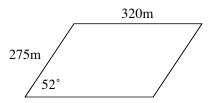
Determine the area of the parking space shown below (it is a parallelogram).
Q5

Show that the following relationships are correct

sin(α)2+cos(α)2=1sin(α)cos(α)=tan(α)cos(α)=sin(90α)\begin{array}{lll} \sin(\alpha)^2+\cos(\alpha)^2&=&1\\ \frac{\sin(\alpha)}{\cos(\alpha)}&=&\tan(\alpha)\\ \cos(\alpha)&=&\sin(90-\alpha) \end{array}
Q6

Right-angled triangles with an angle of α=0\alpha=0^\circ or α=90\alpha=90^\circ do not exist. Nevertheless:

  1. what could be the values of sin(0)\sin(0^\circ), cos(0)\cos(0^\circ) and tan(0)\tan(0^\circ)?
  2. what could be the values of sin(90)\sin(90^\circ), cos(90)\cos(90^\circ) and tan(90)\tan(90^\circ)?

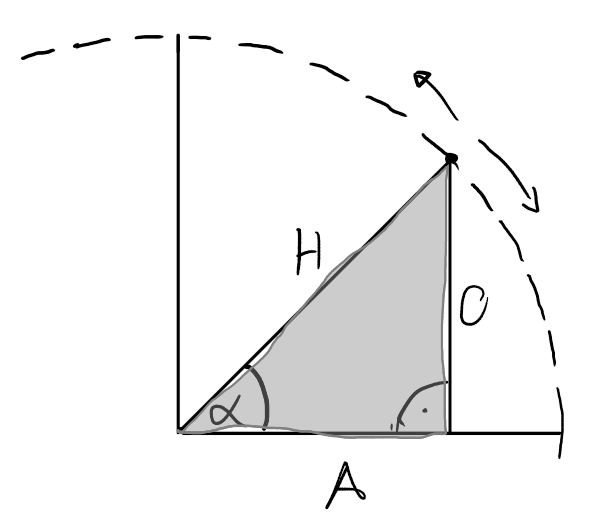
Hint: Consider the figure below.

Solution
A1
  1. x=4.97...,y=4.17...x=4.97..., y=4.17...
  2. x=5.09...,y=3.6x=5.09..., y=3.6
  3. x=1.99...,y=8.24...x=1.99..., y=8.24...
A2

See equilateral triangle. We can choose a side length of 11, or any other length. The height of the triangle is then (using the theorem of Pythagoras)

12(12)2=34\sqrt{1^2-\left(\frac{1}{2}\right)^2}=\sqrt{\frac{3}{4}}

We then have:

  1. sin(30)=1/21=12\sin(30^\circ)=\frac{1/2}{1}=\frac{1}{2}
  2. cos(30)=341=34\cos(30^\circ)=\frac{\sqrt{\frac{3}{4}}}{1}=\sqrt{\frac{3}{4}}
  3. tan(30)=1/234=1234=13\tan(30^\circ)=\frac{1/2}{\sqrt{\frac{3}{4}}}=\frac{1}{2\cdot \sqrt{\frac{3}{4}}}=\frac{1}{\sqrt{3}} We also have:
  4. sin(60)=341=34\sin(60^\circ)=\frac{\sqrt{\frac{3}{4}}}{1}=\sqrt{\frac{3}{4}}
  5. cos(60)=1/21=12\cos(60^\circ)=\frac{1/2}{1}=\frac{1}{2}
  6. tan(60)=341/2=234=3\tan(60^\circ)=\frac{\sqrt{\frac{3}{4}}}{1/2}=2\cdot \sqrt{\frac{3}{4}}=\sqrt{3}

See the square with side length 1. With the theorem of Pythagoras, we get the length of the diagonal:

12+12=2\sqrt{1^2+1^2}=\sqrt{2}

We have

  1. sin(45)=12\sin(45^\circ)=\frac{1}{\sqrt{2}}
  2. cos(45)=12\cos(45^\circ)=\frac{1}{\sqrt{2}}
  3. tan(45)=1212=1\tan(45^\circ)=\frac{\frac{1}{\sqrt{2}}}{\frac{1}{\sqrt{2}}}=1

To summarise, we have

α304560sin(α)121234cos(α)341212tan(α)1313\begin{array}{|l|l|l|l|}\hline \alpha & 30^\circ & 45^\circ & 60^\circ \\\hline \sin(\alpha) & \frac{1}{2} & \frac{1}{\sqrt{2}} & \sqrt{\frac{3}{4}}\\\hline \cos(\alpha) & \sqrt{\frac{3}{4}} & \frac{1}{\sqrt{2}} & \frac{1}{2}\\\hline \tan(\alpha) & \frac{1}{\sqrt{3}} & 1 & \sqrt{3} \\\hline \end{array}
A3
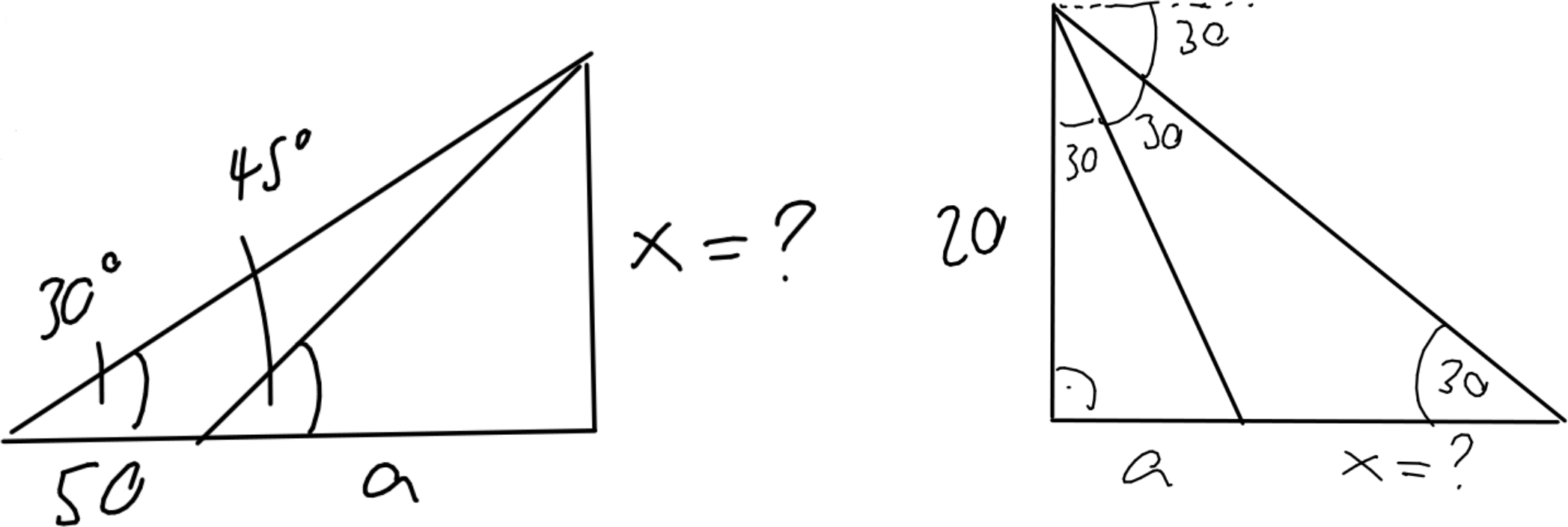
  1. See figure below, left. It is tan(45)=1=xa\underbrace{\tan(45^\circ)}_{=1}=\frac{x}{a} thus x=ax=a With tan(30)0.577=x50+a=x50+x(50+x)\underbrace{\tan(30^\circ)}_{0.577}=\frac{x}{50+a}=\frac{x}{50+x}\quad \vert \cdot(50+x) it follows 28.86=0.422x28.86 = 0.422 x and thus x=68.30x=\underline{68.30}.
  2. See figure below, right. It is tan(30)=0.577=a20\underbrace{\tan(30^\circ)}_{=0.577}=\frac{a}{20} thus a=200.577=11.54a=20\cdot 0.577 = 11.54 With tan(30)=0.577=20a+x=2011.54+x(11.54+x)\underbrace{\tan(30^\circ)}_{=0.577}=\frac{20}{a+x}=\frac{20}{11.54+x} \quad \vert \cdot(11.54+x) follows x=23.09x=\underline{23.09}
A4

Area A=320h=69344.9m2A=320\cdot h=\underline{69\,344.9 m^2}, where h=275sin(52)=216.7h=275\cdot \sin(52^\circ)=216.7.

A5
  1. With the theorem of Pythagoras it follows that A2+O2=H2A^2+O^2=H^2. Thus sin(α)2+cos(α)2=(OH)2+(AH)2=O2+A2H2=H2H2=1\begin{array}{lll} \sin(\alpha)^2+\cos(\alpha)^2&=&\left( \frac{O}{H} \right)^2 + \left( \frac{A}{H} \right)^2\\[5pt] &=&\frac{O^2+A^2}{H^2}\\[5pt] &=&\frac{H^2}{H^2}\\[5pt] &=&1\end{array}
  2. sin(α)cos(α)=OHAH=OHHA=OA=tanα\frac{\sin(\alpha)}{\cos(\alpha)}=\frac{\frac{O}{H}}{\frac{A}{H}}=\frac{O}{H} \cdot \frac{H}{A}=\frac{O}{A}=\tan{\alpha}
  3. Note that the other angle of the right-angle triangle has the value β=90α\beta=90^\circ-\alpha, thus cos(α)=uH=sin(β)=sin(90α)\begin{array}{lll} \cos(\alpha) &=& \frac{u}{H}\\ &=&\sin(\beta)\\ &=&\sin(90^\circ-\alpha) \end{array}
A6

See the figure given in the hint.

For α0\alpha \rightarrow 0^\circ, we see that O0O\rightarrow 0 and AHA\rightarrow H, thus we have:

  1. OH0H=0\frac{O}{H}\rightarrow \frac{0}{H}=0. Thus, sin(0)=0\sin(0^\circ)=0.
  2. AHHH=1\frac{A}{H}\rightarrow \frac{H}{H}=1. Thus, cos(0)=1\cos(0^\circ)=1.
  3. OA0H=0\frac{O}{A}\rightarrow \frac{0}{H}=0. Thus, tan(0)=0\tan(0^\circ)=0.

For α90\alpha \rightarrow 90^\circ, we see that OHO\rightarrow H and A0A\rightarrow 0, thus we have:

  1. OHHH=1\frac{O}{H}\rightarrow \frac{H}{H}=1. Thus, sin(90)=1\sin(90^\circ)=1.
  2. AH0H=0\frac{A}{H}\rightarrow \frac{0}{H}=0. Thus, cos(90)=0\cos(90^\circ)=0.
  3. OAH0=\frac{O}{A}\rightarrow \frac{H}{0}=\infty. Thus, tan(90)=\tan(90^\circ)=\infty.