Tree representation of events
Often we want to find the probability of events like "the person has green eyes but is not tall", or "it is neither windy nor rainy", and so on. If we look closer at structure of such statements, we see that they are composed of two different events, which are combined by logical operators.
For example, if we set ="green eyes" and ="tall", then the event "the person has green eyes but is not tall" can be expressed as "the person has green eyes AND is NOT tall". And this translates into the set theory language .
So, given two possible events and , what are the possible logical statements we can express using AND, OR and NOT? To find out, it is useful to organise the events in a tree (see figure below).
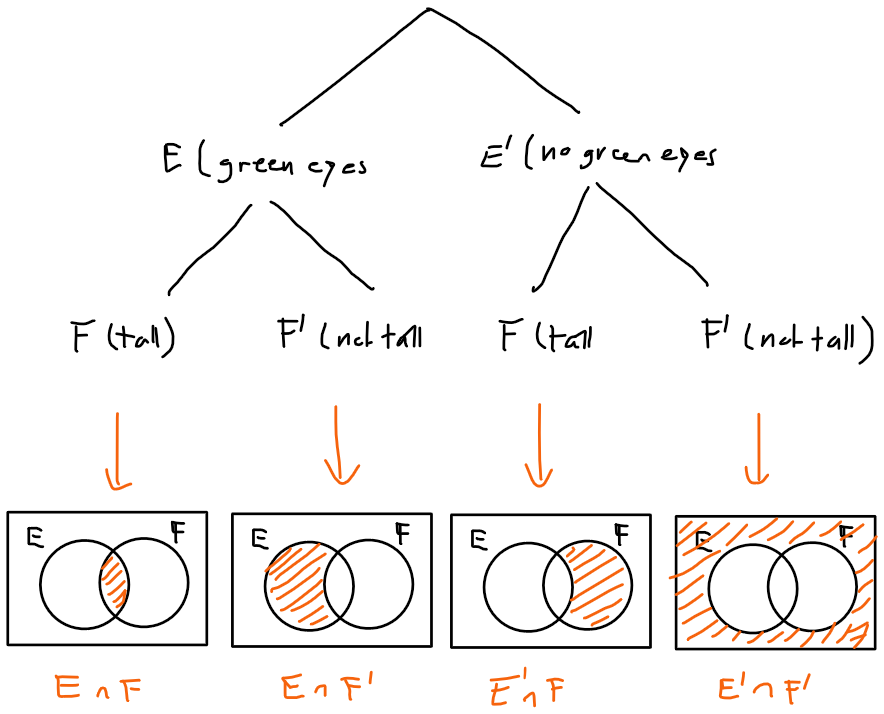
Of course we could have started with event , followed by event . Later it will often become clear from the context, which event to choose first. Important is how we have to read the tree:
Each line in the tree is called a branch. The tree above has branches. Following the branches from top to bottom, we get a path. The tree above has paths, which we denote by the events they pass: , , and .
The convention is to combine the events in the path using the AND operator, or in set notation, with a . For example, following the right path, we get , that is, " occurred not and occurred not".
Following each path, we get the events , and (see the Venn-diagrams above).
Paths are combined using the OR operator, or in set notation with a . For example, combining the paths and , we get the event , which is simply (check out the Venn-diagrams above).
We will use such tree structures more often later. Then the whole thing should hopefully make a bit more sense.
Consider the random experiment given at the top of this section, that is, selecting a person at random from a group, and ="green eyes", ="tall". Which paths belong to the events:
-
The person has green eyes but is small.
-
The person has not green eyes and is small.
-
The person has green eyes.
-
The person is small.
Solution
A tree organisation of events is particularly well suited for multistage experiments, where the top-down hierarchy of the tree reflects the stages. Here is a example.
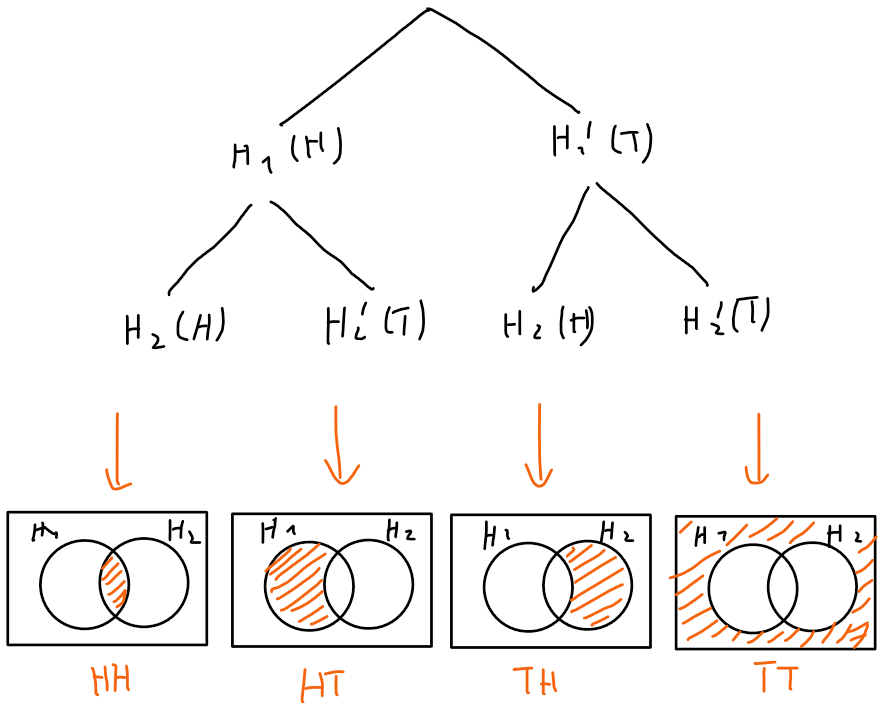
We flip a coin twice, and are interested in the events ="head in first flip" and ="head in second flip". Draw the tree starting with . Express the following events with the help of paths:
-
head in the first flip
-
head in the second flip
-
exactly one head
-
at least one head
-
at most one head
Solution
- Paths : event
- Paths : event
- Paths : event
- Paths : event
- Paths : event