The slope triangle of a straight line
Consider a linear function . We know the graph of is a straight line, and depending on the values and , the straight line will look differently. Here we discus the effects that the values of and have on the straight line.
We start with and lets calculate the -intercept of :
Thus, we see that
is the -intercept of , that is, it denotes the location where the straight line intersects the -axis.
Giving meaning to is a bit more difficult, but not by much. The value even has a name, it is called the slope ("Steigung") of . We will see in a second why this name is fitting. Here are two concrete examples of linear functions and their graphs:
That is, for and for and for both it is .
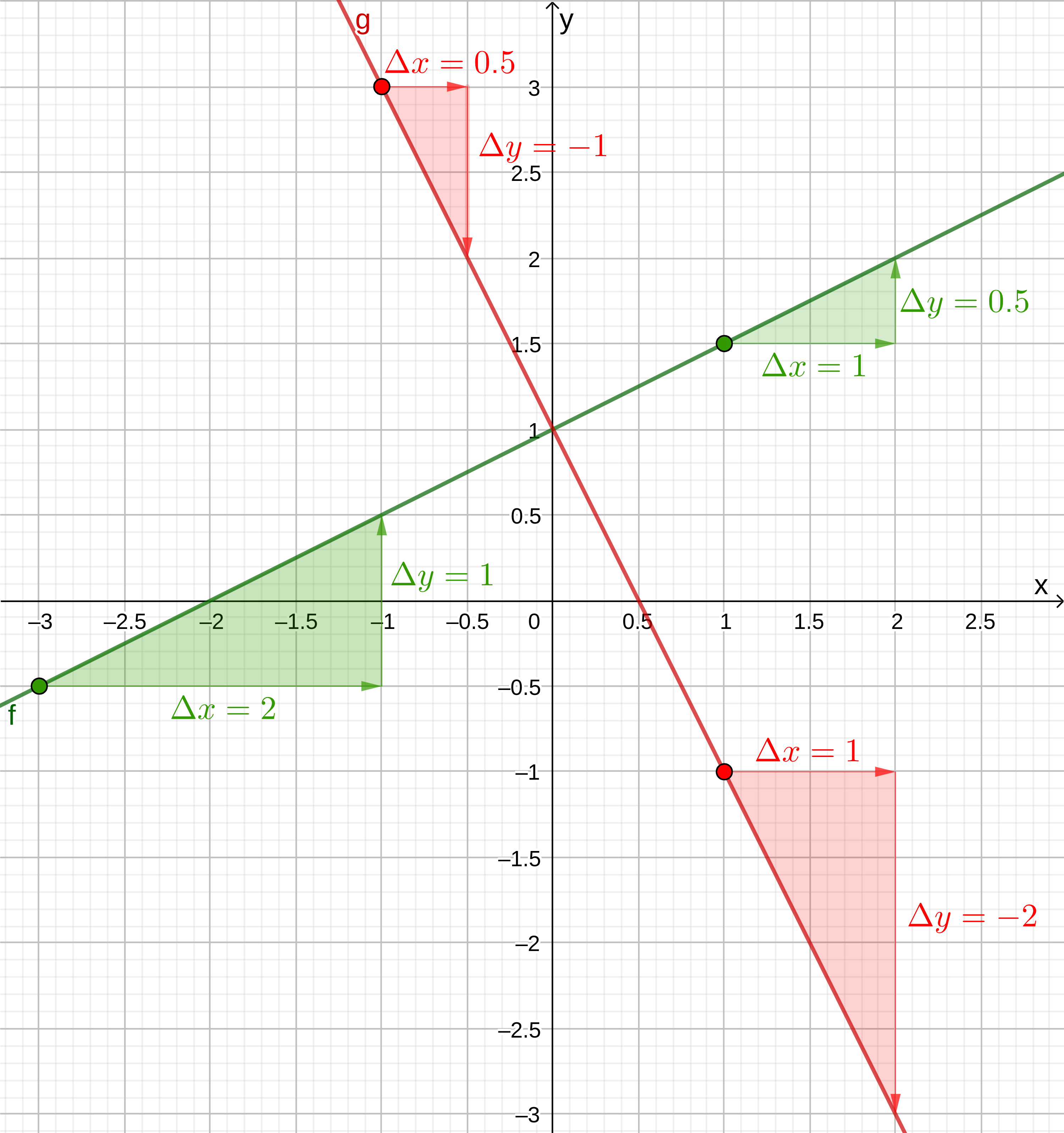
To see where can be detected in the graphs of and , we have to draw the so called slope triangle to the straight lines or graphs. To do so,
- Choose a starting point on the graph, indicated below by a small circle. This point can be chosen freely as long as it is on the graph.
- Starting at this point, move to the right by some distance. We denote this distance by (say delta x). Again, this distance can be chosen freely.
- Then move upwards (or downwards) until you get to the graph again. The distance you had to move is denoted by (say delta y), and we take the distance negative, if we have to move downwards.
- In this way, a triangle is plotted - the slope triangle.
The figure above shows a couple of slope triangles for each graph and .
- for the graph of (green line), if we divide over , we always get , which is just :
- the same is true for , we also get if we divide over
And in fact that is always the case:
Given a graph of a linear function , then
where and are the horizontal and vertical sides of a slope triangle to the graph of . is called the slope of .
- The in front of a variable such as or is often used to indicate a change in this variable, or a difference. Indeed, we move from the starting point on the graph to the right, so we change the -coordinate, then we move upwards and downwards, and therefore change the -coordinate.
- is also called run (you run to the right), and is called rise because you have to go up (or down). So the fraction is often summarised as rise over run.
The name slope makes sense. The bigger the slope, or the more you have to rise for a given distance run, the steeper is the straight line. This is illustrated in the next exercise.
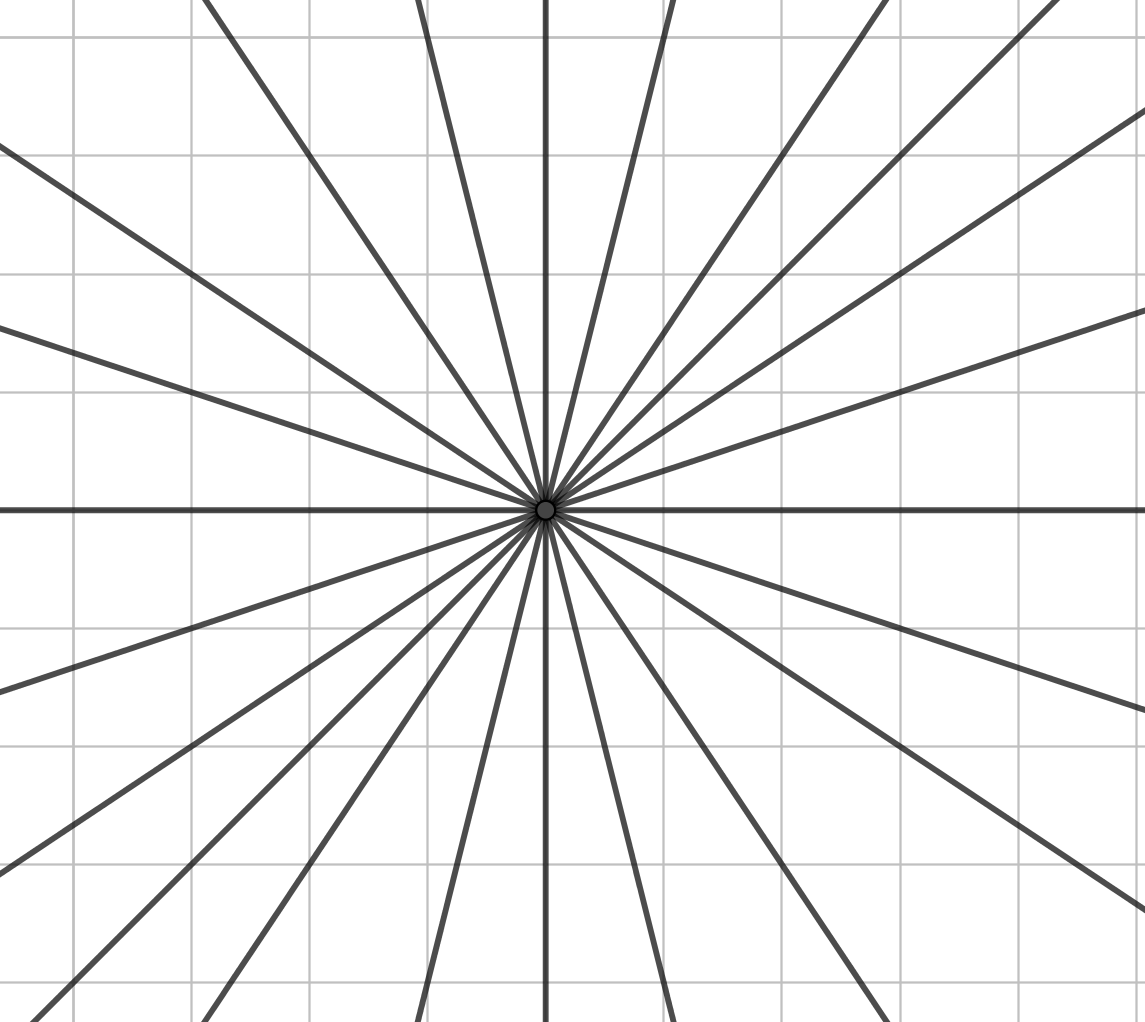
Determine the slope of each straight line by constructing slope triangles. Also, answer the following questions:
- Does the slope double, if the angle between the -axis and the straight line doubles?
- What is the slope of a horizontal line?
- What is the slope of the diagonal?
- What is the slope of a vertical line, and why will we never see this for a linear function?
Solution
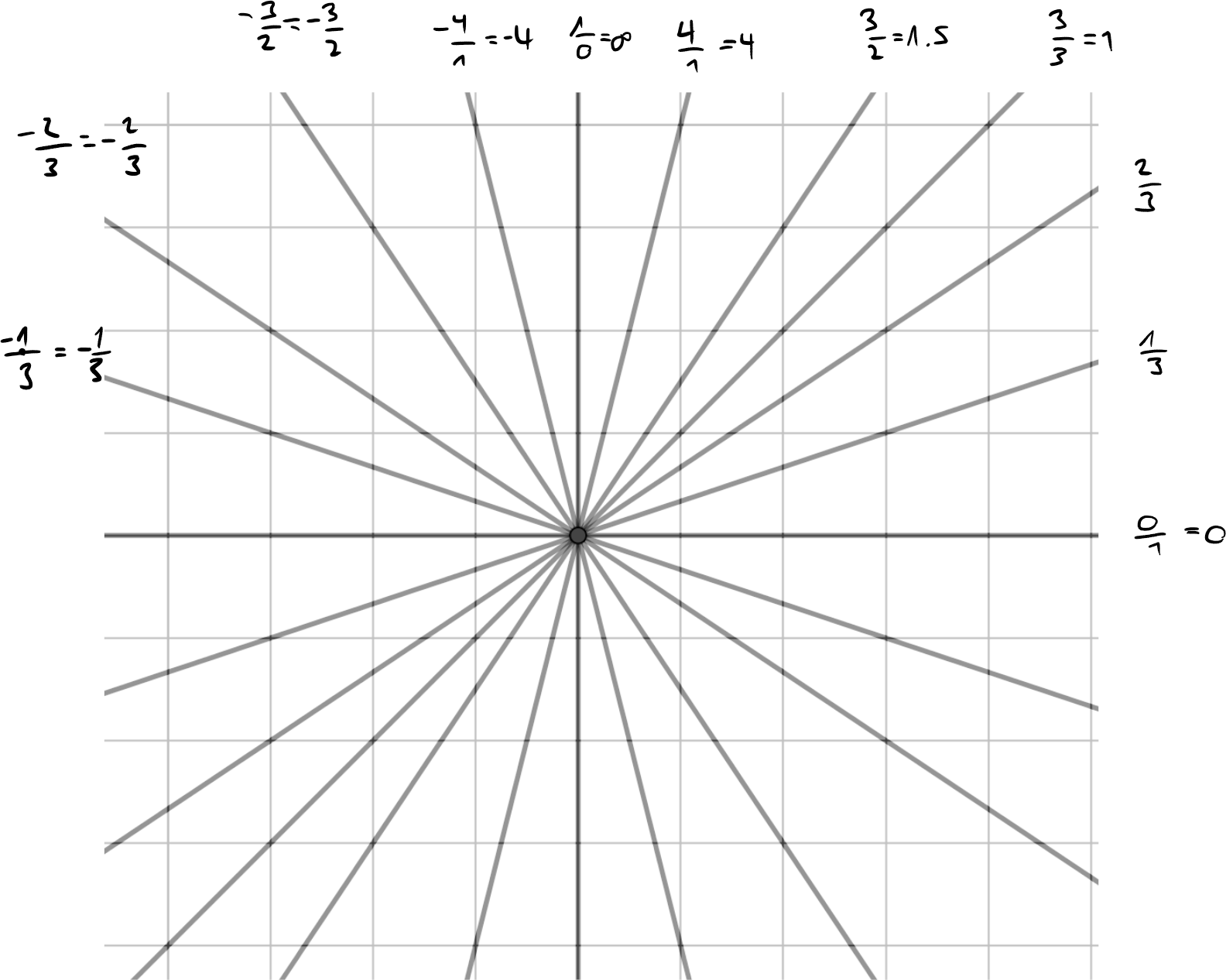
- no!
- , but this cannot be a graph of a function, as one input has many (infinitely many, actually) outputs.
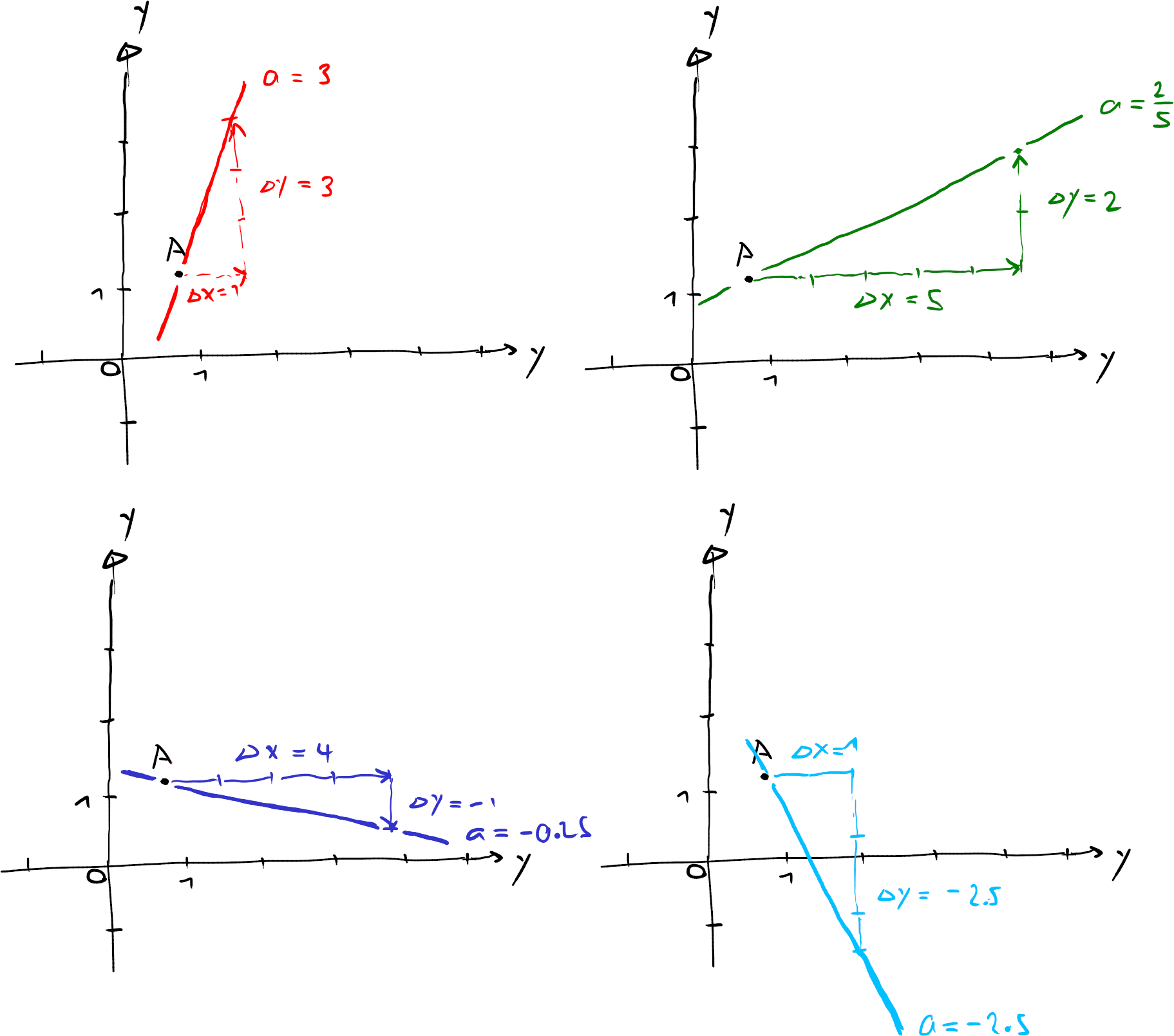
In a coordinate system, construct straight lines passing through the point , where the line has slope:
Solution
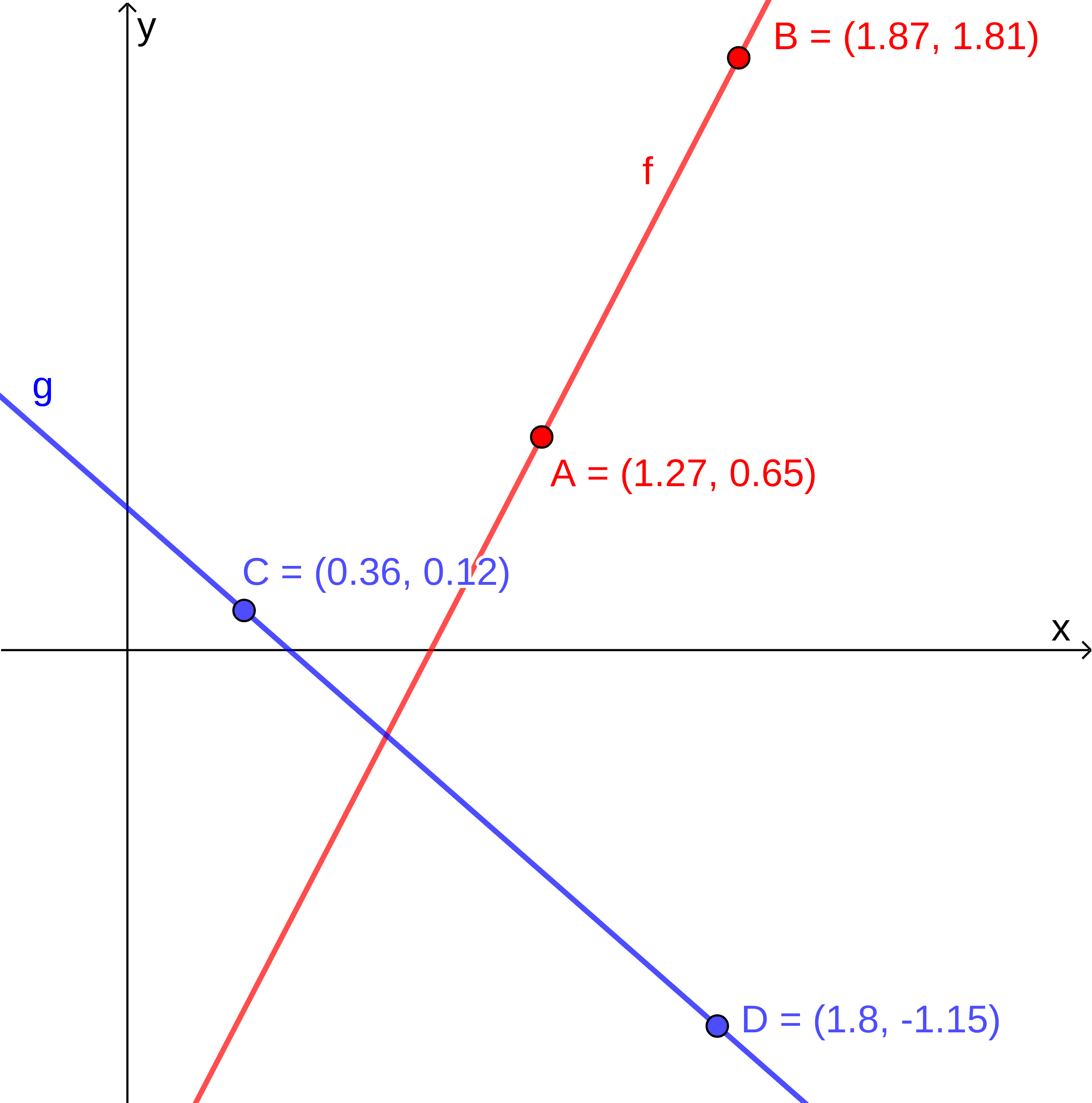
Determine the exact slope. Hint: construct a slope triangle in such a way that you can determine the run and rise with the help of the points through which the straight line passes.
Solution
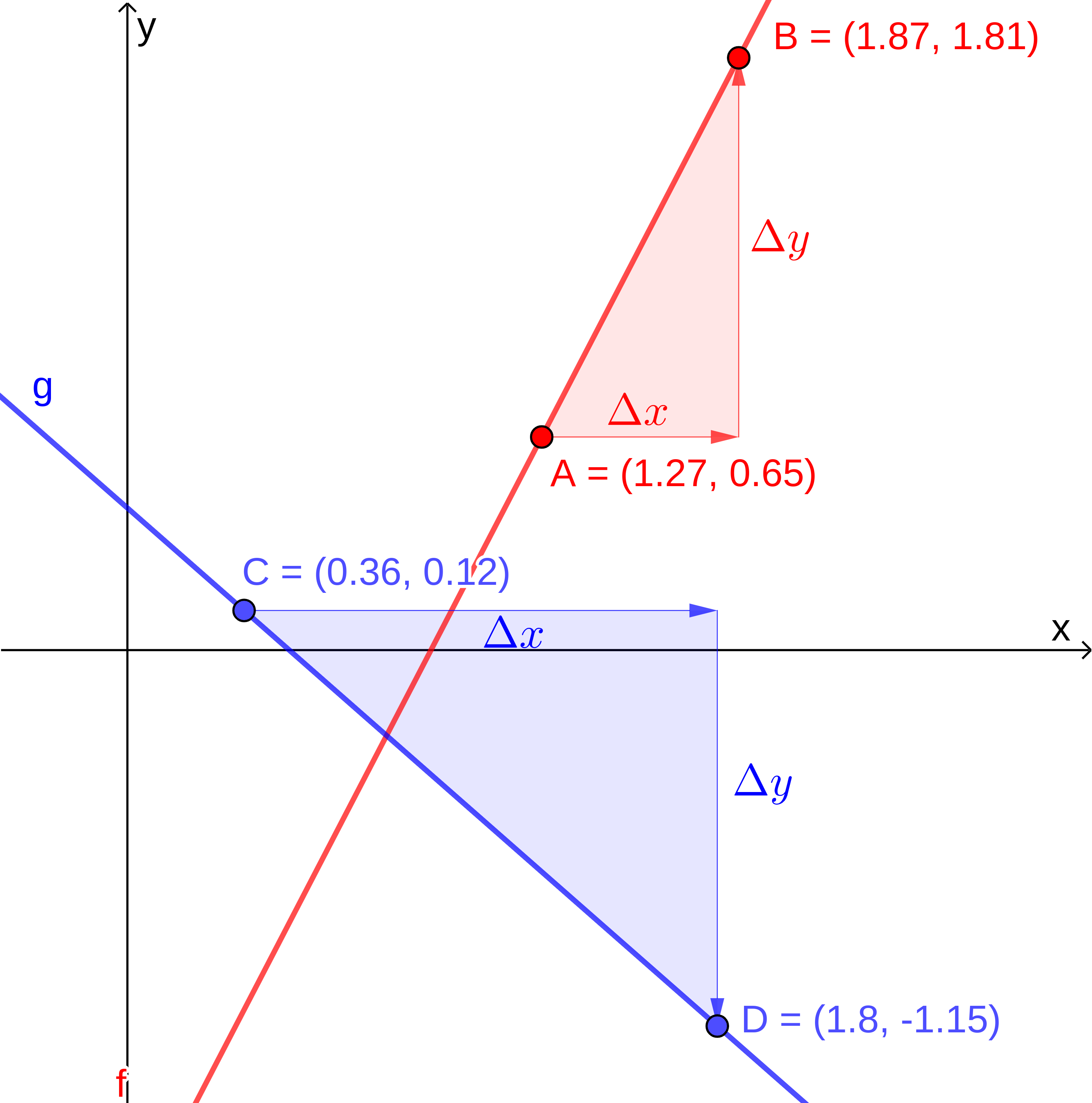
Line : Take the point on the left as starting point, , and move to the right until the other point, , is exactly above you. Constructing the slope triangle in this way (see figure below), we have
and
Thus, the slope is
Line : Similar. We start again at the left point, , and run to the right until is exactly below you. Constructing the slope triangle in this way (see figure below), we have
and
Thus, the slope is
A straight line has slope .
- Another straight line is parallel to . Determine its exact slope.
- Another straight line is orthogonal to . Determine its exact slope. Hints:
-
orthogonal means "senkrecht", thus, the lines and form a right angle at the point of intersection.
-
You can rotate about the point of intersection to get . Now, construct a slope triangle for , and then rotate it as well ... you get a slope triangle for where the sides are interchanged
-
Solution
-
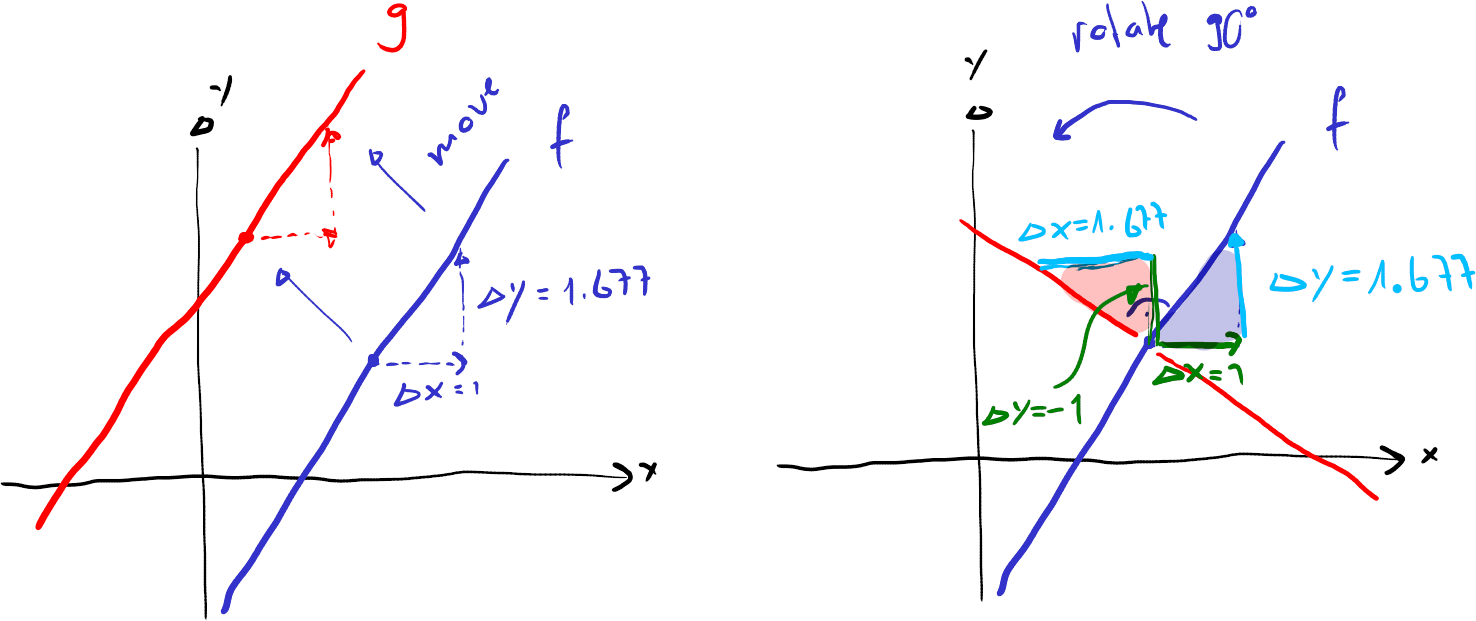
Because and are parallel, we can simply move with its slope triangle to get with the same slope triangle. So and have the same slope . See figure below, left.
-
As you can see from the figure (bottom right), the slope triangle of is a rotated version of the slope triangle of , where the rotation angle is . Thus, the run of becomes the rise of (but negative, because we downwards), and the rise of becomes the run of . Thus, the slope of is
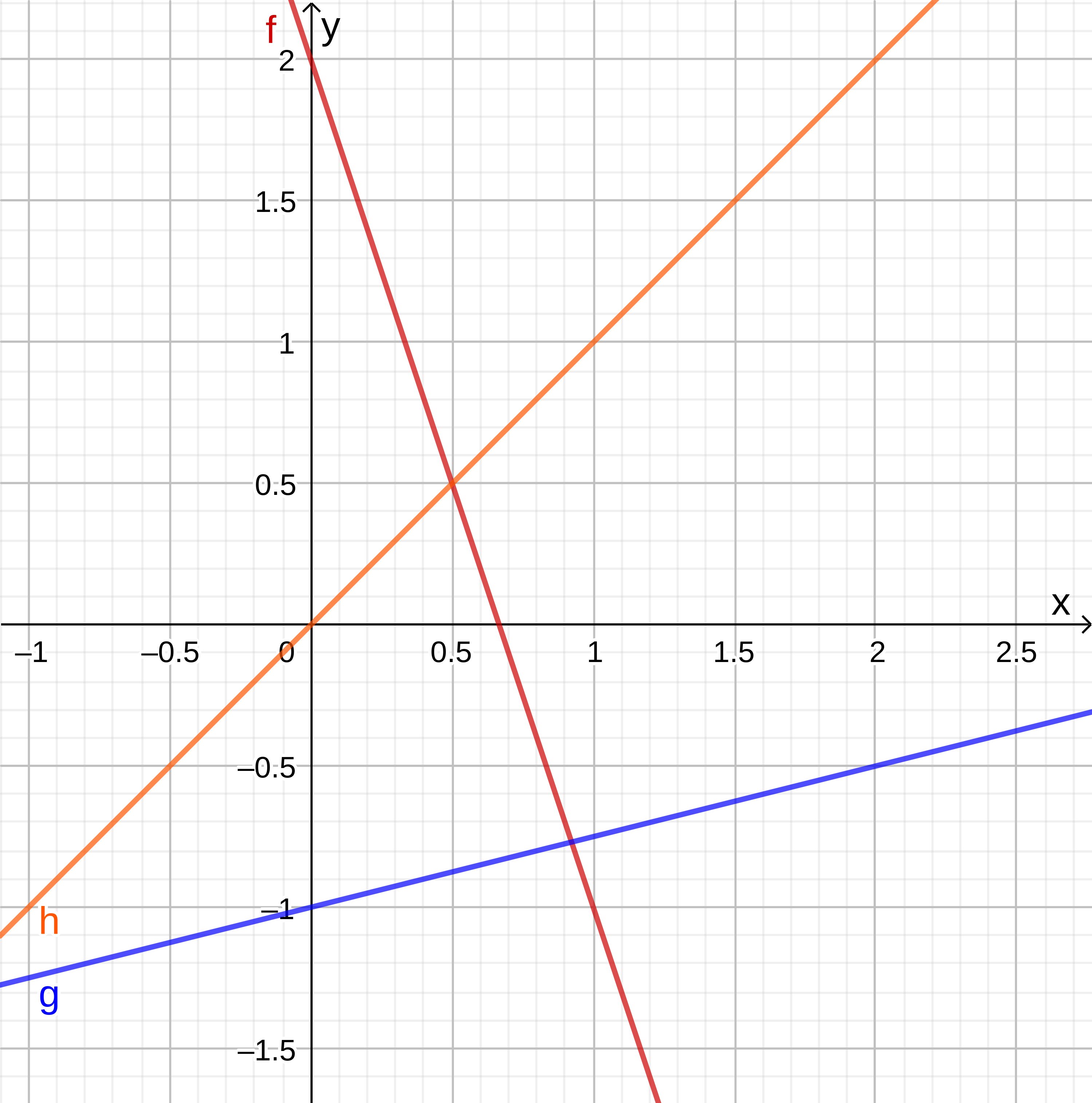
Determine the function equation of the graphs shown below with the help of the slope triangle, and the fact that is the -intercept.
Solution
Line : From the slope triangle follows, that the slope is . Because of , it follows .
Line : From the slope triangle follows, that the slope is . Because of , if follows .
Line : From the slope triangle follows, that the slope is . Because of , if follows .