Further problems 1

Exercise 1: Analysis of a function

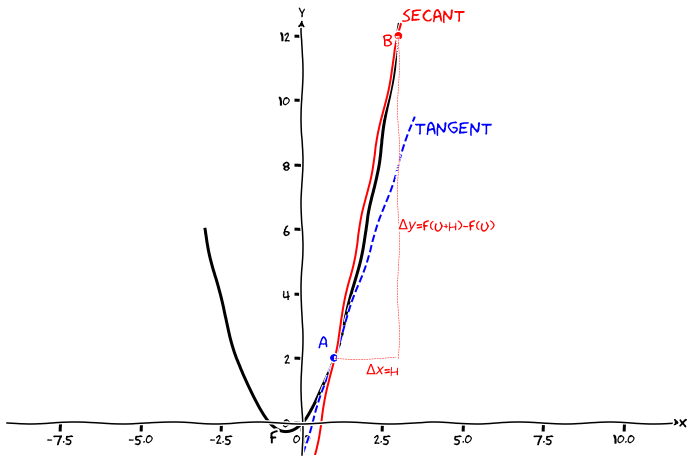
Consider the function f(x)=x2+xf(x)=x^2+x. AA and BB are two points on the graph with Ax=1A_x=1 and Bx=3B_x=3.

  1. Draw the graph of ff and indicate the points AA and BB.

  2. Determine the precise slope of the secant between AA and BB.

  3. Give an estimate of f(1)f^\prime(1) based on a drawing.

  4. Determine the precise value of f(1)f^\prime(1) using the differential quotient.

  5. Determine the precise value of f(1)f^\prime(1) using the law of weighted sums.

  6. Determine the function equation of the tangent to ff at AA.

  7. Find a point CC on the graph of ff such that the tangent to the graph of ff at CC has slope 00. What is interesting about this point if you think of the graph of ff as a landscape?

Solution

f(x)=x2+xf(x)=x^2+x, A(1f(1))=A(12)A(1\vert f(1))=A(1\vert 2) and B(3f(3))=B(312)B(3\vert f(3))=B(3\vert 12).

  1. The graph is shown above.
  2. The exact slope is
ΔyΔx=ByAyBxAx=12231=5\frac{\Delta y}{\Delta x}=\frac{B_y-A_y}{B_x-A_x}=\frac{12-2}{3-1}=\underline{\underline{5}}
  1. f(1)f^\prime(1) is the slope of the tangent to the graph of ff at x=1x=1 (indicated above, stippled straight line), that is, the tangent at A(1f(1))=A(12)A(1\vert f(1))=A(1\vert 2). Draw the tangent at this point and estimate the slope of this tangent using a slope triangle (not shown above). We get aΔyΔx2.7cm1.0cm=2.7a\approx \frac{\Delta y}{\Delta x} \approx \frac{2.7\unit{ cm}}{1.0\unit{ cm}}=\underline{\underline{2.7}}.
  2. a=f(1)=limh0f(1+h)f(1)ha=f^\prime(1)=\lim_{h\rightarrow 0}\frac{f(1+h)-f(1)}{h}. We want to find out towards which value the difference quotient f(1+h)f(1)h\frac{f(1+h)-f(1)}{h} converges if h0h\rightarrow 0. We have
f(1+h)f(1)h=(1+h)2+(1+h)(12+1)h=12+2h+h2+1+h2h=3h+h2h=h(3+h)h=3+h\frac{f(1+h)-f(1)}{h}=\frac{(1+h)^2+(1+h)-(1^2+1)}{h}=\frac{1^2+2h+h^2+1+h-2}{h}=\frac{3h+h^2}{h}=\frac{h(3+h)}{h}=3+h

So a=f(1)=3a=f^\prime(1)=\underline{\underline{3}}. 5. f(x)=x2+x=x2+x1f(x)=2x+1x0=2x+1f(x)=x^2+x=x^2+x^1 \rightarrow f^\prime(x)=2x+1\cdot x^0=2x+1. Thus, a=f(1)=21+1=3a=f^\prime(1)=2\cdot 1+1=\underline{\underline{3}} (as it should be, see previous problem). 6. The function equation of the tangent to ff at AA is t(x)=ax+bt(x)=ax+b, where aa is the slope of the tangent, that is, a=f(1)=3a=f^\prime(1)=3 (see previous problem). So we have t(x)=3x+bt(x)=3x+b. To find bb, note that t(1)=f(1)=2t(1)=f(1)=2 (as the two graphs ff and tt touch at x=1x=1), and therefore t(1)=31+b=2b=1t(1)=3\cdot 1+ b = 2 \rightarrow b=-1. Thus, t(x)=3x1\underline{\underline{t(x)=3x-1}}. 7. The slope of the tangent to ff has to be 00 (horizontal). So find xx with f(x)=2x+1=0x=1/2=0.5f^\prime(x) =2x+1 =0 \rightarrow x=-1/2=-0.5. The point CC has the coordinates C(0.5f(0.5))=C(0.50.25)C(-0.5\vert f(-0.5))=\underline{\underline{C(-0.5\vert -0.25)}}. This is the lowest point of the graph of ff (or in the landscape).

Exercise 2: Derivative of constant and power functions

Determine the derivative:

  1. f(x)=3f(x)=3

  2. f(x)=x4f(x)=x^4

  3. f(x)=x4f(x)=\sqrt[4]{x}

  4. f(x)=1x4f(x)=\frac{1}{x^4}

  5. f(x)=1x4f(x)=\frac{1}{\sqrt[4]{x}}

  6. f(x)=x34f(x)=\sqrt[4]{x^3}

  7. f(x)=xx4f(x)=x\sqrt[4]{x}

  8. f(x)=x2xf(x)=\frac{x^2}{\sqrt{x}}

  9. f(x)=x3x34f(x)=\sqrt{x^3}\sqrt[4]{x^3}

  10. f(x)=1x3xf(x)=\frac{1}{x^3\sqrt{x}}

Solution
  1. f(x)=3=3x0f(x)=30x1=0f(x)=3=3x^0\rightarrow f^\prime(x)=3\cdot 0\cdot x^{-1}=0
  2. f(x)=x4f(x)=4x3f(x)=x^4 \rightarrow f^\prime(x) = 4x^3
  3. f(x)=x4=x1/4f(x)=14x141=14x34f(x)=\sqrt[4]{x}=x^{1/4} \rightarrow f^\prime(x)=\frac{1}{4}x^{\frac{1}{4}-1}=\frac{1}{4}x^{-\frac{3}{4}}
  4. f(x)=1x4=x4f(x)=4x41=4x5f(x)=\frac{1}{x^4}=x^{-4}\rightarrow f^\prime(x)=-4\cdot x^{-4-1}=-4x^{-5}
  5. f(x)=1x4=1x1/4=x14f(x)=14x141=14x54f(x)=\frac{1}{\sqrt[4]{x}}=\frac{1}{x^{1/4}}=x^{-\frac{1}{4}}\rightarrow f^\prime(x) = -\frac{1}{4} x^{-\frac{1}{4}-1}=-\frac{1}{4} x^{-\frac{5}{4}}
  6. f(x)=x34=(x3)14=x34f(x)=34x341=34x14f(x)=\sqrt[4]{x^3}=(x^3)^\frac{1}{4}=x^\frac{3}{4}\rightarrow f^\prime(x) = \frac{3}{4} x^{\frac{3}{4}-1}=\frac{3}{4} x^{-\frac{1}{4}}
  7. f(x)=xx4=x1x14=x54f(x)=54x541=54x14f(x)=x\sqrt[4]{x} = x^1 \cdot x^\frac{1}{4}=x^\frac{5}{4} \rightarrow f^\prime(x)=\frac{5}{4}x^{\frac{5}{4}-1}=\frac{5}{4}x^{\frac{1}{4}}
  8. f(x)=x2x=x21x1/2=x2x1/2=x1.5f(x)=1.5x0.5f(x)=\frac{x^2}{\sqrt{x}}=x^2\cdot \frac{1}{x^{1/2}}= x^2 \cdot x^{-1/2} = x^{1.5} \rightarrow f^\prime(x)=1.5 x^{0.5}
  9. f(x)=x3x34=(x3)1/2(x3)1/4=x3/2x3/4=x9/4f(x)=94x54f(x)=\sqrt{x^3}\sqrt[4]{x^3} = (x^3)^{1/2}\cdot (x^3)^{1/4} = x^{3/2} \cdot x^{3/4} = x^{9/4}\rightarrow f^\prime(x)=\frac{9}{4}x^\frac{5}{4}
  10. f(x)=1x3x=1x3.5=x3.5f(x)=3.5x4.5f(x)=\frac{1}{x^3\sqrt{x}} = \frac{1}{x^{3.5}}=x^{-3.5} \rightarrow f^\prime(x)=-3.5 x^{-4.5}
Exercise 3: Derivative of linear and polynomial functions

Determine the derivative:

  1. f(x)=3xf(x)=3x

  2. f(x)=3x+4f(x)=3x+4

  3. f(x)=x1f(x)=-x-1

  4. f(x)=3x5f(x)=3x^5

  5. f(x)=x7f(x)=-x^7

  6. f(x)=2x4x2+6x3f(x)=2x-4x^2+6x^3

  7. f(x)=x3+5f(x)=-x^3+5

  8. f(x)=3x2+4x0.5f(x)=3x^2+4x^{0.5}

  9. f(x)=2xf(x)=\frac{2}{x}

Solution
  1. f(x)=3x=3x1f(x)=31x0=3f(x)=3x=3x^1 \rightarrow f^\prime(x)=3\cdot 1\cdot x^0=3
  2. f(x)=3x+4=3x1+4x0f(x)=31x0+40x1=3f(x)=3x+4=3x^1+4x^0\rightarrow f^\prime(x)=3\cdot 1 \cdot x^0 + 4\cdot 0\cdot x^{-1} = 3
  3. f(x)=x1=1x1x0f(x)=11x00x1=1f(x)=-x-1=-1\cdot x^1 - x^0 \rightarrow f^\prime(x)=-1\cdot 1 \cdot x^0 -0\cdot x^{-1} = -1
  4. f(x)=3x5f(x)=35x4=15x4f(x)=3x^5\rightarrow f^\prime(x)=3\cdot 5\cdot x^4 =15x^4
  5. f(x)=x7=1x7f(x)=17x6=7x6f(x)=-x^7=-1\cdot x^7 \rightarrow f^\prime(x)=-1\cdot 7\cdot x^6 =-7x^6
  6. f(x)=2x4x2+6x3f(x)=28x+18x2f(x)=2x-4x^2+6x^3\rightarrow f^\prime(x)=2-8x+18x^2
  7. f(x)=x3+5f(x)=3x2f(x)=-x^3+5\rightarrow f^\prime(x)=-3x^2
  8. f(x)=3x2+4x0.5f(x)=6x+2x0.5f(x)=3x^2+4x^{0.5}\rightarrow f^\prime(x)=6x+2x^{-0.5}
  9. f(x)=2x=21x=2x1f(x)=2(1)x2=2x2f(x)=\frac{2}{x}=2\cdot \frac{1}{x}=2\cdot x^{-1} \rightarrow f^\prime(x)=2\cdot (-1)\cdot x^{-2}=-2x^{-2}
Exercise 4: Derivative with simplification

Determine the derivative:

  1. f(x)=(2x)3f(x)=(2x)^3

  2. f(x)=4x3f(x)=\sqrt{4x^3}

  3. f(x)=3x4+5f(x)=\frac{3}{x^4}+5

  4. f(x)=x21x+1f(x)=\frac{x^2-1}{x+1}

  5. f(x)=x(x+x)f(x)=x(x+\sqrt{x})

  6. f(x)=x(x+1)(x+2)f(x)=x(x+1)(x+2)

  7. f(x)=2x33x+4f(x)=\frac{2}{x^3}-3\sqrt{x}+4

  8. f(x)=43xf(x)=4\sqrt{3x}

  9. f(x)=3x5f(x)=\frac{3}{x^5}

  10. f(x)=(x1)3f(x)=(x-1)^3

Solution
  1. f(x)=(2x)3=23x3=8x3f(x)=24x2f(x)=(2x)^3 = 2^3\cdot x^3 = 8x^3 \rightarrow f^\prime(x)=24x^2
  2. f(x)=4x3=(4x3)1/2=41/2x3/2=2x1.5f(x)=3x0.5f(x)=\sqrt{4x^3}=(4x^3)^{1/2}=4^{1/2}\cdot x^{3/2} = 2 x^{1.5} \rightarrow f^\prime(x)=3 x^{0.5}
  3. f(x)=3x4+5=31x4+5=3x4+5x0f(x)=3(4)x5+0=12x5f(x)=\frac{3}{x^4}+5 = 3\cdot\frac{1}{x^4}+5 = 3 x^{-4} +5x^0\rightarrow f^\prime(x)=3\cdot (-4)\cdot x^{-5}+0=-12x^{-5}
  4. f(x)=x21x+1=(x1)(x+1)x+1=x1f(x)=1f(x)=\frac{x^2-1}{x+1}=\frac{(x-1)(x+1)}{x+1}=x-1\rightarrow f^\prime(x)=1
  5. f(x)=x(x+x)=x2+xx1/2=x2+x1.5f(x)=2x+1.5x0.5f(x)=x(x+\sqrt{x})=x^2+x\cdot x^{1/2} =x^2 + x^{1.5}\rightarrow f^\prime(x)=2x+1.5x^{0.5}
  6. f(x)=x(x+1)(x+2)=(x2+x)(x+2)=x3+3x2+2xf(x)=3x2+6x+2f(x)=x(x+1)(x+2)=(x^2+x)(x+2)=x^3+3x^2+2x \rightarrow f^\prime(x)=3x^2+6x+2
  7. f(x)=2x33x+4=2x33x0.5+4f(x)=6x41.5x0.5f(x)=\frac{2}{x^3}-3\sqrt{x}+4 = 2x^{-3}-3x^{0.5}+4\rightarrow f^\prime(x)=-6x^{-4}-1.5x^{-0.5}
  8. f(x)=43x=4(3x)1/2=431/2x1/2f(x)=431/20.5x0.5=23x0.5f(x)=4\sqrt{3x} = 4\cdot (3x)^{1/2}=4\cdot 3^{1/2} \cdot x^{1/2} \rightarrow f^\prime(x)=4\cdot 3^{1/2} \cdot 0.5 \cdot x^{-0.5} = 2\sqrt{3}\cdot x^{-0.5}
  9. f(x)=3x5=31x5=3x5f(x)=15x6f(x)=\frac{3}{x^5} = 3\cdot \frac{1}{x^5}=3\cdot x^{-5} \rightarrow f^\prime(x)=-15 x^{-6}
  10. f(x)=(x1)3=(x1)(x22x+1)=x33x2+3x1f(x)=3x26x+3f(x)=(x-1)^3 = (x-1)(x^2-2x+1)= x^3-3x^2+3x-1\rightarrow f^\prime(x)=3x^2-6x+3
Exercise 5: Tangent properties

Consider a function ff. The tangent to the graph of ff at point A(35)A(3|5) has slope 2.12.1.

  1. Determine the function equation of the tangent.

  2. Where does the tangent intersect the xx-axis, where the yy-axis?

  3. Determine f(3)f^\prime(3).

Solution
  1. t(x)=ax+bt(x)=ax+b, with a=2.1a=2.1 (slope), thus t(x)=2.1x+bt(x)=2.1x+b. With t(3)=f(3)=5t(3)=f(3)=5 (tangent tt and ff touch at x=3x=3), we have t(3)=2.13+b=5b=1.3t(3)=2.1\cdot 3+b=5 \rightarrow b= -1.3. Thus t(x)=2.1x1.3\underline{t(x)=2.1x-1.3}
  2. Intersection with xx-axis: find xx with t(x)=2.1x1.3=0x=0.619t(x)=2.1x-1.3=0 \rightarrow x=\underline{0.619}. Intersection with yy-axis: y=t(0)=1.3y=t(0)=\underline{-1.3}.
  3. f(3)=2.1f^\prime(3)=\underline{2.1}.
Exercise 6: Tangent with slope 8

Consider the function f(x)=x3f(x)=x^3. Find the point(s) on the graph of ff where the tangent to the graph has slope 88.

Solution

Find xx with f(x)=3x2=8x=±83f^\prime(x)=3x^2 = 8 \rightarrow x=\underline{\underline{\pm \sqrt{\frac{8}{3}}}}.

Exercise 7: Tangent equation at x=1

Consider the function f(x)=14x44x2+25f(x)=\frac{1}{4}x^4-4x^2+25. Determine the equation of the tangent to the graph of ff at x=1x=1.

Solution

f(x)=14x44x2+25f(x)=x38xf(x)=\frac{1}{4}x^4-4x^2+25 \rightarrow f^\prime(x)=x^3-8x.

The tangent at x=1x=1 is t(x)=ax+bt(x)=ax+b, with a=f(1)=18=7a=f^\prime(1)=1-8=-7.

Thus t(x)=7x+bt(x)=-7x+b. Because t(1)=f(1)=144+25=21.25t(1)=f(1)=\frac{1}{4}-4+25=21.25, we have t(1)=71+b=21.25b=28.25t(1)=-7\cdot 1+b=21.25 \rightarrow b= 28.25.

Thus t(x)=7x+28.25\underline{t(x)=-7x+28.25}.

Exercise 8: Tangent with slope 16

A tangent to the graph of the function f(x)=7x2x3f(x)=7x^2-x^3 has slope 1616. Where does this tangent touch the graph? Find the coordinates.

Solution

Find xx with f(x)=14x3x2=163x214x+16=0f^\prime(x)=14x-3x^2=16 \rightarrow 3x^2-14x+16=0. With the midnight formula follows x1,2=14±1961926=14±26x_{1,2}=\frac{14\pm\sqrt{196-192}}{6}=\frac{14\pm 2}{6}. Thus x1=83x_1=\frac{8}{3} and x2=2x_2=2. The touch points are A1(83f(83))=A1(8383227)A_1(\frac{8}{3}\vert f(\frac{8}{3}))=\underline{\underline{A_1(\frac{8}{3}\vert \frac{832}{27})}} and A2(2f(2))=A2(220)A_2(2 \vert f(2))=\underline{A_2(2 \vert 20)}.

Exercise 9: Determining polynomial coefficients

The polynomial f(x)=ax2+bx+cf(x)=ax^2+bx+c passes through the point (12)(1|2) and has a horizontal tangent at (21)(2|1). Determine the values aa, bb, and cc.

Solution

f(x)=ax2+bx+cf(x)=2ax+bf(x)=ax^2+bx+c \rightarrow f^\prime(x)=2ax+b. ff passes through (12)f(1)=2a+b+c=2(1\vert 2) \rightarrow f(1)=2 \rightarrow a+b+c=2. And ff has a horizontal tangent at (21)f(2)=02a2+b=04a+b=0(2\vert 1) \rightarrow f^\prime(2)=0 \rightarrow 2a\cdot 2 + b =0 \rightarrow 4a+b=0. Also, the point (21)(2\vert 1) has to be on the graph of ff as well, so we have f(2)=14a+2b+c=1f(2)=1 \rightarrow 4a+2b+c=1. We therefore have the following three equations:

4a+b=0a+b+c=24a+2b+c=1\begin{array}{rcl} 4a+b & = & 0\\ a+b+c & = & 2 \\ 4a+2b+c & = & 1 \end{array}

From the first equation we have 4a=b4a=-b and b=4ab=-4a, inserting this into the second and third equation we get the two equations

a4a+c=24a8a+c=1\begin{array}{rcl} a-4a+c & = & 2\\ 4a-8a+c & = & 1\end{array}

and therefore

c=2+3ac=1+4a\begin{array}{rcl} c & = & 2+3a\\ c & = & 1+4a\end{array}

Thus we have 2+3a=1+4aa=12+3a=1+4a \rightarrow a=1, and thus b=4a=4b=-4a=-4, and c=2+3a=5c=2+3a=5. It follows f(x)=x24x+5f(x)=\underline{x^2-4x+5}.